

You’re standing in the kitchen, and a simple comment about the bins has somehow spiralled into a three-hour post-mortem of your entire marriage. The crushing silence that follows isn’t just quiet; it feels heavy, leaving you wondering why you both feel like lonely roommates rather than intimate partners. If you’re searching for how to stop arguing with your partner, you’re likely exhausted by the feeling of being constantly on edge in your own home.
It’s deeply painful when the person who should be your safe harbour feels like your greatest source of tension. We understand that these rows often feel like a trap you can’t escape, but please know that conflict itself isn’t the enemy. It’s often a misunderstood protest against a loss of connection. You deserve to feel secure, understood, and truly seen by the person you love most.
This guide will help you transform repetitive conflict into a bridge for deeper intimacy. By applying research-based frameworks from leading relationship experts, you’ll learn to decode the invisible scripts of your arguments. We’ll provide a clear, professional roadmap to move you from defensive cycles toward a future of lasting peace and emotional safety.
Key Takeaways
- Identify the “invisible script” behind your repetitive rows to understand why you might feel like roommates rather than intimate partners.
- Learn how to stop arguing with your partner by spotting the four specific behaviours that predict relationship breakdown and replacing them with intentional repair attempts.
- Master the “Softened Startup” technique to ensure your needs are heard without triggering your partner’s natural defensiveness in the first few minutes.
- Apply proven psychological frameworks to build a “Sound Relationship House” that provides emotional security whilst keeping desire alive.
- Discover why a structured recovery programme offers a clear, expert-led roadmap out of conflict, providing more certainty than traditional, open-ended therapy.
The Invisible Script: Why You Keep Having the Same Argument
Many couples feel trapped in a frustrating loop. You might find yourselves rehashing the same disagreement about the mortgage or the housework for the hundredth time, feeling as though you are stuck on a track you cannot leave. This is what we call the “Invisible Script.” It is a rigid, repetitive pattern of behaviour that takes over your relationship, making you feel like actors following a tragic play you didn’t write. When you’re trying to figure out how to stop arguing with your partner, the first step is recognising that this script exists and that it is separate from who you are as individuals.
In the UK, many couples respond to the exhaustion of these cycles by retreating into what’s known as the “Roommate Phase.” You might stop the active shouting, but you also stop the meaningful connecting. This emotional withdrawal is often a misguided attempt to keep the peace, yet it leaves both people feeling lonely and “on edge” in their own home. Understanding that your rows are often a “protest” against this growing distance, rather than an expression of dislike, can change your entire perspective. Your anger is often a desperate plea for the connection you feel you’re losing.
Content Fights vs. Attachment Fights
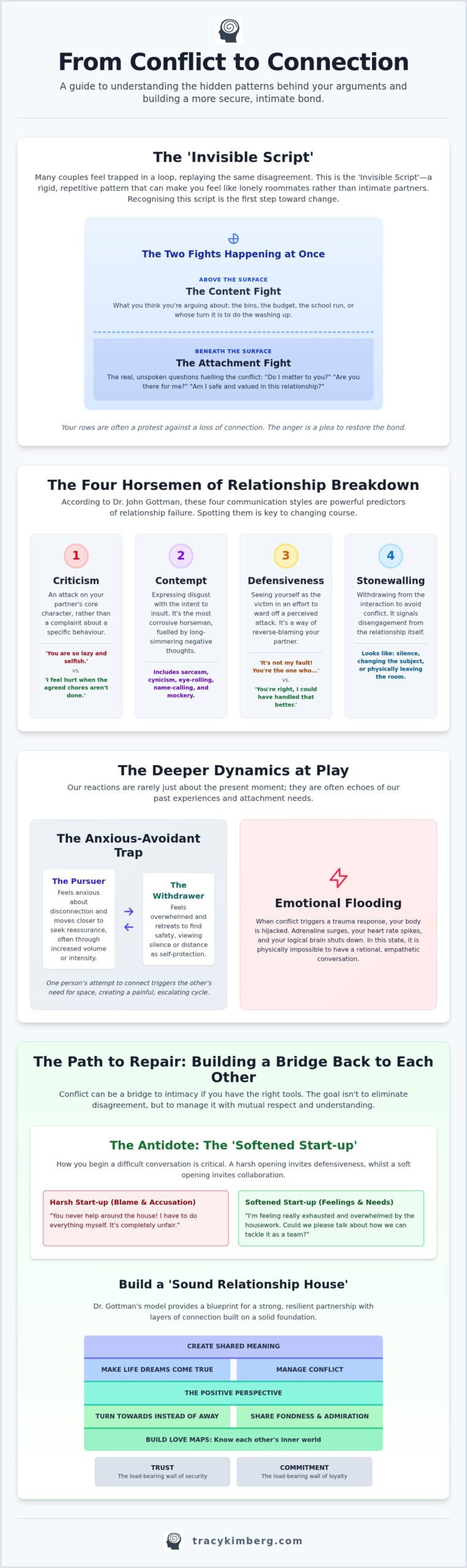
Most rows are actually two different battles happening at once. There is the “content” fight, which is about the bins, the budget, or the school run. Then there is the “attachment” fight, which is about whether you are safe, valued, and prioritised. If you only focus on solving the problem of the bins, you’ll never address the underlying fear that your partner doesn’t respect your contribution to the home. Restoring the bond requires looking beneath the anger to find the vulnerability. You aren’t just trying to fix a schedule; you’re trying to fix a connection.
Recognising the ‘Roommate Phase’ Early
The transition from passionate partners to polite co-habitants often happens slowly. You might notice a drop in curiosity about each other’s internal world or a preference for scrolling on your phones rather than talking over dinner. Whilst active arguing is painful, the “polite silence” of the roommate phase can be more damaging over time. It signals that you’ve given up on the possibility of being truly understood. Identifying this shift early allows you to bring “Conscious Awareness” to the relationship. This awareness is the vital first step in learning how to stop arguing with your partner and beginning the proactive journey back to intimacy.
The Psychology of Conflict: Attachment, Trauma, and the ‘Four Horsemen’
Conflict often feels like an immediate reaction to a partner’s words, but it is frequently a symphony of past experiences playing out in the present. Dr Gabor Maté suggests that many of our overreactions are actually trauma responses, where a minor slight today triggers a deep, unhealed wound from our past. When this happens, your body enters a state of “flooding.” Your heart rate spikes, adrenaline surges, and your logical brain effectively shuts down. In this biological state, it’s physically impossible to have a rational conversation, which is why learning how to stop arguing with your partner requires managing your physiology before your vocabulary.
Identifying Your Attachment Style in Heat
Our childhoods create a blueprint for how we handle conflict as adults. “Anxious” partners often become pursuers, seeking reassurance through increased volume or intensity when they feel an emotional disconnect. Conversely, “Avoidant” partners tend to retreat, viewing silence as a form of self-protection whilst their partner is pursuing them. This creates the “Anxious-Avoidant Trap,” where one person’s need for closeness triggers the other’s need for space, leading to an escalating cycle of pursuit and withdrawal. Emotional safety is the essential foundation that allows both partners to lower their guard and step out of these reflexive roles.
Spotting the ‘Four Horsemen’ in Your Home
John Gottman identified four specific communication styles that reliably predict the end of a relationship. Recognising these “Four Horsemen” is vital for anyone learning how to stop arguing with your partner, as it allows you to see the mechanics of your rows without drowning in shame or judgement.
- Criticism: Attacking your partner’s character or personality rather than a specific behaviour.
- Contempt: Using sarcasm, cynicism, or eye-rolling to signal moral superiority; this is the single greatest predictor of relationship breakdown.
- Defensiveness: Making excuses or cross-complaining to avoid taking responsibility for your part in the conflict.
- Stonewalling: Withdrawing from the interaction entirely, creating a psychological wall that acts as the “silent treatment” and shuts the other person out.
Identifying these patterns is a brave first step toward healing. If you find yourself stuck in these cycles, a 12-Week Relationship Recovery Process can provide the structured, research-based support needed to rewire these responses and build a future of lasting peace.
The Path to Repair: Insights from Gottman and Esther Perel
The journey toward a peaceful home requires more than just stopping the shouts; it involves building a new foundation. Dr John Gottman’s “Sound Relationship House” serves as a research-led blueprint for this reconstruction. It suggests that a healthy partnership is built on layers of friendship, positive perspective, and shared meaning. Whilst Gottman focuses on the structural safety of the bond, Esther Perel reminds us that “Radical Curiosity” is essential to keep desire alive. She argues that we must balance the need for emotional security with the space required for our partner to remain an intriguing, separate individual. Learning how to stop arguing with your partner means embracing both the safety of the known and the excitement of the new.
Building Your ‘Love Maps’
The foundation of any resilient relationship is what Gottman calls “Love Maps.” This is the detailed mental map you hold of your partner’s internal world. Over time, these maps can become outdated as we get bogged down in the logistics of life, such as bills, children, or the weekly shop. To update your map, you must move beyond functional talk. Try replacing “What did you do today?” with deeper enquiries like “How do you feel about the project at work?” or “What is currently your biggest source of stress?”. This shift in focus signals that you are still invested in who they are, not just what they do for the household.
Turning Towards: The 86% Rule
A “bid for connection” is any attempt from one partner for attention, affirmation, or affection. It could be a simple comment about a news story or a gentle touch on the shoulder. Gottman’s research found a striking difference in how couples handle these moments. In stable, happy marriages, partners “turned towards” these bids 86% of the time. In contrast, couples who eventually divorced only turned towards each other 33% of the time.
Each time you acknowledge a bid, you make a deposit into your “emotional bank account.” During a busy UK work week, these moments might look like:
- Putting down your phone when your partner starts talking about their day.
- Validating a small frustration they have with a colleague.
- Sharing a laugh over a silly observation whilst making tea.
These micro-interactions create a buffer of goodwill. When you have a full emotional bank account, you are far less likely to spiral into a row, providing a practical answer to how to stop arguing with your partner during stressful times. By prioritising these small gestures, you build the resilience needed to handle larger disagreements with grace and empathy.
5 Proactive Steps to Stop Arguing and Start Connecting
Moving from a state of constant tension to one of calm requires a shift from reactive habits to intentional actions. Whilst understanding the psychology of your rows is vital, you also need practical tools to use when the temperature in the room begins to rise. These five steps provide a structured way to de-escalate conflict and protect your bond. If you’re committed to learning how to stop arguing with your partner, these techniques offer an immediate way to break the cycle of defensiveness and restore emotional safety.
Step 1: The Gentle Startup Formula
Research by the Gottman Institute indicates that 96% of conversations end on the same note they began. If you start a discussion with a “harsh startup”—such as a character attack or a sharp tone—the interaction is almost certain to fail. To prevent this, use a gentle startup formula: “I feel [emotion] about [specific fact] and I need [positive need].” For example, instead of saying “You’re always lazy with the dishes,” try “I feel overwhelmed about the state of the kitchen and I need some help getting it tidy before bed.” This approach expresses your needs without triggering your partner’s natural “fight or flight” response.
Step 2: The ‘Speaker-Listener’ Technique
In the heat of a row, most people are simply waiting for their turn to speak rather than truly listening. This leads to “cross-complaining,” where each partner hurls grievances at the other without any resolution. The Speaker-Listener technique forces a pause. The speaker must keep their point brief and avoid “you always” language. The listener’s only job is to paraphrase what they heard before they are allowed to respond. This ensures that both people feel heard and understood, which is the essential foundation for how to stop arguing with your partner effectively.
During this process, it’s also vital to practice physiological soothing. If you notice your heart rate rising or your breathing becoming shallow, you have likely entered a state of “flooding.” At this point, logic is impossible. Establish a rule where either partner can call for a “timed break” of at least twenty minutes. This gives your nervous systems time to settle, allowing you to return to the conversation with a clearer, kinder perspective.
Step 3: Creating Rituals of Connection
Conflict often thrives in the gaps where intimacy has faded. Establishing “Rituals of Connection” anchors the relationship and builds a buffer of goodwill. This might include a twenty-minute de-stressing conversation at the end of the day where you talk about your external stresses without trying to solve each other’s problems. Small acts of affection, such as a hug when you return home or organising a weekly activity focused purely on joy, signal that you are still on the same team. These rituals move you away from the “roommate phase” and back toward a partnership built on mutual support.
If you find that these steps are difficult to implement on your own, you may benefit from a more structured approach. You can explore a 12-Week Relationship Recovery Process to gain the expert-led guidance needed to make these changes permanent and transform your relationship into a safe, loving harbour once again.
When to Seek Professional Help: The Path to Relationship Recovery
Sometimes, despite your best intentions, the cycle of conflict feels too heavy to lift on your own. You might find that your rows have become a “Safe Container” for years of unspoken resentment, where every minor disagreement feels like a battle for survival. If you are struggling with how to stop arguing with your partner, recognise that seeking help is a sign of strength, not failure. Specialist support is particularly vital when dealing with complex issues such as infidelity, chronic anxiety, or deep emotional neglect that has persisted for years.
Traditional therapy often involves “directionless talking,” which can sometimes leave couples feeling like they are simply rehashing their pain without a clear way out. A structured, research-led approach offers a different path. It provides the tools to move from crisis management to a strategic partnership. In some cases, the goal might not be “saving” the union in its current form, but rather a “Conscious Approached Divorce” or separation that prioritises the emotional well-being of everyone involved whilst maintaining respect.
The 12-Week Relationship Recovery Process
Tracy Kimberg’s signature 12-Week Relationship Recovery Process is designed specifically for couples who want to move from disconnect to intimacy with momentum. Unlike open-ended counselling, this programme provides a clear, time-bound roadmap for lasting behavioural change. You can expect a transformational coaching journey that draws on the proven methods of Gottman, Perel, and Maté. This structured approach ensures that you aren’t just talking about your problems, but actively building the skills needed to sustain a healthy, loving partnership.
Finding the Right Support in the UK
For busy modern couples, online relationship coaching offers a flexible and effective way to access specialist care from the comfort of their own home. When choosing a professional, look for someone who understands frameworks like the Gottman Method and Esther Perel’s relational intelligence. These research-based tools provide a sophisticated understanding of adult life transitions and the complexities of human attachment. Finding a specialist who offers a safe, non-judgemental environment, whether online or face-to-face, is the key to successful healing.
Taking the first step toward recovery can feel daunting, but it is a proactive and positive adventure for your future. If you are ready to discover how to stop arguing with your partner and begin the work of repair, you can start by booking a discovery call with Tracy Kimberg. This initial connection allows you to explore how a tailored, professional programme can help you find the lasting peace you deserve.
Your Journey Toward Lasting Connection
Breaking free from repetitive cycles of conflict is a brave and proactive step. You’ve learned that understanding how to stop arguing with your partner isn’t about suppressing your needs, but about decoding the invisible scripts and attachment triggers that drive your rows. By prioritising small bids for connection and using gentle startups, you can transform your home from a place of tension into a safe harbour of mutual respect.
Whilst these tools are powerful, deep-seated patterns often require specialised support. As an expert in the Gottman Method and trauma-informed coaching, I offer a transformational, structured approach for UK-based couples ready for change. You don’t have to navigate this path alone; healing is entirely possible when you have a research-led roadmap in place.
It’s time to move beyond the “roommate phase” and rediscover the intimacy you both deserve. Start your 12-Week Relationship Recovery Process today and begin the positive adventure of rebuilding your bond. You’ve already taken the first step by being here; let’s work together to create the lasting peace you deserve.
Frequently Asked Questions
How do I know if my relationship is actually worth saving?
Determining the future of your bond requires looking beyond the current conflict to see if a foundation of respect remains. If both partners still feel a sense of shared meaning and a genuine desire to reconnect, the relationship is often worth saving. It’s helpful to distinguish between a temporary “rough patch” and fundamental incompatibility. A specialist can help you identify if your rows are simply a cry for the connection you’ve lost.
Can one person stop the arguing if the other partner won’t change?
You can significantly alter the dynamic of your relationship by changing your own reactive patterns. By consistently using gentle startups and refusing to engage in defensive behaviours, you force the “invisible script” of your rows to shift. Whilst it takes two people to build deep intimacy, it only takes one person to stop a destructive cycle. This shift often creates the necessary space for your partner to eventually lower their guard.
How long does it typically take to break a cycle of constant arguing?
Significant shifts in communication often begin within the first few weeks of intentional, research-based practice. However, establishing lasting behavioural change usually requires a more sustained and structured focus. A 12-Week Relationship Recovery Process is often the ideal timeframe for this transformation. It provides enough momentum to move past old habits whilst allowing new, healthier communication rituals to become a natural part of your daily life together.
What is the ‘Gottman Method’ and why is it so effective for couples?
The Gottman Method is a research-led approach derived from over forty years of longitudinal studies with thousands of couples. It’s highly effective because it focuses on observable behaviours rather than just abstract feelings. By identifying specific “repair attempts” and using the “Sound Relationship House” framework, it provides couples with a practical, scientific blueprint. This method moves you away from guesswork and toward proven strategies for building a resilient partnership.
Is it normal to argue every day in a long-term relationship?
Whilst all couples experience disagreements, arguing every day suggests you are stuck in a reactive cycle that can lead to emotional exhaustion. This frequency often signals that your “emotional bank account” is depleted, leaving you both feeling “on edge.” If you’re wondering how to stop arguing with your partner daily, the focus should be on increasing positive interactions. Healthy relationships prioritise “turning towards” each other to create a buffer against daily stresses.
What should I do if my partner refuses to go to couples therapy?
You can begin the process of healing by attending individual coaching or therapy yourself. This allows you to work on your own triggers and attachment responses in a safe environment. Often, when one partner begins to demonstrate healthier communication patterns and more emotional stability, the other becomes more open to the process. Suggesting a structured, time-bound programme can also feel less daunting to a partner than open-ended, traditional counselling.
How can we stop arguing about the same things over and over again?
Repetitive arguments are usually “attachment fights” disguised as “content fights.” You aren’t actually arguing about the housework; you’re likely arguing about whether you feel valued or supported. To break this loop, you must address the underlying vulnerability using “I” statements. By expressing the core need beneath the grievance, such as a desire for more quality time, you move away from the “invisible script” and toward a real resolution.
What is the difference between relationship coaching and traditional counselling?
Relationship coaching is typically more goal-oriented and future-focused than traditional counselling. Whilst counselling often explores past wounds in an open-ended way, coaching provides a structured roadmap for change. It focuses on developing specific skills and behaviours to improve your current dynamic. This proactive approach is particularly effective for couples who want to see measurable progress and learn how to stop arguing with your partner by implementing practical, research-based tools quickly.

Article by
Tracy Kimberg
Tracy Kimberg is a Relationship Expert, Couples Therapist and Coach with a dedicated focus on helping couples and individuals rebuild connection, trust and emotional safety in their relationships. Drawing on the research of John and Julie Gottman, the relational insights of Esther Perel, and years of hands-on therapeutic experience, Tracy offers a warm, non-judgemental and deeply compassionate approach to modern relationships.
Based in Dorset, Tracy works with couples navigating communication breakdowns, betrayal, intimacy challenges, separation, family dynamics and life transitions. Known for creating a safe and grounded therapeutic space, she combines practical tools with emotional depth to help clients move beyond survival patterns and towards meaningful, lasting change.
With a reputation for empathy, professionalism and dedication to her clients’ growth, Tracy is passionate about helping people feel seen, understood and empowered — both within their relationships and within themselves.
Disclaimer
Disclaimer:
The information shared in this article is intended for educational and informational purposes only and should not be considered a substitute for professional therapeutic, psychological, medical or legal advice. Every individual and relationship is unique, and the perspectives offered are based on general therapeutic principles, research and professional experience.
Reading this article does not establish a therapist-client relationship with Tracy Kimberg. If you are experiencing significant emotional distress, relationship crisis, trauma, or mental health concerns, it is important to seek support from a qualified professional appropriate to your individual circumstances.
All content remains the intellectual property of Tracy Kimberg and may not be reproduced or distributed without permission.