

What if the biting sarcasm and frequent eye-rolling in your marriage aren’t signs that you’ve simply stopped caring, but are actually a desperate, maladaptive cry for the connection you’ve lost? It’s incredibly draining to live in a home where you feel either morally superior to your partner or constantly belittled by them. You likely remember a time when fondness and admiration came easily, yet now those feelings seem replaced by a profound sense of exhaustion and resentment. It’s a heavy burden to carry, and it’s natural to wonder if the damage has become permanent.
We understand that overcoming contempt in a relationship requires more than just “trying harder”; it demands a deep, psychologically informed shift in how you view one another. This article provides the research-based tools you need to neutralise the sting of belittling behaviours and begin the delicate work of restoring mutual respect. We’ll explore how to identify the subtle triggers of contempt, look at practical methods to re-establish emotional safety, and help you discern whether your partnership is ready for a meaningful recovery or a conscious, respectful transition.
Key Takeaways
- Identify contempt as a toxic blend of anger and moral superiority that attacks a partner’s character rather than their specific behaviour.
- Discover why overcoming contempt in a relationship requires viewing disdain as a desperate, often unconscious, attempt to be heard when vulnerability feels too risky.
- Gain practical, research-based tools like the 5:1 positivity ratio to help neutralise sarcasm and rebuild the foundation of fondness and admiration.
- Understand how the Signature 12-Week Relationship Recovery Process provides a clear, structured roadmap for couples to move from deep disconnect to a place of safety.
What is Contempt in a Relationship? Understanding the “Sulphuric Acid” of Love
Contempt is far more than a simple disagreement or a flash of anger. It’s a toxic cocktail of anger and disgust, served with a side of moral superiority. When you’re in the thick of it, you aren’t just upset with what your partner did; you’re disgusted by who they are. This is why John Gottman famously refers to it as the “sulphuric acid” of relationships. Like acid, it doesn’t just stain the surface; it eats through the very fabric of respect and fondness that holds a couple together.
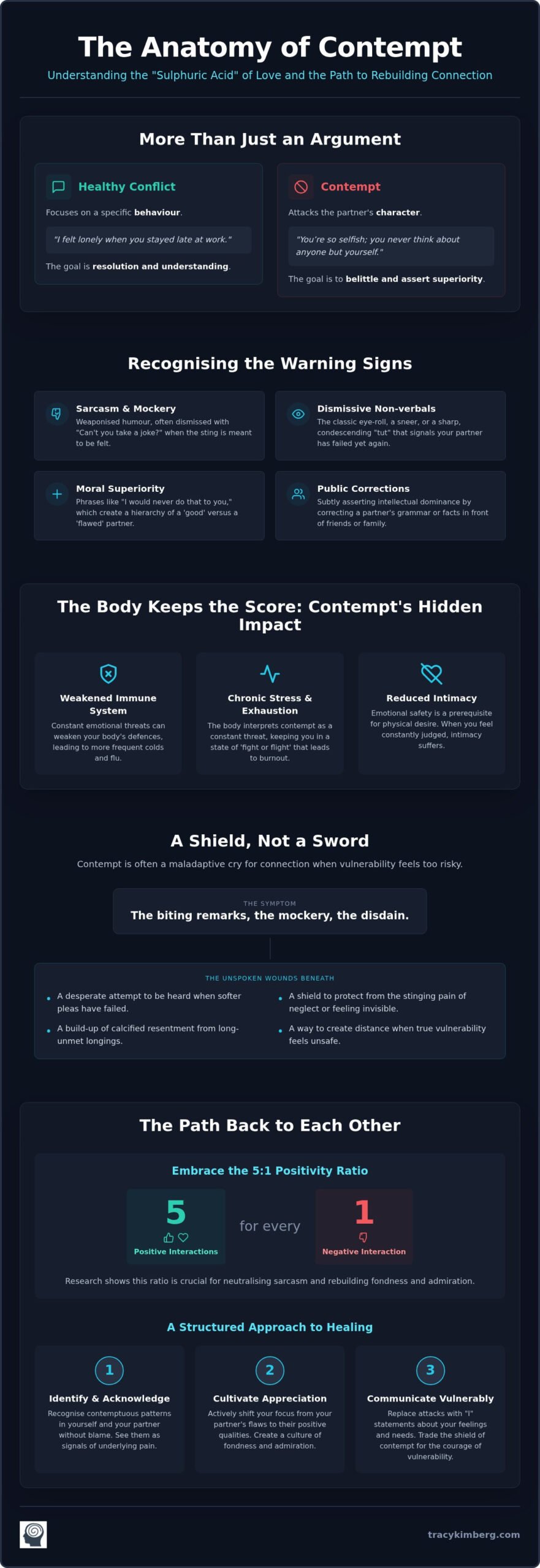
Whilst healthy conflict focuses on a specific behaviour, contempt targets the person’s character. For instance, a partner in conflict might say, “I felt lonely when you stayed late at work.” A partner using contempt says, “You’re so selfish; you never think about anyone but yourself.” The goal of contempt is to make the other person feel small, worthless, or excluded. It often manifests in non-verbal cues that are just as damaging as words: the dismissive eye-roll, the curled lip of a sneer, or that sharp, condescending “tut” that signals your partner has failed yet again.
The Subtle Signs You Might Be Missing
Sometimes, contempt doesn’t arrive with a shout. It sneaks in through weaponised sarcasm, often dismissed with a “can’t you take a joke?” when the sting is felt. You might notice one partner correcting the other’s grammar or facts in front of friends, a subtle way to assert intellectual dominance. These moments are underpinned by “moral high ground” thinking, expressed through phrases like “I would never dream of doing that to you.” This creates a hierarchy where one person is the “good” partner and the other is fundamentally flawed.
The Physical Toll of Living with Contempt
The impact of this dynamic isn’t just emotional; it’s biological. Research has shown that couples who live with chronic contempt actually have weaker immune systems and suffer from more frequent infectious illnesses like colds and flu. Your body interprets contempt as a constant threat, keeping you in a state of “fight or flight” that eventually leads to exhaustion. When you don’t feel safe or respected, your body naturally shuts down the desire for intimacy. It’s hard to open your heart to someone who makes you feel like you’re under a microscope. Understanding these patterns is the first step toward overcoming contempt in a relationship and reclaiming a sense of mutual safety.
The Hidden Roots of Disdain: Why We Resort to Contempt
Why do we often reserve our sharpest barbs for the person we love most? It’s a painful irony that the very individual who holds our heart is often the one who triggers our deepest disdain. In many cases, contempt is a “desperate attempt” to be heard when vulnerability has failed. Whilst you might feel unheard or invisible, the subconscious mind often trades a soft plea for a sharp attack, hoping that a biting remark will finally pierce through the silence. This shift is a crucial realisation for anyone overcoming contempt in a relationship; the disdain isn’t usually the core problem, but a noisy symptom of a silent wound.
Gabor Maté’s perspective on the conflict between attachment and authenticity offers a profound lens here. If you grew up in an environment where you had to suppress your true self to maintain a connection with caregivers, you might find that adult partnership feels like a cage. This internal friction manifests as disdain for your partner, who becomes the symbolic jailer of your authenticity. Similarly, Esther Perel suggests that the suffocating nature of domesticity can dissolve the “otherness” required for desire. When a partner is no longer seen as a separate, mysterious individual but as a collection of domestic failures, contempt fills the void where eroticism once lived.
Over time, unmet longings for appreciation or intimacy don’t just vanish. They calcify. What started as a small disappointment can harden into a mountain of resentment that feels impossible to climb amongst the daily pressures of life. If you find yourself in this cycle, exploring relationship counselling and coaching for couples can help you unearth these roots before they permanently damage the foundation of your home.
Contempt as a Shield, Not a Sword
We often use moral superiority to protect ourselves from the stinging pain of neglect. By looking down on a partner, we create a safe distance that prevents them from reaching our softest spots. Mockery becomes a distancing mechanism, ensuring that if we are to be hurt, it’s from a position of perceived strength rather than raw vulnerability. Contempt is a maladaptive survival strategy for emotional disconnect.
The Impact of “Small T” Traumas
Years of “small T” traumas, those tiny, unaddressed hurts like a forgotten promise or a dismissive shrug, build a mountain of disdain. This often fuels the “pursuer-distancer” dynamic, where one partner’s desperate chase for connection leads the other to retreat into a cold, judgemental shell. Eventually, the body and mind simply shut down to avoid further injury, making the road back to respect feel longer than it truly is.
Myth vs Reality: Is Contempt Truly the Point of No Return?
You may have heard that once contempt enters the room, the relationship is effectively over. This is a common narrative on internet forums and in casual conversation, but the reality is far more nuanced. One of the most persistent myths is that contempt signifies a total lack of love. In truth, love and contempt often coexist in a painful, tangled mess. Contempt doesn’t necessarily mean the love has vanished; it means the love is being smothered. It’s like a garden where the weeds have grown so tall that you can no longer see the flowers, even though their roots remain in the soil.
Another damaging myth is the idea that the partner expressing disdain is a “narcissist” or simply a “bad person”. Whilst it’s easy to label someone when their behaviour is hurtful, this clinical-sounding shorthand often misses the mark. More often than not, the person expressing contempt is someone who feels profoundly powerless, ignored, or unheard. They’ve adopted a stance of moral superiority as a last-ditch effort to reclaim some sense of agency. This doesn’t excuse the behaviour, but understanding this reality is vital for overcoming contempt in a relationship. It shifts the focus from character assassination to addressing the underlying emotional starvation.
When Repair is Possible
Repair becomes a tangible possibility when both partners are willing to look at their own “shadow” side. This involves a brave, honest inventory of the ways you’ve contributed to the disconnect. The primary antidote to this toxic dynamic is the intentional cultivation of fondness and admiration. By consciously looking for what is working, rather than what is failing, you begin to neutralise the acid. Professional coaching provides the safe, structured container needed to navigate these vulnerable conversations without falling back into old patterns of attack and defence.
When Conscious Separation is the Healthier Path
We must also acknowledge that, in some cases, the damage to an individual’s sense of self is too great for the “us” to survive. If the environment has become fundamentally unsafe or the cycle of belittling has eroded your core identity, staying may no longer be the bravest choice. Tracy Kimberg offers a specialised service for Conscious Approached Divorce and separation, providing a compassionate safety net for those who realise that repair isn’t the healthy path. Prioritising emotional safety and mutual respect during a transition is just as important as it is during reconciliation. Choosing to end a partnership with dignity and empathy allows both individuals to heal and move forward without carrying the heavy weight of unresolved disdain into their next chapter.
Reclaiming Respect: Practical Steps to Neutralise Contempt
Neutralising the “acid” of contempt requires a radical shift in how you inhabit your relationship. It isn’t enough to simply stop the biting remarks; you must actively cultivate a new emotional environment. One of the most effective ways to begin overcoming contempt in a relationship is by mastering the shift from “You” statements to “I” statements. When you say, “You always ignore me,” you’re attacking character. When you say, “I feel invisible when I talk and don’t get a response, and I need to feel heard,” you’re sharing a vulnerability. This shift invites your partner in rather than pushing them away.
Research by the Gottman Institute highlights the “5:1 Ratio” as a hallmark of stable partnerships. For every one negative interaction, there must be at least five positive ones to maintain a healthy emotional bank account. You can build this balance by naming contempt when it happens, without counter-attacking. If you feel the sting of a sneer, try saying, “That felt condescending, can we try again?” This pauses the cycle and gives both of you a chance to reset. To truly transform your dynamic, you can start the Signature 12-Week Relationship Recovery Process, which provides a structured roadmap for rebuilding this foundation of respect.
The Power of Softened Start-ups
The first three minutes of a conversation are the most critical. If you begin with a sharp tone or a character jab, the outcome is almost certainly a defensive shutdown or a fight. Instead, try bringing up grievances with a “softened start-up.” This involves stating your feelings and a specific, positive need without blame. A softened start-up is a request for connection rather than a critique of character. It signals to your partner that you’re on the same team, even whilst you’re discussing a difficult topic.
Developing Emotional Literacy
Contempt is often a secondary emotion, a protective lid covering a pot of primary emotions like sadness, fear, or unworthiness. Developing emotional literacy means learning to look beneath the disdain. Couples can practice sharing their “internal landscapes” by asking each other, “What is the feeling under the anger?” This requires active listening and a commitment to resisting the urge to eye-roll, even when the conversation feels clunky. By acknowledging the fear or hurt amongst the daily chaos, you begin to replace the hierarchy of contempt with the horizontal plane of mutual understanding.
Healing the Disconnect: How Professional Coaching Transforms Dynamics
When contempt has become the background noise of your life, the prospect of change can feel overwhelming. This is where professional coaching serves as more than just a conversation; it becomes a scaffolding for a new way of being. Unlike generic “talk therapy” that might simply recycle old grievances, research-based coaching provides a practical toolkit for overcoming contempt in a relationship. It offers a structured path that moves beyond the “he said, she said” dynamic and into the deeper waters of relational repair.
Having a neutral third party is essential when respect has worn thin. It allows for a safe container where difficult truths can be spoken without the immediate fear of a sneer or a biting retort. The coach holds the space, ensuring that vulnerability isn’t met with the “sulphuric acid” of disdain, but with curiosity and care. This professional guidance helps you navigate the complexities of partnership with a sense of calm optimism, focusing on what is possible rather than just the weight of the past.
The 12-Week Relationship Recovery Journey
The Signature 12-Week Relationship Recovery Process is designed as a proactive and positive adventure. It isn’t just about crisis management. It’s about moving from the “roommate phase” or the cold silence of neglect into a state of deep emotional reconnection. Throughout these twelve weeks, couples address the calcified resentments and unaddressed hurts that have built up over years. The focus remains on building sustainable communication habits that protect the long-term emotional health of both individuals. Whether you are navigating the aftermath of infidelity or the slow erosion of intimacy, this structured roadmap provides the clarity needed to move forward together.
Taking the First Step Towards Healing
It is never too late to try a different approach. Choosing to invest in your relationship is, at its core, a profound form of self-care. You aren’t just saving a partnership; you are reclaiming your own peace of mind and emotional well-being. Transformation begins with a single, courageous decision to step out of the cycle of disdain and into a process of healing. You can Begin your journey with Tracy Kimberg’s 12-Week Relationship Recovery Process today and start the vital work of restoring the safety and respect you both deserve.
Reclaiming Your Relational Future
Living with the “sulphuric acid” of contempt is exhausting, but it doesn’t have to be the final chapter of your story. We’ve explored how disdain is often a desperate, albeit painful, attempt to be heard when vulnerability feels too risky. By shifting to softened start-ups and prioritising a culture of appreciation, you can begin the delicate work of overcoming contempt in a relationship. Whether you find yourself in the “roommate phase” or are navigating deeper neglect, remember that respect can be rebuilt when both partners commit to looking at their own “shadow” side.
If you feel stuck in these destructive cycles, you don’t have to navigate the path alone. Our research-based approach, influenced by the work of Gottman and Perel, offers a clear way forward through a structured roadmap. You can Book your Signature 12-Week Relationship Recovery Process with Tracy Kimberg to access safe, UK-based support either online or face-to-face. There is a profound sense of peace that comes from restoring emotional safety and mutual admiration. Your relationship is an evolving journey, and with the right guidance, healing is entirely within your reach.
Frequently Asked Questions
Can a relationship really survive contempt?
Yes, a relationship can survive contempt provided both partners are genuinely committed to the work of repair. Whilst it is a highly destructive force, it isn’t an automatic death sentence for your partnership. Success depends on replacing disdain with a culture of appreciation and learning to see the unmet needs beneath the biting words. It requires a conscious, daily effort to move from a hierarchy of moral superiority back to a partnership of equals.
What is the difference between contempt and criticism?
Criticism targets a specific action or behaviour, whereas contempt attacks the person’s character from a position of superiority. If you say, “I’m upset you forgot the bins,” that’s criticism. If you say, “You’re so lazy and irresponsible, you can’t even remember the bins,” accompanied by a sneer, that is contempt. Criticism usually seeks a solution to a problem; contempt seeks to belittle, exclude, and make the other person feel worthless.
How do I stop being contemptuous towards my partner?
The first step is acknowledging the pain or powerlessness you’re trying to mask with your disdain. Practice the “5:1 Ratio” by intentionally looking for things your partner does right each day. When you feel a sharp remark rising, pause and identify the primary emotion underneath, such as fear or loneliness. Using “I” statements to express those raw feelings instead of attacking character is essential for overcoming contempt in a relationship.
What should I do if my partner is constantly eye-rolling or mocking me?
Address the behaviour calmly and directly in the moment without counter-attacking. You might say, “When you roll your eyes, I feel belittled and it’s hard for me to keep talking.” This names the non-verbal cue and its emotional impact without escalating the conflict. If this pattern continues despite your requests for respect, it’s often a sign that you need a neutral third party to help establish new boundaries and emotional safety.
Is contempt a form of emotional abuse?
Chronic and intentional contempt can certainly cross the line into emotional abuse, especially when it’s used to maintain power and control. While a single eye-roll is a lapse in respect, a consistent pattern of mocking, sneering, and character assassination erodes a person’s self-worth over time. It creates an environment of fear and inferiority that is fundamentally unsafe. This dynamic requires professional intervention to either repair the foundation or safely exit the partnership.
How long does it take to rebuild respect in a relationship?
There is no fixed timeline, but meaningful change usually requires months of consistent effort rather than a few weeks. Rebuilding respect involves unlearning years of defensive habits and proving through repeated actions that the dynamic has shifted. Our Signature 12-Week Relationship Recovery Process provides a structured timeframe to begin this transformation, giving couples the tools to sustain their progress and deepen their connection long after the initial crisis has passed.
Can individual therapy help if my partner refuses to go to couples coaching?
Yes, individual therapy for adults can be a powerful catalyst for systemic change within a marriage. By changing your own reactions and understanding your childhood triggers, you naturally alter the “dance” of the relationship. Even if your partner isn’t in the room, your shift towards vulnerability and away from counter-contempt can sometimes prompt them to lower their own defences. It’s a proactive way to reclaim your agency and emotional health.
What happens if we try to fix it and it doesn’t work?
If repair isn’t possible despite your best efforts, you can transition into a process of conscious separation. Not every relationship is meant to last forever, and acknowledging that the damage is too deep is a brave act of self-care. We support couples in navigating this transition with empathy and respect, ensuring that the end of the partnership doesn’t have to mean the end of your long-term emotional well-being or personal growth.

Article by
Tracy Kimberg
Tracy Kimberg is a Relationship Expert, Couples Therapist and Coach with a dedicated focus on helping couples and individuals rebuild connection, trust and emotional safety in their relationships. Drawing on the research of John and Julie Gottman, the relational insights of Esther Perel, and years of hands-on therapeutic experience, Tracy offers a warm, non-judgemental and deeply compassionate approach to modern relationships.
Based in Dorset, Tracy works with couples navigating communication breakdowns, betrayal, intimacy challenges, separation, family dynamics and life transitions. Known for creating a safe and grounded therapeutic space, she combines practical tools with emotional depth to help clients move beyond survival patterns and towards meaningful, lasting change.
With a reputation for empathy, professionalism and dedication to her clients’ growth, Tracy is passionate about helping people feel seen, understood and empowered — both within their relationships and within themselves.
Disclaimer
Disclaimer:
The information shared in this article is intended for educational and informational purposes only and should not be considered a substitute for professional therapeutic, psychological, medical or legal advice. Every individual and relationship is unique, and the perspectives offered are based on general therapeutic principles, research and professional experience.
Reading this article does not establish a therapist-client relationship with Tracy Kimberg. If you are experiencing significant emotional distress, relationship crisis, trauma, or mental health concerns, it is important to seek support from a qualified professional appropriate to your individual circumstances.
All content remains the intellectual property of Tracy Kimberg and may not be reproduced or distributed without permission.