

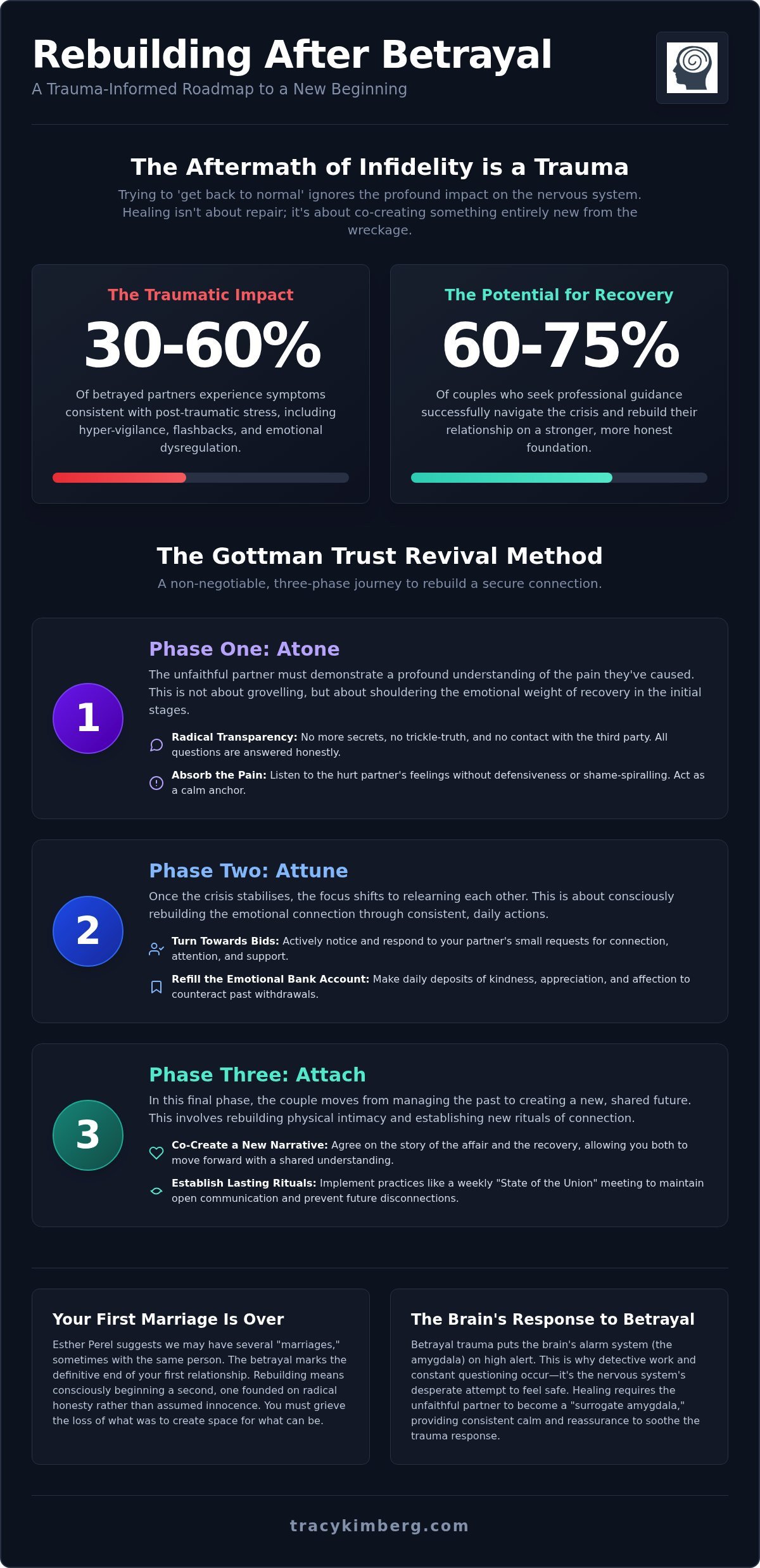
The relationship you knew yesterday is gone, and whilst that reality feels like a physical weight, it’s the only honest place to start. You’re likely exhausted by the “mind movies” that play on a loop or the suffocating cycle of hyper-vigilance that has turned your home into a surveillance zone. Whether you’re drowning in the trauma of betrayal or lost in a shame-spiral, the pain is a signal that your old ways of relating can no longer sustain you. Rebuilding trust after cheating isn’t about “getting back to normal”; it’s about acknowledging that 30 to 60 per cent of betrayed partners experience symptoms consistent with post-traumatic stress and deciding to build something entirely new.
I understand the quiet fear that things will never feel safe again. However, research indicates that with professional guidance, 60 to 75 per cent of couples successfully recover from infidelity. This guide offers a compassionate, research-based roadmap to help you navigate this crisis using the wisdom of the Gottman Method and trauma-informed perspectives. We’ll explore how to stop the constant questioning, move past defensiveness, and co-create a partnership rooted in radical transparency. You’ll discover how a structured recovery process can transform this wreckage into a foundation for a connection that feels deeper and more honest than the one you had before.
Key Takeaways
- Understand why the “old” relationship must be grieved to make space for a trauma-informed healing process that addresses the nervous system’s response to betrayal.
- Discover the three essential phases of the Trust Revival Method-Atone, Attune, and Attach-and why rushing these stages often leads to further setbacks.
- Learn to navigate the delicate balance of transparency and privacy whilst establishing the emotional safety required for rebuilding trust after cheating.
- Implement practical daily rituals, such as the “State of the Union” meeting, to foster active listening and prevent shame-spiralling or defensiveness.
- Recognise when “DIY” efforts have reached a stalemate and how a structured 12-Week Relationship Recovery Process can provide the expert guidance needed for long-term health.
The Death of the Old Relationship: Understanding the Trauma of Betrayal
When a partner cheats, the relationship you once had doesn’t just change; it ends. This is a painful truth to accept, but it’s the only honest foundation for rebuilding trust after cheating. You aren’t fixing a slightly chipped vase; you’re sweeping up the shards to decide if you want to create a mosaic. Trying to “just move on” or “get back to normal” is a recipe for long-term resentment because it ignores the fundamental trauma that has occurred. Gabor Maté often speaks of trauma not as what happens to you, but what happens inside you as a result of an event. Betrayal is a profound disconnection from safety, and you cannot simply think your way out of a nervous system that feels under siege.
Betrayal Trauma and the Nervous System
Your brain is wired for survival. When your primary source of emotional safety becomes the source of danger, your amygdala goes into overdrive. This explains why the betrayed partner experiences flashbacks, hyper-vigilance, and the exhausting need for “detective work.” It’s not irrational behaviour; it’s your biology trying to find a predictable pattern so it can feel safe again. If the wayward partner responds to questions with defensiveness or “shame-spiralling,” it confirms the brain’s fear that the environment is still hostile. Real healing requires the wayward partner to become a “surrogate amygdala” for their spouse, providing the calm and transparency needed to settle a shattered nervous system.
Grieving the Loss of Innocence
You’ve lost the version of your partner you thought you knew and the untainted story of your life together. Healing requires grieving this loss of innocence rather than rushing toward a hollow version of forgiveness. To move forward, you must address the “Why” with clinical honesty. This involves distinguishing between a situational mistake and a systemic issue within the relationship’s architecture. Part of this process includes:
- Acknowledging the pain without a timeline for when it should “stop hurting.”
- Ending the secrecy that fuels the trauma response.
- Writing a “truth narrative” that both partners can eventually agree on to replace the gaps in the story.
Esther Perel famously suggests that most of us will have two or three marriages in our lifetime; some of us will have them with the same person. Your first marriage is over. Rebuilding trust after cheating is the difficult, profound work of beginning your second marriage with the same partner, built on a foundation of radical honesty rather than assumed safety.
The Gottman Framework for Rebuilding: Atone, Attune, and Attach
Rebuilding trust after cheating isn’t a linear path, but it does require a map. Dr John Gottman’s research-based Trust Revival Method provides this through three distinct phases: Atone, Attune, and Attach. These stages are chronological and non-negotiable. If you try to jump to “feeling better” or “moving on” without completing the atonement phase, the foundation of your relationship will eventually buckle under the weight of unaddressed trauma. This isn’t a checklist of chores; it’s a profound emotional journey that requires both partners to show up with radical honesty and a willingness to be seen.
Phase 1: Atonement and Radical Transparency
This initial phase is where the wayward partner carries the heaviest load. Atonement isn’t about grovelling; it’s about demonstrating a deep, visceral understanding of the pain you’ve caused. It requires total transparency. This means no more secrets, no contact with the third party, and an absolute end to “trickle-truth.” Research indicates that over half of affairs are revealed through confession, but when information is leaked slowly over weeks or months, it restarts the trauma clock for the betrayed partner every single time. To heal, the wayward partner must learn to hold the other’s pain without becoming defensive, acting as a steady anchor whilst the storm of betrayal trauma passes.
Phase 2 & 3: Attuning to a New Reality
Once the immediate crisis has stabilised, the work shifts toward attunement and attachment. This is where you begin to fill your “emotional bank account” again through small, daily acts of connection. It’s about learning to “turn toward” each other’s bids for attention instead of turning away. You’ll need to develop a new conflict language that allows you to express needs and fears without triggering the old patterns of secrecy. In the final phase, you co-create a shared vision for your future. This is where the “second marriage” we discussed earlier takes shape, built on a foundation that is often more resilient and transparent than the original bond.
Navigating these complex emotional waters can feel overwhelming when you’re doing it alone. If you find yourselves stuck in the same exhausting cycles, engaging in a structured 12-Week Relationship Recovery Process can provide the professional scaffolding needed to move through these phases safely and effectively. By following this research-led path, you aren’t just surviving the crisis; you’re actively evolving your partnership into something deeper and more honest.
Transparency vs. Privacy: Navigating the Scrutiny Phase
One of the most friction-filled chapters in rebuilding trust after cheating is the “scrutiny phase.” This is the period where passwords are shared, and “Find My Phone” becomes a constant companion. For the betrayed partner, this access is a vital lifeline; for the wayward partner, it can feel like being indefinitely policed. To navigate this, we must distinguish between secrecy and privacy. Privacy is a healthy boundary where you have space for your own thoughts and bodily autonomy. Secrecy is the deliberate withholding of information to manage a partner’s reactions. In the wake of an affair, the right to privacy isn’t lost, but the privilege of secrecy is revoked until safety is restored.
The Gift of Accessibility
Think of radical transparency as an emotional cast for a broken limb. You wouldn’t expect someone with a shattered leg to walk without support, and you can’t expect a shattered heart to function without evidence of safety. When the wayward partner offers access proactively, rather than waiting to be interrogated, it shifts the dynamic from a courtroom to a collaborative effort. It signals that you value your partner’s peace of mind more than your own convenience. This phase is temporary, but its duration depends entirely on how consistently the wayward partner leads the effort to be seen and known.
Moving from Policing to Partnership
The goal is to move from a “warden and prisoner” dynamic to one of partnership. This transition happens when specific “safety markers” are met consistently over time. These markers indicate that the relationship is moving out of the acute trauma phase and into a more stable rhythm. Key actions include:
- Proactive checking-in: Texting when you’re leaving work or if you’re running late before your partner has to ask.
- Identifying triggers: Flagging potential issues first, such as seeing a coworker or a social media post that might cause distress.
- Sustainable boundaries: Agreeing on check-in times that provide safety for the betrayed whilst remaining manageable for the wayward partner.
Managing triggers in public requires a pre-agreed plan. Instead of the betrayed partner having to “catch” a suspicious look or a hidden notification, the wayward partner takes responsibility for narrating their experience. This proactive approach reduces the need for the betrayed partner to spend their emotional energy “checking up.” Rebuilding trust after cheating is ultimately about reaching a point where the digital “cast” can be removed because the bone beneath has become strong enough to bear weight once more.
Daily Actions for Rebuilding: A Practical Roadmap
Trust isn’t a light switch. It’s a series of small, intentional choices made every morning before you’ve even had your first cup of tea. Whilst the big conversations are necessary, the actual work of rebuilding trust after cheating happens in the quiet intervals of daily life. To prevent the trauma of the affair from consuming every waking moment, I recommend establishing a weekly “State of the Union” meeting. This is a dedicated 30 to 60 minute container where you discuss the relationship’s health, address lingering triggers, and practise active listening. By giving the conflict a scheduled home, you allow the rest of your week to focus on connection and stability.
For the Partner Who Cheated
Your primary task is radical accountability. This means owning your actions without the “but” that often follows an apology. You must learn to sit with your partner’s anger without withdrawing or becoming defensive. In therapy, we often see the wayward partner “shame-spiral,” which effectively turns the focus back onto their own suffering. Instead, stay present. Identify the “slippery slopes”-those small, seemingly insignificant boundary crossings that preceded the affair-and share them openly. This level of self-awareness proves to your partner that you’re actively deconstructing the behaviour that led to the betrayal.
For the Partner Who Was Betrayed
Healing requires you to move from being a “detective” to being an “investigator.” As Esther Perel suggests, detective questions focus on the sordid details that only serve to feed the “mind movies” and deepen the trauma. Investigative questions, however, look at the meaning and the motives, helping you understand the landscape of the relationship. To manage the intrusive thoughts that naturally arise, you’ll need to develop self-soothing techniques. This might include grounding exercises or specific breathing patterns to regulate your nervous system when hyper-vigilance takes hold. Setting clear milestones for what “progress” looks like will help you recognise that you aren’t just circling the same drain.
Physical intimacy often feels like a minefield during this stage. It must move at the pace of the person who feels the least safe. Rediscovering desire isn’t about forgetting the past; it’s about eventually allowing for a new type of closeness that acknowledges the scars whilst choosing to reach for the other person anyway. This is a delicate balance of domestic safety and erotic mystery that takes time to recalibrate.
If you’re ready to stop the exhausting cycle of hyper-vigilance and start building a more transparent partnership, my 12-Week Relationship Recovery Process provides the structured, research-based intervention needed to guide you through these daily actions. You don’t have to navigate this complex emotional landscape without a map.
The Path Forward: Integrating Professional Support
Rebuilding trust after cheating is a monumental task that often exceeds the capacity of a “DIY” approach. Many couples find themselves stuck in an exhausting “stalemate” where the betrayed partner cannot stop questioning and the wayward partner cannot stop defending. This cycle eventually leads to a “roommate phase,” characterised by cold tolerance and a lack of genuine intimacy. Professional coaching offers a neutral, expert space to navigate the intense shame and trauma that often sink solo attempts at reconciliation. Unlike traditional talk therapy, which can sometimes meander through the past, a structured recovery process provides a proactive roadmap with clear goals and accountability.
The 12-Week Relationship Recovery Process
My signature 12-Week Relationship Recovery Process is designed to move you from the initial crisis into a transformational shift in your dynamic. This approach blends the research-based Gottman Method with systemic therapy to address not just the affair, but the underlying patterns in your partnership. The process is structured to provide immediate relief whilst building long-term health:
- Weeks 1-4: Stabilising the crisis and establishing the “radical transparency” needed for safety.
- Weeks 5-8: Navigating the “why” and beginning the work of emotional attunement.
- Weeks 9-12: Strengthening the bond and creating a shared vision for your “second marriage.”
The goal isn’t just survival. It’s about evolving into a partnership that is more resilient, honest, and connected than the one you had before the betrayal.
Is Conscious Separation the Right Choice?
Sometimes, despite the best intentions and professional support, the damage is too great or the desire to rebuild is only one-sided. In these cases, the most compassionate path forward may be a “conscious approach to divorce and separation.” This isn’t a failure; it’s a courageous decision to end the relationship in a way that preserves the dignity of both partners and protects the emotional well-being of any children involved. Therapy provides a safe, non-judgemental environment to explore whether reconciliation is truly possible or if it’s time to transition into a new configuration of family life.
If you feel stuck amongst the wreckage and aren’t sure which way to turn, book a consultation to discuss your path forward. Whether we work toward a total restoration of your partnership or a healthy, conscious ending, you don’t have to carry this weight alone.
Choosing the Path Toward a New Connection
The wreckage of betrayal doesn’t have to be the end of your story. Whilst the “old” version of your partnership has passed, you now have the opportunity to co-create a “second marriage” built on radical honesty and deep emotional attunement. Rebuilding trust after cheating is a profound undertaking that requires you to move beyond the cycle of hyper-vigilance and into a space of shared meaning. By integrating research-backed methods and daily rituals like the “State of the Union,” you can stop merely surviving the trauma and start evolving together.
As a UK-based expert specialising in infidelity recovery, I utilise the proven frameworks of Gottman and Perel to guide couples through their most difficult transitions. Whether you choose face-to-face or compassionate, non-judgemental online sessions, the path to a more transparent partnership is within reach. You can Begin your 12-Week Relationship Recovery Process with Tracy Kimberg to move past the stalemate and rediscover a sense of emotional safety. Healing is an active, evolving adventure; it’s time to start yours.
Frequently Asked Questions
How long does it take to rebuild trust after cheating?
Research suggests a typical timeline of two to five years to fully heal. This isn’t a sign of failure, but a reflection of how the nervous system processes deep betrayal. Rebuilding trust after cheating requires consistent transparency and patience as the betrayed partner’s brain moves from high alert back to safety. It’s a marathon that cannot be rushed if you want the new foundation to be permanent.
Can a relationship ever be the same after infidelity?
No, and that’s actually the goal of healthy recovery. The “old” relationship contained vulnerabilities that allowed the betrayal to occur. Instead of trying to return to that state, we focus on co-creating a “second marriage” with the same partner. This version is often more resilient and honest because it’s built on conscious choice and radical transparency rather than assumed security or naive trust.
Should I tell my partner every detail about the affair?
Total transparency is vital, but the nature of the details matters immensely. You should disclose the “who, what, when, and where” to eliminate secrecy. However, sharing graphic sexual details often feeds “mind movies” and deepens the trauma without aiding the healing process. Focus on “investigative” questions about the meaning of the affair rather than “detective” questions that only serve to further traumatise the betrayed partner.
Is it normal to feel like I’m “policing” my partner?
It is entirely normal to feel like a warden in the early stages. This hyper-vigilance is a trauma response; your brain is trying to protect you from being blindsided again. Whilst it feels exhausting, this phase acts as a temporary “emotional cast” for a broken relationship. As your partner demonstrates consistent, proactive honesty, the need for “policing” will naturally decrease, allowing the relationship to return to a partnership.
Can trust be rebuilt if the affair lasted for years?
Yes, trust can be rebuilt, though the path is often more complex. Long-term affairs involve an extensive “double life,” which requires a longer atonement phase to process the gaslighting involved. The key is the wayward partner’s willingness to provide a full, honest narrative. When both partners commit to a structured recovery process, even years of deception can be integrated into a new, honest connection.
How do I stop the “mind movies” and intrusive thoughts?
Intrusive thoughts are symptoms of betrayal trauma, affecting 30 to 60 per cent of betrayed partners. You can manage them by using grounding techniques to regulate your nervous system. When a “mind movie” starts, acknowledge it as a survival signal rather than a current threat. Shared transparency from your partner also helps, as real-time evidence of safety is the best antidote to fear-based projections.
What if my partner refuses to go to therapy?
You cannot rebuild a relationship alone. If your partner refuses professional support, it may indicate they aren’t ready to face the shame or take full accountability. You can still begin individual therapy to process your own trauma and establish healthy boundaries. Often, when one partner starts the work, it creates a systemic shift that might eventually encourage the other to join the healing process.
When is it time to give up on rebuilding trust?
It may be time to consider conscious separation if there is a continued pattern of “trickle-truth” or a refusal to take accountability. Rebuilding trust after cheating requires two active participants. If you find yourself in a permanent “roommate phase” where your partner is unwilling to engage in the emotional labour of atonement, prioritising your own long-term emotional health becomes the most compassionate choice.

Article by
Tracy Kimberg
Tracy Kimberg is a Relationship Expert, Couples Therapist and Coach with a dedicated focus on helping couples and individuals rebuild connection, trust and emotional safety in their relationships. Drawing on the research of John and Julie Gottman, the relational insights of Esther Perel, and years of hands-on therapeutic experience, Tracy offers a warm, non-judgemental and deeply compassionate approach to modern relationships.
Based in Dorset, Tracy works with couples navigating communication breakdowns, betrayal, intimacy challenges, separation, family dynamics and life transitions. Known for creating a safe and grounded therapeutic space, she combines practical tools with emotional depth to help clients move beyond survival patterns and towards meaningful, lasting change.
With a reputation for empathy, professionalism and dedication to her clients’ growth, Tracy is passionate about helping people feel seen, understood and empowered — both within their relationships and within themselves.
Disclaimer
Disclaimer:
The information shared in this article is intended for educational and informational purposes only and should not be considered a substitute for professional therapeutic, psychological, medical or legal advice. Every individual and relationship is unique, and the perspectives offered are based on general therapeutic principles, research and professional experience.
Reading this article does not establish a therapist-client relationship with Tracy Kimberg. If you are experiencing significant emotional distress, relationship crisis, trauma, or mental health concerns, it is important to seek support from a qualified professional appropriate to your individual circumstances.
All content remains the intellectual property of Tracy Kimberg and may not be reproduced or distributed without permission.