

What if the most direct route to saving your relationship doesn’t actually involve sitting on the same sofa? When you’re trapped in a cycle of repetitive arguments, the choice between couples therapy vs individual therapy for relationship issues can feel overwhelming. You might worry if the connection is worth saving or feel anxious about airing your private struggles in front of the person you’re currently clashing with. It’s a lonely place to be, but please know that these feelings are a natural part of the healing process.
I understand the uncertainty you’re facing, and I’m here to help you find a clear way forward. In this article, you’ll discover whether individual growth or joint counselling is the most effective way to reclaim intimacy and reverse a relational breakdown. I’ll provide clarity on the best starting point for your situation, offer practical tools to improve your communication, and explain how a structured approach can transform your shared future into something vibrant and hopeful.
Key Takeaways
- Understand the fundamental difference between focusing on your personal history and addressing the “space between” you and your partner.
- Navigate the choice of couples therapy vs individual therapy for relationship issues by assessing whether your primary hurdle is individual trauma or a shared breakdown in communication.
- Recognise how the “Four Horsemen” of communication might be stalling your progress and learn the tools needed to dismantle defensiveness and contempt.
- Use our specific decision framework to identify the most effective entry point for healing, whether you are dealing with infidelity, a sexless marriage, or constant bickering.
- Explore how a structured 12-Week Relationship Recovery Process can integrate personal growth with joint healing to reclaim intimacy and long-term connection.
The Crossroads of Repair: Deciding Between Individual and Couples Therapy
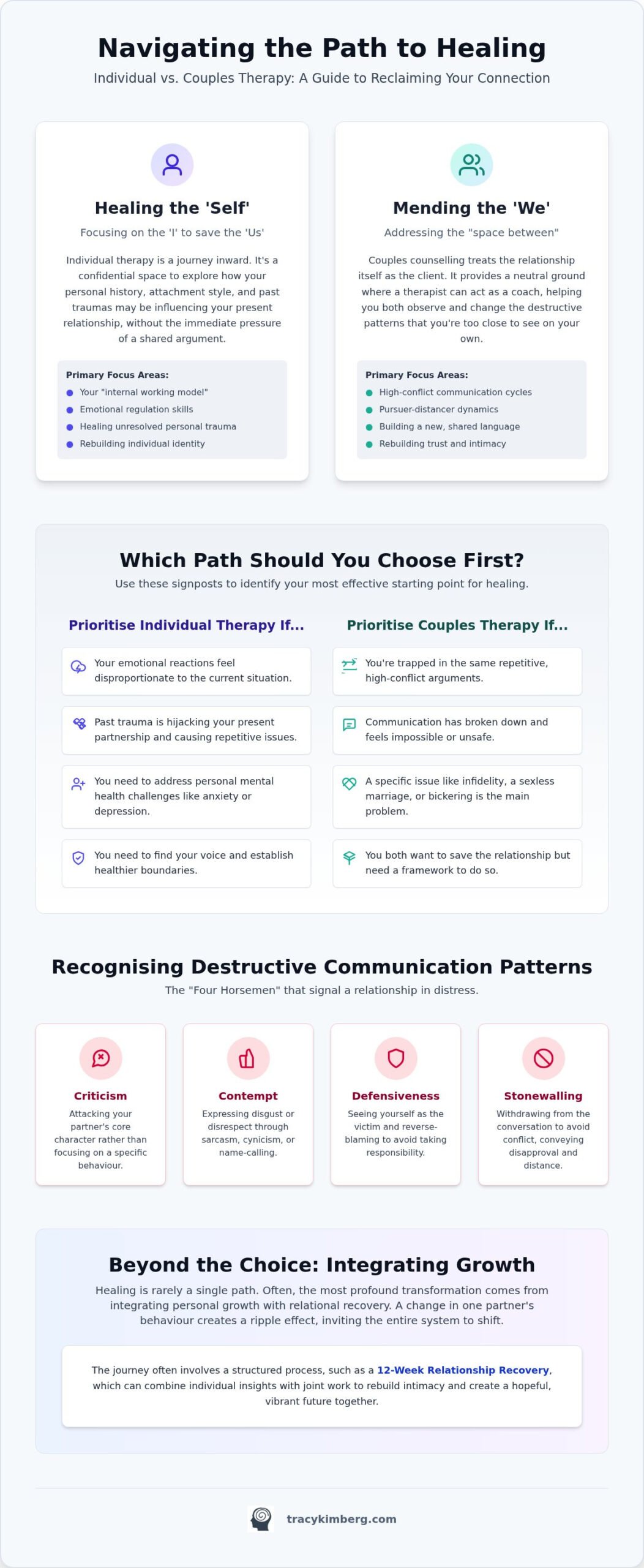
Standing at the crossroads of a relational breakdown is often exhausting. You want things to change, but you aren’t sure if you should be looking inward or outward. The fundamental choice between couples therapy vs individual therapy for relationship issues boils down to where you place the focus. Individual work explores your personal history, attachment styles, and the “self”, whilst joint work examines the “space between” you and your partner. It’s a systemic dance; if you change your own steps, the whole rhythm of the relationship shifts because every part of a system is interconnected.
Choosing the right entry point is vital because it helps reduce “therapy fatigue”, that specific exhaustion that sets in when you feel like you’re working hard but moving in circles. It’s about finding the path of least resistance to healing. By 2026 standards, relationship counselling is defined as the study of patterns rather than the study of people. This reframe moves the focus away from blame and toward the shared architecture of your connection.
When the ‘We’ is the Primary Patient
Sometimes the “patient” isn’t either individual, but the relationship itself. This is particularly true for interactional issues like the “pursuer-distancer” dynamic, where one person’s attempt to connect feels like pressure to the other, causing them to withdraw. Couples therapy provides the neutral ground needed to dismantle these high-conflict communication patterns. In this setting, the therapist acts as a coach for the relationship’s health, helping you both observe the game rather than just playing it. It allows you to build a shared language that doesn’t exist when you’re arguing in private.
When the ‘I’ Needs to Lead the Way
There are times when your own “baggage” or past trauma hijacks the present partnership. If you find your emotional reactions are disproportionate to the current situation, individual work might be the priority. You need a safe space to develop emotional regulation before you can effectively engage in joint work. By focusing on your own internal landscape, you reduce the pressure on the relationship to be your only source of validation. Personal growth often acts as a catalyst; when one person begins to heal and set healthy boundaries, it frequently inspires the partner to change their own behaviour in response. It’s about ensuring you’re “fit to dance” before you try to master a complex routine together.
Healing the ‘Self’ to Save the ‘Us’: When Individual Therapy is the Priority
When considering couples therapy vs individual therapy for relationship issues, we often overlook how much of our relational distress originates within our own internal landscape. Your attachment style, or your “internal working model”, acts as a blueprint for how you seek closeness or handle conflict. If this blueprint was formed under stress or inconsistent care, you might find yourself subconsciously pushing your partner away or clinging too tightly. Individual therapy allows you to examine these blueprints in a safe, non-judgemental space, away from the immediate heat of a shared argument.
Renowned therapist Esther Perel often speaks of the “Secret Garden” of the self. She argues that maintaining a distinct individual identity is actually what fuels desire and curiosity in a long-term partnership. When you lose yourself entirely in the “we”, the relationship can become suffocating or lose its spark. Additionally, individual mental health challenges like clinical anxiety or depression often mask themselves as relationship friction. By treating the underlying condition, the “relational” problem sometimes evaporates entirely. Through this work, individual therapy empowers you to show up as a more regulated, authentic version of yourself in your partnership.
The Power of One: Changing the Relationship Alone
You don’t always need two people in the room to break a deadlock. If your partner refuses to attend sessions, a “unilateral” approach can still be incredibly effective. By changing your reaction to a partner’s habitual “trigger”, you disrupt the entire conflict cycle. It’s like a game of tennis; if you stop hitting the ball back in the same way, the game must change. Individual work also helps you find your voice amongst the noise of a failing marriage, allowing you to set clear, compassionate boundaries that protect your well-being. If you’re ready to start this personal journey, exploring therapy for adults can provide the clarity you need.
Healing Childhood Wounds and Projections
Gabor Maté highlights how early childhood trauma manifests as adult relational disconnect. We often bring “projections” into our homes, arguing with a partner when we are actually reacting to a parent’s past behaviour. Recognising this distinction is a profound moment of healing. It shifts the narrative from “you are doing this to me” to “I am feeling this because of my history”. Developing self-compassion is a vital prerequisite for partner-compassion. Once you understand your own wounds, you can view your partner’s struggles with a softer, more informed lens, creating a bridge where there was once a wall.
Mending the Space Between: The Power of Joint Couples Counselling
Whilst individual work strengthens the dancers, joint counselling focuses on the choreography itself. When weighing up the merits of couples therapy vs individual therapy for relationship issues, the joint approach is often the most efficient way to address toxic patterns in real time. We utilise the Gottman Method to identify the “Four Horsemen”: Criticism, Contempt, Defensiveness, and Stonewalling. These specific behaviours act as the most reliable predictors of relationship distress. By spotting them as they occur during a session, we can immediately replace them with healthier alternatives. Joint therapy serves as a safe container where partners can explore difficult conversations without the fear of the discussion spiralling out of control.
Beyond managing conflict, joint sessions focus on building “Love Maps”. This involves the intentional process of re-learning who your partner is in 2026, including their current dreams, fears, and daily stresses. We also look closely at “Bids for Connection”, those small, often subtle moments where one person reaches out for attention or affection. Missing these bids frequently leads to a slow, painful drift apart. Learning to turn toward these bids rather than away from them is a cornerstone of reclaiming intimacy and mutual respect.
Navigating Crisis: Infidelity and Betrayal
Rebuilding trust after an affair is a complex process that almost always requires joint work. It’s non-negotiable because the betrayal happened to the “we”, so the healing must happen within that shared space. We guide you from the painful “Discovery” phase into a structured “Recovery” phase in a safe environment. Using the 12-Week Relationship Recovery Process, couples can navigate the aftermath of infidelity with a clear roadmap. This ensures the work is both deep and manageable, preventing further trauma whilst seeking a path toward forgiveness.
Communication as a Skill, Not an Intuition
Many people believe communication should be natural, but it’s actually a skill that requires deliberate practice. We move away from “You” statements, which often sound like accusations, and toward “I” statements that express personal needs and feelings. Learning the art of the “Softened Start-up” helps you bring up a grievance without triggering a partner’s immediate defensiveness. We also utilise the “Speaker-Listener” technique to ensure both of you feel truly heard and validated before any problem-solving begins. This shift from reactive arguing to intentional dialogue is what allows a relationship to breathe again.
A Decision Framework: Comparing Approaches for Specific Relationship Challenges
Choosing between couples therapy vs individual therapy for relationship issues requires an honest assessment of your current dynamic. Not every problem needs the same entry point. Whilst some issues live in the interaction between you, others are rooted deeply in personal history. This framework helps you identify the most effective path for your specific situation.
| Common Challenge | Best Starting Path | Primary Focus |
|---|---|---|
| Infidelity & Betrayal | Couples Therapy | Rebuilding trust and safety |
| Sexless Marriage | Couples Coaching | Reigniting desire and intimacy |
| Constant Bickering | Couples Therapy | De-escalating conflict cycles |
| Individual Trauma | Individual Therapy | Emotional regulation and healing |
If you feel completely “stalled”, it’s often because you’re trying to solve a systemic problem with an individual tool, or vice versa. Sometimes, the goal isn’t necessarily to stay together; a “Conscious Approached Divorce and separation” path allows you to end a partnership with dignity and mutual respect. Regarding the investment required, a full course of couples therapy typically involves between 12 and 25 sessions to achieve lasting results, whilst individual therapy often focuses on specific goals over a similar timeframe.
The ‘Roommate Phase’ vs High-Conflict Dynamics
The “Roommate Phase” is a slow drift into relational boredom, where you feel more like business partners than lovers. This often requires joint coaching to reignite the spark. In contrast, high-conflict dynamics involve active relational breakdown. If arguments are explosive, you might need individual de-escalation work first to ensure both partners can stay present and calm during joint sessions.
When One Partner is ‘Leaning Out’
Ambivalence is a heavy weight to carry. Discernment counselling is a specialised path for couples where one person is unsure if they want to stay. We use individual sessions within a broader couples framework to explore this “stay vs leave” tension. My approach manages both the “leaver” and the “stayer” with equal empathy, ensuring no one feels judged for their uncertainty. If you’re ready to find a path through the confusion, I invite you to explore my Relationship Counselling and Coaching for Couples to discover the clarity you deserve.
Beyond the Choice: Integrating Personal Growth and Relational Recovery
The debate of couples therapy vs individual therapy for relationship issues often suggests you must choose just one. However, the most resilient transformations usually happen through a “Hybrid” model. This approach acknowledges that whilst you are a couple, you are also two distinct individuals with your own histories. I offer a 12-Week Relationship Recovery Process that acts as a structured, integrated journey. It blends the personal deep-dives of individual work with the interactional coaching of joint sessions. This dual focus ensures that neither the “self” nor the “us” is neglected during the healing process.
For many modern UK couples, the logistical challenge of attending sessions is a significant barrier. Online therapy has become a vital tool in making consistent support accessible, allowing you to connect from the comfort of your own home without the stress of a commute. It takes immense bravery to acknowledge that your relationship needs support; choosing to seek help is the first proactive step toward a healthier, more vibrant partnership. Taking that first step requires profound courage, but it is the most significant gift you can give to your future self and your partner.
What to Expect in Your First Session with Tracy Kimberg
Walking into your first session can feel daunting, but my goal is to demystify the process immediately. You’ll find a safe, non-judgemental space where your concerns are heard with compassion. We begin with an initial assessment to determine the best path for your unique situation, looking at whether you need to focus on individual regulation or joint communication first. We then move from simply “fixing a problem” to “creating a future”. This goal-oriented approach ensures that our work feels like an active adventure rather than a static treatment.
Taking the First Step Towards Connection
Bringing up the idea of therapy to a reluctant partner can be delicate. I suggest framing it as a “Relationship Check-Up” or a positive investment in your shared happiness rather than a last resort for a crisis. It’s about wanting the best for both of you. Starting early, before patterns become deeply entrenched, often leads to faster and more sustainable recovery. If you feel ready to explore how we can work together, you can book a discovery call to find your best path to recovery. Whether you choose individual growth or joint counselling, the act of reaching out is a powerful statement of hope.
Reclaiming Your Connection and Clarity
Deciding between couples therapy vs individual therapy for relationship issues doesn’t have to be another source of stress. Whether you choose to focus on your personal growth or mending the “space between” with your partner, the most vital step is simply beginning. You’ve seen how individual work can heal the blueprints of your past, whilst joint sessions provide the safe container needed to dismantle toxic communication patterns. Both paths offer a route back to the closeness you deserve.
As a specialist in infidelity and relational breakdown, I utilise a research-based approach inspired by the Gottman and Perel methodologies. My 12-Week Relationship Recovery Process offers a structured path that integrates the best of both worlds, available through online therapy or face-to-face sessions in the UK. This proactive adventure is designed to be manageable and powerful, focusing on positive outcomes rather than just the weight of your problems.
Start your 12-Week Relationship Recovery journey with Tracy Kimberg
Your relationship is an evolving experience, and your desire for connection is a sign of its potential. By choosing to invest in your emotional health today, you’re creating the foundation for a more vibrant future. Healing is possible, and I’m here to guide you every step of the way.
Frequently Asked Questions
Is it better to do couples therapy or individual therapy first?
The best starting point depends entirely on the nature of your distress. If you’re struggling with personal trauma or severe emotional regulation issues, individual therapy is often the priority to ensure you can show up effectively for joint work. Conversely, if your primary struggles are communication breakdowns or a lack of intimacy, starting with joint sessions allows you to address those relational patterns in real time.
Can individual therapy save a marriage if the partner won’t go?
Yes, individual work can be a powerful catalyst for change even if your partner is absent. By altering your own reactions and setting healthier boundaries, you disrupt the existing conflict cycle. When one person in a relationship system changes their behaviour, the other person is often forced to adapt, which can lead to significant improvements in the marriage over time.
What if my partner refuses to go to couples therapy?
If your partner refuses to attend, focusing on your own growth is the most productive step you can take. You can’t force someone else to engage, but you can explore your own feelings and needs in a safe space. This provides clarity on whether the relationship is sustainable and helps you develop the tools to manage your own well-being regardless of their choices.
Will an individual therapist tell me to leave my partner?
A professional therapist won’t tell you what to do; their role is to help you find your own answers. They provide a neutral space to explore your ambivalence and the health of your partnership. The goal is to empower you with the clarity and self-awareness needed to make a decision that aligns with your long-term emotional health and personal values.
How do I know if we need a coach or a therapist for our relationship issues?
Therapy typically addresses deep-seated emotional wounds, trauma, and past patterns that hinder your present. Coaching is often more future-oriented, focusing on building specific skills like communication or reigniting intimacy. When weighing up couples therapy vs individual therapy for relationship issues, consider whether you need to heal old wounds or learn new ways to move forward together.
Can we do both individual and couples therapy at the same time?
Engaging in both simultaneously is often the most effective route to lasting recovery. This “Hybrid” model allows you to work on your personal triggers in individual sessions whilst addressing the shared dynamic in joint sessions. It provides a comprehensive support structure that ensures both your individual needs and the health of the relationship are being nurtured at the same pace.
What is the success rate of couples therapy vs individual therapy for relationships?
Research indicates that over 75% of couples report relationship improvement after therapy. Specifically, Emotionally Focused Therapy (EFT) shows a recovery rate of approximately 70% to 73%. Success rates for couples therapy vs individual therapy for relationship issues are high when both partners are committed to the process and the chosen modality matches their specific needs.
How long does relationship recovery typically take?
A full course of therapy typically requires between 12 and 25 sessions to achieve sustainable change. My 12-Week Relationship Recovery Process is designed to provide a structured roadmap that moves you from crisis to connection within a clear timeframe. The actual duration depends on the complexity of your issues and how consistently you apply the tools learned during your sessions.

Article by
Tracy Kimberg
Tracy Kimberg is a Relationship Expert, Couples Therapist and Coach with a dedicated focus on helping couples and individuals rebuild connection, trust and emotional safety in their relationships. Drawing on the research of John and Julie Gottman, the relational insights of Esther Perel, and years of hands-on therapeutic experience, Tracy offers a warm, non-judgemental and deeply compassionate approach to modern relationships.
Based in Dorset, Tracy works with couples navigating communication breakdowns, betrayal, intimacy challenges, separation, family dynamics and life transitions. Known for creating a safe and grounded therapeutic space, she combines practical tools with emotional depth to help clients move beyond survival patterns and towards meaningful, lasting change.
With a reputation for empathy, professionalism and dedication to her clients’ growth, Tracy is passionate about helping people feel seen, understood and empowered — both within their relationships and within themselves.
Disclaimer
Disclaimer:
The information shared in this article is intended for educational and informational purposes only and should not be considered a substitute for professional therapeutic, psychological, medical or legal advice. Every individual and relationship is unique, and the perspectives offered are based on general therapeutic principles, research and professional experience.
Reading this article does not establish a therapist-client relationship with Tracy Kimberg. If you are experiencing significant emotional distress, relationship crisis, trauma, or mental health concerns, it is important to seek support from a qualified professional appropriate to your individual circumstances.
All content remains the intellectual property of Tracy Kimberg and may not be reproduced or distributed without permission.