

What if the widening distance between you and your child isn’t a sign of a failing relationship, but a quiet invitation to evolve how you connect? Many parents find themselves walking on eggshells, worried that a simple question about school or screen time might ignite a household conflict. It’s a heavy burden to carry, feeling like the communicative child you once knew has retreated behind a digital wall or a mask of academic anxiety. You aren’t alone in this struggle to bridge the gap whilst maintaining a sense of family peace.
Seeking online therapy for teens UK is a proactive step toward understanding the complex emotional landscape of adolescence through a relational lens. By shifting the focus from managing a crisis to nurturing a bond, you can help your teenager develop the resilience they need for the modern world. This guide provides a clear path forward, offering practical tools to handle emotional outbursts and insights into how expert guidance can restore a sense of harmony amongst all family members. We’ll explore how to move from a place of friction to a future of authentic, heartfelt communication.
Key Takeaways
- Understand the specific pressures of the 2020s, from social media to academic anxiety, and how they shape your teenager’s behaviour.
- Discover how online therapy for teens UK offers a flexible, confidential environment that respects your child’s growing need for autonomy.
- Learn to identify the subtle differences between typical adolescent moodiness and the deeper signs of persistent emotional distress.
- Gain practical strategies to suggest therapeutic support whilst ensuring your child feels empowered and involved in the process.
- Shift the focus from managing household conflict to building a bridge of authenticity that restores harmony amongst family members.
Understanding Online Therapy for Teens in the UK
Adolescence is a profound period of transformation where the need for autonomy often clashes with the desire for safety. Adolescent therapy provides a collaborative, confidential space where your child can explore these shifts without the weight of expectation. Unlike the clinical environments of the past, modern online therapy for teens UK creates a sanctuary for emotional growth. It’s helpful to look at an overview of online therapy to see how this digital approach has evolved to meet the needs of a generation that communicates primarily through screens.
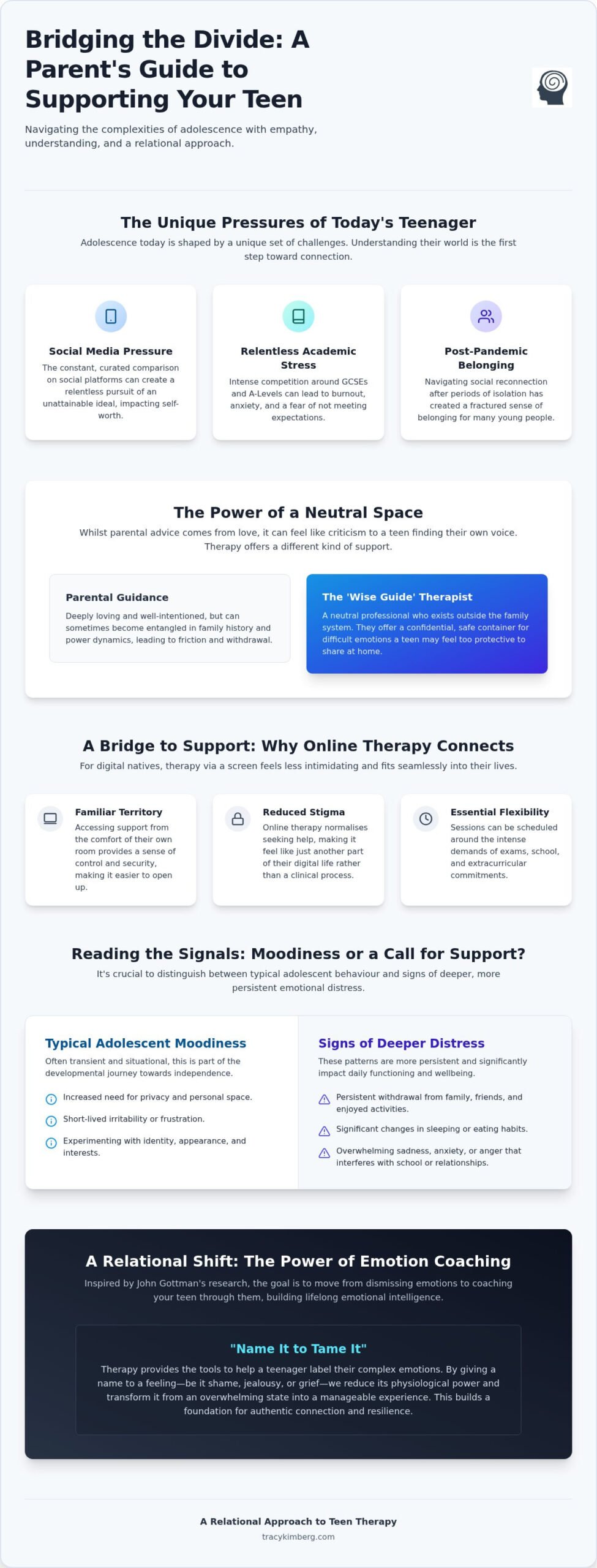
Today’s teenagers face a unique set of pressures that didn’t exist a generation ago. These stressors often include:
- The constant, curated comparison found on social media platforms.
- Relentless academic competition and the pressure of GCSEs or A-Levels.
- Post-pandemic social anxiety and a fractured sense of belonging.
When these pressures mount, a teen’s natural instinct is often to withdraw or lash out. Whilst parental advice comes from a place of deep love, it can frequently feel like criticism to a teenager trying to find their own voice. A neutral professional can often reach a teen when parental guidance creates friction, simply because the therapist exists outside the family’s daily power dynamics.
The Role of a Professional “Wise Guide”
A neutral professional acts as a “Wise Guide”, offering a perspective that isn’t entangled in the family’s daily history. This distance is vital. It allows the therapist to hold a safe container for “difficult” emotions like deep-seated anger or paralysing shame that a teen might feel too protective to share with you. In the UK, this relationship is built on a foundation of trust and clear confidentiality. Whilst the teen’s privacy is paramount, it always operates within a robust safeguarding framework, ensuring that safety is the underlying priority in every session.
Why Online Therapy Suits the Digital Native
For a generation that has grown up online, a laptop screen feels far less intimidating than a therapist’s office. Accessing support from the comfort of their own bedroom acts as a catalyst for opening up, as the physical environment provides a sense of control and security. This format significantly reduces the stigma often associated with mental health support, making it feel like just another part of their digital life. The flexibility is essential for UK students juggling the intense demands of exams and extracurricular commitments. Online therapy for teens serves as a modern bridge to emotional literacy, connecting their digital reality with their internal world.
The Psychology of Adolescence: Authenticity and Connection
Adolescence is often described as a storm, yet it’s more accurately a profound relational shift. When a teenager “acts out” or retreats into silence, they aren’t simply being difficult. These behaviours are unarticulated cries for connection. As Gabor Maté often observes, there is a fundamental tension between our need for attachment and our need for authenticity. For a teenager, the drive to be their true self can feel like it threatens their connection to you. They may push away to see if the bond holds, testing whether you can love the person they are becoming, not just the child they once were.
This transition from childhood dependency to adult autonomy is a necessary, albeit painful, evolution. It’s vital to remember that your teen’s behaviour is a developmental signal rather than a personal failure on your part. By engaging with online therapy for teens UK, families can begin to decode these signals together. This process helps transform a household of conflict into a space where authenticity is celebrated and the parent-child bond is reinforced through understanding rather than control.
The Gottman Perspective on Emotion Coaching
John Gottman’s research highlights the transformative power of “Emotion Coaching” over “Emotion Dismissing.” When we dismiss a teen’s feelings, even with the best intentions, we inadvertently tell them their internal world is incorrect or unimportant. Therapy teaches the “name it to tame it” technique; by helping a teenager label their complex emotions, we reduce the physiological charge of those feelings. This builds emotional intelligence that lasts a lifetime, allowing them to navigate future adult relationships with clarity and grace.
Navigating the “Roommate Phase” at Home
Many parents describe the teenage years as the “roommate phase,” where you share a kitchen and a hallway but feel emotionally miles apart. This disconnection often stems from a cycle of withdrawal and pursuit; the more a parent pushes for information, the further the teen retreats. Relational therapy identifies these subtle patterns, helping parents remain a “secure base.” You become the steady anchor they can return to after exploring their independence. If you feel stuck in this cycle, exploring specialised relationship support can help bridge the gap. Restoring this bond ensures that even amongst the chaos of growing up, the family remains a source of strength and mutual respect.
Identifying the Signs: When Does a Teenager Need Therapy?
Distinguishing between typical adolescent moodiness and persistent emotional distress is one of the most challenging tasks a parent faces. It’s natural for a teenager to seek privacy or experience occasional irritability as they navigate the hormonal shifts of puberty. However, when these behaviours become the baseline rather than the exception, it may be time to consider professional support. Early intervention is vital; it prevents temporary struggles from hardening into long-term patterns that can affect their transition into adulthood.
We often look for the loud signals of distress, such as shouting or defiance. Yet, some of the most profound cries for help are silent. Masking is a common phenomenon where a teenager hides their anxiety behind a veneer of perfectionism or over-compliance. They become the “perfect” student or the “easy” child to avoid causing trouble, whilst internally they are struggling with a deep sense of inadequacy. Accessing online therapy for teens UK allows these young people to drop the mask in a safe, neutral space.
Common Challenges for UK Teenagers Today
The current climate for British youth is uniquely demanding. Many are trapped in an “exam factory” culture where their self-worth is tied directly to GCSE or A-Level results. This relentless pressure often manifests as crippling anxiety or a complete loss of interest in previously favourite activities. Relational breakdowns are also a significant factor. Friendship “drama” or social exclusion on digital platforms can feel catastrophic to a teen, leading to a sense of isolation that is difficult to navigate without an objective guide.
Subtle Red Flags Parents Often Overlook
Distress doesn’t always show up in the mind first; often, it speaks through the body. Somatisation is a frequent red flag, where emotional pain manifests as unexplained headaches, stomach aches, or chronic fatigue. You might also notice a sudden shift in friendship circles or a move toward secretive online behaviour. Perhaps the most overlooked sign is the “Good Child” syndrome. If a teenager is too afraid to fail, too eager to please, or never expresses anger, they may be suppressing their authentic self to maintain a sense of safety. Recognising these subtle shifts is the first step toward restoring harmony amongst your family members.
Preparing for the Journey: How to Support Your Teen
Suggesting therapy to a teenager can feel like walking through a minefield. Many parents worry their child will feel “broken” or singled out as the family’s problem. To avoid this, frame the conversation around support rather than “fixing.” Position therapy as a proactive investment in their wellbeing; it’s a neutral space where they can be heard without the fear of disappointing you. When exploring online therapy for teens UK, involve them in the process from the very first step. This isn’t something being done to them; it’s a resource they’re invited to use.
The power of choice is a vital motivator during adolescence. Letting your teen lead the selection of their therapist or the format of their sessions restores a sense of agency that they often feel they’ve lost. Whilst you naturally need reassurance about their safety, it’s essential to balance this with their need for privacy. Confidentiality is the cornerstone of the therapeutic bond. Knowing that their words won’t be immediately reported back to you allows them to be truly honest. In the first session, the focus is entirely on creating a safe, non-judgemental environment where they can test the waters of this new relationship.
Effective Communication Strategies for Parents
Before you sit down to talk, consider your approach. Using “I” statements, such as “I’ve noticed you’ve been feeling more stressed lately and I’m worried about you,” is far more effective than “You’re always in a bad mood.” The goal is to validate their feelings before rushing in with solutions. Practising active listening means hearing what they’re saying without preparing your rebuttal. If you’re unsure where to start, learning how to communicate with my teenager can provide the foundational skills needed for these sensitive discussions.
Choosing Between Online and Face-to-Face Therapy
The traditional clinical centre experience can sometimes feel cold or intimidating to a young person. In contrast, the accessibility of online sessions allows them to engage from their bedroom, a space where they already feel secure. Whilst a physical presence can be beneficial for some, the ease of digital connection often outweighs the logistical stress of travel for a busy student. Tracy Kimberg offers a flexible approach for families across the country, ensuring that high-quality online therapy for teens UK is available regardless of your location. If you’re ready to bridge the gap in your relationship, you can book a discovery call to discuss the best path forward for your family.
A Relational Approach to Teen Therapy with Tracy Kimberg
Tracy Kimberg’s approach to online therapy for teens UK is rooted in the belief that we cannot heal the individual without also nurturing their relational world. Whilst many clinical models focus solely on the teenager as an isolated subject, Tracy views the adolescent experience through a systemic lens. Drawing on the foundational research of John Gottman and the insightful relationship dynamics explored by Esther Perel, she helps families identify the invisible threads that bind them together. This isn’t just about managing symptoms; it’s about understanding how connection, or the lack thereof, influences a young person’s internal landscape.
The therapeutic bond Tracy creates is both safe and professional, yet it remains fundamentally human. It’s a partnership where the teenager is treated as an equal participant in their own healing. By integrating Gabor Maté’s perspectives on authenticity, Tracy provides a space where teens can explore who they are without the pressure of external expectations. She acts as a Wise Guide, positioning herself as the vital bridge between a teen’s fierce need for autonomy and a parent’s deep desire for connection. This relational bridge allows for a restored sense of harmony to return to the home, turning a period of friction into a shared chapter of growth.
Beyond Labels: Treating the Person, Not the Diagnosis
In this space, we move away from clinical jargon and restrictive labels. Instead, the focus remains on the teenager’s unique narrative. We don’t just look at what’s “wrong”; we look at how they’ve learned to navigate their world. By focusing on the person rather than a diagnosis, we build resilience and emotional tools that serve them well into adulthood. Progress is framed not as a static treatment, but as an active, evolving adventure. It’s about helping them reclaim their voice whilst strengthening the bonds they share with those they love. This shift in perspective helps the teenager feel seen and understood rather than analysed and fixed.
Taking the Next Step for Your Family
Choosing to seek support is a profound act of love for your child and your family. The initial consultation process is designed to be low-pressure and welcoming, ensuring that both you and your teenager feel comfortable with the path ahead. Tracy remains committed to providing a safe, non-judgemental, and expert experience for every family she supports across the UK. It’s time to move beyond the cycle of conflict and begin a new chapter of authentic connection.
Book a Compassionate Consultation for Your Teenager and discover how a relational approach can transform your family’s future.
Restoring the Bridge of Connection
Adolescence doesn’t have to be a period of isolation or constant household conflict. By reframing these challenging years as a relational transition, you can move from a place of friction to one of mutual respect. We’ve explored how identifying subtle red flags and choosing a format that respects your teen’s autonomy can transform your family dynamic. Online therapy for teens UK offers a modern, flexible sanctuary where young people can develop emotional literacy whilst staying connected to those who love them most.
As a professional UK-based therapist, I utilise research-based methods inspired by the work of Gottman, Perel, and Maté to help you through this process. My goal is to provide a safe, non-judgemental environment where your teenager feels seen and your family feels supported. You don’t have to walk through these complex emotional landscapes alone. It’s entirely possible to restore harmony and build a resilient, communicative relationship that lasts a lifetime.
Book a Compassionate Consultation for Your Teenager today and take the first step toward a more connected future. Healing is an active adventure, and it begins with a single, heartfelt conversation.
Frequently Asked Questions
How do I know if my teenager actually needs counselling or if it is just a phase?
You can distinguish between the two by observing the duration and intensity of the behaviour. A developmental phase is usually transient, but persistent emotional distress often interferes with their ability to sleep, eat, or maintain friendships. If their withdrawal or irritability feels like a constant barrier to connection rather than an occasional mood swing, it’s worth seeking professional support. Early intervention helps prevent these patterns from becoming their default way of relating to the world.
Will my teenager’s therapist tell me what they talk about in their sessions?
Confidentiality is the cornerstone of the therapeutic relationship, especially for teenagers seeking autonomy. I don’t share the specific details of our conversations unless there is a significant risk of harm to your child or someone else. This privacy creates a safe container where they can explore difficult emotions without fear of judgement. However, I do work with you to understand the broader themes of their progress whilst respecting their need for a private emotional space.
Is online therapy as effective as face-to-face counselling for young people?
Research and clinical experience suggest that online therapy for teens UK is highly effective, often because it meets young people in their natural digital environment. Many teenagers feel more comfortable opening up from the safety of their own bedroom rather than an unfamiliar clinical setting. This comfort often leads to deeper authenticity and faster engagement. The digital format removes the logistical stress of travel, allowing them to focus entirely on their emotional journey and personal growth.
What should I do if my teenager refuses to attend their therapy sessions?
If your teenager is reluctant, try reframing the suggestion as an invitation rather than a requirement. Forcing a child into therapy often creates more resistance and damages the trust between you. You might suggest a single, no-pressure session to see if they feel a connection with the therapist. Giving them the power of choice over the format or the practitioner can help them feel like an active participant in their own wellbeing rather than a problem to be fixed.
How long does teenage counselling typically last before we see an improvement?
Every teenager’s journey is unique, so there is no fixed timeline for improvement. Some families notice subtle shifts in communication after just a few sessions, whilst deeper relational healing often takes longer. Therapy is an evolving process rather than a static treatment. We focus on building sustainable emotional tools and resilience. The goal is long-term health, so we move at a pace that respects your child’s internal readiness to process their experiences and make lasting changes.
Can counselling help with my teenager’s school-related anxiety and exam stress?
Counselling is incredibly effective for managing the pressures of the exam factory culture. We work together to decouple their self-worth from their academic results, helping them manage the physiological symptoms of anxiety. By teaching them to name it to tame it, we reduce the power that exam stress holds over their daily lives. This process builds emotional intelligence, allowing them to navigate academic challenges with a greater sense of calm and perspective amongst their peer groups.
Do you offer support for parents alongside the teenager’s individual therapy?
Yes, my approach is fundamentally relational, meaning I often provide guidance for parents to help bridge the gap at home. Whilst the teenager’s sessions are private, I can offer you practical tools to manage household conflict and improve your communication style. Supporting the family system ensures that the progress made in online therapy for teens UK is reinforced by a more harmonious and understanding environment. We work collaboratively to restore the vital bonds between you and your child.
What is the first step to booking online therapy for my teen in the UK?
The first step is to book an initial discovery call through my website. This brief conversation allows us to discuss your concerns and determine if my relational approach is the right fit for your family. I’ll explain how the sessions work and answer any specific questions you or your teenager might have. It’s a low-pressure way to begin this proactive adventure toward healing, ensuring everyone feels comfortable and informed before the first full session begins.

Article by
Tracy Kimberg
Tracy Kimberg is a Relationship Expert, Couples Therapist and Coach with a dedicated focus on helping couples and individuals rebuild connection, trust and emotional safety in their relationships. Drawing on the research of John and Julie Gottman, the relational insights of Esther Perel, and years of hands-on therapeutic experience, Tracy offers a warm, non-judgemental and deeply compassionate approach to modern relationships.
Based in Dorset, Tracy works with couples navigating communication breakdowns, betrayal, intimacy challenges, separation, family dynamics and life transitions. Known for creating a safe and grounded therapeutic space, she combines practical tools with emotional depth to help clients move beyond survival patterns and towards meaningful, lasting change.
With a reputation for empathy, professionalism and dedication to her clients’ growth, Tracy is passionate about helping people feel seen, understood and empowered — both within their relationships and within themselves.
Disclaimer
Disclaimer:
The information shared in this article is intended for educational and informational purposes only and should not be considered a substitute for professional therapeutic, psychological, medical or legal advice. Every individual and relationship is unique, and the perspectives offered are based on general therapeutic principles, research and professional experience.
Reading this article does not establish a therapist-client relationship with Tracy Kimberg. If you are experiencing significant emotional distress, relationship crisis, trauma, or mental health concerns, it is important to seek support from a qualified professional appropriate to your individual circumstances.
All content remains the intellectual property of Tracy Kimberg and may not be reproduced or distributed without permission.