

What if we viewed the end of a partnership not as a failure to be survived, but as a sacred transition to be honoured? When you’re standing in the “waiting room” of a relationship, the weight of the unknown often feels suffocating. You’re likely grappling with an overwhelming anxiety about what comes next, perhaps fearing the lasting impact this change might have on your children. It’s a space of profound vulnerability where the distinction between a “break” and an “ending” feels impossibly blurred. Navigating a separation requires more than just legal logistics; it demands a deep, psychological clarity that protects your well-being and the emotional health of your entire family.
I understand that the path ahead feels treacherous, yet it’s entirely possible to move through this period with dignity and empathy. This guide offers a structured way to manage the transition, helping you find emotional stability whilst you make significant life decisions. We’ll explore research-based strategies to foster an amicable outcome, transforming a potentially messy breakup into a conscious recovery process. By focusing on healing rather than just the weight of the problems, you can emerge from this experience with a sense of peace and a clear vision for your new beginning.
Key Takeaways
- Learn to distinguish between a chaotic emotional break and a structured, conscious transition that prioritises psychological growth and mutual respect.
- Identify how Gottman’s “Four Horsemen” manifest during distance and learn to balance your domestic responsibilities with the need for personal space.
- Establish firm “Rules of Engagement” regarding your shared finances and communication to maintain your dignity whilst navigating a separation.
- Protect your children’s emotional well-being by adopting a “United Front” and using age-appropriate language that avoids assigning blame.
- Explore structured pathways to clarity, such as the 12-Week Relationship Recovery Process, to help you move from a place of reactive pain to one of conscious choice.
What Does Navigating a Separation Truly Mean in 2026?
In 2026, the way we approach the end of a partnership has shifted significantly. We’re moving away from the scorched-earth tactics of the past and toward a more enlightened, psychological framework. Navigating a separation today isn’t merely about who gets the house or how you’ll split the weekends; it’s about the internal landscape. It’s often described as the “waiting room” of a relationship. This is a period of profound uncertainty where you aren’t quite together, yet you aren’t fully apart. It’s a space where the air is thick with “what-ifs,” and the desire for an amicable path often battles with raw, reactive pain. Couples are now seeking clarity through empathy rather than through the cold lens of adversarial combat.
The Difference Between a Break and a Separation
A reactive “break” usually happens in the heat of an argument. One person grabs a bag and leaves, fuelled by a desperate need for oxygen. A structured Marital Separation, however, is a deliberate choice made with specific intent. You must ask yourselves: is the goal reconciliation, or are you looking for a “soft landing” for a permanent ending? The intent determines the boundaries you set. Cooling off for a night might lower the temperature, but it doesn’t provide the psychological safety needed for big life decisions. Conscious Separation is a deliberate, agreed-upon period of physical or emotional distance designed to preserve the psychological integrity of both individuals while they determine the future of their partnership.
Why “Conscious” Matters
Choosing a “conscious” path means you’re deciding to maintain healthy dynamics even whilst your lives are uncoupling. It’s a shift from a “blame-culture,” where we track each other’s failures, to a “growth-culture,” where we examine our own contributions to the relationship’s state. This shift is essential for your long-term emotional health. Without this intentionality, you risk the “Relationship Tumbleweed” effect. Unresolved issues don’t just disappear; they roll forward, gathering mass and resurfacing in future conflicts or co-parenting struggles. By navigating a separation with intention and clear psychological goals, you ensure that the transition is an active, evolving experience rather than a static state of suffering. It allows both parties to breathe, reflect, and eventually move forward without the weight of lingering resentment.
The Emotional Landscape: Insights from Gottman and Perel
Separation is rarely a clean, clinical break. It’s more often a messy, overlapping period of discernment. You’re likely navigating a space where you feel the urge to flee whilst simultaneously feeling a desperate pull to stay. This emotional disconnect is exhausting. It’s the friction between your history and your hope. To move through this with clarity, we must look at the psychological undercurrents that brought you here. Understanding these patterns isn’t about assigning blame; it’s about gaining the insight needed to decide your next steps with a clear head.
Identifying the “Four Horsemen” in Your Space
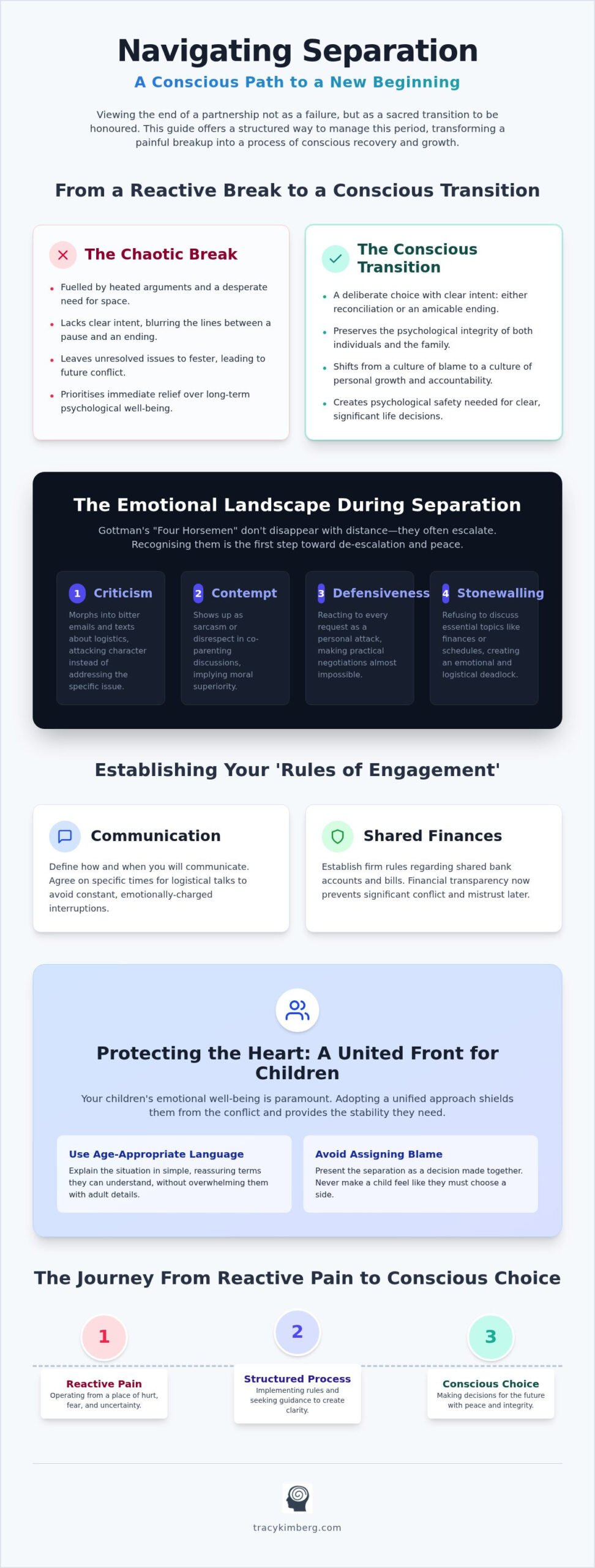
John Gottman’s research highlights four specific behaviours—Criticism, Contempt, Defensiveness, and Stonewalling—that act as predictors of relationship breakdown. These “Four Horsemen” don’t simply vanish because you’re living in different houses. In fact, they often follow you. Criticism can morph into bitter emails about late school runs, while stonewalling becomes a refusal to discuss shared finances. When you’re navigating a separation, these patterns can escalate because the stakes feel so high. To effectively approach a marital separation, you must learn to de-escalate these interactions. This requires creating a non-judgemental environment where logistics can be handled without the weight of past grievances. It’s about choosing a “United Front” for the sake of your own peace.
The Paradox of Distance
Esther Perel often discusses the tension between our need for security (the domestic) and our need for adventure (the erotic). In many long-term partnerships, the domestic side becomes so heavy that it smothers the spark. Distance, though painful, creates the space necessary for desire to breathe again. Sometimes, being apart reveals the value of what was lost. Other times, it confirms that the disconnect is permanent. This paradox of distance can trigger intense anxiety about the unknown. Using this time for individual Therapy for Adults is a powerful way to regain your self-identity. It allows you to process your trauma and personal history without the constant reactive presence of your partner. Navigating a separation is an active experience, and this individual work ensures that whatever decision you make—to reconcile or to uncouple—is grounded in self-awareness rather than fear. If you find the emotional landscape too difficult to traverse alone, professional Relationship Counselling can provide the map you need to find your way back to stability.
Establishing Your ‘Rules of Engagement’ for a Healthy Break
Many separations descend into chaos not because of a lack of love, but because of a lack of structure. When you’re navigating a separation, the absence of clear, written expectations creates a vacuum that anxiety quickly fills. Without a roadmap, every text message becomes a potential landmine and every bank statement a source of resentment. To avoid this “tumbleweed” of conflict, you must establish a set of ‘Rules of Engagement’ that protect both your heart and your practical reality. This isn’t about being cold; it’s about being clear so that you both have the safety required to heal.
Relationship experts often suggest a timeline of three to six months for this period. This duration is long enough to step out of reactive cycles and regain a sense of self, yet short enough to keep the goal of clarity in focus. One of the most vital conversations involves the boundary of monogamy. Are you still exclusive, or is this a period of total exploration? Deciding this upfront prevents the trauma of “accidental” betrayal whilst you are already vulnerable. Establishing these boundaries is essential when navigating a separation, as it prevents the logistical from poisoning the emotional.
The Communication Protocol
How you speak to each other determines the temperature of the transition. I often recommend moving away from “instant” messaging for anything other than logistics. Instant platforms invite impulsive, emotional reactions that we later regret. Instead, use email for heavier topics; it allows for reflection and a more measured tone. Agree on a frequency that works for both. Perhaps you decide on a weekly check-in rather than daily chatter. It’s also wise to define an “Emergency Only” rule. A crisis is a burst pipe or a child’s illness, not an impulsive desire to rehash an old argument at midnight.
Living Arrangements and Financial Boundaries
Whilst the “in-home separation” might seem financially prudent, it rarely provides the psychological space needed for true discernment. It’s hard to find clarity when you’re still sharing a kettle or navigating the same hallway. If you must remain in the same house, you need to create distinct zones and schedules. This discipline extends to your finances. Resentment grows in the shadows of shared expenses. Be explicit about who covers which bill and how you will handle “favourite” household items. Ensuring both parties feel financially safe is a prerequisite for emotional honesty. You cannot make a clear-headed decision about your future if you are terrified of your bank balance or where you will sleep next Tuesday.
Protecting the Heart: Children and External Communication
When you are navigating a separation, the family system undergoes a profound structural shift. Children are incredibly sensitive to the emotional climate of the home; they feel the tremors long before the earthquake hits. To protect them, you must adopt the “United Front” principle. This means that regardless of the pain between you, your children receive a consistent, calm, and blame-free narrative. They don’t need to know the intricacies of your adult heartbreak. Instead, they need to feel that the “container” of the family is still holding them, even if the shape of that container is changing. Consistency in your message is the only way to provide the psychological safety they crave.
Supporting Your Children through Transition
The “Big Talk” should always happen with both parents present. Use simple, age-appropriate language that focuses on the children’s safety and routine rather than your interpersonal conflict. You might say, “We have decided to live in different houses for a while so we can focus on being the best parents possible.” For younger children, focus on the logistics: who will take them to school, where they will sleep, and when they will see each parent. Teenagers, however, require a different approach. They have a refined radar for inauthenticity and often feel a need for more autonomy and truth. Whilst they deserve honesty, they should never be used as emotional confidants or messengers between parents.
Watch closely for signs of school anxiety or emotional withdrawal. Some children may internalise their grief, whilst others may act out. Providing a neutral space through Therapy for Teenagers can be a vital lifeline. It allows them to process their own confusion without feeling like they have to choose a side or protect a parent’s feelings.
Managing the Social Narrative
The “noise” from well-meaning friends, in-laws, and social circles can be deafening whilst you are still processing your own emotions. You are under no obligation to provide a detailed account of your relationship to anyone. Craft a simple, neutral statement for the outside world: “We are navigating a separation and are currently focusing on our family’s well-being; we appreciate your privacy.” This protects your personal space and prevents the “tumbleweed” of gossip from gaining momentum. Decide early who in your inner circle is truly safe for emotional support and keep the wider social narrative minimal. If you need professional support to find clarity during this transition, consider my Conscious Approached Divorce and separation services to help you manage the process with dignity.
Choosing a Conscious Path with Professional Guidance
Navigating a separation is often the most significant emotional work you’ll ever undertake. It’s a period where the noise of the external world—the legalities, the opinions of others, the logistical strain—can easily drown out the quiet voice of your own truth. This is why many find that individual relationship counselling is the first step toward genuine clarity. Unlike legal divorce mediation, which focuses strictly on assets and physical custody, professional relational support focuses on the heart. It’s about understanding the psychological “why” behind the breakdown and deciding, with intention, whether you are preparing for a new chapter together or a healthy, conscious goodbye.
The Role of a Relationship Expert
A neutral third party provides a mirror to your relationship. They identify the systemic patterns you’re simply too close to see. Perhaps it’s a trauma-informed perspective on how your past is playing out in the present, or a research-based look at your specific communication style. If you’re physically apart, online therapy offers a safe, accessible way to continue this work without the immediate pressure of being in the same room. It helps you move from “survival mode”—where you’re just trying to get through the day—to “intentional living.” This shift is vital because it ensures your future isn’t dictated by reactive pain but by conscious choice.
For those seeking a structured way out of the fog, the 12-Week Relationship Recovery Process offers a guided path toward deep healing. It isn’t just about “fighting for the relationship” in the traditional sense; it’s about fighting for the emotional health of everyone involved. It allows for a safe, non-judgemental environment where you can explore the relational breakdown with the guidance of a wise expert.
Your Next Steps Toward Clarity
Choosing professional support isn’t an admission of defeat. It’s an act of radical courage. It’s a decision to honour the history you’ve built by giving the transition the respect it deserves. Whether you need to heal the wounds of the past or find a way to co-parent with peace, help is available. You don’t have to be navigating a separation alone. Taking that first step toward professional guidance can transform a period of crisis into a proactive and positive adventure of self-discovery.
- Explore the 12-Week Relationship Recovery Process for deep healing.
- Learn more about Conscious Divorce and Separation Support.
The path forward may not be clear yet, but the decision to seek clarity is the most important one you will make. Your long-term emotional health is worth the investment.
Moving Toward a New Beginning
The transition from a shared life to an independent future doesn’t have to be defined by chaos. By establishing clear “Rules of Engagement” and prioritising the emotional health of your children, you transform a period of reactive pain into one of conscious growth. We have explored how Gottman’s research and Perel’s perspectives help you understand the deeper relational patterns at play. Navigating a separation is rarely easy, but with a structured approach and psychological clarity, it becomes a manageable journey rather than an overwhelming crisis.
Choosing to work with a specialist provides the safe, non-judgemental environment you need to process this change effectively. Whether you’re seeking a new chapter together or a healthy goodbye, my specialised 12-Week Relationship Recovery Process offers the expertise in conscious separation required to find your footing. You don’t have to walk this path alone. I invite you to Book a Discovery Call with Tracy Kimberg to begin your journey toward emotional stability. There’s healing on the horizon, and taking this first step is a powerful act of self-care for your future.
Frequently Asked Questions
How long should a trial separation last for it to be effective?
Experts suggest three to six months for a trial separation to be truly effective. This timeframe is long enough to step out of reactive cycles when navigating a separation, yet short enough to maintain focus on the future. It prevents the “waiting room” phase from becoming a permanent state of limbo. During this time, both partners can engage in individual work to gain the clarity needed for a final decision about their path forward.
Is it possible to reconcile after a formal separation?
Reconciliation is absolutely possible, provided both partners are willing to address the systemic issues that led to the disconnect. A formal separation can act as a circuit breaker, allowing space for desire and appreciation to resurface. Many couples use this time to engage in a structured recovery process, which helps them rebuild trust and intimacy. It’s about choosing a new chapter together rather than simply trying to return to a broken and painful past.
What are the first steps to take when navigating a separation?
The first steps when navigating a separation involve establishing clear “Rules of Engagement” to prevent the process from becoming adversarial. You should agree on a communication protocol, such as using email for logistics to avoid impulsive emotional reactions. It’s also vital to set boundaries regarding finances and living arrangements. Seeking professional guidance early ensures that you have a neutral space to explore your options with dignity and empathy, rather than falling into a blame-culture.
How do we handle the finances whilst living in separate locations?
Handling finances requires radical transparency and explicit agreements to prevent resentment from festering. You must decide who covers specific bills and how shared expenses will be managed whilst you are living apart. Ensuring that both parties feel financially safe is a prerequisite for making honest emotional decisions. It’s often helpful to document these arrangements in writing. This clarity allows you to focus on the psychological transition without the constant stress of financial instability or unexpected bank charges.
Can we navigate a separation whilst still living in the same house?
Whilst an in-home separation is possible, it requires strict boundaries and designated “zones” to be effective. You need to create separate schedules and living areas to find the psychological space necessary for true discernment. It’s often more challenging than living apart because the physical proximity can trigger old reactive patterns. If you choose this path, maintaining a “United Front” for any children in the house is essential to protect their long-term emotional well-being and security.
How do I tell my partner I want a conscious separation rather than a divorce?
Frame the conversation around the need for clarity and healing rather than a final ending. You might explain that you want a conscious separation to honour the history you’ve built by giving the transition the respect it deserves. Focus on the “why” behind the need for space, using “I” statements to express your feelings. This approach invites your partner into a collaborative solution, moving away from a reactive “break” toward a structured, agreed-upon period of reflection.
What is the difference between relationship coaching and traditional counselling?
Relationship coaching often follows a more structured, goal-oriented path compared to traditional counselling. For instance, my 12-Week Relationship Recovery Process provides a specific roadmap for couples seeking to transform their dynamics. Whilst traditional counselling may focus on exploring past traumas and deep-seated patterns, coaching often emphasises actionable steps and future-focused strategies. Both approaches provide a safe, non-judgemental environment, but the choice depends on whether you need open-ended exploration or a guided, time-bound recovery programme for your partnership.
How can I support my anxious teenager during our separation?
Supporting an anxious teenager involves providing them with a consistent narrative and a safe space to express their grief. Teenagers have a refined radar for inauthenticity, so it’s important to be honest about the transition without using them as emotional confidants. Maintaining their routine as much as possible provides a sense of stability. Offering a neutral third party, such as specialised therapy for teenagers, allows them to process their confusion without feeling they must choose a side or protect you.

Article by
Tracy Kimberg
Tracy Kimberg is a Relationship Expert, Couples Therapist and Coach with a dedicated focus on helping couples and individuals rebuild connection, trust and emotional safety in their relationships. Drawing on the research of John and Julie Gottman, the relational insights of Esther Perel, and years of hands-on therapeutic experience, Tracy offers a warm, non-judgemental and deeply compassionate approach to modern relationships.
Based in Dorset, Tracy works with couples navigating communication breakdowns, betrayal, intimacy challenges, separation, family dynamics and life transitions. Known for creating a safe and grounded therapeutic space, she combines practical tools with emotional depth to help clients move beyond survival patterns and towards meaningful, lasting change.
With a reputation for empathy, professionalism and dedication to her clients’ growth, Tracy is passionate about helping people feel seen, understood and empowered — both within their relationships and within themselves.
Disclaimer
Disclaimer:
The information shared in this article is intended for educational and informational purposes only and should not be considered a substitute for professional therapeutic, psychological, medical or legal advice. Every individual and relationship is unique, and the perspectives offered are based on general therapeutic principles, research and professional experience.
Reading this article does not establish a therapist-client relationship with Tracy Kimberg. If you are experiencing significant emotional distress, relationship crisis, trauma, or mental health concerns, it is important to seek support from a qualified professional appropriate to your individual circumstances.
All content remains the intellectual property of Tracy Kimberg and may not be reproduced or distributed without permission.