

What if the most daunting hour of your week actually becomes the first time you finally feel safe enough to breathe? Many couples arrive at my door feeling as though they’re entering a courtroom where a judge will decide who’s at fault; it’s a heavy burden to carry. You might be worried about your partner’s reaction or feel an intense vulnerability about sharing your private world with a stranger. It’s completely normal to feel this way whilst you’re standing on the threshold of change.
I want to help you understand what to expect in first couples counselling session appointments to transform that anxiety into a sense of calm optimism. We aren’t here to dwell on a list of grievances. Instead, we’ll use this time as a vital discovery phase to identify the hidden cycles of your disconnect and establish a foundation for lasting intimacy. This article provides a clear roadmap for your relational recovery, exploring how we’ll organise your goals and set the stage for the 12-Week Relationship Recovery Process toward deeper understanding and healing.
Key Takeaways
- Discover what to expect in first couples counselling session by reframing the experience as a collaborative discovery phase rather than a courtroom for past grievances.
- Learn how we create a safe, non-judgemental environment to explore your shared history and favourite memories, moving beyond the “stiff upper lip” to find genuine connection.
- Gain insights into how the research-based frameworks of Gottman, Perel, and Maté help us map out your relational dynamics with clinical precision and human warmth.
- Master the mindset shift required for success by focusing on your own 50% contribution and approaching the therapy room as a unified team.
- Understand the transition from the initial intake into a structured 12-Week Relationship Recovery Process designed to provide a clear roadmap for your long-term emotional health.
Beyond the Anxiety: Reframing Your First Couples Counselling Session
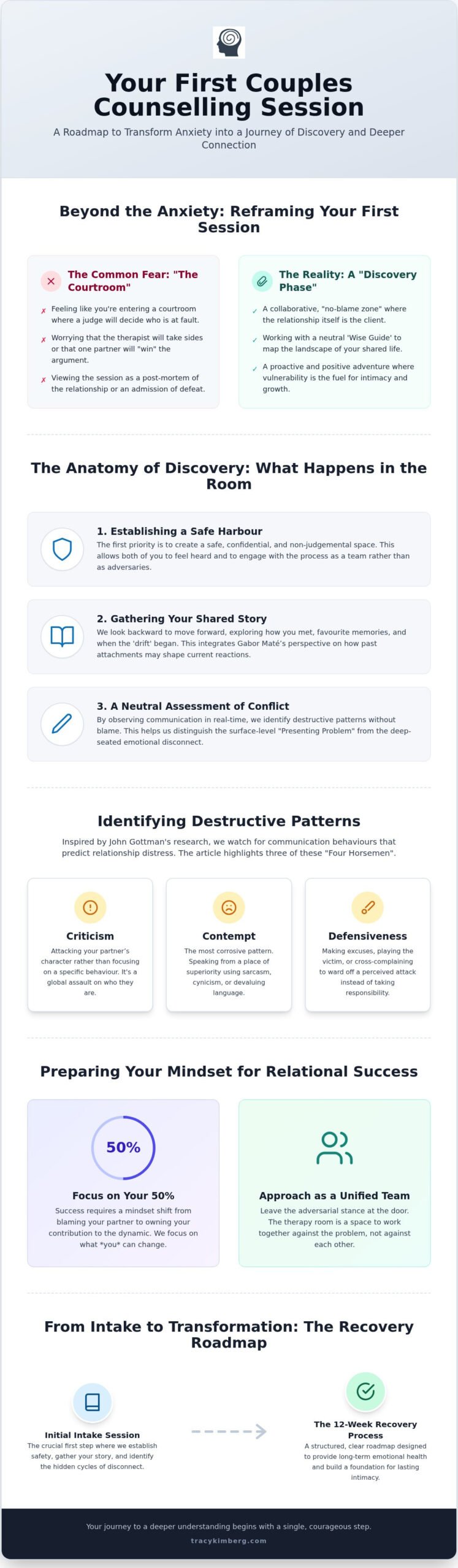
Walking into a therapist’s office for the first time often feels like a radical act of exposure. In the UK, we’re frequently raised with the “stiff upper lip” mentality; it’s a cultural habit of keeping our private struggles behind closed doors. This can make the idea of Couples therapy feel intimidating, as if you’re admitting defeat. However, I invite you to see this first hour differently. It isn’t a post-mortem of your relationship. It’s a “relational intake,” a vital discovery phase where we begin to understand the unique language of your partnership.
When considering what to expect in first couples counselling session visits, think of me as a neutral Wise Guide. My role isn’t to judge who’s right or wrong, but to help you map the territory of your connection. We’re here to understand the landscape of your shared life, from your favourite memories to the triggers that cause you pain. This initial meeting sets the foundation for our 12-Week Relationship Recovery Process, turning a daunting step into a proactive and positive adventure. We’re creating a “no-blame zone” where growth becomes possible because the weight of judgement has been lifted.
The Myth of the “Courtroom” Session
One of the most common anxieties is the fear that the session will become a courtroom. You might worry I’ll take sides or that your partner will “win” the hour by presenting a better case. The reality is quite different. In this room, the relationship itself is the client, not the individuals. This shift in perspective removes the need for blame and allows us to look objectively at patterns of behaviour. Neutrality creates a safe harbour where honest dialogue can finally happen without the threat of a verdict. I’m not here to be a judge; I’m here to help you both see the dance you’re doing together.
Reframing Vulnerability as a Strength
It takes immense courage to organise that first hour and show up as you are. Whilst many couples wait until they’re in “crisis management” mode, reframing this as a proactive exploration can change the entire energy of the room. We move away from simply talking about problems and begin discovering solutions. Vulnerability isn’t a sign of a failing partnership; it’s the very fuel needed for intimacy. When you’re open about what to expect in first couples counselling session environments, you realise that being seen is the first step toward being understood.
The Anatomy of Discovery: What Actually Happens in the Room
The moment you step into the room, our focus shifts from the chaos of your daily life to the internal architecture of your relationship. My first priority is establishing a safe, confidential space where both of you feel heard without the fear of being judged. Understanding what to expect in first couples counselling session appointments helps lower the heart rate, allowing you to engage with the process as a team rather than as adversaries. This initial hour is about gathering the pieces of your story to see how they fit together today.
The Intake and History Gathering
We begin by looking backward before we can move forward. I often ask how you first met, a technique rooted in the Gottman Method assessment process, because the way you remember your beginning reveals the underlying “glow” or “gloom” currently affecting your bond. When you know what to expect in first couples counselling session visits, the history-gathering portion feels less like an interrogation and more like a shared narrative. We’ll explore your favourite early memories to see what’s worth fighting for. From there, we integrate Gabor Maté’s perspective on attachment, looking at how childhood influences might be shaping your current emotional reactions. By mapping the timeline of when the “drift” or “rupture” began, we can distinguish the “Presenting Problem” from the deep-seated emotional disconnect that truly needs our attention.
The Neutral Assessment of Conflict
Whilst we talk, I’m also observing the subtle dance of your communication behaviour in real-time. It isn’t about catching you out, but rather identifying the “Four Horsemen” that John Gottman identified as predictors of relationship distress:
- Criticism: Attacking your partner’s character rather than a specific behaviour.
- Contempt: Speaking from a place of superiority or using sarcasm to devalue the other.
- Defensiveness: Making excuses or playing the victim to ward off a perceived attack.
- Stonewalling: Withdrawing from the interaction or shutting down emotionally.
A relational assessment serves as a diagnostic lens that identifies the health of the connection rather than the faults of the individuals. By naming these patterns, we can start to replace them with healthier habits during our 12-Week Relationship Recovery Process. If you feel ready to move from conflict to connection, you can explore how this structured approach works for couples like you. Setting collaborative goals during this first session ensures that we have a clear roadmap for the weeks ahead, moving you closer to the intimacy you both deserve.
Research-Based Guidance: Integrating Gottman, Perel, and Maté
When you sit on my sofa, we aren’t just chatting; we’re applying decades of clinical research to your specific story. Understanding what to expect in first couples counselling session appointments involves recognising the blueprints we use to rebuild your connection. I utilise the “Sound Relationship House” as our primary structural guide. This framework, developed by John Gottman, allows us to see where the walls of your partnership are strong and where the foundation might need reinforcement. It’s a way to make the complex work of healing feel both powerful and manageable from the very first hour.
The Gottman Method in Practice
In our initial meeting, I’m particularly interested in your “Friendship System.” Research shows that the quality of a couple’s friendship is the most significant predictor of long-term stability. I’ll be looking at how you engage with each other’s bids for connection. Are you “Turning Towards” one another with interest, or “Turning Away” with indifference? This isn’t a test you can fail; it’s a way to establish the starting point for our 12-Week Relationship Recovery Process. By measuring these small interactions, we can begin to organise a roadmap that leads back to mutual respect and affection.
The Perel Influence on Intimacy
Whilst Gottman provides the structure, Esther Perel offers the soul of our work. Many couples arrive feeling trapped in the “Roommate Phase,” where the heavy weight of domesticity has extinguished the spark of desire. We’ll explore the delicate balance between your need for security and your longing for erotic intelligence. By looking beyond the surface-level arguments about chores or schedules, we can uncover the underlying emotional longings that have gone unmet. We’re interested in the “why” behind the disconnect, moving from simple crisis management to a deeper, more proactive exploration of your intimacy.
Finally, we apply a trauma-informed lens inspired by Gabor Maté. We don’t just ask what’s wrong with your relationship; we look at the individual histories that shape your current reactions. This compassionate approach ensures that our intake is deep and transformative. We’re aiming to cultivate “Relational Intelligence,” which is the ability to stay connected to yourself whilst staying connected to your partner. By integrating these research-based perspectives, we turn your first session into a sophisticated and grounded adventure into the heart of your connection.
How to Prepare Your Mindset for Relational Success
Approaching your first session requires more than just showing up on time; it’s about a fundamental shift in how you view your partnership. In the UK, we often default to emotional reservation, but real progress happens when we trade the “stiff upper lip” for radical, compassionate honesty. You might be wondering what to expect in first couples counselling session visits regarding the “rules” of engagement. The most important rule is adopting a team mentality. You aren’t there to win an argument, but to work with your partner against the patterns that keep you stuck.
Managing your expectations is equally vital. The first hour is for mapping the territory, not fixing every problem that’s accumulated over the years. Think of it as a strategic discovery phase. You’re laying the groundwork for future growth, which requires patience and a willingness to be seen. If you’re ready to start this journey, you can book your initial discovery session here to begin the process.
The Power of Personal Accountability
Success in therapy often hinges on moving away from the “if only they would change” trap. Before you arrive at the centre, I encourage you to reflect on your own 50% contribution to the relationship dynamic. Identifying your own triggers and reactive behaviours allows you to speak from a place of self-awareness rather than blame. This is why many find that individual therapy for adults serves as a powerful support to the couples process, helping each person show up more fully for their partner.
Practical Logistics for the Day
Your environment and schedule play a significant role in how you process the experience. Organise your day to avoid rushing; arriving flustered only adds to the baseline anxiety. I highly recommend creating a “buffer zone” after the session. Instead of heading straight back to work or domestic chores, take twenty minutes to sit quietly together or walk in silence. Be prepared for the emotional hangover that often follows the first intake, as it’s a natural sign that you’ve begun the deep work of relational recovery. Giving yourselves space to land softly after such a vulnerable hour is essential for long-term success.
From Intake to Transformation: The 12-Week Recovery Roadmap
The first hour is often a whirlwind of emotions, but it serves a specific purpose: it’s the seed from which your relational recovery grows. Once you understand what to expect in first couples counselling session visits, the path forward becomes much clearer. We move away from the exhausting cycle of “paying to argue” and instead begin investing in your collective emotional intelligence. This transition from a single discovery hour to my structured 12-Week Relationship Recovery Process is designed to replace uncertainty with a sense of calm optimism. Having a time-bound roadmap reduces the anxiety of the unknown, giving you both a visible finish line for this phase of your journey.
What Happens After the First Hour?
Following our initial meeting, I’ll deliver your personalised Relational Roadmap. This isn’t a generic treatment plan; it’s a strategy built on the specific findings of our intake. We’ll build on the history, triggers, and strengths we identified to create a blueprint for “Conscious Relationship” maintenance. Each subsequent session is a purposeful step toward the outcomes we’ve defined together, ensuring that our work remains an active, evolving experience rather than a static treatment. My role as your Wise Guide is to keep us on track, ensuring that the insights we gather are translated into actionable changes in your daily life.
The First Step Towards Healing
Whilst the first session is frequently the most emotionally taxing, it is also the most rewarding. It represents the moment you stopped drifting and started navigating. Knowing what to expect in first couples counselling session appointments allows you to focus on the most critical factor: the “fit” between you and your therapist. You should both feel heard, understood, and respected by a neutral expert who is genuinely invested in your long-term emotional health. If you feel that sense of safety and professional competence, you’ve found the right space to begin your transformation.
Your relationship deserves more than a quick fix; it deserves a foundation built on research and human connection. You can Book your initial Discovery Call and start your 12-week recovery today to take that first courageous step towards lasting intimacy.
Embarking on Your Journey of Relational Recovery
Taking the step to cross the threshold into therapy is an act of profound courage. By reframing your perspective and understanding what to expect in first couples counselling session appointments, you’ve already begun the work of dismantling the walls between you. We move away from the “stiff upper lip” and toward a research-based, trauma-informed discovery phase that identifies the hidden cycles of your disconnect. This isn’t about assigning blame; it’s about building a “Sound Relationship House” where both partners feel truly seen and heard.
Your relationship doesn’t have to stay stuck in a loop of conflict or silence. My specialised 12-Week Relationship Recovery Programme offers a structured, safe, and non-judgemental environment where you can transform your partnership from the ground up. If you’re ready to trade domesticity for desire and security for genuine connection, I invite you to take the next step. Book a Discovery Call for the 12-Week Relationship Recovery Process and let’s begin this transformational adventure together. Healing is possible, and your future connection starts with this single, brave choice.
Frequently Asked Questions
How long does the first couples counselling session usually last?
A standard first session typically lasts between 50 and 90 minutes, allowing enough time for a thorough relational intake. This duration ensures we can explore your history and current challenges without rushing the process. Whilst it might feel like a long time to be vulnerable, the hour is structured to keep you feeling safe and supported. It’s the first step in our 12-Week Relationship Recovery Process, setting a steady pace for your transformation.
Will the therapist tell us who is right and who is wrong?
No, my role as a neutral Wise Guide is not to act as a judge or jury. In the therapy room, the relationship itself is the client, and we focus on the patterns of behaviour between you rather than individual fault. I won’t take sides or declare a winner. Instead, we work together to understand the “dance” you’re doing, helping you both move toward a more conscious and connected way of relating.
Can we attend the first session online or must it be face-to-face?
You have the flexibility to choose between online therapy or face-to-face sessions based on what feels most comfortable for your partnership. Both formats are equally effective for the initial discovery phase. Online sessions offer convenience and the comfort of your own home, whilst face-to-face meetings provide a dedicated physical space for your work. Regardless of the medium, we maintain the same safe, non-judgemental environment to explore your relational dynamics and long-term emotional health.
What if my partner is reluctant to speak during the first session?
It’s completely normal for one partner to feel more hesitant or anxious about opening up to a stranger. I’m experienced in managing these dynamics and will never force anyone to speak before they’re ready. My approach is gentle and inclusive, ensuring that the quiet space is respected whilst inviting participation at a comfortable pace. We focus on creating a secure base where even the most reluctant partner eventually feels safe enough to share their perspective.
Do we need to bring anything with us to the first appointment?
You don’t need to bring any physical documents to your appointment. When considering what to expect in first couples counselling session visits, the most valuable thing you can bring is an open mind and a willingness to be honest. Some couples find it helpful to reflect on their shared history or favourite memories beforehand, but this isn’t a requirement. We provide all the structure needed to begin mapping out your journey toward relational recovery and understanding.
Will the therapist recommend we separate after the first session?
The first session is a phase of discovery and foundation-building, not a time for making life-altering decisions. My goal is to help you understand your current dynamic and provide a roadmap for healing. Whilst I offer support for a Conscious Approached Divorce and separation if that becomes the healthiest path, we don’t rush to conclusions in the first hour. We focus on exploring the potential for recovery and identifying the steps needed for your emotional well-being.
How do we know if couples counselling is actually working for us?
You’ll know the process is working when you notice small shifts in your daily interactions, such as “turning towards” each other more frequently during conflict. Feeling heard and understood by a neutral expert is often the first sign of progress. Most couples begin to see meaningful changes within 8 to 12 sessions as they apply the research-based tools we discuss. Success is measured by increased relational intelligence and a reduction in the “Four Horsemen” of communication.
Is it normal to feel worse or more emotional after the first session?
Yes, it’s very common to experience what I call an “emotional hangover” after your initial intake. Opening up about long-standing problems can feel exhausting and may temporarily heighten your sensitivity. This is actually a sign that you’ve begun the deep work of healing. I recommend creating a “buffer zone” after the hour to process your feelings quietly. Understanding what to expect in first couples counselling session environments includes preparing for this natural emotional vulnerability as you start your journey.

Article by
Tracy Kimberg
Tracy Kimberg is a Relationship Expert, Couples Therapist and Coach with a dedicated focus on helping couples and individuals rebuild connection, trust and emotional safety in their relationships. Drawing on the research of John and Julie Gottman, the relational insights of Esther Perel, and years of hands-on therapeutic experience, Tracy offers a warm, non-judgemental and deeply compassionate approach to modern relationships.
Based in Dorset, Tracy works with couples navigating communication breakdowns, betrayal, intimacy challenges, separation, family dynamics and life transitions. Known for creating a safe and grounded therapeutic space, she combines practical tools with emotional depth to help clients move beyond survival patterns and towards meaningful, lasting change.
With a reputation for empathy, professionalism and dedication to her clients’ growth, Tracy is passionate about helping people feel seen, understood and empowered — both within their relationships and within themselves.
Disclaimer
Disclaimer:
The information shared in this article is intended for educational and informational purposes only and should not be considered a substitute for professional therapeutic, psychological, medical or legal advice. Every individual and relationship is unique, and the perspectives offered are based on general therapeutic principles, research and professional experience.
Reading this article does not establish a therapist-client relationship with Tracy Kimberg. If you are experiencing significant emotional distress, relationship crisis, trauma, or mental health concerns, it is important to seek support from a qualified professional appropriate to your individual circumstances.
All content remains the intellectual property of Tracy Kimberg and may not be reproduced or distributed without permission.