

What if the most effective way to transform your relationship didn’t actually require your partner to be in the room? It’s a heavy burden to feel lonely whilst sitting right next to the person you love. Perhaps you’re exhausted by repetitive, circular arguments or terrified that your connection is simply beyond repair. You might be asking, “can i do couples counselling alone?” because your partner isn’t yet ready to face these challenges alongside you. It’s a common crossroads, but it’s certainly not a dead end.
I understand the deep frustration of wanting change when you feel like you’re the only one doing the work. This article will show you how individual relationship counselling can act as a powerful catalyst for your entire partnership; when you change your steps, the dance must change too. We’ll explore how shifting your own patterns can stop the cycle of reactivity, provide much-needed clarity on your future, and create a safe path for your partner to eventually join the process. Even if you’re starting this journey solo, you’re taking a vital step toward a healthier, more connected life.
Key Takeaways
- Understand that individual relationship counselling is a powerful, proactive choice that allows you to address partnership dynamics even whilst your partner isn’t ready to attend.
- Discover the “Relationship Dance” metaphor and how shifting your own emotional reactions naturally forces a change in your partner’s behaviour.
- If you are asking, “can i do couples counselling alone?” you will learn why many successful relationship recoveries begin with the courage of just one person.
- Gain the professional clarity needed to move beyond repetitive arguments and decide your next steps with confidence and calm.
- Learn how your solo progress can eventually serve as a gentle invitation for your partner to join a structured recovery process.
Can You Attend Couples Therapy Alone? Understanding Individual Relationship Counselling
Many people believe that healing a partnership requires two people sitting on a sofa, facing a therapist together. However, when you ask, “can i do couples counselling alone?” the answer is a resounding yes. Individual relationship counselling is a specialised clinical approach that focuses on your role, your reactions, and your influence within the partnership. Unlike traditional individual therapy, which primarily explores your personal history and self-actualisation, this work keeps the relationship centre-stage. It’s about the bond itself and the space between you and your partner.
Starting this process solo is a courageous, proactive choice. It isn’t a sign of a failed marriage or a one-sided effort; it’s an acknowledgement that you have the power to initiate change. In the broader context of Couples therapy, working individually allows you to examine your relational blueprints and attachment styles without the immediate pressure of a partner’s presence. If you’re wondering, “can i do couples counselling alone”, you’re already demonstrating a commitment to the future of your partnership that could be the catalyst for a total transformation.
The Myth of the “Joint-Only” Requirement
There’s a persistent myth that if your partner won’t attend, nothing can change. This belief often leads to a “waiting room” mentality, where resentment grows whilst you wait for them to “wake up”. Waiting for a reluctant partner can cause the relationship to decay further. Your perspective is not only valid but essential. You don’t need permission to start healing the way you interact with the person you love. Change is a systemic process; when one person shifts, the entire system must adjust to accommodate that new way of being.
When Your Partner Refuses: Navigating the “No”
Hearing a “no” when you suggest therapy can feel like a final rejection. It’s heavy, and it often triggers a fear that the relationship is beyond repair. But often, a partner’s refusal stems from fear, shame, or a sense of being “ganged up on”. When you begin individual work, you start to model different behaviours. You learn to regulate your emotions and stop reacting to their triggers. This shift often lowers their defences. By leading with your own growth, you create a new, safer environment that may eventually invite them to step into the process with you.
The Systemic Shift: How Changing Yourself Changes the Relationship
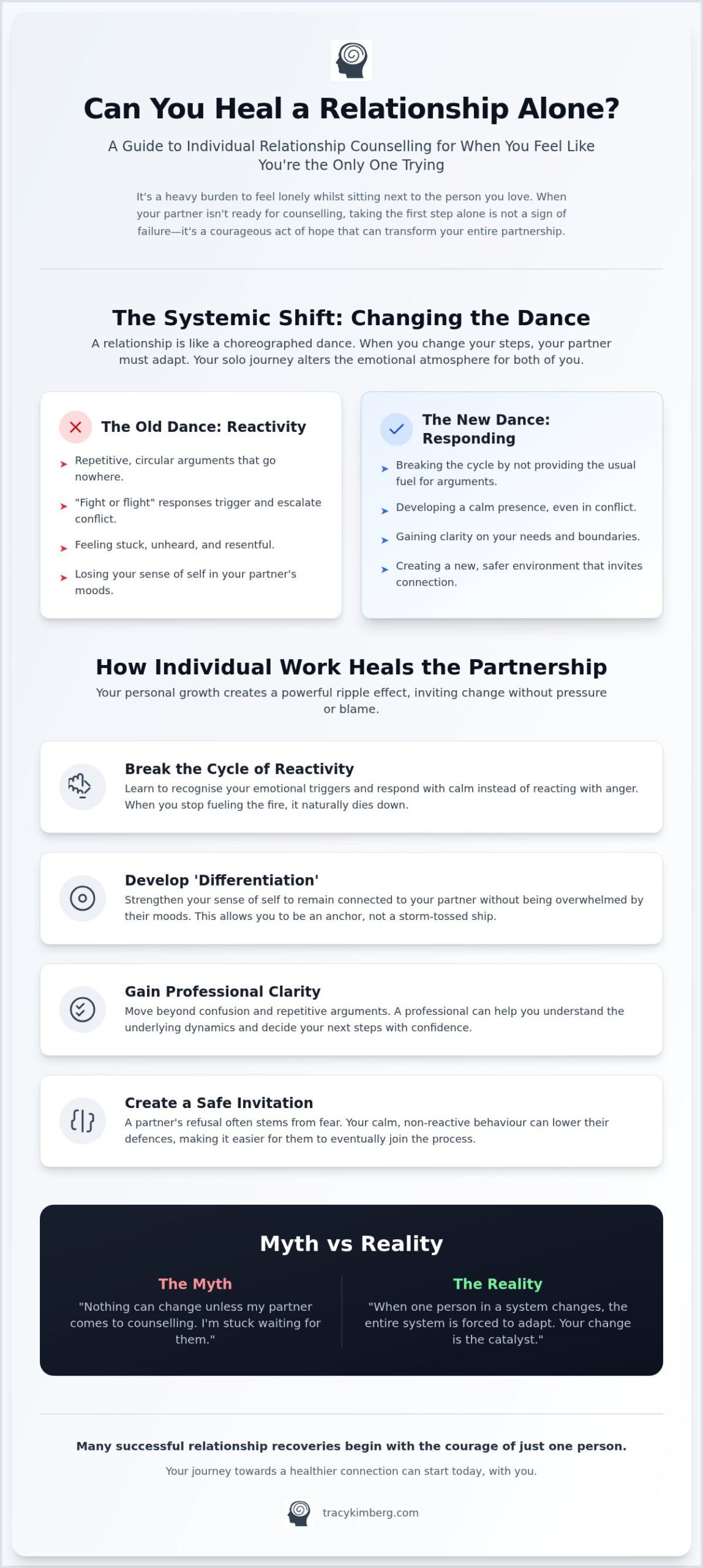
Imagine your relationship as a complex, choreographed dance. For years, you and your partner have followed the same steps, even the ones that lead to a stumble or a painful tread on the toes. When you ask, “can i do couples counselling alone?”, you’re essentially asking if you can change the music. Systemic therapy teaches us that a relationship is a living organism. If one part of that organism shifts its behaviour, the rest of the system is forced to adapt. You aren’t just working on yourself; you’re altering the emotional atmosphere of your entire household.
A core pillar of this work is differentiation. This is the delicate ability to remain connected to your partner whilst maintaining a clear sense of your own identity and values. When we lose ourselves in a partnership, we often become overly reactive to our partner’s moods. By engaging in Individual & Relationship Counseling, you learn to anchor yourself. This stability prevents you from being swept away by their anger or withdrawal; it is the first step in breaking a toxic cycle.
Breaking the Cycle of Reactivity
Conflict often triggers our “fight or flight” response, a neurobiological survival mechanism that shuts down the logical part of our brain. Individual sessions help you recognise the physical sensations of this amygdala hijack before you say something you regret. Instead of a reflexive row, you develop a calm presence. This shift from reacting to responding is incredibly powerful. When you stop providing the usual fuel for an argument, the fire eventually dies down because the old “dance” requires two people to keep it going.
The Ripple Effect of Personal Growth
Your growth creates a ripple effect throughout the relationship. As you establish healthy boundaries, you provide a new, clearer framework for how you wish to be treated. It’s often said that we cannot change others, but our change invites them to change. Improved self-communication—truly understanding your own needs and fears—naturally leads to more honest communication with your partner. This proactive approach is the foundation of a Relationship Recovery Process that can heal even the most fractured bonds. If you find yourself wondering can i do couples counselling alone, remember that you are the architect of your own emotional environment.
Core Benefits of Individual Relationship Coaching
Choosing to engage in relationship work solo isn’t just a fallback option; it’s a profound investment in your own emotional architecture. When you ask, “can i do couples counselling alone”, you’re opening the door to a safe, non-judgemental space where you can unpack the complexities of your partnership without the immediate heat of conflict. This objective perspective is vital. Often, we’re so deep in the “we” that we lose sight of the “I”, and a professional guide helps you zoom out to see the patterns that have become invisible to you through years of repetition.
Individual coaching fosters a deep sense of emotional resilience. You learn to hold your own feelings with compassion, which in turn allows you to navigate the relationship’s turbulence without losing your centre. This isn’t about blaming your partner in their absence. Rather, it’s about developing the emotional intelligence to understand why certain behaviours trigger you and how you can manage those internal storms. By building this inner strength, you become less dependent on your partner’s immediate validation for your own sense of peace.
Gaining Clarity on Your Needs and Values
In these sessions, we work to identify your core values and relational needs. It’s a time to ask the hard questions: Is this a fixable communication breakdown, or is there a fundamental misalignment of values? By exploring your attachment style, whether you tend to pursue or withdraw when threatened, you gain a map of your own relational history. This clarity is essential. It prevents you from making reactive decisions based on temporary frustration and instead allows you to move forward with a grounded sense of purpose and self-awareness.
Developing the Tools for Future Joint Work
Solo work acts as a powerful preparation for the 12-Week Relationship Recovery Process. You aren’t just waiting for your partner; you’re training for the marathon. We practice research-based techniques like Gottman’s “softened start-ups”, which involve initiating difficult conversations without blame or criticism. By reclaiming the favourite version of yourself, the person you were before the relationship stress took hold, you bring a healthier energy back to the household. If you’ve wondered “can i do couples counselling alone”, see it as a way to sharpen your tools so that if your partner joins, you’re already standing on solid ground.
When Solo Counselling is the Necessary Priority
While we often view joint sessions as the gold standard for relational repair, there are times when working solo isn’t just an option; it’s a therapeutic necessity. If you’re trapped in the “Roommate Phase”—that hollow space where you share a mortgage and a calendar but haven’t shared a meaningful look in months—the inertia can be paralysing. Often, it takes one person to “wake up” and step outside the cycle first. If you are asking, “can i do couples counselling alone,” it’s likely because the emotional neglect has become a quiet crisis that you can no longer ignore by yourself.
Solo work is also essential when safety or extreme emotional volatility is a factor. Before a couple can safely navigate their shared history, each individual must have the tools to regulate their own nervous system. By seeking individual support first, you create a foundation of stability. This allows you to process your own pain without the immediate fear of being shut down or misunderstood by your partner in the room. It’s about finding your feet before you try to walk together again.
Healing from Infidelity or Betrayal
Betrayal is a form of relational trauma that shatters one’s sense of reality. Before trust-building can even begin in a joint setting, the betrayed partner often needs a dedicated space to process intrusive thoughts, hyper-vigilance, and profound anxiety. Solo work provides a container for this raw emotion. It allows you to explore the “why” of the situation and, more importantly, to determine if you have the emotional capacity to stay and rebuild. You need to heal the “I” before you can decide on the future of the “we”.
Preparing for Conscious Separation
Sometimes, the most courageous and compassionate path forward is to acknowledge that the partnership has reached its natural end. Individual sessions provide the clarity needed to navigate this transition without the vitriol that often accompanies a breakup. This process, often called conscious uncoupling, focuses on empathy and the long-term well-being of everyone involved, especially if children are part of the picture. By prioritising your emotional health now, you ensure that any future transition is handled with dignity and respect. If you feel you’ve reached this crossroads, exploring Conscious Approached Divorce and separation can provide the expert guidance needed to move forward with peace.
The Path Forward: From Individual Insight to Shared Healing
The healing journey often feels like a steep climb, but every massive shift in a relationship starts with a single, individual commitment. If you’ve spent months wondering, “can i do couples counselling alone,” you’re already partway up the mountain. This initial solo work isn’t just a placeholder; it’s the foundation for a new, shared architecture. When you first ask, “can i do couples counselling alone,” you are often seeking a lifeline. What you find is a new way of being that eventually invites your partner to join you on more solid ground.
By the time your partner notices the change in your energy and reactions, the path is already being prepared for a deeper, more collaborative experience. This transition from “I” to “we” is a delicate process, but it is one of the most rewarding adventures a couple can undertake. It marks the moment where individual growth begins to weave back into a shared tapestry of intimacy and trust.
Inviting Your Partner Without Pressure
One of the most delicate parts of this process is sharing your progress without triggering your partner’s defences. Instead of the old narrative—”You need to fix this”—try a softer approach: “I am working on us.” Share what you’re learning about your own triggers and attachment style whilst remaining open to their perspective. When you lead with vulnerability rather than accusation, you create a safe space for them to be curious. You’ll know they’re becoming open when they stop withdrawing and start asking questions about your sessions. This curiosity is the first sign that the “dance” is truly shifting.
The 12-Week Relationship Recovery Process
While solo insight is transformative, the ultimate goal for many is a structured, joint path back to intimacy. The 12-Week Relationship Recovery Process is designed to take the strength you’ve built individually and weave it into a shared relational health plan. This programme isn’t a clinical necessity; it’s a proactive adventure into the heart of your partnership. It provides the research-based tools needed to turn circular arguments into constructive dialogue and emotional distance into genuine connection.
Your path from that first solo session to long-term relational health is a roadmap we can build together. Solo work bridges the gap, ensuring you’re emotionally ready to engage in deep, joint work without being overwhelmed. If you’re ready to see how this transition could work for your specific dynamic, I encourage you to book a discovery call to discuss your unique situation. Whether you continue solo or eventually transition into the full recovery programme, the most important step is the one you take today.
Reclaiming Your Relational Power
Healing a partnership isn’t always a joint effort from day one. It starts with the courage to look inward and the willingness to change the steps of a dance that no longer serves you. By focusing on your own emotional regulation and relational needs, you naturally invite a different energy into your home. This systemic shift is often the catalyst that moves a partnership from the “roommate phase” back into genuine intimacy.
If you’ve been asking, “can i do couples counselling alone“, remember that your growth is never wasted. Whether you are navigating a quiet disconnect or the aftermath of betrayal, taking the first step solo is a powerful act of leadership. As a specialist in Gottman and Perel methodologies, I offer a safe, non-judgemental space through online sessions available globally. Whether we work toward a full recovery process or a conscious separation, you don’t have to navigate this transition without a guide.
Ready to change the dance? Book your individual relationship discovery call with Tracy Kimberg today. You have the power to initiate the change you deserve, and that adventure begins with you.
Frequently Asked Questions
Is individual relationship counselling as effective as couples therapy?
Individual relationship work is highly effective but serves a different purpose than joint sessions. While couples therapy focuses on shared dialogue, solo sessions allow you to master your own emotional regulation and boundaries. Research into systemic dynamics suggests that when one person changes their “steps” in the relationship dance, the partner is forced to adapt. This makes it a powerful catalyst for change, especially if you are the only one currently motivated to do the work.
Can I talk about my partner in therapy if they aren’t there?
Talking about your partner is a vital part of the process. In these sessions, we examine your perceptions, your reactions to their behaviour, and the dynamic you share. The goal isn’t to diagnose your partner in their absence, but to understand how you interact with them. This allows us to identify repetitive patterns and help you develop more effective, less reactive ways of responding to their specific triggers and communication styles.
What if my partner gets angry that I am going to counselling alone?
A partner’s anger often stems from a fear of being judged or criticised behind their back. It’s helpful to reassure them that your sessions are about your own growth and learning how to be a better partner. If you are asking, “can i do couples counselling alone,” it’s often because you want to save the bond. Framing your solo work as a commitment to the relationship can help lower their defences over time.
How many sessions will I need before I see a change in my relationship?
Most clients begin to notice a shift in their own emotional regulation within four to six sessions. However, lasting systemic change often takes longer to solidify. My structured 12-week Relationship Recovery Process is designed to provide a clear roadmap for transformation. While every dynamic is unique, consistency is key. You’ll likely see your partner’s behaviour begin to shift once you consistently apply your new communication tools and maintain your healthy boundaries.
Will a therapist tell me to leave my partner if I go alone?
No, a professional therapist’s role is to provide clarity, not to make life decisions for you. I act as a Wise Guide to help you explore your values and needs. We look at whether your current dynamic aligns with your long-term emotional health. The goal is to empower you with the tools to decide whether to stay and rebuild or move toward a conscious approach to divorce and separation with confidence.
Can I switch to couples therapy later with the same therapist?
Transitioning to joint sessions is a common and positive outcome of solo work. Starting alone often acts as an entry point for the 12-week Relationship Recovery Process. If your partner becomes curious and willing, we can discuss how to integrate them into the therapeutic space. This ensures that the progress you’ve made individually becomes the solid foundation for your shared healing, improved intimacy, and a more resilient future together.
How do I explain my solo counselling to my partner?
Use “I” statements to explain that you are seeking support to manage your own stress and reactions within the relationship. You might say, “I’m finding our current arguments difficult and I want to learn how to communicate better.” This removes the element of blame. By focusing on your desire for a healthier connection, you make it clear that your solo work is a proactive and positive step toward a more peaceful household.
What is the difference between individual therapy and individual relationship coaching?
Individual therapy often focuses on personal history and mental health, whereas individual relationship coaching is specifically bond-centred. When you ask, “can i do couples counselling alone,” you are looking for a specialised approach that prioritises your role in a partnership. We use Gottman and Perel-inspired methods to target relational dynamics. We focus on how your personal growth and emotional intelligence can directly improve the quality and depth of your connection.

Article by
Tracy Kimberg
Tracy Kimberg is a Relationship Expert, Couples Therapist and Coach with a dedicated focus on helping couples and individuals rebuild connection, trust and emotional safety in their relationships. Drawing on the research of John and Julie Gottman, the relational insights of Esther Perel, and years of hands-on therapeutic experience, Tracy offers a warm, non-judgemental and deeply compassionate approach to modern relationships.
Based in Dorset, Tracy works with couples navigating communication breakdowns, betrayal, intimacy challenges, separation, family dynamics and life transitions. Known for creating a safe and grounded therapeutic space, she combines practical tools with emotional depth to help clients move beyond survival patterns and towards meaningful, lasting change.
With a reputation for empathy, professionalism and dedication to her clients’ growth, Tracy is passionate about helping people feel seen, understood and empowered — both within their relationships and within themselves.
Disclaimer
Disclaimer:
The information shared in this article is intended for educational and informational purposes only and should not be considered a substitute for professional therapeutic, psychological, medical or legal advice. Every individual and relationship is unique, and the perspectives offered are based on general therapeutic principles, research and professional experience.
Reading this article does not establish a therapist-client relationship with Tracy Kimberg. If you are experiencing significant emotional distress, relationship crisis, trauma, or mental health concerns, it is important to seek support from a qualified professional appropriate to your individual circumstances.
All content remains the intellectual property of Tracy Kimberg and may not be reproduced or distributed without permission.