

What if the heavy silence behind your teenager’s bedroom door isn’t a rejection of your love, but a muffled cry for a different kind of connection? When you are parenting a depressed teenager UK life can quickly feel like a series of closed doors and “walking on eggshells” in your own home. It is exhausting to face the total withdrawal of a child you once knew so well, all whilst worrying about the staggering waiting lists for CAMHS or feeling the silent judgement of family members who don’t understand the depth of this struggle.
You don’t have to stay in this place of fear. This guide is an invitation to move from a state of crisis to a proactive adventure in healing. Instead of trying to “fix” a child, we will explore how to evolve your relationship into a secure base for their recovery. You will learn how to recognise small “bids for connection” that often go unnoticed and how to engage with professional support with renewed confidence. We are moving toward a calmer home environment where communication is restored and your family can finally breathe again.
Key Takeaways
- Learn how to distinguish between typical adolescent rebellion and the persistent numbness of clinical depression so you can respond with clarity and compassion.
- Discover why parenting a depressed teenager UK requires a shift from being a manager to a consultant who leads with curiosity rather than control.
- Master the art of spotting bids for connection to rebuild communication and replace intrusive questioning with deep, restorative dialogue.
- Explore the science of co-regulation to understand how your own emotional calm acts as a powerful anchor for your teenager’s healing process.
- Recognise the specific red flags that necessitate professional guidance and learn how a third-party therapist can facilitate a path toward family recovery.
Recognising the Signs: Is it Teenage Angst or Clinical Depression?
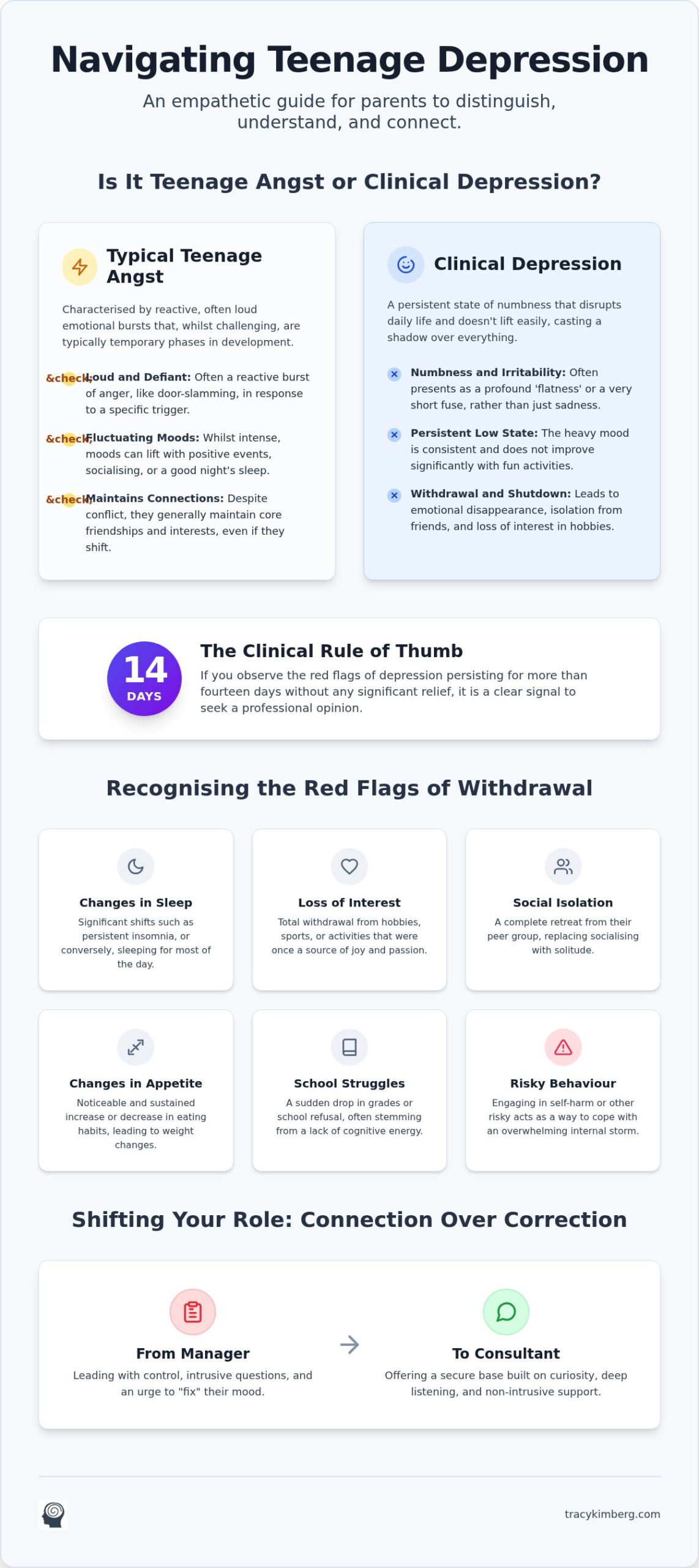
Distinguishing between “typical” adolescent turbulence and clinical depression is one of the hardest tasks for any caregiver. When you’re parenting a depressed teenager UK, you might find yourself questioning if their behaviour is just a phase or something much deeper. Depression isn’t merely a “bad mood” that lifts with a fun weekend or a good night’s sleep. It’s a persistent, heavy state that disrupts their ability to function in daily life, casting a shadow over their education, relationships, and sense of self-worth.
Whilst healthy adolescent rebellion is often loud and defiant, depression is frequently characterised by a profound sense of numbness or “flatness.” In boys particularly, this internal pain doesn’t always look like sadness. It often presents as intense irritability or a short fuse, masking a deep-seated feeling of being trapped within their own emotional landscape. This disconnect is partly due to the biological lag between a teenager’s heightened emotional intensity and their still-developing impulse control.
The Red Flags of Adolescent Withdrawal
A critical part of understanding adolescent depression involves watching for shifts in their basic rhythms. Look for significant changes in sleep patterns, such as insomnia or sleeping through the day, and noticeable shifts in appetite. You might observe a total withdrawal from favourite hobbies or a transition from socialising with friends to total isolation amongst their peers. School refusal or a sudden drop in grades is rarely about laziness; it’s often a silent cry for help from a child who no longer has the cognitive energy to meet expectations.
When “Angst” Becomes a Mental Health Concern
Timing is everything. The general clinical rule is the two-week mark: if these symptoms persist for more than fourteen days without any reprieve, it’s time to look closer. There’s a vast difference between “normal” door-slamming, which is usually a reactive burst of anger, and depressive shutdowns where the child seems to vanish emotionally. In some cases, risky behaviour or self-harm emerges as a misguided attempt at emotional regulation. These aren’t just “attention-seeking” acts; they’re desperate tools used to manage an internal storm that feels otherwise uncontrollable. As you navigate the complexities of parenting a depressed teenager UK, recognising these distinctions is the first step toward opening a door that has been firmly shut.
The Relational Impact: Why Your Teenager Might Feel Like a Stranger
Parenting a depressed teenager UK often involves a silent, heavy sense of loss that few people talk about. You might feel as though the child you knew has been replaced by a stranger. This isn’t just a change in their personality; it’s a fundamental shift in the relational dance between you. It’s common to experience a form of “relational mourning” as you miss the ease of your previous connection. When every interaction feels like a potential conflict, the exhaustion of walking on eggshells can become overwhelming. This emotional disconnect often feels like a personal rejection, but it is actually the symptom of a child who no longer has the internal resources to reach out.
Esther Perel speaks about the necessity of shifting our roles during this period. We must move from being the “Manager” of our child’s life to being a “Consultant.” This means letting go of the need to micro-manage their moods and instead focusing on being a reliable, non-intrusive resource. The NHS provides helpful guidance for concerned parents to help navigate these early shifts in communication and understand the boundaries of this new role.
Understanding the Adolescent Brain Remodel
The teenage brain is currently undergoing a massive structural overhaul. The prefrontal cortex, responsible for logic and impulse control, is effectively “under construction,” whilst the amygdala, the emotional engine, takes the lead. This neurobiological reality means your teen cannot simply snap out of it. Their withdrawal is a protective mechanism, not a lack of love. Recognising this as a necessary, albeit painful, stage toward their future autonomy can help lower the temperature in your home and reduce the pressure on both of you.
The Mirror Effect: How Their Pain Becomes Yours
In the field of interpersonal dynamics, we often see “projective identification.” This occurs when a parent unconsciously absorbs the teenager’s feelings of hopelessness or anger. You might find yourself feeling just as stuck or despondent as they are. Learning to separate your own emotional identity from your child’s current struggle is vital for your own health. If you find the weight of this transition is impacting your own well-being or your partnership, seeking Individual Relationship Counselling can provide the space you need to process these complex feelings. By stabilising your own emotional ground, you become the steady anchor they need to eventually find their way back.
Connection Over Correction: Communication Strategies That Work
When you are parenting a depressed teenager UK, the instinct to “fix” the situation is incredibly strong. You see your child suffering and you want to pull them out of the darkness immediately. However, adolescent depression often turns traditional communication into a minefield. If we approach our teens with a list of solutions or an interrogative tone, they naturally retreat. The goal must shift from correction to connection. This requires us to become experts in “listening to understand” rather than “listening to solve.”
John Gottman’s research introduces the concept of “bids for connection.” In a teenage context, these are rarely profound requests for a heart-to-heart. Instead, a bid might be a shared meme, a grunt while they walk past you, or a request for a lift to the shops. When we “turn toward” these small gestures, we build a reservoir of emotional trust. Conversely, the classic question “How was school?” often acts as a conversation killer. To a depressed teen, it feels like an audit of their performance. Try replacing it with low-pressure observations or simply offering your presence without a hidden agenda.
One of the most effective ways to facilitate this is through “side-by-side” communication. Talking whilst driving or walking removes the intense pressure of direct eye contact, which can often feel confrontational to a struggling adolescent. This physical positioning allows for a more relaxed exchange of thoughts. For further support on these nuances, you can find NHS advice for parents of teenagers which provides official guidance on managing these delicate interactions.
The Art of the Softened Start-Up
Raising concerns shouldn’t trigger a “fight or flight” response. A softened start-up involves using “I” statements that focus on your feelings rather than their perceived failings. For example, “I’ve been feeling a bit worried because I’ve noticed you’re spending more time alone” is far more inviting than “You’re always in your room.” Silence is also a profound tool. Sometimes, just sitting in the same room without speaking communicates more safety and acceptance than any lecture ever could.
Validating the Inexpressible
Validation is often misunderstood as agreement. You don’t have to agree that “everything is hopeless” to validate that your teen feels hopeless. When they say “You don’t understand,” resist the urge to list your credentials or past experiences. Instead, try saying, “I can see how much pain you’re in, and I’m here with you.” This acknowledges their reality without trying to talk them out of it. Learning How to Communicate with My Teenager Effectively is a proactive step in turning these moments of friction into opportunities for deep, restorative connection.
The Parent as the Secure Base: Managing Your Own Emotional Response
When you are parenting a depressed teenager UK, it is easy to forget that your own nervous system is the primary environment your child lives in. Gabor Maté often emphasises that a child’s recovery is deeply intertwined with the parent’s emotional state. If you are constantly vibrating with anxiety, suppressed anger, or exhaustion, your teenager will instinctively match that frequency. This creates a cycle of co-escalation where your stress inadvertently feeds theirs. Understanding co-regulation means accepting that your ability to remain calm is one of the most powerful tools you can offer. It is not about being a perfect parent; it is about being the steady ground beneath their feet whilst they navigate their own internal storm.
Many parents view looking after their own mental health as a luxury they cannot afford during a crisis. In reality, self-care is a clinical necessity. If you are burnt out, you cannot provide the “secure base” your teen needs to explore their own healing. Identifying your own triggers is a vital part of this process. Perhaps their silence makes you feel rejected, or their sarcasm makes you feel disrespected. When you recognise these triggers, you can prevent yourself from reacting with “co-escalation”-those moments of yelling or biting remarks that only widen the gap between you.
Becoming the Emotional Anchor
To be an anchor, you must stay grounded whilst your teenager is in an emotional tempest. This role requires you to hold space for their pain without being swept away by it. Before you enter the “teen zone”-whether that is their bedroom or the car-try a simple three-second breathing technique. Inhale for three seconds, hold for three, and exhale for three. This brief pause resets your vagus nerve and prevents immediate reactivity. Compassionate inquiry is a tool for parental growth that allows you to look at your own reactions with curiosity instead of judgement, asking why a specific behaviour feels so threatening to your own peace.
The Importance of Parental Self-Compassion
Parental guilt often leads to over-functioning, where you try to manage every aspect of your teen’s life to “make up” for their suffering. This almost always leads to burnout and resentment. By practising self-compassion, you model healthy emotional regulation for your teenager. You show them that it is possible to feel big emotions, acknowledge them, and move through them. Processing the unique stress of this period is vital for the whole family’s recovery. If you find yourself struggling to maintain your own equilibrium, seeking Online Therapy can provide a safe, non-judgemental space to process your own feelings. Strengthening your own mental health is the most proactive step you can take in supporting your teenager’s journey back to wellness.
Seeking Professional Support: The Path to Family Recovery in the UK
While the home environment is the foundation of healing, there are moments when professional guidance becomes the essential bridge back to safety. Parenting a depressed teenager UK often involves a difficult wait for NHS referrals, yet you don’t have to wait for a crisis to take action. Seeking help is a proactive adventure in family wellness, not a sign that you have failed as a parent. A neutral, third-party therapist provides a sanctuary where your teenager can express their darkest thoughts without the fear of hurting or worrying you. This professional distance allows for a level of honesty that is often impossible within the family unit, positioning the therapist as a wise guide for both the child and the parents.
Certain red flags necessitate immediate intervention. If you notice persistent self-harm, expressions of hopelessness about the future, or a total inability to function in daily life, professional support is essential. Tracy Kimberg’s Therapy for Teenagers provides a safe, non-judgemental space where these complex emotions can be unpacked. This environment demystifies the therapeutic process, moving away from a clinical necessity and toward a manageable path of growth. The goal is to move beyond the weight of the diagnosis and find a path toward restorative connection.
Choosing Between Online and Face-to-Face Therapy
For many digital-native teens, online therapy feels significantly less intimidating than sitting in a clinical office. It allows them to engage from the safety of their own space, reducing the “fight or flight” response that often accompanies new social interactions. It’s their territory. The therapist acts as a bridge between the teenager’s internal world and the parent’s perspective, facilitating a dialogue that has perhaps been silent for months. If your teen is resistant, try presenting therapy as a time-limited experiment rather than a permanent fixture. This gives them agency. It provides a sense of control in their own recovery process.
Building a Roadmap for Relational Recovery
Families in crisis often feel they are wandering without a map. A structured programme, tailored to your family’s specific needs, can provide a clear roadmap for healing. By utilising research-based relationship coaching and therapeutic strategies, such approaches address the systemic dynamics of the home rather than solely focusing on the individual. The aim is to transform the way you interact, listen, and support one another, fostering an environment where honesty and genuine connection can flourish. If you are ready to move from a place of fear to a position of restorative connection, I invite you to book a discovery call with Tracy Kimberg to discuss your family’s unique dynamics and how we can begin this journey together.
Embracing the Journey Toward Restorative Connection
Parenting a depressed teenager UK is a journey that requires shifting your perspective from “fixing” a problem to nurturing a profound relationship. You’ve explored how becoming a secure base and recognising small bids for connection can transform the heavy silence in your home into a space of safety. By managing your own nervous system and utilising research-based communication tools, you provide the steady anchor your child needs to navigate their internal storm. Healing isn’t a linear path, but it’s one you don’t have to walk alone.
If you are ready to move from a place of fear to one of deep, restorative connection, professional guidance can offer the roadmap your family needs. Tracy Kimberg specialises in research-based therapy, drawing on the work of Gottman, Perel, and Maté to provide a safe, non-judgemental environment for emotional recovery. Whether you prefer online sessions for your digital-native teen or face-to-face therapy, specialised support is available across the UK. Book a Discovery Call with Tracy Kimberg to find the right support for your family and begin this proactive adventure in healing today. There is always hope, and your family’s story of recovery is just beginning.
Frequently Asked Questions
What are the most common signs of depression in UK teenagers?
Common indicators include a persistent state of numbness, significant changes in sleep or appetite, and a withdrawal from previously enjoyed hobbies. Whilst typical angst is reactive, depression is often characterised by a flatness that lasts longer than two weeks. In the UK, we often see school refusal or a sharp drop in academic performance as a primary cry for help rather than a lack of motivation.
How can I support my teenager without being overbearing or “suffocating” them?
Supporting your child requires a shift from being a manager to a consultant. Instead of asking interrogative questions, offer low-pressure presence and focus on side-by-side activities like walking or driving. This removes the intensity of direct eye contact and allows them to share on their own terms. Your goal is to be a reliable resource they can turn to, rather than someone trying to force a specific outcome.
Is it normal for my teenager to stop talking to me entirely during this phase?
Total silence is a frequent, though distressing, symptom of depressive shutdown. It’s often a protective mechanism rather than a personal rejection of your love. When parenting a depressed teenager UK, it is helpful to view this silence as an internal storm they don’t yet have the words to describe. Maintaining a steady, calm presence without demanding speech creates the safety they need to eventually re-engage with the family.
How do I handle teenage defiance when I know they are struggling with low mood?
Defiance is often a mask for deep-seated feelings of being trapped or hopeless. Respond with a softened start-up by using I statements that focus on your concern rather than their behaviour. You can maintain boundaries whilst still validating their underlying pain. For instance, you might say, “I can see you’re struggling, but it is not okay to speak to me that way,” which balances empathy with a secure household structure.
Can online therapy really be as effective as face-to-face for an anxious teen?
Online therapy is often remarkably effective for anxious teenagers who find clinical offices intimidating. It allows them to engage from the safety of their own bedroom; this is their primary secure base. This digital environment often lowers their fight or flight response, making them more likely to open up. Tracy Kimberg offers both online and face-to-face sessions, ensuring the therapeutic process feels like a manageable adventure rather than a clinical necessity.
How do I rebuild trust with my teenager after a period of intense conflict?
Trust is rebuilt through small, consistent bids for connection rather than grand gestures. Acknowledge past conflicts without defensiveness and show them that you’ve been working on your own emotional regulation. When you model self-compassion and stay grounded during their outbursts, you demonstrate that the relationship is resilient enough to survive their pain. These micro-moments of turning toward them eventually form a new foundation of restorative trust and interpersonal intimacy.
What should I do if my teenager refuses to attend a therapy session?
If a teenager is resistant, avoid coercion, as this often triggers further withdrawal. Instead, offer them agency by suggesting a single discovery call or a time-limited experiment of three sessions. If they still refuse, consider seeking support for yourself first. By engaging in your own therapeutic process, you can change the relational dynamics at home, which often encourages the teenager to eventually seek their own path toward healing.
How does my own relationship health affect my teenager’s emotional state?
Your relationship health acts as the emotional atmosphere of the home. When parenting a depressed teenager UK, your own stress levels and partnership dynamics directly impact their ability to co-regulate. A calm, supportive partnership provides a secure base that facilitates their recovery. Research-based coaching can help you and your partner stay aligned, ensuring your home remains a restorative environment rather than a source of additional tension for your child.

Article by
Tracy Kimberg
Tracy Kimberg is a Relationship Expert, Couples Therapist and Coach with a dedicated focus on helping couples and individuals rebuild connection, trust and emotional safety in their relationships. Drawing on the research of John and Julie Gottman, the relational insights of Esther Perel, and years of hands-on therapeutic experience, Tracy offers a warm, non-judgemental and deeply compassionate approach to modern relationships.
Based in Dorset, Tracy works with couples navigating communication breakdowns, betrayal, intimacy challenges, separation, family dynamics and life transitions. Known for creating a safe and grounded therapeutic space, she combines practical tools with emotional depth to help clients move beyond survival patterns and towards meaningful, lasting change.
With a reputation for empathy, professionalism and dedication to her clients’ growth, Tracy is passionate about helping people feel seen, understood and empowered — both within their relationships and within themselves.
Disclaimer
Disclaimer:
The information shared in this article is intended for educational and informational purposes only and should not be considered a substitute for professional therapeutic, psychological, medical or legal advice. Every individual and relationship is unique, and the perspectives offered are based on general therapeutic principles, research and professional experience.
Reading this article does not establish a therapist-client relationship with Tracy Kimberg. If you are experiencing significant emotional distress, relationship crisis, trauma, or mental health concerns, it is important to seek support from a qualified professional appropriate to your individual circumstances.
All content remains the intellectual property of Tracy Kimberg and may not be reproduced or distributed without permission.