

What if the reason you’re going in circles isn’t a lack of effort, but a misunderstanding of the help you actually need? When your partnership feels strained, the weight of choosing the wrong support can be paralysing. You might worry about the risks of an unregulated expert or feel lost in a sea of professional acronyms. Understanding the distinction between a BACP registered relationship counsellor vs coach is the first step toward reclaiming your connection. It’s about finding a space where your history is respected, yet your future is actively and strategically built.
We understand that you’re looking for more than just a listener; you’re looking for a way back to each other. It’s natural to feel confused by the different paths available. You want the clinical depth of therapy but perhaps crave the forward motion that coaching provides. This article clarifies these professional roles, offering you the safety of expert guidance and a clear map for your journey. We’ll look at how the BACP Ethical Framework 2026 ensures your protection, whilst exploring how an integrated approach can finally break those old, painful patterns and restore the intimacy you’ve been missing.
Key Takeaways
- Understand why professional regulation is vital for your safety and how a BACP registered relationship counsellor vs coach offers different levels of clinical depth and ethical accountability.
- Learn to distinguish between exploring the ‘why’ of your past patterns through counselling and the ‘how’ of your future connection through proactive coaching strategies.
- Discover how relationship coaching can become a positive adventure, using tools to reignite curiosity and desire within your partnership.
- Identify whether your current crisis, such as rebuilding trust after infidelity or improving daily communication, requires therapeutic healing or strategic skill-building.
- Explore the benefits of an integrated approach, like the 12-Week Relationship Recovery Process, which bridges the gap between psychological depth and practical action.
Choosing Between a BACP Registered Relationship Counsellor and a Coach
When you’re standing at a crossroads in your relationship, the pressure to choose the right help can feel overwhelming. It’s a high-stakes decision because the path you select dictates how you’ll navigate your pain. The core of the BACP registered relationship counsellor vs coach debate lies in the direction of the gaze. One looks into the shadows of the past to find the light; the other looks at the horizon to map a journey. Choosing the wrong type of support isn’t just a waste of time; it can leave deep wounds unaddressed or leave you feeling stuck in an endless loop of ‘why’ when you’re desperate for ‘how’.
Your entry state is the most reliable compass. If you’re in the midst of a crisis, such as the discovery of an affair or a total breakdown of safety, you need the containment of a clinical environment. If you’re stable but stagnant, perhaps feeling like roommates who’ve lost their spark, the strategic energy of coaching might be more effective. Understanding these nuances ensures you don’t bring a map to a surgery or a scalpel to a hike.
What is a BACP Registered Relationship Counsellor?
A professional registered with the British Association for Counselling and Psychotherapy (BACP) is anchored by a commitment to clinical rigour. This isn’t just a title. It represents years of training, mandatory supervision, and adherence to a strict ethical code. Couples therapy in this context is often about deconstructing the painful cycles that keep you trapped. It’s the space for healing trauma, processing infidelity, and unpicking the childhood attachment patterns that bleed into your adult behaviour.
You’re essentially investing in a safety net. By November 2026, all BACP members must adhere to a new mandatory Ethical Framework, which specifically emphasises the practitioner’s rationale for ethical decision-making. This ensures that when you’re at your most vulnerable, you’re held by someone who’s professionally accountable. Counselling asks the deep, often difficult questions about your history to ensure your future isn’t just a repetition of the past.
What is a Relationship Coach?
Coaches are the architects of your future dynamics. While a counsellor might ask where a specific pain began, a coach asks where you want to go next. Drawing on research-based methods like John Gottman’s ‘Sound Relationship House’, coaching focuses on tangible communication strategies and building shared meaning. It’s a proactive adventure designed for couples who want a toolkit for daily life.
Coaching appeals to those seeking immediate, tactical changes. It’s about ‘tuning in’ to your partner’s bids for connection and mastering the mechanics of a healthy argument. Whilst coaching is less regulated than counselling, it offers a dynamic pace that can feel incredibly refreshing for couples who are ready to move from survival mode into a phase of active growth and reignited desire.
The Authority of the BACP Registered Relationship Counsellor
When your relationship feels like it’s fracturing, you aren’t just looking for advice; you’re looking for a container that can hold your collective pain. This is where the clinical rigour of a registered professional becomes your greatest asset. In the delicate balance of a BACP registered relationship counsellor vs coach, the counsellor’s authority isn’t about power. It’s about the safety created through years of clinical training and a profound understanding of human vulnerability. Empathy in this setting isn’t just a soft skill. It’s a clinical tool used to de-escalate conflict and create a non-judgemental space where both partners can finally feel seen.
A registered counsellor acts as a Wise Guide, helping you navigate the ‘Deep Dive’ into the roots of your relational breakdown. Instead of just managing the symptoms of your arguments, we look at the underlying architecture of your connection. This involves a commitment to clinical safety that ensures even the most volatile conversations are handled with specialized care, allowing for a level of honesty that often feels impossible at home.
Navigating the ‘Why’ of Relational Conflict
We often bring ghosts into our partnerships. These are the attachment styles and childhood imprints that dictate how we react when we feel threatened or ignored. A counsellor doesn’t just see the argument about the household chores; they see the underlying fear of abandonment or the trauma of not being heard. By taking a trauma-informed perspective, we can untangle these complex emotional disconnects. It’s a process of discovering that your partner’s withdrawal might not be a personal rejection, but a protective mechanism forged in a different time and place. This insight is foundational for anyone seeking professional relationship counselling to break long-standing patterns.
The Ethical Advantage of BACP Registration
Choosing a registered professional offers a layer of protection that coaching cannot always guarantee. When you look at BACP’s definition of counselling, you see a commitment to a relationship based on trust, confidentiality, and professional boundaries. This is especially vital when navigating sensitive areas like infidelity recovery, where emotions are raw and the risk of further harm is high.
A BACP register ensures your therapist adheres to a strict ethical code and undergoes regular professional supervision. This means a second expert eye is consistently reviewing the work to ensure you receive the highest standard of care. By November 2026, the new mandatory Ethical Framework will further strengthen these standards, requiring practitioners to provide a clear rationale for their clinical decisions. This accountability provides the safety net you need to explore your most vulnerable feelings, knowing you’re in expert hands.
The Dynamics of Relationship Coaching: A Proactive Approach
Whilst counselling often looks into the rear-view mirror to understand the road behind, coaching is about firming your grip on the steering wheel. It’s a proactive adventure that shifts the focus from “why did we break?” to “how do we build?”. Many modern couples feel they don’t have a pathology to fix, but a connection to revitalise. They crave a masterclass in intimacy rather than a clinical diagnosis. This is where the strategic energy of coaching becomes transformative, offering a roadmap for couples who are ready to move from survival mode into a phase of active growth and intentionality.
When weighing up a BACP registered relationship counsellor vs coach, it’s helpful to see BACP’s official definition of coaching. It highlights how coaching is typically more goal-directed and future-focused. For couples stuck in the ‘roommate phase’, where the fire has been replaced by the mundane details of chores and schedules, the coaching approach offers the tools to reignite desire. This mirrors the insights of Esther Perel, who suggests that intimacy requires a delicate balance of safety and a sense of ‘otherness’. Coaching helps you find that distance again so you can bridge it with renewed curiosity.
Research-Based Tools for Daily Connection
The coaching process relies heavily on structured, research-based interventions. We often implement Gottman-inspired exercises to help you manage conflict without eroding the friendship at the core of your union. This involves learning the ‘how-to’ of healthy communication, specifically identifying and breaking the cycle of contempt. John Gottman famously identified contempt as a primary predictor of divorce; by practising these skills in real-time, you begin to build a ‘shared meaning’ for your partnership. This ensures you’re both pulling in the same direction even when life feels chaotic.
Actionable Strategies for Transformation
Coaching is built on the foundation of accountability. Unlike traditional talk therapy, which can sometimes feel open-ended, coaching involves setting measurable goals for your relationship satisfaction. You’ll work on specific assignments between sessions to ensure the progress made in the room translates to your life at home. This structured approach provides a sense of momentum that is incredibly reassuring. If the path forward leads to an ending, coaching provides the framework for a conscious approached divorce and separation, ensuring that even in parting, you maintain respect and clarity for the future.
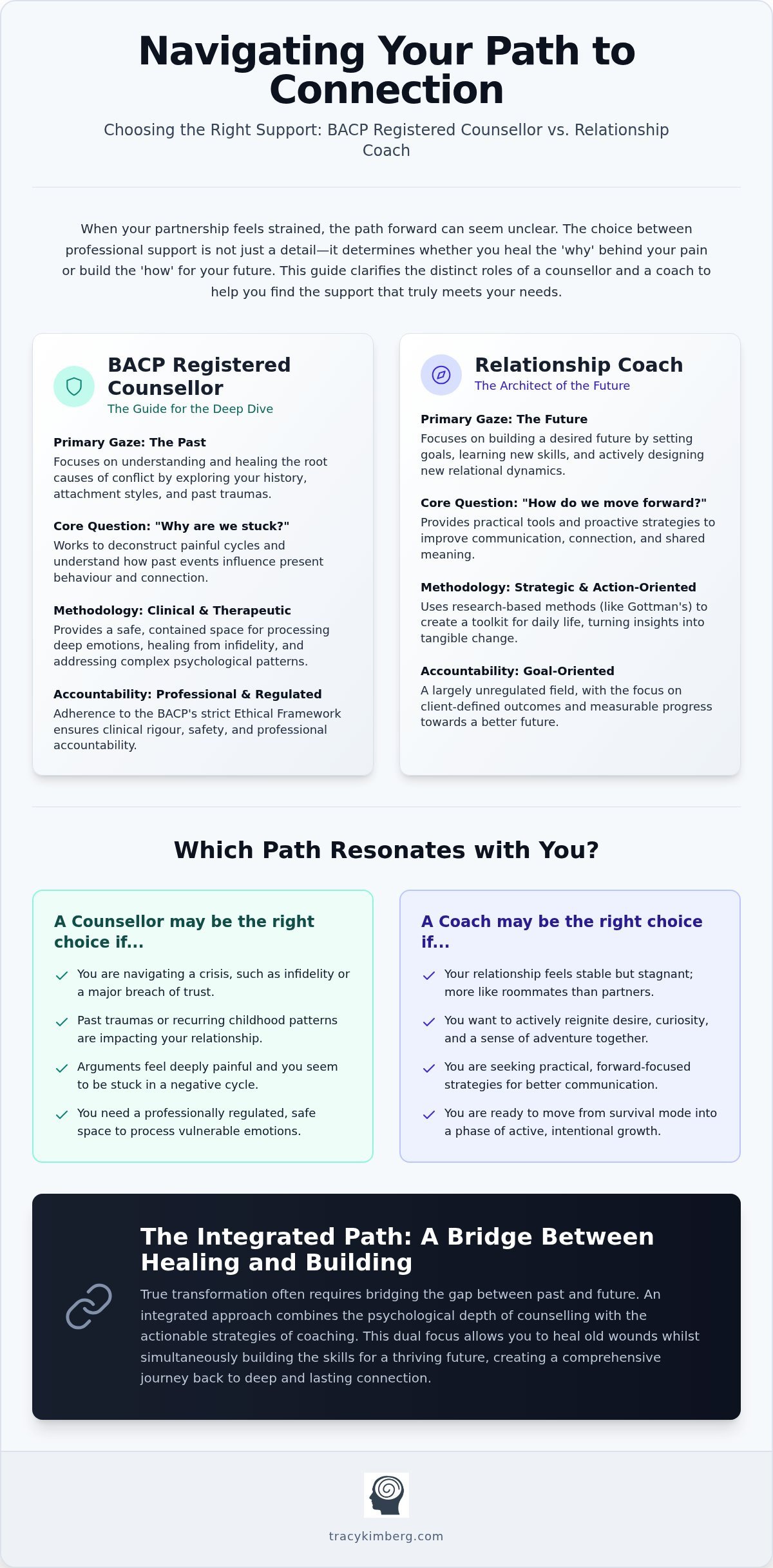
Counsellor vs Coach: Identifying the Right Support for Your Crisis
Choosing between a BACP registered relationship counsellor vs coach often comes down to the nature of the wound you’re trying to heal. If you’re rebuilding after a major infidelity, you’re dealing with a betrayal trauma that requires the clinical depth of counselling. This is a space for the slow, careful work of restoration, where the primary goal is to re-establish a sense of basic safety. Conversely, if your foundation of trust is solid but you’ve lost the ability to ‘tune in’ to each other, coaching provides the strategic framework to revitalise that connection. It’s the difference between needing a surgeon to repair a break and a trainer to help you run a marathon.
Sometimes, the healthiest path forward isn’t reconciliation, but a conscious approached divorce and separation. This requires immense emotional awareness to ensure the ending is handled with dignity. In these transitions, the impact on the wider family is significant. If you notice your child withdrawing or struggling with the shifting family dynamic, individual therapy for teenagers can provide them with their own safe harbour whilst you navigate the adult complexities. Recognising when a crisis requires a clinical safety net versus a strategic roadmap is the first step toward genuine healing.
When to Prioritise Clinical Counselling
Clinical counselling is essential when deep-seated trauma or mental health challenges like depression and anxiety are sabotaging your intimacy. If your arguments feel like echoes of childhood imprints, or if the pain is so raw that you cannot see a path forward, you need a long-term healing space. This isn’t about a quick fix. It’s about the containment and professional accountability that only a regulated professional can provide. It’s the right choice when the past is so present that it prevents you from building a future.
When to Choose Relationship Coaching
Coaching is ideal when you feel ‘stuck’ or ‘roommate-bound’ but the core trust remains intact. It’s for couples seeking a structured programme to navigate specific life transitions, such as the transition to parenthood or career shifts. It offers a roadmap of actionable steps to rebuild intimacy and master the mechanics of healthy partnership. If you are ready to move from confusion to clarity, you can book a session with a relationship specialist to determine which path best suits your specific needs.
The Integrated Path: Why Professional Depth and Practical Tools Matter
In the complex landscape of human intimacy, the most profound transformations often happen when we stop trying to separate the ‘why’ from the ‘how’. Choosing between a BACP registered relationship counsellor vs coach doesn’t have to be an either-or decision. In fact, many of the most effective relationship experts today refuse to be confined by a single label. They recognise that whilst we must understand the roots of our pain, we also need a practical map to navigate our way out of it. This integrated approach ensures that you aren’t just talking about your problems, but actively evolving beyond them.
By incorporating Gabor Maté’s trauma-informed lens, we can see how past wounds manifest as current triggers. When this deep psychological insight is paired with practical coaching tools, the results are both powerful and sustainable. You aren’t just learning to stop shouting; you’re learning why you feel the need to shout in the first place and how to soothe that underlying fear. This depth is accessible regardless of where you are. Online therapy allows for this high level of clinical and strategic support without compromising the intimacy of the session, providing a flexible path for busy couples.
A Structured Journey to Healing
The 12-Week Relationship Recovery Process was designed specifically to bridge the gap between clinical safety and proactive strategy. It provides a hybrid model that honours your history whilst demanding momentum for your future. This 12-week framework creates a container of safety where you can deconstruct old patterns and immediately replace them with healthier behaviours. It’s about merging the psychological rigour of therapy with the goal-oriented drive of coaching. This structure prevents the process from feeling like an aimless conversation, giving you clear milestones to celebrate as you rebuild your bond.
Finding Your Wise Guide
Ultimately, the greatest predictor of success in any therapeutic or coaching engagement is the person-centred connection you share with your guide. You need someone who balances clinical expertise with a warm, welcoming accessibility. This Wise Guide persona ensures that you feel held, understood, and challenged in equal measure. It’s about finding a professional who is genuinely invested in your long-term emotional health and who can walk beside you through the complexities of adult life transitions.
Discover how a structured recovery process can transform your relationship today
Reclaiming Your Connection Through Expert Guidance
Finding the right path forward isn’t about choosing a title; it’s about honouring the specific needs of your partnership. Whether you require the clinical safety of therapy to heal deep-seated wounds or the strategic momentum of coaching to reignite your spark, your journey deserves professional clarity. The debate between a BACP registered relationship counsellor vs coach highlights a vital truth: effective healing requires both psychological depth and actionable strategy.
By blending the rigour of BACP professional standards with the research-based tools of the Gottman Method and Esther Perel’s insights, you can move beyond survival mode. My signature 12-Week Relationship Recovery Process serves as a bridge, providing the containment you need to process the past whilst equipping you with a roadmap for a vibrant future. You don’t have to navigate this complex emotional landscape alone. I invite you to Book Your Initial Relationship Discovery Call with Tracy Kimberg today. Let’s begin this proactive adventure together and restore the intimacy you both deserve. Healing is entirely possible, and your first step starts here.
Frequently Asked Questions
Is a relationship coach the same as a therapist in the UK?
A relationship coach and a therapist occupy different professional spaces in the UK. Therapists are clinically trained to address deep-seated trauma and psychological patterns, whilst coaches focus on strategic goal-setting and future dynamics. In my practice, I find that the most profound healing happens when we bridge these roles. You get the clinical safety of a regulated professional along with the proactive energy required to build a new, intentional partnership.
What are the benefits of seeing a BACP registered counsellor?
Choosing a BACP registered professional provides you with a crucial clinical safety net. It means your practitioner is bound by a strict ethical framework and undergoes regular supervision to ensure the highest standard of care. This registration is your guarantee of accountability, especially when navigating sensitive issues like betrayal. It ensures that the space we create together remains non-judgemental, secure, and entirely focused on your long-term emotional health.
Can a relationship coach help with infidelity recovery?
Infidelity recovery requires a delicate blend of healing and strategy. Whilst a coach provides the “how-to” for rebuilding daily trust, the clinical depth of a BACP registered relationship counsellor vs coach is often necessary to process the underlying betrayal trauma. My approach integrates both, using a trauma-informed lens to understand the “why” before implementing Gottman-inspired tools to help you navigate the difficult journey of reconnection and shared meaning.
How do I know if we need couples counselling or just better communication?
The distinction often lies in the “weight” of your conflict. If you’re simply stuck in the “roommate phase” and need better tools to handle daily friction, coaching is a fantastic fit. However, if your arguments feel like repetitive cycles of childhood imprints or deep-seated resentment, counselling is required to heal those roots. We look at whether you need a toolkit for the future or a scalpel to address past wounds.
Is online relationship coaching as effective as face-to-face therapy?
Online sessions are incredibly effective and often feel more manageable for busy couples. Research suggests that online therapy provides the same clinical depth as face-to-face work, with the added benefit of being in your own comfortable environment. This accessibility ensures you don’t compromise on the quality of support. Whether we meet online or face-to-face, the focus remains on creating a safe, transformational space for your partnership to evolve.
What should I look for in a relationship expert’s credentials?
You should prioritise registration with a recognised professional body like the BACP, which ensures ethical accountability. Additionally, look for specialists trained in research-based frameworks like the Gottman Method or Esther Perel’s systemic approach. These credentials distinguish a Wise Guide from an unregulated “expert.” They ensure your therapist has the clinical rigour to hold your pain and the strategic skill to help you move beyond it.
How long does a typical relationship recovery programme take?
Standard therapy can be open-ended, but many couples prefer a structured journey. My signature 12-Week Relationship Recovery Process is designed to provide both clinical safety and measurable momentum. By committing to a three-month programme, you move from the initial crisis into a phase of active rebuilding. This timeframe is long enough to deconstruct old patterns whilst being short enough to maintain the energy needed for genuine transformation.
Can individual counselling help my marriage if my partner won’t attend?
Relationships are interconnected systems, so when you change your own behaviour, the entire dynamic must shift. Individual therapy for adults allows you to explore your attachment styles and emotional triggers. Even if your partner isn’t ready to attend, your personal growth can break the cycle of reactivity. This often creates the safety your partner needs to eventually join the process or helps you navigate a conscious approach to separation.

Article by
Tracy Kimberg
Tracy Kimberg is a Relationship Expert, Couples Therapist and Coach with a dedicated focus on helping couples and individuals rebuild connection, trust and emotional safety in their relationships. Drawing on the research of John and Julie Gottman, the relational insights of Esther Perel, and years of hands-on therapeutic experience, Tracy offers a warm, non-judgemental and deeply compassionate approach to modern relationships.
Based in Dorset, Tracy works with couples navigating communication breakdowns, betrayal, intimacy challenges, separation, family dynamics and life transitions. Known for creating a safe and grounded therapeutic space, she combines practical tools with emotional depth to help clients move beyond survival patterns and towards meaningful, lasting change.
With a reputation for empathy, professionalism and dedication to her clients’ growth, Tracy is passionate about helping people feel seen, understood and empowered — both within their relationships and within themselves.
Disclaimer
Disclaimer:
The information shared in this article is intended for educational and informational purposes only and should not be considered a substitute for professional therapeutic, psychological, medical or legal advice. Every individual and relationship is unique, and the perspectives offered are based on general therapeutic principles, research and professional experience.
Reading this article does not establish a therapist-client relationship with Tracy Kimberg. If you are experiencing significant emotional distress, relationship crisis, trauma, or mental health concerns, it is important to seek support from a qualified professional appropriate to your individual circumstances.
All content remains the intellectual property of Tracy Kimberg and may not be reproduced or distributed without permission.