

Did you know that a mere fifteen minutes of observation can allow a researcher to predict the end of a marriage with over 90% accuracy? It sounds clinical, yet for many, the reality feels much more personal. You might be living in a constant state of bracing yourself for the next sharp jab or dismissive glance. When mutual respect begins to erode, overcoming contempt in a relationship becomes the most urgent task for any couple wishing to survive. It’s exhausting to feel belittled by the person who is supposed to be your greatest ally, and that loss of emotional safety can leave you feeling deeply isolated amongst the familiar walls of your own home.
I understand how heavy this burden feels, but I also know that contempt isn’t an ending; it’s often a misplaced cry for a connection that’s gone off course. In this guide, you’ll discover how to identify the subtle signs of this destructive dynamic and implement research-backed strategies to transform your partnership. We’ll explore how to replace mockery with genuine admiration whilst looking at how a structured approach, such as my 12-Week Relationship Recovery Process, can help you restore the fondness you once shared. You can learn to argue without causing permanent damage and, most importantly, feel truly liked by your partner once again.
Key Takeaways
- Learn to distinguish between a healthy complaint and the corrosive nature of contempt, which attacks your partner’s character rather than their behaviour.
- Understand how “bracing” for mockery destroys vulnerability and why overcoming contempt in a relationship is the first step toward restoring mutual respect.
- Discover how to replace chronic sarcasm and emotional distance with a proactive culture of appreciation and fondness.
- Master the art of self-soothing to manage emotional flooding, ensuring your difficult conversations lead to repair rather than further damage.
- Find out how the 12-Week Relationship Recovery Process offers a structured, research-based roadmap for couples seeking a profound relational reset.
Understanding the Poison: What is Contempt in a Relationship?
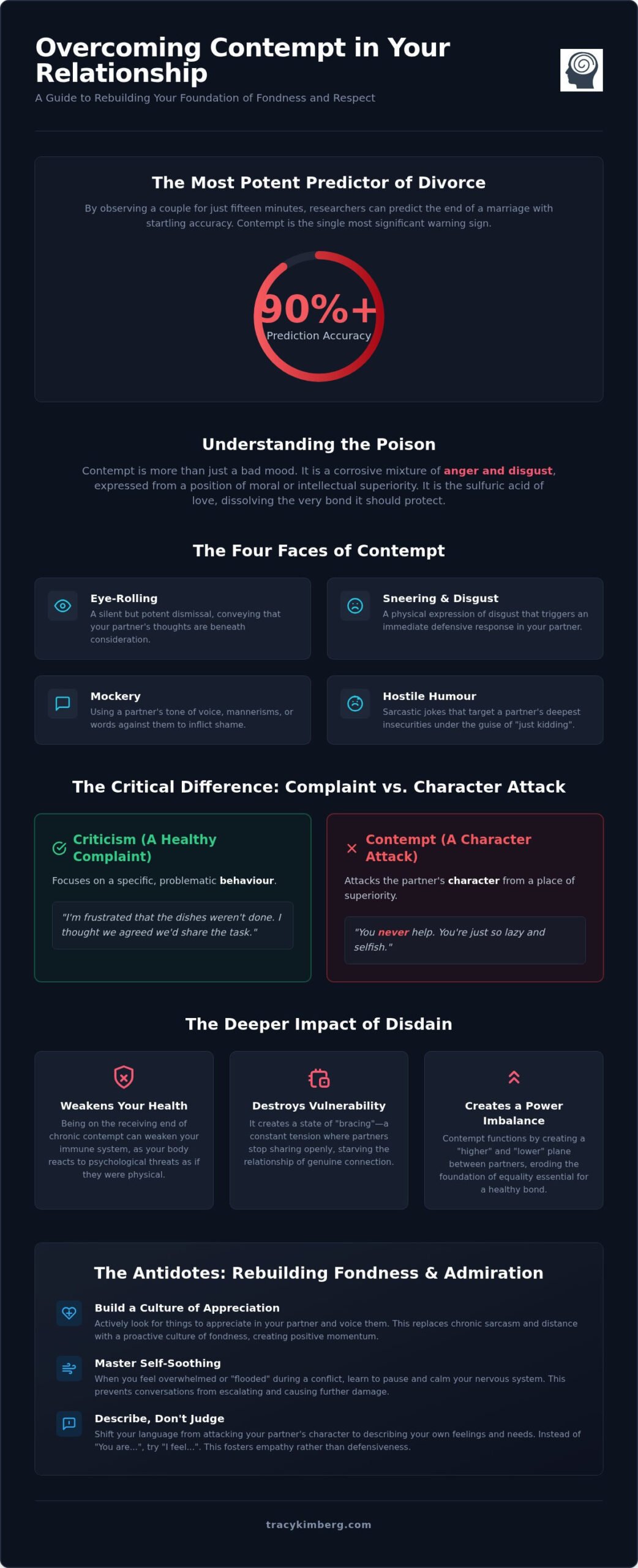
Contempt is more than just a bad mood or a sharp word. It’s a complex, acidic blend of anger and disgust that fundamentally changes the architecture of a partnership. When one partner looks down on the other from a position of moral or intellectual superiority, the ground beneath the relationship begins to crumble. To understand What is Contempt in a clinical sense, we must look at how it creates a “higher” and “lower” plane between two people who were once equals. Contempt is the sulfuric acid of love that erodes the bond whilst destroying emotional safety. In my work, I see how overcoming contempt in a relationship requires a deep acknowledgement of this power imbalance.
You might recognise the presence of this “poison” through specific, painful cues that signal a lack of respect:
- Eye-rolling: A silent but potent way of saying your partner’s thoughts are beneath consideration.
- Sneering: A physical expression of disgust that triggers an immediate defensive response.
- Mocking: Using a partner’s tone of voice or mannerisms against them to cause shame.
- Hostile humour: Sarcastic jokes that target a partner’s deepest insecurities under the guise of “just kidding”.
The Subtle Signs of Disdain You Might Be Missing
Sarcasm often wears the mask of “harmless” banter, but when it’s chronic, it functions as a tool for emotional distance. You might feel like you’re constantly walking on eggshells, bracing for a jab that hasn’t come yet. This isn’t just a mental strain. Research indicates that being on the receiving end of chronic contempt actually weakens your immune system. Your body reacts to the psychological dismissal as a physical threat, leading to more frequent illness and higher stress levels. Recognising this superiority dynamic in your daily tea-time chats is a vital step toward healing.
Contempt vs. Criticism: Knowing the Difference
It’s easy to confuse these two, but the difference is profound. A complaint or criticism focuses on a specific behaviour, such as being upset that the dishes weren’t done. Contempt, however, attacks the very soul of your partner. It shifts the narrative from “I am frustrated” to “You are disgusting”. Phrases like “You always…” or “You never…” act as gateways to this behaviour. They stop being about the dishes and start being about a perceived character flaw. Criticism attacks the action; contempt attacks the person’s character from a place of superiority. Overcoming contempt in a relationship starts with learning how to return to the level ground of mutual respect.
The Anatomy of Disdain: Why Contempt Predicts Relational Breakdown
Contempt isn’t just a symptom of a struggling partnership; it’s a powerful predictor of its end. Dr John Gottman famously identifies it as one of The Four Horsemen: Contempt, the single most significant sign that a relationship is heading toward breakdown. But why does it take such a firm hold? Often, it’s a maladaptive coping mechanism. We use disdain to protect ourselves from unmet needs or deep-seated fears. By looking down on a partner, we create a psychological distance that feels like safety, but in reality, it’s a wall that prevents any genuine connection.
The Trauma-Informed Root: Why We Resort to Contempt
Drawing on the insights of Gabor Maté, we can see that our adult behaviours are often echoes of childhood survival. If you grew up in an environment defined by harsh judgement or neglect, you might have internalised a critic who now speaks through you. Contempt becomes a defensive posture. It’s a way to avoid feeling small or powerless by ensuring the other person feels smaller. Overcoming contempt in a relationship requires us to look at these roots with compassion. We must understand that the sneer is often a shield for a part of us that still feels incredibly vulnerable.
This dynamic leads to a state of “bracing”. It’s that constant physical and emotional tension where partners stop being vulnerable because they’re waiting for the next mocking comment. When vulnerability disappears, the heart of the relationship stops beating. It is a learned behaviour, often picked up from past trauma where being “superior” was the only way to stay safe from being hurt.
How Contempt Kills Intimacy and Desire
Esther Perel often observes that desire needs respect and a bit of mystery to thrive. You simply cannot feel attracted to someone you feel superior to, nor can you feel desire for someone who views you with disdain. This is how many couples slip into the “Roommate Phase”. The erotic intelligence of the partnership is extinguished because the “Safe Base” has transformed into a “Battleground”. It’s impossible to feel sexy or playful when you’re busy defending your character.
The Gottman Method highlights that a strong friendship base is the foundation of all lasting love. Contempt erodes this base until there’s nothing left but resentment. It’s hard to be friends with a judge. If you find yourself in this cycle, exploring relationship coaching can provide the tools to dismantle these defensive walls. Overcoming contempt in a relationship isn’t just about stopping the insults; it’s about reclaiming the safety of being truly seen and admired by your partner again.
Myth vs. Reality: Why Contempt is Not Just “Mean” Behaviour
Many couples dismiss contemptuous remarks as “just my sense of humour” or a sign of a “thick-skinned” relationship. However, chronic sarcasm isn’t a playful quirk; it’s a sophisticated form of emotional distance. It creates a barrier that prevents true intimacy. We often treat contempt as a fixed personality trait, believing “that’s just how I am.” In reality, it is a communication habit. Because habits are learned, they can be unlearned. Overcoming contempt in a relationship begins with the belief that your patterns aren’t set in stone.
Perhaps the most damaging myth is that contempt is the final nail in the coffin. While research identifies it as the greatest predictor of divorce, it isn’t a death sentence. Instead, think of it as a high-decibel smoke alarm. It signals that the relational system needs a radical reset. It tells us that the current way of interacting is no longer sustainable and that a fundamental shift toward mutual respect is required to save the bond.
The “Honesty” Trap: When Truth Becomes a Weapon
I often hear partners justify cruel remarks by claiming they are simply “telling it like it is.” This is the honesty trap. There’s a vast difference between radical honesty, which seeks to deepen connection, and “brutal” honesty, which lacks empathy. When you use truth as a weapon, your intent matters far less than the impact on your partner. If your “truth” is delivered with a sneer, the message received is one of worthlessness. Learning to speak your truth without diminishing the other person is a vital skill for any couple in recovery.
Can a Relationship Truly Recover from Contempt?
The short answer is yes. Thanks to neuroplasticity, we can literally re-wire how we view and respond to our partners. Recovery involves rebuilding the “bank account of trust” through small, daily acts of appreciation. These “small things often” create a buffer against future conflict. However, because contempt often functions as a self-perpetuating loop, breaking the cycle usually requires professional intervention. A structured approach can help you navigate this complex emotional landscape, moving you from a state of disdain back to one of genuine, heartfelt admiration.
The Antidotes: Practical Steps for Overcoming Contempt Together
Shifting from a state of disdain to one of connection requires a conscious rewiring of your daily interactions. It isn’t enough to simply stop the eye-rolling; you must actively cultivate a new way of being. Overcoming contempt in a relationship is about moving from a “detective of what is wrong” to a “scavenger for what is right”. This transition is less about following a checklist and more about a fundamental shift in how you choose to see your partner every day.
Building the “Appreciation Bank Account”
Research by the Gottman Institute suggests that stable relationships maintain a 5:1 ratio. This means for every one negative interaction, you need five positive ones to keep the “bank account” in the black. When contempt has taken hold, your balance is likely overdrawn. You must begin finding the gold amongst the dross. Even whilst you are angry, try to identify one trait you still admire in your partner. This isn’t just about politeness; it’s about reviving the playfulness and erotic intelligence that Esther Perel notes are often the first casualties of disdain. Daily rituals, like a genuine “thank you” for a routine chore or a shared morning coffee, act as vital insulation against future resentment.
Softening Your Communication: From “You” to “I”
How you begin a conversation almost always determines how it ends. A “harsh start-up” usually leads to a defensive finish. Instead of pointing the finger, try softening your approach. Use the formula: “I feel… about [fact]… and I need…”. For example, “I feel overwhelmed about the kitchen, and I need some help tonight,” sounds very different to “You never clean up.” Taking responsibility for even 1% of the conflict can bridge the gap. It signals that you are partners in a solution rather than adversaries in a battle.
Recognising when you are “flooded” is equally vital. If your heart is racing, you are physiologically unable to be kind or creative. Practising self-soothing, such as taking a twenty-minute break to breathe and calm your nervous system, prevents an argument from escalating into a character attack. These moments are often missed “bids for connection,” where one partner is reaching out and the other is turning away. If these patterns feel too deeply ingrained to shift alone, my 12-Week Relationship Recovery Process provides the structured guidance needed to uncover these hidden bids and restore your bond. Overcoming contempt in a relationship is a journey of repair, and with the right tools, you can move from a place of judgement back to a place of love.
Beyond the Horsemen: Rebuilding Your Bond with Relationship Coaching
When you’ve spent months or even years in a cycle of disdain, simply talking about the problem can sometimes feel like re-opening a wound without providing a bandage. This is where relationship coaching offers a distinct advantage. Unlike traditional talk therapy, which often looks backward, coaching is an active, forward-moving process. It provides you with research-based tools to disrupt the “Four Horsemen” and replace them with healthy communication patterns. For those committed to overcoming contempt in a relationship, my 12-Week Relationship Recovery Process serves as the ultimate reset button. It moves beyond the “why” and focuses heavily on the “how” of healing.
The 12-Week Relationship Recovery Journey
This structured programme is designed for couples who feel they are at the end of their tether. By following a time-bound roadmap, you create a sense of momentum that is often missing in open-ended therapy. We don’t just patch up the cracks. We look at the root causes of anxiety and emotional disconnect that allowed contempt to flourish in the first place. Whether we meet face-to-face or through online therapy sessions, I provide a safe, non-judgemental environment where both partners feel heard. Overcoming contempt in a relationship is a journey of transformational change, moving from a place of relational breakdown to a new chapter defined by deep intimacy and mutual respect.
Taking the First Step Toward Healing
Healing begins with what I call the “Conscious Choice”. It’s the moment you decide to stop fighting against each other and start fighting for the relationship. This shift in perspective is powerful. When you book a consultation, we’ll begin by exploring your unique history and the specific challenges you face. You can expect a conversation that is both professional and deeply human, grounded in the proven methods of experts like Gottman and Perel. We’ll identify the “bids for connection” you’ve been missing and start the work of rebuilding your friendship base. If you’re ready to move past the sneers and the silence, the path to reconnection is open.
Begin your journey to a healthier relationship with Tracy Kimberg today
Reclaiming Your Future Together
Contempt doesn’t have to be the final word in your story. By understanding that this dynamic is often a defensive shield for unmet needs, you can begin the vital work of dismantling the walls between you. We’ve explored how shifting from a culture of criticism to one of appreciation can breathe new life into your partnership, restoring the playfulness and respect that once felt lost. Remember, overcoming contempt in a relationship is a courageous choice to prioritise connection over the hollow victory of being right.
If you’re ready to move from a state of bracing to one of belonging, a structured path can make all the difference. As a UK-based expert trained in the research-backed methods of Gottman and Perel, I offer a safe, non-judgemental space for both online and face-to-face therapy. My proven 12-week framework is designed to guide you through deep relational healing, providing the actionable tools you need to thrive. You don’t have to navigate this complex emotional landscape alone. Book your 12-Week Relationship Recovery Consultation and take the first step toward a transformational new chapter. There is hope for your bond, and the journey to a more intimate, resilient love starts here.
Frequently Asked Questions
Can a relationship really survive contempt?
Yes, a relationship can survive if both partners commit to a radical reset. While research shows it is a major predictor of divorce, it isn’t an inevitable end. Overcoming contempt in a relationship involves active repair and rewiring how you view one another. By replacing disdain with mutual respect and using research-based tools, many couples move from the battleground back to a safe base. It requires patience and a genuine willingness to address underlying resentment.
How do I tell my partner their contempt is hurting me without starting a fight?
Use a softened start-up by focusing on your own feelings rather than your partner’s flaws. Instead of saying “You are being mean,” try “I feel belittled when you use that tone, and I need to feel respected to stay in this conversation.” This avoids the “You always” trap that often triggers defensiveness. By taking responsibility for your emotional safety, you invite your partner to join you in a collaborative solution rather than a fight.
What is the “antidote” to contempt in the Gottman Method?
The primary antidote is building a culture of appreciation and fondness. This means intentionally looking for things your partner is doing right rather than cataloguing their failures. You aim to express gratitude for small, everyday actions. This shift in focus helps rebuild the friendship base of the relationship, creating a buffer of positive sentiment that makes it much harder for contemptuous thoughts to take root and flourish in your daily life.
Is sarcasm always a sign of contempt in a relationship?
Not all sarcasm is contemptuous, but it often sits on the edge of emotional distance. Playful banter is fine if both partners feel safe and liked. However, if sarcasm is used to mock, belittle, or dismiss your partner’s feelings, it has crossed into contempt. It’s often a sign that someone is afraid to be vulnerable and is using hostile humour as a shield to avoid a more direct, honest conversation.
How long does it take to overcome contemptuous habits?
Relational habits often take several months of consistent practice to shift permanently. While you might see immediate improvements by using softened start-ups, true rewiring requires sustained effort. My 12-Week Relationship Recovery Process is specifically designed to create this momentum. It provides a structured timeframe to break old loops and establish new, healthier communication patterns, ensuring that the changes you make are deeply rooted and last for the long term. Overcoming contempt in a relationship is a journey, not a quick fix.
Can individual therapy help if my partner refuses to go to couples coaching?
Individual therapy is incredibly valuable even if your partner isn’t ready for coaching yet. Relationships are systems; when one person changes their reactions and sets healthier boundaries, the entire dynamic must shift. By working on your own triggers and learning how to communicate your needs more effectively, you can often inspire a change in your partner’s behaviour. It’s a proactive way to begin overcoming contempt in a relationship from your own side.
What if I am the one who feels contempt for my partner?
Feeling contempt for your partner is often a sign of deep, unmet needs or past trauma. It’s a defensive posture that makes you feel superior to avoid feeling powerless or small. Acknowledge these feelings without judgement and explore what they are trying to protect. Often, beneath the disdain is a significant amount of hurt. Understanding these roots is the first step toward softening your heart and finding a more constructive way to connect.
How does the 12-Week Relationship Recovery Process specifically address contempt?
This programme provides a structured reset button that moves beyond simple talk therapy. We utilise research-based tools from the Gottman and Perel methods to identify misshapen bids for connection and address the root causes of disconnect. The process creates a safe, non-judgemental environment where you can dismantle the Four Horsemen together. By the end of the twelve weeks, couples often feel a profound restoration of mutual respect, fondness, and deep emotional intimacy.

Article by
Tracy Kimberg
Tracy Kimberg is a Relationship Expert, Couples Therapist and Coach with a dedicated focus on helping couples and individuals rebuild connection, trust and emotional safety in their relationships. Drawing on the research of John and Julie Gottman, the relational insights of Esther Perel, and years of hands-on therapeutic experience, Tracy offers a warm, non-judgemental and deeply compassionate approach to modern relationships.
Based in Dorset, Tracy works with couples navigating communication breakdowns, betrayal, intimacy challenges, separation, family dynamics and life transitions. Known for creating a safe and grounded therapeutic space, she combines practical tools with emotional depth to help clients move beyond survival patterns and towards meaningful, lasting change.
With a reputation for empathy, professionalism and dedication to her clients’ growth, Tracy is passionate about helping people feel seen, understood and empowered — both within their relationships and within themselves.
Disclaimer
Disclaimer:
The information shared in this article is intended for educational and informational purposes only and should not be considered a substitute for professional therapeutic, psychological, medical or legal advice. Every individual and relationship is unique, and the perspectives offered are based on general therapeutic principles, research and professional experience.
Reading this article does not establish a therapist-client relationship with Tracy Kimberg. If you are experiencing significant emotional distress, relationship crisis, trauma, or mental health concerns, it is important to seek support from a qualified professional appropriate to your individual circumstances.
All content remains the intellectual property of Tracy Kimberg and may not be reproduced or distributed without permission.