

What if the end of your partnership wasn’t a failure of your life, but the beginning of an essential re-integration of who you actually are? It’s natural to feel adrift when the “we” dissolves. You might find yourself staring at a future that looks nothing like the one you planned, whilst grappling with a heavy sense of loss and a fractured identity. Many people find that moving on after separation feels like trying to navigate a forest without a map, especially when carrying the weight of social stigma or personal regret.
We understand that this transition is as much about unlearning the past as it is about building the future. You deserve a path toward emotional peace that honours your history without letting it define your future. This guide offers a psychologically grounded approach to reclaiming your individual self and regulating the storm of anxiety. We’ll explore how to find clarity amongst the chaos, rediscover your personal values, and cultivate a renewed sense of hope for healthy relationships in 2026. Your healing isn’t just possible; it’s already in motion.
Key Takeaways
- Learn to reframe your experience as a necessary evolution for your mental health rather than a personal failure.
- Discover how your attachment style shapes your recovery and learn to reclaim your sense of vitality after the partnership dissolves.
- Master the practical steps for moving on after separation, including setting boundaries to calm your nervous system and establishing rituals that belong only to you.
- Understand why the “brain fog” you’re experiencing is a valid response to the disenfranchised grief that the world often underestimates whilst you heal.
- Explore how a structured 12-week recovery process can help you find your emotional centre and break old relational patterns for good.
Understanding the Emotional Landscape of Separation
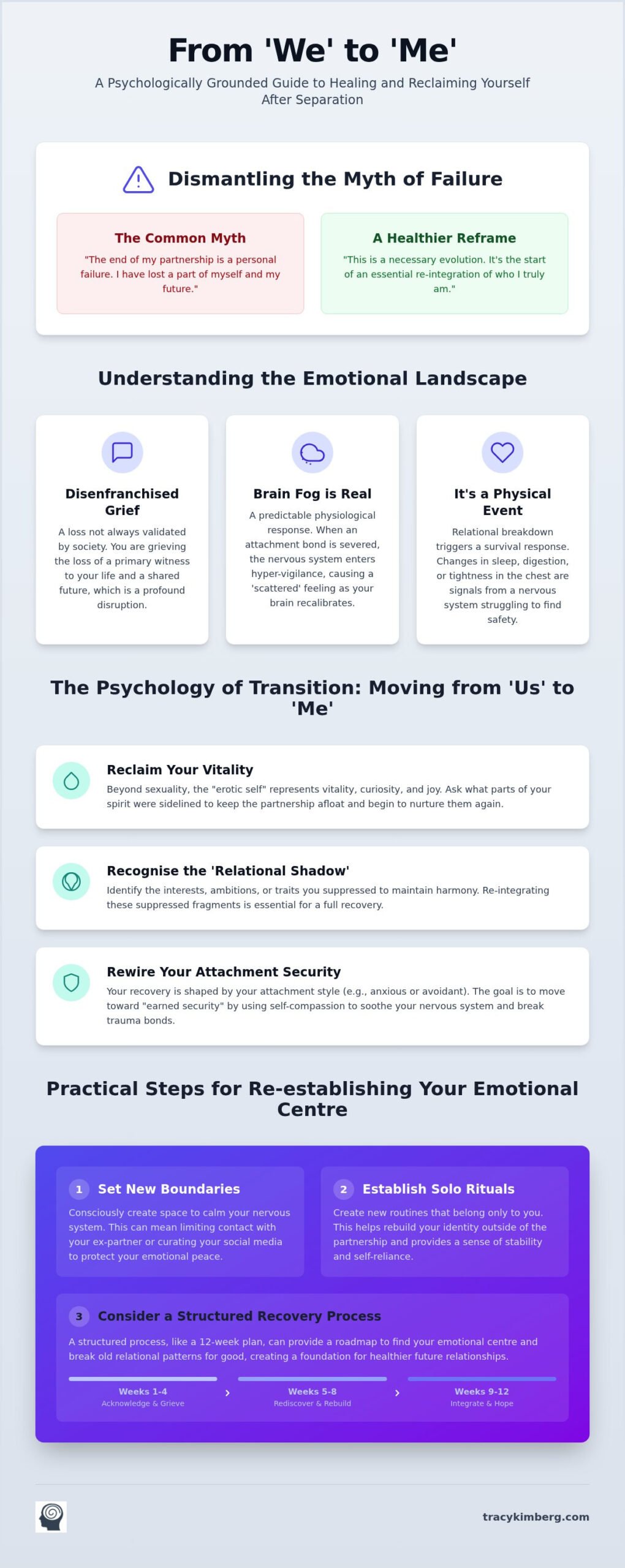
Separation is rarely just the end of a contract; it’s a profound disruption of your internal world. We often categorise this experience as “disenfranchised grief”, a type of loss that isn’t always validated by society in the same way as a physical death. Because the person is still present in the world, others might expect you to bounce back quickly, yet the internal reality is far more complex. Truly moving on after separation requires acknowledging that you aren’t just losing a partner, you’re losing a primary witness to your daily life.
If you feel like your brain is operating through a thick fog, know that this is a predictable physiological response. When a primary attachment bond is severed, your nervous system can enter a state of chronic hyper-vigilance. This “scattered” feeling is your brain trying to recalibrate whilst processing the psychological effects of a breakup. It’s essential to distinguish between the legal finality of a decree and the long, winding road of emotional recovery. One is a signature; the other is a cellular shift that takes time to integrate.
Relational breakdown isn’t just an emotional event; it’s a physical one. When we experience the threat of separation, our bodies often react as if our very survival is at risk. You might notice changes in your sleep patterns, digestion, or a persistent tightness in your chest. These are not just symptoms of sadness, but signals from a nervous system that is struggling to find safety without its familiar co-regulator. Acknowledging this physical reality is the first step in moving from survival mode back into a state of genuine living.
The Multidimensional Nature of Grief
Grief isn’t reserved only for the “good” times. You might find yourself missing the mundane morning routines or even the predictable patterns of conflict, simply because they provided a sense of familiar structure. The most acute pain often stems from the death of the “shared future”, those unwritten chapters you assumed you’d finish together. To navigate this with grace, many find solace in conscious uncoupling, a deliberate approach that prioritises emotional preservation and mutual respect over blame.
Normalising the Post-Separation Identity Crisis
The question “Who am I?” often echoes loudly when the “we” dissolves. For years, your identity may have been tethered to your role within a couple, and standing alone can feel like a sudden loss of gravity. This often brings a specific kind of social anxiety, especially when you feel like the “single person” amongst a group of coupled friends. Remember that moving on after separation isn’t a linear climb; it’s a fluctuating process where some days feel like progress and others feel like a return to the start.
The Psychology of Transition: Moving from Us to Me
Whilst the legalities of a split focus on assets and custody, the true work of moving on after separation happens within the quiet architecture of your own mind. It is a transition from a shared identity back to a singular one. Esther Perel often speaks about the “erotic self” not just in terms of sexuality, but as a placeholder for vitality, curiosity, and the capacity for joy. When a relationship ends, that vitality often feels extinguished. Reclaiming it requires you to look beyond the debris of the breakup and ask what parts of your own spirit were sidelined to keep the partnership afloat.
This process often reveals what we call the “Relational Shadow”. These are the interests, traits, or ambitions you suppressed to maintain harmony with your partner. Perhaps you quieted your ambition or dimmed your social energy to accommodate their temperament. Recognising these suppressed fragments is essential for your recovery. Gabor Maté reminds us that the stress of relational disharmony isn’t just an emotional burden; it has a tangible impact on our physical health. Chronic relational stress can manifest as exhaustion or physical tension, making it vital to adopt practical coping strategies that prioritise your biological and emotional restoration.
Rewiring Your Attachment Security
Your behaviour during a split is often dictated by your attachment style. If you have an anxious attachment, you might find yourself obsessively checking a former partner’s social media or feeling a desperate need for closure. Those with avoidant styles might shut down entirely. The goal of this transition is to move toward “earned security”. This involves using self-compassion as a clinical tool to soothe your own nervous system. It’s about identifying if you’re caught in a “trauma bond”, where the intermittent reinforcement of the relationship keeps you hooked, and gently breaking that cycle through consistent self-care.
The Gottman Perspective on Relational Endings
John Gottman’s research into the “Four Horsemen”—criticism, contempt, defensiveness, and stonewalling—provides a roadmap for understanding why things ended without drowning in shame. Instead of seeing these behaviours as personal failures, view them as data. They tell you exactly where the communication broke down and what boundaries you need to establish for your future self. In individual therapy, the first step is often learning to “turn towards” yourself with the same empathy you once reserved for your partner. If you feel ready to explore these layers in a supportive environment, our 12-Week Relationship Recovery Process offers a structured path to help you find your feet again.
Dismantling the Myth of the Failed Relationship
Society often measures the success of a relationship by its longevity alone. If it doesn’t end in death, it’s frequently branded a “failure”. This binary view ignores the profound growth that can occur within a partnership, even if that partnership eventually reaches its natural conclusion. Moving on after separation requires you to dismantle this myth. You must recognise that a relationship can be both successful for a season and necessary to leave for the sake of your individual mental health. The “sunk cost fallacy” often keeps people trapped in unhappy dynamics simply because of the time already invested. However, your past years are not “wasted” just because the future looks different than you once imagined.
Understanding that an ending is multifaceted can help ease the sting of perceived failure. Research into the six types of divorce highlights that the legal dissolution is only one layer of the experience. There is also the emotional, psychic, and community aspect to consider. By viewing the split through this structured lens, you can start to see it as a complex life transition rather than a singular mark against your character. This clarity allows you to find the “lesson” without over-analysing the past into a state of emotional paralysis.
Conscious Separation vs. Traditional Divorce
A conscious approach to separation prioritises emotional awareness and integrity over the impulse for reactive anger. It’s a proactive choice to honour the history you shared whilst acknowledging that your paths must now diverge. This method is particularly vital for maintaining healthy family dynamics. When parents choose an amicable ending, they provide a blueprint for their children on how to handle conflict with dignity. Seeking professional support, such as a Conscious Approached Divorce and separation process, isn’t a sign of weakness; it’s a strategic move to preserve your long-term well-being.
Reclaiming Your Narrative
How you tell your story matters. Many people feel a defensive urge to explain their separation to friends or colleagues, often slipping into a “victim” or “villain” narrative. Reclaiming your story means moving away from these rigid roles. You can acknowledge the pain of loss or betrayal without letting it become your entire identity. Storytelling is a powerful tool for healing; it allows you to frame the separation as a chapter of your life, not the final conclusion of your worth. Moving on after separation becomes easier when you own the narrative, speaking your truth with a calm confidence that requires no external validation.
Practical Steps for Re-establishing Your Emotional Centre
Moving on after separation is rarely a passive event that happens to you over time. Instead, it’s an active practice of emotional first aid. To begin, you must prioritise your nervous system. When a partnership ends, your body is often stuck in a loop of fight-or-flight, making it difficult to think clearly. Establishing a “No-Contact” or “Limited-Contact” boundary is not about being unkind; it’s about giving your physiology the space to settle without the constant trigger of your former partner’s presence. During this time, engaging in “Identity Auditing” can be transformative. This involves listing the interests, hobbies, and core values that you may have sidelined to accommodate the relationship. Reclaiming these fragments is how you begin to feel like a whole person again.
To support this internal shift, consider these foundational practices:
- Daily Rituals: Create one small habit that belongs solely to your new life, such as a morning walk or a specific evening reading time.
- Somatic Grounding: Use breathwork or gentle movement to pull your awareness out of ruminative thoughts and back into your body.
- Identity Re-engagement: Choose one activity you loved before the relationship and schedule it into your week.
The First 90 Days: A Survival Framework
In 2026, research indicates that the average time for significant emotional recovery has shifted to approximately 14-16 weeks. This makes the first 90 days a critical survival window. During this phase, your primary goal is stability rather than “fixing” your life. You’ll need to manage practical logistics whilst in a state of emotional shock, which is why identifying “safe people” is vital. These are friends or family members who can offer non-judgemental support without pushing you to “get over it” too quickly. Setting clear boundaries with mutual friends about what information you do or do not want to hear is essential for protecting your peace.
Reconnecting with Your Individual Desires
There is a significant difference between “distraction” and genuine “re-engagement” with life. Distraction is an attempt to numb the pain, whilst re-engagement is a slow turning back towards the world. You will inevitably face “firsts”—the first holiday alone or the first birthday without them. Handling these moments requires radical self-care, which is not a luxury but a therapeutic necessity for anyone rebuilding their world. If you find yourself struggling to navigate these steps alone, our 12-Week Relationship Recovery Process offers a structured, compassionate environment to help you move through the chaos and find your feet again.
Navigating Your New Chapter with Conscious Support
Moving on after separation is a journey that often requires a mirror. Individual relationship counselling acts as that mirror, allowing you to examine the architecture of your past choices. It’s a vital step in ensuring you don’t rebuild the same limiting patterns in your next chapter. By exploring the intricacies of your previous partnership, you can identify where your boundaries were breached and where your own needs were quieted. This work isn’t about assigning blame; it’s about gaining the psychological insight necessary to move forward with a sense of agency and wisdom.
A structured approach is often the most effective way to find order amongst the emotional chaos. Our 12-Week Relationship Recovery Process provides the scaffolding you need during this transition. Instead of waiting for time to heal all wounds, this process actively guides you through the stages of grief and identity reclamation. For many, online therapy offers the most accessible path, providing a consistent and safe space to process these changes without the added stress of travel or scheduling conflicts. This digital sanctuary ensures that your support remains steady, regardless of where your new life takes you.
The Path to Relational Recovery
Tracy Kimberg’s approach to post-separation support is deeply rooted in the research-based models of John Gottman and Gabor Maté. By addressing both the communication breakdowns and the physical toll of relational stress, we create a stable foundation for your recovery. We invite you to view this time not as a period of brokenness, but as a transformational programme for the self. It’s an opportunity to rewire your attachment security and reconnect with your innate vitality. Knowing when to transition from a focus on internal healing to an openness for new connections is a delicate balance, and professional guidance can help you identify when you are truly ready to invite another person into your world.
Taking the Next Step
Booking an initial session is the first step in mapping out your specific landscape. During this time, we can explore the difference between coaching, which focuses on future-oriented strategies, and therapy, which addresses the deeper emotional roots of your behaviour. Both modalities are powerful tools for moving on after separation and ensuring your future relationships are built on a foundation of health and mutual respect. You don’t have to navigate this transition in isolation. Begin your journey of reclamation with Tracy Kimberg today.
Embracing the Vitality of Your Next Chapter
Reclaiming your life is a deliberate act of self-compassion. You’ve explored how separation is a profound relational transition rather than a personal failure, and how your attachment style influences your unique path to healing. By dismantling cultural myths and establishing small, personal rituals, you can begin to calm your nervous system and rediscover the interests you once sidelined. Moving on after separation isn’t about erasing your history; it’s about integrating your experiences into a more resilient and authentic version of yourself.
If you’re ready to find structure amongst the emotional fog, we provide a safe, non-judgemental environment for both teenagers and adults. Our 12-Week Relationship Recovery Process uses a research-based approach inspired by the work of John Gottman and Esther Perel to help you navigate this transition with clarity. You don’t have to carry this weight alone or feel trapped by old relational patterns that no longer serve you.
Book a Conscious Separation Support Session with Tracy Kimberg to begin your proactive adventure toward emotional peace and individual reclamation. The vitality you’ve been searching for is waiting just beyond this threshold, and your healing is a journey worth taking.
Frequently Asked Questions
How long does it typically take to move on after a long-term separation?
Significant emotional recovery often begins to take shape around 14 to 16 weeks after the initial split. However, for long-term partnerships, the process of moving on after separation is rarely a sprint. It involves untangling years of shared history and complex nervous system co-regulation. Your timeline depends on your attachment style and the support you have in place. Be patient with yourself; healing is a fluctuating experience rather than a fixed destination.
Is it normal to still feel love for my partner even after we have separated?
It is entirely normal and deeply human to still feel love for a partner after you have parted ways. Love is not a tap that can be turned off simply because a relationship has reached its conclusion. You are grieving the loss of a primary witness to your life. This lingering affection doesn’t mean the separation was a mistake; it simply reflects the depth of the bond you once shared whilst you navigate your new reality.
What is conscious separation, and how is it different from a traditional divorce?
Conscious separation is a specialised approach that prioritises emotional awareness and healthy relational dynamics over reactive conflict. Unlike a traditional divorce, which often focuses heavily on legal battles and assets, this method centres on the psychological well-being of everyone involved. It frames the ending as a transition to be managed with dignity. This proactive choice helps preserve your mental health and ensures that mutual respect remains the foundation for any future interactions.
How can I support my children whilst I am struggling to move on myself?
Supporting your children starts with prioritising your own emotional regulation. Children are incredibly sensitive to the emotional climate of the home. By seeking your own support through therapy for adults, you model healthy coping mechanisms. Be honest about the changes in an age-appropriate way, but reassure them of their safety. When you work on your own healing, you provide a more stable environment for them to process their own feelings about the family transition.
When should I consider seeking professional therapy after a relationship ends?
You should consider professional therapy if you feel stuck in a loop of rumination or if your daily functioning is consistently impaired by anxiety. Seeking help is a proactive step toward reclamation. A structured 12-Week Relationship Recovery Process can be particularly beneficial for those who want to understand their relational patterns. If you find yourself unable to envision a future without your partner, a safe, non-judgemental environment can help you find your feet.
Can I move on if I still have to co-parent with my ex-partner?
Moving on after separation is absolutely possible even whilst co-parenting. The key is to transition the relationship from an intimate partnership to a business-like collaboration focused solely on the children. Establishing clear boundaries and limited-contact protocols allows your nervous system to settle. By focusing on your individual growth and rituals, you create a life that is distinct from your role as a co-parent. This separation of identities is essential for long-term peace.
What are the signs that I am finally starting to heal from the separation?
Healing often shows up in subtle shifts. You might notice that you are spending less time ruminating on the past and more time feeling curious about your own future. A significant sign is reaching a state of emotional neutrality, where thoughts of your ex-partner no longer trigger a sharp physical or emotional response. You begin to reclaim your vitality and find yourself engaging in activities that belong solely to you, rather than the couple.
Is it possible to move on without getting “closure” from my ex?
Closure is an internal shift, not something granted by another person. Waiting for an ex-partner to provide an apology or an explanation often keeps you tethered to the past. You can create your own closure by accepting the reality of the situation and honouring your own narrative. Moving on is about the work you do within yourself to find peace. It involves deciding that your future happiness is no longer dependent on their understanding or validation.

Article by
Tracy Kimberg
Tracy Kimberg is a Relationship Expert, Couples Therapist and Coach with a dedicated focus on helping couples and individuals rebuild connection, trust and emotional safety in their relationships. Drawing on the research of John and Julie Gottman, the relational insights of Esther Perel, and years of hands-on therapeutic experience, Tracy offers a warm, non-judgemental and deeply compassionate approach to modern relationships.
Based in Dorset, Tracy works with couples navigating communication breakdowns, betrayal, intimacy challenges, separation, family dynamics and life transitions. Known for creating a safe and grounded therapeutic space, she combines practical tools with emotional depth to help clients move beyond survival patterns and towards meaningful, lasting change.
With a reputation for empathy, professionalism and dedication to her clients’ growth, Tracy is passionate about helping people feel seen, understood and empowered — both within their relationships and within themselves.
Disclaimer
Disclaimer:
The information shared in this article is intended for educational and informational purposes only and should not be considered a substitute for professional therapeutic, psychological, medical or legal advice. Every individual and relationship is unique, and the perspectives offered are based on general therapeutic principles, research and professional experience.
Reading this article does not establish a therapist-client relationship with Tracy Kimberg. If you are experiencing significant emotional distress, relationship crisis, trauma, or mental health concerns, it is important to seek support from a qualified professional appropriate to your individual circumstances.
All content remains the intellectual property of Tracy Kimberg and may not be reproduced or distributed without permission.