

What if feeling closer to your teenager didn’t mean agreeing on everything or finding the perfect thing to say? If conversations turn into arguments, or your teen has become quieter about everyday life, it’s understandable to wonder what’s changed. Improving relationship with your teenager isn’t about removing every disagreement. It’s about creating enough trust and emotional safety for both of you to speak, listen and find your way back to each other.
Teenagers are working out who they are while still needing connection, guidance and boundaries. That push and pull can leave parents unsure when to step in and when to give space. This guide offers practical ways to build closeness in everyday moments, respond to conflict without escalating it, and respect growing independence while holding limits that matter. It also looks at how small acts of warmth and repair can help after a difficult exchange, and when ongoing tension may benefit from additional support. You don’t need to get every interaction right. A steadier connection can grow through the way you keep showing up.
Key Takeaways
- Improving relationship with your teenager starts with seeing distance and disagreement as part of change, not proof that love has disappeared.
- Respect your teenager’s growing independence while keeping clear, appropriate boundaries.
- For recurring tension, notice the pattern, choose one change and reflect on what happens.
- When the issue isn’t urgent, curiosity and listening can help you understand your teenager before offering advice or correction.
- Ongoing distress or disconnection may make additional support worth considering, but it doesn’t mean every family needs therapy.
Improving your relationship with your teenager starts with understanding the distance
Your teenager may want more privacy, question a decision or choose to spend more time with friends. These changes can feel like a loss of closeness, especially as familiar family routines shift. But wanting space and caring about you can exist at the same time. A quieter teenager isn’t necessarily rejecting the relationship. They may be working out how to become more independent while still needing a dependable connection.
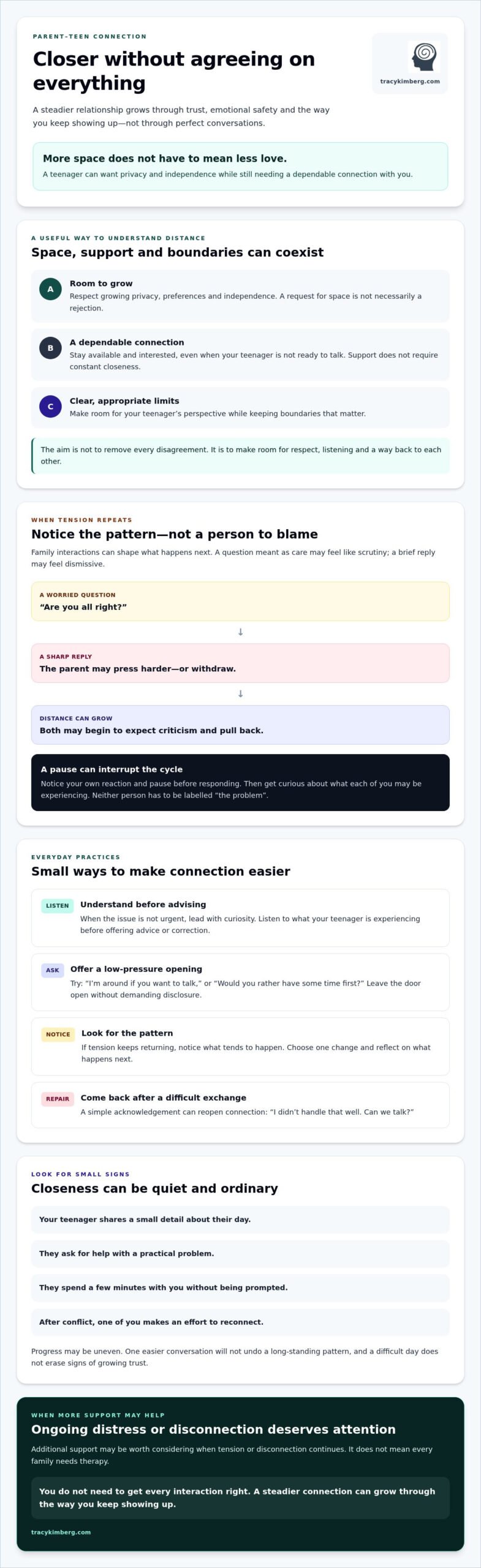
A healthy parent-teen connection gives a teenager room to grow, a sense of safety when they need support, and a way back to connection after disagreements. It doesn’t depend on constant agreement or perfect conversations. Improving relationship with your teenager means building trust and emotional safety over time, including by noticing when conflict has caused hurt and making an effort to repair it.
What can make a parent and teenager feel further apart?
As a teenager’s need for privacy grows, everyday patterns may change. They might share less about school, want time alone after getting home or prefer to make more choices about their social life. It can help to understand these shifts in the context of adolescent development, rather than treating every request for space as a sign that something is wrong.
Stress and repeated misunderstandings can add to the distance. A question meant as care might land as scrutiny; a brief reply might feel dismissive. If these moments regularly turn into arguments, both of you may start to expect criticism and pull back. That pattern doesn’t make either person the problem. It gives you a place to get curious about what each of you is experiencing.
What does a stronger relationship look like in everyday life?
Often, it looks less dramatic than parents expect. Your teenager tells you a small detail about their day, asks for help with a practical problem or sits with you for a few minutes without being prompted. After a tense exchange, one of you might come back later and say, “I didn’t handle that well. Can we talk?” These moments can create connection without demanding an immediate heart-to-heart conversation.
Progress may be uneven. One easier conversation won’t undo a long-standing pattern, and a difficult day doesn’t erase signs of growing trust. The aim isn’t to get every exchange right, but to make room for respect, listening and reconnection. Staying interested in your teenager’s perspective, even while holding a boundary, gives the relationship space to move forward.
How adolescence changes connection, autonomy and family relationships
As teenagers grow, they often want more say over their choices, more privacy and a different kind of support from their parents. That shift can unsettle familiar routines: a young person who once talked on the way home may now prefer quiet, or want to try solving a problem before asking for help. There isn’t one universal reason for these changes. Stress, friendships, school or simply needing time alone may all play a part. Curiosity about your teenager’s experience is more useful than assuming you already know what their distance means.
Adolescence brings changes in identity, relationships and decision-making. A teenager may seek greater autonomy while still benefiting from a parent’s steady emotional support and clear limits. Supporting independence doesn’t mean disappearing. It means making room for their perspective while staying available and keeping appropriate boundaries. The HHS Office of Population Affairs offers guidance on healthy teen relationships, including the supportive role adults can play.
Why might my teenager want more space from me?
Privacy can be a way for teenagers to explore their own thoughts and preferences, rather than a rejection of their parents. If your teenager resists a direct conversation, leave the door open without demanding disclosure: “I’m around if you want to talk,” or “Would you rather have some time first?” A low-pressure check-in can communicate care and respect together. If you’re unsure what’s behind the withdrawal, ask gently and listen, including if they aren’t ready to answer.
How can stress and strong emotions shape family behaviour?
Family interactions are reciprocal. A worried question may prompt a sharp reply, which can make a parent press harder or withdraw, shaping what happens next. Neither person needs to be labelled the problem for this cycle to take hold. Self-regulation means noticing your own reaction and pausing before responding, not pretending you aren’t hurt or frustrated. Later, consider what tends to happen before and after tense exchanges. That wider view can help you choose a different response without expecting your teenager to change first.
Improving relationship with your teenager can include seeking support when a pattern feels difficult to shift. If your teenager is experiencing ongoing distress, therapy for teenagers may be one option to explore. It isn’t a requirement for ordinary disagreements, and it doesn’t replace the value of a supportive relationship at home.
Common relationship worries: boundaries, resistance and repeated arguments
It can feel as though you have two choices: give your teenager more freedom or risk pushing them away. But respecting growing independence doesn’t mean stepping back from every limit. A relationship can make room for a teenager’s voice while parents continue to offer care and guidance.
Connection and clear boundaries can coexist: a teenager can feel heard and respected even when a parent holds a limit. The challenge is to distinguish what needs a firm response from what allows room for personal choice. Safety and care may call for clear expectations; preferences about clothes, music or free time may leave more space for your teenager to decide.
Can I respect independence and still set boundaries?
Try explaining the reason for a limit calmly, rather than relying only on “because I said so”. Where appropriate, invite your teenager to share their view or help work out how an expectation can fit their growing independence. You might say, “I want to understand what you think, and I’m still concerned about this part.” They may disagree or resist at first. That doesn’t automatically mean your approach has failed; trust and negotiation take time.
What if every conversation turns into an argument?
Escalating in the moment can turn a disagreement into a contest over who gets the last word. A pause-and-return approach offers another option: acknowledge that you’re both upset, take some space and suggest coming back to the subject when you can listen more fully. This doesn’t guarantee agreement, but it can prevent the argument from becoming the only way you communicate.
Notice what tends to set off the same exchange. Is it a particular topic, a rushed moment or the feeling that one of you isn’t being heard? Choosing a calmer time to revisit the issue may make it easier to talk about what matters beneath the disagreement. You can own your part without taking responsibility for every reaction: “I raised my voice, and I’m sorry. I’d still like us to talk about the plan when you’re ready.”
A repair attempt is an invitation, not a demand for an immediate answer or forgiveness. Your teenager may need time before responding. In the meantime, staying calm and consistent shows that disagreement doesn’t have to end the relationship. That steady approach is part of improving relationship with your teenager, even when change isn’t visible straight away.
Practical ways to improve your relationship with your teenager this week
You don’t need to overhaul family life to make a start. Choose one interaction that often feels difficult, then experiment with a small change. The aim isn’t to make your teenager open up on demand. It’s to offer a different experience of being with you: one where they can speak without being immediately corrected, and where small moments of contact don’t have to become serious conversations.
Try this simple sequence:
- Notice the pattern. Think about when conversations tend to go off track and what each of you might be feeling.
- Choose one change. For example, ask a question and listen before offering advice.
- Try it without pressure. Let your teenager respond in their own time, or not at all.
- Reflect afterwards. Consider what felt different and what you might adjust next time.
Keep the experiment manageable. Improving relationship with your teenager is less about getting one perfect conversation right and more about creating repeated opportunities for trust.
How can I listen without turning the moment into a lecture?
When your teenager brings up a non-urgent problem, start with curiosity rather than correction. Ask, “What was that like for you?” or “What do you think you’ll do next?” Then reflect the main concern in your own words: “It sounds as though you felt left out.” You could also ask, “Would you like me to listen, help you think it through, or offer practical ideas?”
Listening doesn’t mean you have to agree or set aside a boundary. Acknowledging feelings first can help your teenager feel understood. You can then share advice or explain a limit, especially if there’s a safety concern. If emotions are running high, it may be easier to return to the practical question later.
How can we reconnect through small everyday moments?
Look for low-pressure time that suits your teenager, rather than expecting them to join an activity you’ve chosen. You might share a meal, watch something they enjoy, ask them to show you a favourite song or take a brief walk together. Keep the invitation open: “I’m making a snack if you want to join me.” If they decline, try not to treat it as a verdict on your relationship.
Small gestures matter, but they aren’t a test. Be consistent and flexible, and let connection happen without asking every shared moment to produce a disclosure. If your teenager is distressed or the relationship feels persistently hard to manage, you could explore therapy for teenagers as an optional source of support.
When extra support may help you and your teenager move forward
Not every argument or period of quiet calls for professional help. But if distress, conflict or disconnection continues, affects everyday life or feels too difficult to manage alone, support may be worth considering. Asking for help isn’t a verdict on you or your teenager. It can be a way to understand what’s happening and consider a next step together.
How do I know when it may be time to seek help?
Rather than judging by one difficult conversation, look at the wider picture. How long have you been concerned? Is the situation affecting your teenager’s relationships, routines or ability to manage day-to-day life? What does your teenager say about it, and what kind of support do they feel ready to consider? These questions can help you distinguish a challenging patch from concerns that feel persistent or overwhelming, without trying to diagnose the cause yourself.
If you’re worried, you can seek guidance from an appropriate professional. Your teenager may not see things in the same way you do, so make room for their perspective instead of presenting help as a punishment or proof that something is wrong with them. If there’s an urgent concern about anyone’s safety, check current UK guidance and verified support options for what to do.
What can parents expect when exploring teenage therapy?
Teenage therapy is distinct from couples counselling: it is support for the teenager, rather than counselling focused on a couple’s relationship. Tracy Kimberg offers therapy for teenagers, online and face to face, in an approach described as safe and non-judgemental. Discuss and confirm details such as how sessions work, confidentiality and parent involvement directly before deciding whether it feels suitable.
Improving relationship with your teenager doesn’t require therapy, and choosing to explore it doesn’t promise a particular outcome. It may simply offer another setting in which a young person can consider what they’re experiencing. If you’re weighing up whether teenage therapy could be relevant, learn more about Tracy Kimberg’s approach and check the current details before taking a next step. Support can be explored gently, at a pace that takes both your concerns and your teenager’s perspective seriously.
Keep building trust, one moment at a time
Improving relationship with your teenager isn’t about preventing every disagreement. It’s about making room for growing independence while staying available, holding appropriate boundaries and finding ways to reconnect after tension. Small shifts can matter: listen before offering advice, notice what keeps setting off arguments and choose one manageable change to try.
Progress may not be immediate or even. Your teenager might need time before responding to a repair attempt or accepting an invitation to spend time together. Keep showing care without making closeness a test, and stay curious about what your teenager needs as well as what you’re feeling.
If ongoing distress or disconnection feels difficult to manage, additional support is an option, not a requirement for every family. Tracy Kimberg offers therapy for teenagers, with online and face-to-face options. This is distinct from couples counselling and may be worth exploring if it feels relevant to your teenager’s needs.
Explore support for teenagers with Tracy Kimberg and consider whether it could be a helpful next step. Trust can grow through small, steady moments of understanding.
Frequently Asked Questions
How can I improve my relationship with my teenager?
Start with one small, consistent change rather than trying to fix everything at once. Improving relationship with your teenager might mean listening before offering advice, showing interest in something they enjoy or giving them more say in an age-appropriate choice. If a conversation gets heated, pause and return to it when you’re both calmer. Progress isn’t measured by never disagreeing; it may look like greater trust or finding your way back to each other sooner.
Why is my teenager suddenly distant from me?
There isn’t one explanation for a teenager becoming distant. A growing wish for privacy and independence may change how they connect with you, while stress or a particular difficulty can also affect how much they share. Try to stay available without insisting on an immediate explanation. You might say, “I’ve noticed you seem quieter. I’m here if you want to talk.” If the change persists or worries you, consider seeking appropriate professional guidance.
Should I give my teenager space or keep checking in?
You can respect your teenager’s privacy and let them know you’re available. Rather than asking repeatedly for explanations, agree a check-in that feels manageable to both of you. The right balance depends on your teenager and the situation, including any safety concerns. Explain the reason for a boundary, listen to their perspective and offer choices where possible. A check-in can be brief and warm, without turning into a demand for a full conversation.
What should I do when every conversation with my teenager becomes an argument?
Notice what tends to happen just before an argument and how each of you responds. If the subject isn’t urgent, pause rather than trying to resolve it while emotions are high, then suggest returning to it later. When you reconnect, listen first and raise one point at a time. You can acknowledge your own part without taking responsibility for the whole exchange. A calmer approach doesn’t guarantee agreement, but it can make repair easier.
Can I set boundaries without damaging my relationship with my teenager?
Yes. A boundary doesn’t have to mean withdrawing care or dismissing your teenager’s point of view. Explain why a limit matters, keep your tone respectful and distinguish essential expectations from areas where they can make their own choices. You can listen to their perspective without promising to change your decision. If you disagree, returning to the conversation afterwards helps show that the relationship remains important, even when you don’t see things the same way.
How can I get my teenager to open up to me?
You can’t make your teenager share, but you can make it easier for them to choose to. Look for a low-pressure moment, ask an open question and listen without immediately correcting or interrogating. Try asking, “Would you like advice, practical help or just someone to listen?” If they’d rather talk later, respect that where appropriate. Being available without pushing helps keep communication open, even if they don’t tell you everything straight away.
When should I consider therapy for my teenager?
Consider professional support if your teenager seems persistently distressed, difficulties at home feel hard to manage or your concerns are affecting everyday life. These signs don’t diagnose what’s happening, and seeking help doesn’t mean you’ve failed as a parent. Tracy Kimberg offers therapy for teenagers, online and face to face. Check that the service is suitable for your teenager’s needs. If you’re worried about immediate safety, consult current UK guidance and verified support options.

Article by
Tracy Kimberg
Tracy Kimberg is a Relationship Expert, Couples Therapist and Coach with a dedicated focus on helping couples and individuals rebuild connection, trust and emotional safety in their relationships. Drawing on the research of John and Julie Gottman, the relational insights of Esther Perel, and years of hands-on therapeutic experience, Tracy offers a warm, non-judgemental and deeply compassionate approach to modern relationships.
Based in Dorset, Tracy works with couples navigating communication breakdowns, betrayal, intimacy challenges, separation, family dynamics and life transitions. Known for creating a safe and grounded therapeutic space, she combines practical tools with emotional depth to help clients move beyond survival patterns and towards meaningful, lasting change.
With a reputation for empathy, professionalism and dedication to her clients’ growth, Tracy is passionate about helping people feel seen, understood and empowered — both within their relationships and within themselves.
Disclaimer
Disclaimer:
The information shared in this article is intended for educational and informational purposes only and should not be considered a substitute for professional therapeutic, psychological, medical or legal advice. Every individual and relationship is unique, and the perspectives offered are based on general therapeutic principles, research and professional experience.
Reading this article does not establish a therapist-client relationship with Tracy Kimberg. If you are experiencing significant emotional distress, relationship crisis, trauma, or mental health concerns, it is important to seek support from a qualified professional appropriate to your individual circumstances.
All content remains the intellectual property of Tracy Kimberg and may not be reproduced or distributed without permission.