

What if good couples counselling doesn’t ask one partner to communicate differently, but makes room for both of you to be understood? When conversations leave you feeling unheard, misread or blamed, it can be hard to see a way back to connection. Different ways of processing, communicating or managing stress may shape the pattern between you, without either partner being at fault.
A search for couples counselling for emotional disconnect UK can bring up plenty of options, but not every approach will feel right for your relationship. It’s reasonable to want practical support that takes both partners’ needs seriously, rather than generic advice or pressure to fit one assumed norm. You can ask a counsellor about their experience with neurodiverse couples and discuss access needs before deciding whether to begin.
This guide explains what to look for in a couples counsellor, what questions to ask and how to talk about your relationship goals without judgement. You’ll also find ways to reflect on an initial conversation and decide whether the counsellor feels like a good fit for both of you.
Key Takeaways
- A good counselling fit means both partners feel safe, understood and able to communicate in ways that work for them.
- For couples counselling for emotional disconnect UK, look for a therapist who explores your shared interaction patterns without assuming what causes them.
- Compare counsellors by their relevant experience, approach, communication style and session format. Ask for details behind broad claims.
- Before an initial conversation, note what each of you hopes will change, what feels difficult and what questions you want to ask.
- Tracy Kimberg offers relationship counselling and coaching for couples online and face to face. Use a conversation with her to discuss your needs and consider whether the approach suits you both.
Couples counselling for emotional disconnect UK: what does a good fit mean?
You can care deeply for each other and still keep missing one another in conversation. One partner may want time to think before replying, while the other reads that pause as withdrawal. A quick attempt to resolve things might feel reassuring to one person and overwhelming to the other. Neither interpretation tells the whole story, but repeated misunderstandings can leave both partners feeling alone.
Neurodivergent people aren’t a single group, and no one communication style or set of needs applies to everyone. The term neurodiversity describes variation in how people think and experience the world. You can read a broader overview of Neurodiversity, while remembering that each person’s experience is their own.
Inclusive couples counselling makes space for both partners’ ways of communicating, helps them understand the pattern between them and supports choices that feel workable for both. A good fit means you can speak openly, feel taken seriously and explore difficult moments without either partner being treated as the problem. When considering couples counselling for emotional disconnect UK, notice whether the counsellor is curious about both perspectives instead of assuming what causes the distance.
How can different communication needs affect a relationship?
Partners may differ in how quickly they process a difficult conversation, express emotion or interpret tone and indirect language. These are individual experiences, not traits to assume from a diagnosis or label.
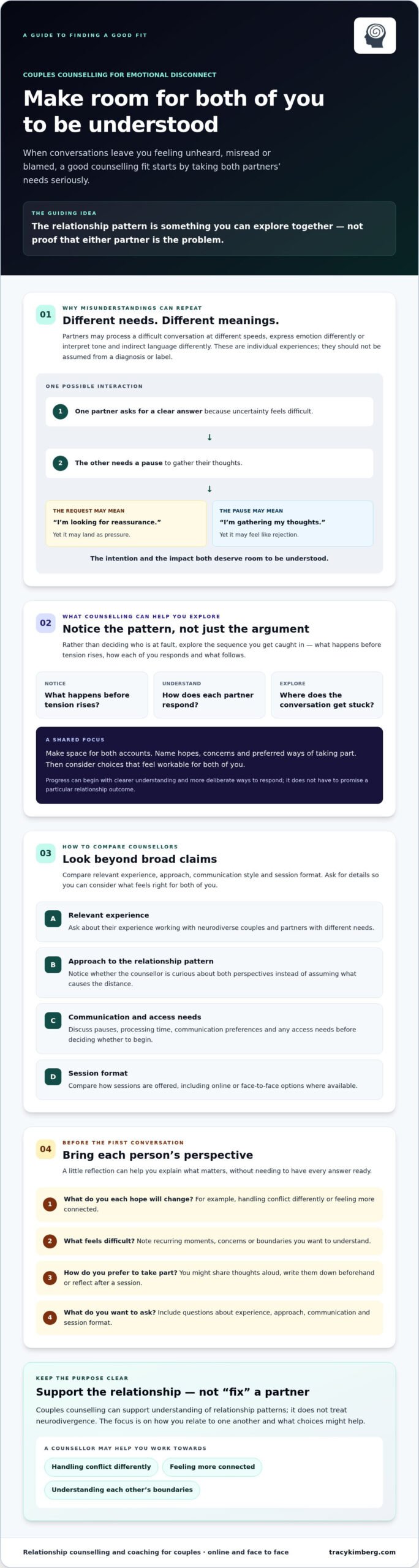
For example, one partner might ask for a clear answer because uncertainty feels difficult. The other might need a pause to gather their thoughts. The request may be intended as a bid for reassurance, yet land as pressure. The pause may be intended to prevent a reactive reply, yet feel like rejection. A counsellor can help you make room for both the intention and the impact, then find ways to check what each person means.
What should counselling help both partners explore?
Rather than deciding who is at fault, counselling can help you notice the sequence you get caught in: what happens before tension rises, how each of you responds and what follows. Seeing the pattern as something you face together can open up different choices.
Both partners should have space to name their hopes, concerns and preferred ways of taking part. You might want to discuss what helps you feel heard, whether you need more time to respond or how you’d like to handle moments of overwhelm. Progress doesn’t have to mean promising a particular relationship outcome. It can begin with a clearer understanding of each other and more deliberate ways to respond.
What should marriage counselling for neurodiverse couples address?
Couples may seek counselling when they feel emotionally distant, argue about recurring issues, have concerns about intimacy or keep misunderstanding one another. The starting point shouldn’t be an assumption about why this is happening. A counsellor can invite each partner to describe their experience, then help you notice the interaction cycle: what tends to happen, how each of you responds and where the conversation gets stuck.
Both accounts matter. A moment one partner experiences as criticism may have been intended as a request for closeness, but the impact still deserves to be heard. The British Psychological Society discusses some challenges for the autistic partner, but no article can tell you exactly what either person in your relationship experiences. Ask a prospective counsellor directly about their experience with neurodiversity and how they work with partners who have different needs.
Couples counselling can support understanding of relationship patterns; it doesn’t treat neurodivergence. The focus is on how you relate to one another and what choices might help, without making either partner responsible for being “fixed”. Agreeing shared goals can keep the work relevant, whether you want to handle conflict differently, feel more connected or understand each other’s boundaries.
Can counselling make space for different ways of communicating?
Ask how the counsellor handles pauses, processing time and different communication styles. You might also discuss whether you each prefer to share thoughts aloud, write them down beforehand or reflect after a session. These are questions to explore together, not accommodations to assume are available. A clear conversation about what helps each of you participate can show whether the counsellor is open to understanding your needs.
How can a therapist keep the work balanced?
You can ask, “How do you make sure neither partner is treated as the sole cause of our difficulties?” and “What happens if we disagree in a session?” Both of you should have room to raise concerns and express different views without one person’s perspective being dismissed. Consider agreeing what progress would look like to each of you, then revisit that shared definition as the work develops.
If you’re exploring couples counselling for emotional disconnect UK, an initial conversation can help you discuss what you each need and consider whether the approach feels right. Learn more about relationship counselling and coaching for couples with Tracy Kimberg, and ask her about her experience and the session formats that may suit you both.
How to compare marriage counsellors for neurodiverse couples in the UK
Choosing a counsellor is less about finding a perfect label and more about finding someone who can understand your relationship without making assumptions. Compare a few practical areas, then use an initial conversation to notice whether both of you feel heard. A clear answer to your questions is more useful than broad claims such as “inclusive” or “neurodiversity-friendly” on their own.
| Area | What to check |
|---|---|
| Experience | What relevant training or experience do they have supporting couples with different communication needs? |
| Approach | How do they understand recurring relationship patterns, and how do they make space for both partners’ perspectives? |
| Access | Can you discuss what helps each of you take part? Ask which adjustments, if any, can be arranged rather than assuming. |
| Format | Are online or face-to-face sessions available, and which might work best for your circumstances? |
| Communication | Do their explanations feel clear, respectful and open to questions from both partners? |
Separate what you can verify, such as a stated qualification or specific experience, from general marketing language. You don’t need to decide in advance whether a counsellor has the right expertise. Ask direct questions and listen for answers that explain their approach without promising outcomes or treating neurodivergence as a relationship problem to fix.
What questions should you ask before choosing a counsellor?
Try asking: “What experience do you have supporting couples with different communication needs?” “How are sessions structured, and how do both partners contribute to goals?” “What would you do if one of us felt misunderstood?” The responses can help you assess whether your concerns are met with curiosity and whether each partner has room to speak and disagree.
How do online and face-to-face sessions compare?
Neither format is automatically better. Consider privacy, comfort and practical access for both of you. Online sessions may suit your circumstances, whilst meeting face to face may feel more comfortable for others. Tracy Kimberg offers both online and face-to-face therapy. Ask which format is available and discuss what would work for you as a couple.
If you’re looking into couples counselling for emotional disconnect UK, an initial conversation is also a chance to notice how it feels to speak with the counsellor together. Do both partners have space to ask questions? Can you discuss what you need without being judged? That sense of mutual fit can matter as much as the information you gather.
How to prepare for your first couples counselling conversation
An initial conversation doesn’t need to be a polished account of your relationship. Think of it as a chance to explain what has brought you here, ask practical questions and see whether the counsellor’s approach feels right for both of you. Preparing a little can help if difficult conversations leave either partner feeling stuck, but you don’t need to agree on every detail beforehand.
You can use this simple sequence:
- Identify concerns: Each of you can write down one relationship concern and one thing you hope might change.
- Agree questions: Choose what you’d like to ask about the counsellor’s experience, approach and session structure.
- Discuss access needs: Consider whether communication style, pacing or sensory factors may affect how you take part. Share only what you’re comfortable discussing.
- Review fit: After the conversation, reflect separately and together on whether you both felt heard and respected.
It’s also reasonable to ask directly about fees, session format and practical arrangements. If you’re exploring couples counselling for emotional disconnect UK, those details are part of making an informed choice, not an awkward interruption.
What should each partner bring to an initial conversation?
Alongside one concern and one hope, note a situation where communication feels easier and one where it tends to break down. Perhaps you connect better during a calm walk than in a rushed discussion, or find it harder to speak when you feel put on the spot. These examples can help you describe what happens without needing perfect wording or a complete relationship history.
How can you tell whether the first conversation feels right?
Afterwards, ask yourselves: Did we both have room to speak? Were our concerns treated with respect? Did the counsellor respond thoughtfully to questions about accessibility and fit? You don’t have to decide on the spot. Taking time to reflect can help you distinguish initial nerves from a genuine concern that the approach may not suit one or both of you.
If you’d like to understand Tracy Kimberg’s approach to relationship support before deciding, explore couples counselling with Tracy and consider what you’d want to ask in an initial conversation.
Explore couples counselling with Tracy Kimberg: decide on your next step
Seeking support doesn’t mean you’ve failed as a couple or already know what the future should hold. It can be a way to understand what’s happening between you and consider what you’d each like to change. If you’re weighing up couples counselling for emotional disconnect UK, ask whether the counsellor’s approach and arrangements feel suitable for both partners.
What does Tracy Kimberg offer couples?
Tracy Kimberg offers relationship counselling and coaching for couples, including support for emotional disconnect and relational breakdown. Her research-based approach is inspired by the work of John Gottman and Esther Perel. This describes the influences behind her approach, not an endorsement by either of them.
Online and face-to-face therapy are available. Tracy also offers the 12-Week Relationship Recovery Process, a structured programme for couples. If you’re considering it, ask whether its structure and approach fit your circumstances.
What should you discuss before deciding to begin?
If experience with neurodiversity or particular session adjustments are important to you, ask Tracy directly about her relevant experience and whether the adjustments you need can be accommodated. You might also confirm the session format and practical arrangements, and explain what helps each of you take part. That conversation can help you decide whether the support feels appropriate for both partners.
There’s no need to arrive with a final answer about your relationship or a complete plan. Use an initial discussion to share what you hope to work on, hear how the service is structured and consider whether you both feel respected. Counselling can support clearer understanding and more considered choices, but it can’t promise a particular outcome.
To discuss your needs and explore whether the approach suits you both, get in touch with Tracy Kimberg about couples counselling. You can take the next step at your own pace and decide together whether her counselling and coaching feel like a suitable way forward.
Take a thoughtful next step towards understanding each other
Feeling disconnected doesn’t mean you’ve stopped caring. It may mean the ways you communicate, process difficult moments or seek reassurance aren’t meeting each other’s needs. A helpful counsellor makes room for both perspectives, helps you look at the patterns between you and supports you in deciding what you want to work towards.
As you consider couples counselling for emotional disconnect UK, focus on whether you and your partner feel listened to, whether questions about experience and access needs are welcomed, and whether the approach feels workable for you both. You don’t need to reach a decision before asking about support.
Tracy Kimberg offers relationship counselling and coaching for couples, with online and face-to-face therapy available. Her 12-Week Relationship Recovery Process is another option to discuss. Ask Tracy directly about your circumstances and any session adjustments you may need.
If you’d like to explore whether her approach feels like a suitable next step, explore couples counselling with Tracy. A thoughtful first conversation can help you decide together, at your own pace, what comes next.
Frequently Asked Questions
Can marriage counselling help neurodiverse couples feel more connected?
It can help partners explore what’s happening between them and identify ways to communicate that feel more workable. For couples seeking couples counselling for emotional disconnect UK, sessions might focus on how misunderstandings arise, what helps each person feel heard and what each partner hopes will change. Neurodivergent people have varied experiences, so a counsellor should ask rather than assume. Counselling can support understanding, but it can’t guarantee reconnection or a particular outcome.
How do we find a counsellor who understands neurodiverse couples in the UK?
Ask directly about the counsellor’s experience supporting couples with different communication needs and how they approach neurodiversity. Look for clear, specific answers rather than relying only on broad descriptions such as “inclusive”. You can also check any qualifications or experience they mention and ask how both partners’ perspectives are included. An initial conversation can help you judge whether you feel respected and whether the approach seems appropriate for your relationship.
What should we ask a couples counsellor before starting?
Ask how sessions are structured, how both partners contribute to goals and what the counsellor does if one of you feels misunderstood. You might also ask about their relevant experience, online or face-to-face formats, fees and practical arrangements. If pauses, processing time or another access need matters to either of you, raise it and ask what may be possible. The answers can help you decide whether the counsellor feels like a good fit.
Is online marriage counselling suitable for neurodiverse couples?
It can suit some couples, but the right format depends on each partner’s comfort, privacy and practical circumstances. Consider whether you can both take part without interruptions and whether meeting online feels easier or more distracting. Tracy Kimberg offers online therapy as well as face-to-face therapy. Ask which format may suit your circumstances and whether any session arrangements you need can be accommodated.
What happens if one partner is unsure about counselling?
Start by making space for the uncertainty rather than treating it as resistance or a refusal to work on the relationship. The hesitant partner may have questions about being blamed, what sessions involve or whether their needs will be understood. You could agree to ask a counsellor those questions before deciding. An initial conversation can help both of you consider the approach; you don’t have to commit before you feel ready.
Does couples counselling require both partners to communicate in the same way?
No. Couples counselling doesn’t require you to express feelings, process conversations or respond at the same pace. The useful question is how the counsellor can help each of you take part and understand the other’s perspective. You might prefer speaking spontaneously, while your partner needs time to reflect. Discussing these differences together can help you explore communication patterns without treating one style as the standard or either partner as the problem.

Article by
Tracy Kimberg
Tracy Kimberg is a Relationship Expert, Couples Therapist and Coach with a dedicated focus on helping couples and individuals rebuild connection, trust and emotional safety in their relationships. Drawing on the research of John and Julie Gottman, the relational insights of Esther Perel, and years of hands-on therapeutic experience, Tracy offers a warm, non-judgemental and deeply compassionate approach to modern relationships.
Based in Dorset, Tracy works with couples navigating communication breakdowns, betrayal, intimacy challenges, separation, family dynamics and life transitions. Known for creating a safe and grounded therapeutic space, she combines practical tools with emotional depth to help clients move beyond survival patterns and towards meaningful, lasting change.
With a reputation for empathy, professionalism and dedication to her clients’ growth, Tracy is passionate about helping people feel seen, understood and empowered — both within their relationships and within themselves.
Disclaimer
Disclaimer:
The information shared in this article is intended for educational and informational purposes only and should not be considered a substitute for professional therapeutic, psychological, medical or legal advice. Every individual and relationship is unique, and the perspectives offered are based on general therapeutic principles, research and professional experience.
Reading this article does not establish a therapist-client relationship with Tracy Kimberg. If you are experiencing significant emotional distress, relationship crisis, trauma, or mental health concerns, it is important to seek support from a qualified professional appropriate to your individual circumstances.
All content remains the intellectual property of Tracy Kimberg and may not be reproduced or distributed without permission.