

What if the icy silence your partner retreats into during a conflict isn’t a tactical punishment, but a physiological emergency? When an argument abruptly dies, the emotional impact is immediate and painful. Living with the profound effects of stonewalling in a marriage often leaves you feeling completely invisible, rejected, and burdened by a chronic anxiety that lingers long after the dispute ends.
It is exhausting to feel so hopeless about basic communication, especially when you are simply desperate to resolve the issue. However, this silence rarely means your partner has stopped caring. Instead, it is usually a sign of emotional flooding, where their nervous system is too overwhelmed to process words. Forcing a conversation during this state only builds the barricade higher.
In this guide, you will discover how this silent killer of relationships erodes intimacy, whilst learning the research-backed steps to safely dismantle the wall and reconnect. By understanding the root cause of the silence, you can gain the practical tools needed to re-engage and restore lasting emotional safety to your partnership.
Key Takeaways
- Recognise that stonewalling is a protective psychological barricade and one of the critical signs that your relationship requires immediate, compassionate attention.
- Understand how physiological flooding triggers the “thinking brain” to shut down, contributing to the long-term effects of stonewalling in a marriage.
- Learn why chronic silence erodes the foundation of trust and creates a profound sense of loneliness, even whilst you are in the same room.
- Master the art of physiological self-soothing and discover how to use respectful “Time-Outs” to pause conflict before it leads to a total withdrawal.
- Explore how a structured 12-Week Relationship Recovery Process can provide the safe, professional environment needed to dismantle the wall and restore intimacy.
Understanding Stonewalling: The Silent Killer of Marital Intimacy
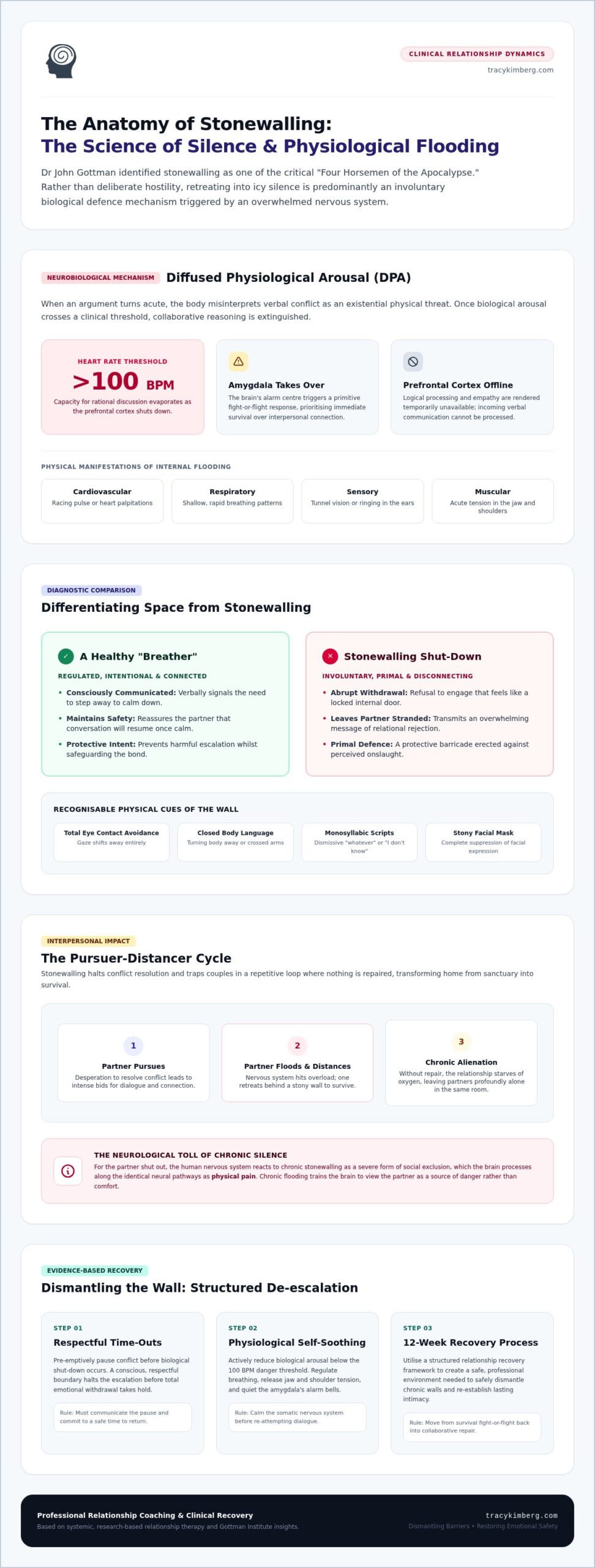
Stonewalling isn’t just a lapse in conversation or a quiet evening on the sofa. It’s a psychological barricade that one partner builds to shut the other out. Dr John Gottman famously identified Stonewalling as one of the “Four Horsemen of the Apocalypse,” a predictor of relationship distress so potent it can signal the end of a partnership if left unaddressed. While the silent partner might feel they’re simply avoiding a fight, the other person experiences a total emotional shut-out. This isn’t the same as setting a healthy boundary or asking for space to think; it’s a withdrawal that leaves the other person stranded. It’s a refusal to engage that feels like a door being slammed and locked from the inside.
The Anatomy of the Wall
When someone stonewalls, their body language tells a story of disconnection. You might notice specific physical cues when the wall goes up:
- A total avoidance of eye contact.
- Turning the body away or crossing arms tightly.
- Brief, non-committal responses like “whatever” or “I don’t know.”
- A sudden, stony facial expression that masks all emotion.
It’s vital to distinguish this from “taking a breather.” A breather is a conscious, communicated pause to calm down. In contrast, shutting down is an involuntary retreat. For many, this is a primal defence mechanism against perceived threats. One of the primary effects of stonewalling in a marriage is that it transforms the home from a sanctuary into a site of physiological survival, where one partner is literally too overwhelmed to speak. They aren’t trying to be cruel; they’re trying to survive a perceived emotional onslaught, even if that onslaught is just a difficult conversation.
Why Silence is Louder Than Words
Silence often carries a weight that words cannot match. In the context of a relationship, silence doesn’t just mean a lack of noise; it communicates a clear message of rejection. This dynamic halts conflict resolution entirely, keeping couples trapped in a repetitive loop where nothing is ever truly solved. It frequently fuels the “pursuer-distancer” cycle. One partner chases for connection, whilst the other retreats further into the shadows.
This pattern is one of the most destructive effects of stonewalling in a marriage, as it replaces collaborative problem-solving with a game of hide-and-seek that no one wins. It turns your partner into a stranger, making the distance between you feel like an unbridgeable chasm. When you can’t talk, you can’t repair. Without repair, the relationship begins to starve of the oxygen it needs to thrive, leaving both partners feeling profoundly alone despite sharing a life together.
The Science of Silence: Physiological Flooding and the Brain
If you’ve ever felt your heart pounding or your mind go completely blank during a disagreement, you’ve experienced what researchers call Diffused Physiological Arousal (DPA). It’s a state of biological overwhelm. According to The Gottman Institute, when a person’s heart rate exceeds 100 beats per minute, the capacity for rational discussion evaporates. This isn’t a calculated attempt to be difficult; it’s a shutdown of the prefrontal cortex, the part of the brain responsible for empathy and logic. When this happens, the stonewaller literally cannot process the information you’re trying to share.
When the Body Takes Over
During these moments, the physical experience is intense. You might notice:
- A racing pulse or heart palpitations.
- Shallow, rapid breathing.
- A sense of “tunnel vision” or ringing in the ears.
- Muscle tension, particularly in the jaw or shoulders.
The amygdala, your brain’s alarm centre, has taken over. It triggers a primitive fight-or-flight response that effectively mutes your ability to communicate. Physiological flooding is a state where the body perceives a verbal argument as a physical threat. In this survival mode, the brain prioritises safety over connection, leading to the stony silence that feels so painful to the other partner.
The Impact of Chronic Stress
The long-term effects of stonewalling in a marriage extend far beyond the immediate argument. Chronic flooding trains the brain to view the partner as a source of danger rather than a source of comfort. For the partner being shut out, the nervous system reacts to the silence as a form of social exclusion, which the brain processes similarly to physical pain. For the stonewaller, the repeated cycle of overwhelm leads to a sense of helplessness. Over time, both individuals may find their baseline anxiety levels rising, making it harder to return to a state of calm connection without professional guidance.
This constant state of “bracing” prevents the vulnerability required for true intimacy. It’s why creating a safe environment is so crucial in the healing process. If you find yourselves stuck in this biological loop, engaging in specialised relationship coaching can help you learn to regulate these responses together, whilst building a new foundation of mutual trust. Shifting the perspective from one of malice to one of biological overwhelm is the first step toward dismantling the wall.
The Long-Term Effects of Stonewalling on Your Marriage
When silence becomes a permanent fixture in your home, the very fabric of your connection begins to fray. It’s no longer just about a single, difficult evening; it’s about the cumulative erosion of trust. Living with the chronic effects of stonewalling in a marriage creates a “loneliness in a crowd” scenario that is deeply painful. You might be sharing a bed and a bank account, yet you feel miles apart. This persistent emotional disconnect often leads to a state of apathy, which is frequently the final stage before a relationship reaches its breaking point.
The Emotional Toll on the Partner
For the spouse who is repeatedly shut out, the experience is one of profound invisibility. When your attempts to share your heart are met with a blank stare or a turned back, it triggers a sense of worthlessness. You start to wonder if your feelings even matter. This often leads to what psychologists call “protest behaviour.” You might find yourself shouting, crying, or following your partner from room to room, desperately seeking any sign of engagement. It’s a primal response to the threat of abandonment.
If this cycle continues, the fire of the relationship eventually dims into the “roommate phase.” You stop fighting because you’ve lost hope that anything will change. Intimacy becomes a memory, replaced by a polite but icy co-existence. This state of emotional starvation is dangerous; it’s often amongst this debris that one partner may begin to look elsewhere for the validation and connection they are missing at home.
The Structural Decay of the Partnership
Beyond the emotional pain, the relationship stops functioning on a practical level. When one person withdraws, the ability to solve even minor problems vanishes. Whether it’s a disagreement over finances or a simple scheduling conflict, the issue remains unresolved because the door to dialogue is locked. These long-term effects of stonewalling act like a slow poison, ensuring that today’s minor annoyance becomes tomorrow’s insurmountable resentment.
Unresolved issues don’t just disappear; they pile up, creating a mountain of baggage that eventually feels too heavy to move. Research from the Gottman Institute consistently highlights that this specific pattern of withdrawal is one of the most reliable predictors of divorce. It signals that the couple has moved past active conflict into a much more dangerous territory: indifference. Once you stop caring enough to even try to break the silence, the structural integrity of the marriage is at significant risk. Recognising these signs early is vital for anyone hoping to rebuild a foundation of safety and mutual respect.
Dismantling the Wall: How to Break the Cycle of Silence
To mitigate the devastating effects of stonewalling in a marriage, you must replace the wall with a bridge of safety. This process begins with a fundamental shift in how you handle conflict. Instead of viewing silence as a weapon, we treat it as a signal that the nervous system needs to reset. The primary antidote to this shutdown is physiological self-soothing. By learning to calm your own body, you regain access to your “thinking brain,” allowing for a conversation that is productive rather than destructive.
Prevention is just as vital as the cure. Using a “softened start-up” when bringing up a concern can prevent flooding before it even begins. This means starting the conversation without blame or criticism. When you lead with your own feelings and a positive need, your partner is far less likely to feel attacked and retreat into silence. Once the body is calm, you can move into active listening, where the goal is to understand your partner’s perspective rather than preparing a rebuttal.
Learning to Self-Regulate
If you feel the tell-tale signs of flooding, you must ask for a respectful “Time-Out.” This isn’t an excuse to run away; it’s a commitment to return when you’re capable of connection. You should agree on a break of at least 20 minutes. It takes this long for the body to metabolise stress hormones like adrenaline and for the heart rate to return to a baseline level. During this time, you must engage in calming activities such as deep breathing, a brisk walk, or listening to your favourite music.
Crucially, you must use this time for soothing, not for ruminating on the argument. If you spend the break rehearsing your next point or dwelling on your partner’s perceived faults, you’ll remain flooded. The goal is to reach a state of internal quiet so that when you re-engage, you do so with a spirit of collaboration. This simple ritual is one of the most effective ways to stop the cycle of withdrawal before it causes lasting damage.
Communication Tools for the Pursuer
If you’re the partner who usually chases for connection, learning to give space can feel incredibly counterintuitive. It may trigger a fear of abandonment. However, giving your partner 20 minutes to breathe is an act of love, not a sign of defeat. You can support this by using “I” statements to express your needs. Saying “I feel lonely and worried when we stop talking” is far more effective than saying “You always shut me out,” which only invites further defensiveness.
By shifting your focus from your partner’s behaviour to your own emotional experience, you lower the temperature of the interaction. This approach creates the room necessary for your spouse to step back toward you. To help you navigate these moments, you can explore these exercises for couples to reconnect. Learning these skills together ensures that the effects of stonewalling in a marriage don’t become the final chapter of your story. If you’re ready to move beyond the silence, you can book a session for relationship coaching today to start building a more resilient bond.
The Path to Healing: How Relationship Coaching Can Help
Healing from the profound effects of stonewalling in a marriage requires more than just a desire to talk; it requires a structured framework that prioritises emotional safety. When you’re trapped in a cycle of silence, the prospect of opening up can feel incredibly daunting. This is where professional guidance becomes essential. As a specialised authority in interpersonal dynamics, I help couples move beyond the weight of their problems toward a state of calm optimism. We don’t just look at what’s wrong; we actively build the skills to make it right.
The transition from a relational breakdown to a conscious approach for the future is a powerful journey. It involves moving from a state of chronic anxiety during conflict to a place where you both feel seen and heard. Even if silence has been a feature of your partnership for years, the damage can be repaired with the right tools and a commitment to change. By focusing on the possibility of healing rather than just the weight of the past, we create space for a new kind of intimacy to grow.
A Research-Based Approach to Recovery
My work is deeply rooted in research-based methodologies, drawing on the clinical expertise of figures like Dr John Gottman and the systemic insights of Esther Perel. The goal is transformation rather than merely “venting.” Whilst traditional talk therapy can sometimes feel like a static repetition of old grievances, the 12-Week Relationship Recovery Process is designed as an evolving experience. It provides a non-judgemental, safe environment where both partners can explore their triggers without fear of further conflict. Whether you choose online therapy or face-to-face sessions, the focus remains on dismantling the barricade and restoring the interpersonal closeness you’ve lost.
Taking the First Step Towards Connection
Choosing to seek help isn’t a clinical necessity born of failure; it’s a proactive adventure in relationship health. It signals that you value the connection enough to invest in its long-term emotional well-being. By framing the work as a collaborative solution, we demystify the therapeutic process and make the path to recovery feel manageable and inviting. If you’re ready to address the effects of stonewalling in a marriage and breathe new life into your partnership, the path forward is clear and supportive.
You don’t have to navigate this silent landscape alone. Taking that first step towards professional support is often the most courageous part of the process. Book a discovery call to start your 12-Week Relationship Recovery today. Let’s work together to turn your silence into a supportive, lasting conversation.
Reclaiming Your Connection Beyond the Silence
The silence that once felt like a protective shield has likely become a heavy weight between you. Understanding that this withdrawal is a physiological response to overwhelm is the first step toward empathy. By recognising the profound effects of stonewalling in a marriage, you can stop viewing your partner as an adversary and start seeing the biological emergency at play. It’s possible to dismantle this wall by prioritising self-regulation and creating a safe environment where both voices feel heard.
You don’t have to navigate this journey alone or without a map. My research-based approach provides a structured path back to intimacy. Through expert guidance in a safe, non-judgemental environment, you can transform your relationship from a state of breakdown into a conscious, thriving partnership. Healing is a proactive adventure that begins the moment you decide to reach out. It’s about moving from a place of isolation to a shared future of mutual respect.
Begin your journey to reconnection with the 12-Week Relationship Recovery Process. There is hope for your future together, and the first step is simply choosing to break the silence.
Frequently Asked Questions
Is stonewalling a form of emotional abuse in a marriage?
Stonewalling isn’t always intended as abuse; it’s often a primal physiological shutdown. However, when silence is weaponised to punish or control a partner, it crosses the line into emotional harm. The primary effects of stonewalling in a marriage include a total breakdown of safety and trust. If you feel manipulated rather than just shut out, it’s vital to seek a safe environment to explore these dynamics. Understanding the intent behind the silence is the first step toward healing.
How do I know if my partner is stonewalling or just needs space?
The difference lies in communication and intent. A partner who needs space will typically state, “I’m feeling overwhelmed and need a moment to calm down before we continue.” They provide a timeline for returning to the conversation. Stonewalling, however, is an abrupt withdrawal without explanation or a clear path back. It leaves you stranded in the conflict. Recognising this distinction helps you move from anxiety to a more informed, calm approach when marital tension rises.
Can a marriage survive years of stonewalling behaviour?
A marriage can certainly survive years of this behaviour, but it rarely thrives without intervention. Long-term silence creates a “roommate phase” where intimacy is replaced by apathy. The effects of stonewalling in a marriage are cumulative, often requiring a structured 12-Week Relationship Recovery Process to dismantle the built-up resentment. Survival is possible when both partners commit to learning new research-based tools for emotional regulation, moving away from relational breakdown toward a proactive adventure in reconnection.
What should I do if my partner refuses to stop stonewalling?
If your partner refuses to engage, focus on your own emotional health and boundaries first. You cannot force another person to speak, but you can change your response to their silence. Seeking individual therapy for adults can provide the support you need to navigate this isolation. Often, when one partner stops the “pursuer” behaviour and focuses on their own regulation, it creates a shift in the dynamic that may eventually invite the other person back into a safe conversation.
Does stonewalling always lead to divorce or separation?
Whilst stonewalling is a significant predictor of divorce, it isn’t an inevitable death sentence for your partnership. It serves as a loud alarm bell that your current communication style is failing. Many couples use this crisis as a turning point to adopt a more conscious approach to their relationship. By addressing the root causes of the silence through specialised relationship coaching, you can prevent separation and build a foundation that is more resilient than before the conflict began.
How can I stay calm when I am being stonewalled by my spouse?
Staying calm requires you to recognise that your spouse’s withdrawal is a reflection of their internal overwhelm, not a statement on your worth. Practice deep breathing and remind yourself that chasing them will only increase their need to retreat. By focusing on your own physiological self-soothing, you break the pursuer-distancer cycle. This shift in energy often lowers the temperature in the room, making it easier for the stonewaller to eventually feel safe enough to re-engage with you.
What is the difference between stonewalling and the “silent treatment”?
The distinction is found in the underlying motivation. The “silent treatment” is usually a conscious, tactical choice used to punish or manipulate a partner. Stonewalling, by contrast, is often an involuntary physiological collapse known as flooding. In this state, the person’s heart rate spikes and their brain’s ability to process language effectively shuts down. Whilst both result in painful silence, the path to resolving stonewalling involves nervous system regulation rather than just addressing a simple behavioural choice.
How does the Gottman Method help with stonewalling during conflict?
The Gottman Method offers a specific “Antidote” to this shutdown: physiological self-soothing. It teaches couples to identify the physical signs of flooding early. When these signs appear, you agree to take a structured break to let your heart rates drop. My 12-Week Relationship Recovery Process integrates these research-based tools, guiding you to replace the silent barricade with a culture of appreciation and effective conflict management. This structured approach provides the safety needed to turn silence into genuine connection.

Article by
Tracy Kimberg
Tracy Kimberg is a Relationship Expert, Couples Therapist and Coach with a dedicated focus on helping couples and individuals rebuild connection, trust and emotional safety in their relationships. Drawing on the research of John and Julie Gottman, the relational insights of Esther Perel, and years of hands-on therapeutic experience, Tracy offers a warm, non-judgemental and deeply compassionate approach to modern relationships.
Based in Dorset, Tracy works with couples navigating communication breakdowns, betrayal, intimacy challenges, separation, family dynamics and life transitions. Known for creating a safe and grounded therapeutic space, she combines practical tools with emotional depth to help clients move beyond survival patterns and towards meaningful, lasting change.
With a reputation for empathy, professionalism and dedication to her clients’ growth, Tracy is passionate about helping people feel seen, understood and empowered — both within their relationships and within themselves.
Disclaimer
Disclaimer:
The information shared in this article is intended for educational and informational purposes only and should not be considered a substitute for professional therapeutic, psychological, medical or legal advice. Every individual and relationship is unique, and the perspectives offered are based on general therapeutic principles, research and professional experience.
Reading this article does not establish a therapist-client relationship with Tracy Kimberg. If you are experiencing significant emotional distress, relationship crisis, trauma, or mental health concerns, it is important to seek support from a qualified professional appropriate to your individual circumstances.
All content remains the intellectual property of Tracy Kimberg and may not be reproduced or distributed without permission.