

What if the reassuring praise you offer your teenager is accidentally driving them deeper into their shell? When an adolescent struggles with self-doubt, hearing “you are brilliant” can feel like an impossible standard rather than genuine comfort. If you are searching for how to help a teenager with low self-esteem without triggering slammed doors and defensive anger, you are not alone.
It is exhausting to watch your child withdraw behind a screen, quietly measuring their worth against curated feeds whilst batting away your attempts to connect. You might worry whether their silence masks deeper depression, feeling torn between stepping in to fix the hurt and stepping back to keep the peace. True confidence rarely stems from superficial compliments; it blossoms through emotional attunement and felt relational safety.
Here, you will discover psychologically grounded, practical methods to understand your teenager’s emotional world and rebuild their self-worth from within. We explore the hidden drivers behind adolescent insecurity, practical shifts to establish calm dialogue, and how to recognise when professional therapeutic support can help restore their inner spark.
Key Takeaways
- Understand the underlying neurological remodelling that shapes your adolescent’s sensitivity to perceived peer rejection and self-evaluation.
- Learn how to distinguish typical teenage moodiness from deep-seated, chronic patterns of self-criticism and catastrophic thinking.
- Discover practical conversational shifts showing how to help a teenager with low self-esteem by replacing dismissive praise with emotional attunement.
- Master low-pressure ways to validate your child’s vulnerable reality before stepping into instinctive problem-solving mode.
- Recognise the vital turning points when introducing Therapy for Teenagers creates a collaborative harbour for genuine healing.
Understanding Adolescent Self-Esteem: What Is Happening Beneath the Surface?
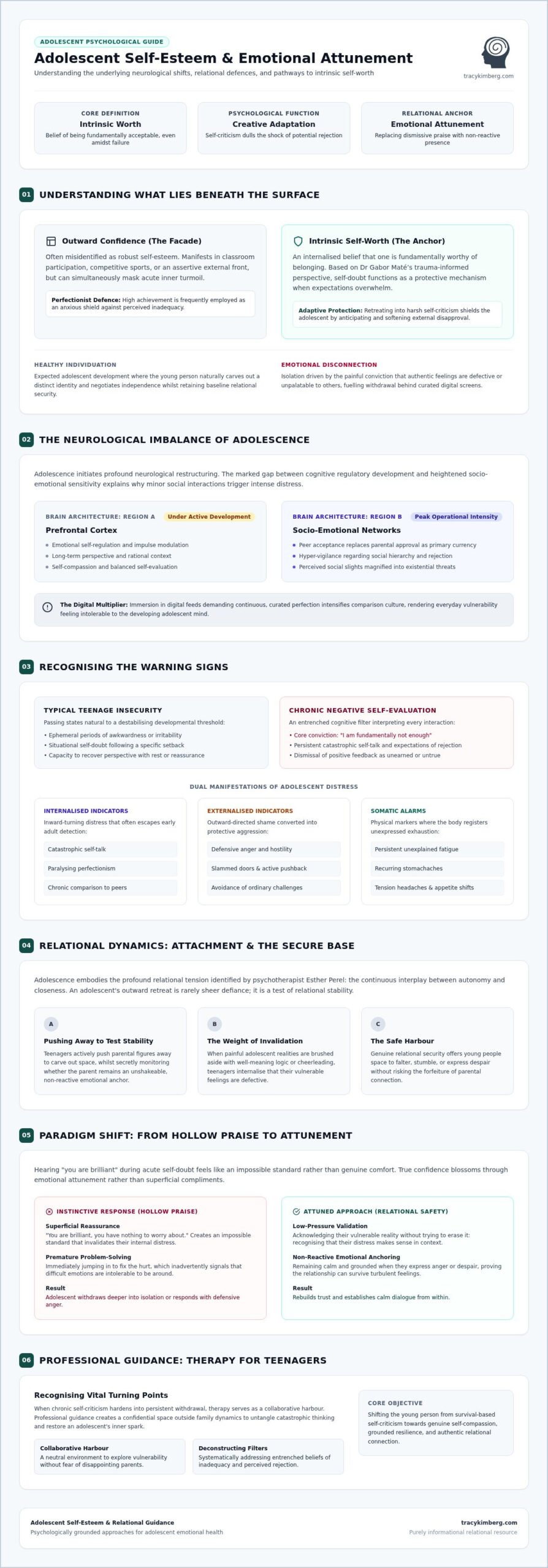
Self-esteem during the teenage years is often mistaken for outward confidence, such as speaking up in class, participating in sports, or presenting a bold front. At its core, genuine self-esteem is an internalised sense of intrinsic worth. It is an enduring belief that one is fundamentally acceptable and worthy of belonging, even amidst failure. Understanding what is happening beneath the surface allows us to see that adolescent insecurity is rarely an inherent flaw. Drawing on the trauma-informed perspective of Dr Gabor Maté, low self-esteem is best understood as a creative adaptation. When a young person feels overwhelmed by expectations or vulnerable to rejection, retreating into harsh self-criticism protects them by dulling the shock of outside disapproval.
There is a profound difference between healthy individuation and the isolation that stems from emotional disconnection. As teenagers carve out their personal identities, pulling away from family life is expected. Yet, when parents wonder how to help a teenager with low self-esteem, they often uncover a young person who has isolated themselves because they believe their authentic feelings are unpalatable to others. Disconnection breeds profound self-doubt.
The Neurological and Social Shifts of Adolescence
Adolescence triggers profound neurological remodelling. The prefrontal cortex, which governs emotional regulation, long-term perspective, and self-compassion, is still developing. Meanwhile, the brain’s social and emotional networks operate at peak intensity. This imbalance magnifies perceived social slights into existential threats. Peer acceptance abruptly replaces parental approval as primary social currency, leaving adolescents hyper-vigilant. When immersed in digital channels that demand constant curated perfection, teenagers experience relentless comparison culture, making ordinary vulnerability feel entirely unacceptable.
Attachment and the Need for a Secure Base
As psychotherapist Esther Perel highlights in her relational work, human connection thrives within the delicate dance between autonomy and closeness. Teenagers embody this tension intensely:
- Pushing away to test stability: Adolescents frequently push parental figures away to assert their emerging independence, yet they secretly track whether that parent remains an unshakeable, non-reactive emotional anchor.
- The weight of invalidation: When difficult emotions are brushed aside at home with well-meaning logic, adolescents internalise that their feelings are defective, deepening self-doubt.
- A safe harbour: True relational security gives young people room to falter without forfeiting connection.
Learning how to help a teenager with low self-esteem begins by viewing their retreat not as stubborn defiance, but as a tender plea for relational safety.
Recognising the Warning Signs: Is It Normal Teenage Insecurity or Low Self-Esteem?
Every adolescent experiences days coloured by self-doubt, awkwardness, or irritability. Adolescence is an inherently destabilising threshold. The challenge arises when temporary insecurity hardens into a pervasive, chronic negative self-evaluation. Rather than passing moods, low self-esteem creates an internal filter where every interaction confirms a painful belief: “I am fundamentally not enough.” Parents trying to decipher these shifts can benefit from recognising the warning signs before patterns of emotional withdrawal become deeply entrenched.
Distress presents differently in every adolescent. Some internalise their struggle through catastrophic self-talk and chronic comparison, while others externalise their shame through anger, defiance, or total avoidance of everyday challenges. The body often registers this emotional weight first; persistent fatigue, mysterious stomachaches, tension headaches, and sudden shifts in appetite frequently serve as somatic alarms for unexpressed emotional exhaustion.
Subtle Emotional and Behavioural Indicators
Low self-worth does not always look like an obvious decline in academic performance. Often, the highest-achieving teenagers carry the deepest wounds:
- Paralysing perfectionism: Striving relentlessly for top marks or flawless appearances often operates as an anxious defence mechanism, an attempt to stay beyond reproach so unworthiness remains hidden.
- Self-deprecating humour: Using constant self-mockery deflects vulnerability, striking preemptively before anyone else can point out perceived shortcomings.
- Strategic avoidance: Abruptly abandoning favourite clubs, sports, or creative passions shields the ego from potential failure or peer scrutiny.
When Low Self-Worth Signals Emerging Anxiety or Depression
Persistent self-criticism rarely stays contained. When a teenager expresses absolute statements like “nothing I do matters” or “everyone would be happier without me”, low self-worth has crossed the threshold into depressive distress. This often coincides with severe body image concerns, where perceived physical inadequacy becomes the tangible scapegoat for deeper emotional pain.
Understanding how to help a teenager with low self-esteem requires moving past surface irritation at their sullenness and meeting the vulnerability beneath. If your household feels caught in recurring cycles of defensive anger and withdrawal, exploring supportive therapeutic guidance can help your family restore open, compassionate connection.
Why Hollow Praise Backfires: Shifting from Compliments to Attunement
When an adolescent sinks into self-doubt, our parental instinct is to offer reassurance. We reflexively tell them, “You are brilliant,” “You look lovely,” or “Don’t be silly, everyone likes you.” Yet these cheerleading phrases often provoke eye rolls, slammed doors, or bitter rebuttals. To an insecure adolescent, sweeping compliments do not soothe pain; they trigger sharp internal scepticism. They make the teenager feel unseen, as if their genuine despair is being glossed over with an easy brush-off. Discovering how to help a teenager with low self-esteem requires moving away from hollow flattery toward deep emotional attunement.
Much of this disconnect stems from our own parental discomfort with sadness. Watching our children suffer ignites profound helplessness, prompting us to rush in and fix the mood rather than sit beside their pain. When we immediately contradict their struggles, we unintentionally invalidate their reality. Instead of feeling comforted, they conclude that their difficult emotions are inconvenient or wrong. True emotional resilience is fostered when we implement grounded, practical strategies that meet adolescents where they are, rather than demanding they instantly cheer up.
The Problem with Unearned and Evaluative Praise
Evaluative praise creates a fragile foundation for identity. Focusing heavily on outcomes like high grades or outward appearances teaches teenagers that love is conditional on perfection. Adolescents possess finely tuned authenticity detectors; they readily dismiss blanket compliments as parental duty rather than genuine truth. When verbal praise clashes violently with their internal self-concept, teens reject it outright, assuming the adult simply does not understand what their life feels like.
Emotion Coaching: The Gottman Method for Teenagers
Drawn from Dr John Gottman’s research, emotion coaching offers a powerful relational bridge. It reframes emotional crises as collaborative invitations for intimacy:
- Notice low-intensity emotions: Tune into subtle shifts in posture or tone before defensiveness peaks.
- View emotion as connection: Treat vulnerability as a doorway to intimacy rather than a behavioural disruption.
- Validate and label the feeling: Reflect the emotional experience aloud using phrases like, “It makes complete sense that you felt overlooked today.”
- Listen empathetically: Hold a non-judgemental space without offering premature advice or silver linings.
- Problem-solve collaboratively: Explore solutions only after the teenager feels genuinely heard and emotionally regulated.
Replacing generic praise with relational presence transforms how to help a teenager with low self-esteem, showing your child that they are accepted through every storm.
Practical Strategies: How to Support Your Teenager’s Self-Worth Daily
Rebuilding self-worth is not an overnight intervention; it unfolds through small, intentional relational habits. Teenagers do not need polished solutions from their parents. They need stable witnesses to their growth who can hold distress without crumbling or taking control. Understanding how to help a teenager with low self-esteem in daily family life centres on five fundamental relational practices:
- Cultivate curious, non-judgemental presence: Sit quietly beside them during mundane tasks without demanding conversation or probing for details.
- Validate before resolving: Acknowledge their emotional distress as completely understandable before proposing any practical problem-solving measures.
- Foster genuine personal agency: Give them ownership over daily choices, routines, and physical boundaries so they experience tangible autonomy.
- Encourage effort-focused self-efficacy: Notice and praise grit, patience, and recovery from mistakes rather than focusing on appearance or academic grades.
- Model honest vulnerability: Share the ways you navigate your own professional errors and personal insecurities with calm self-compassion.
Creating Safe Spaces for Difficult Conversations
Intense, eye-to-eye sit-downs often trigger an adolescent’s fight-or-flight response. Instead, initiate discussions during side-by-side activities like driving, preparing dinner, or walking the dog. The absence of direct gaze softens perceived confrontation. Replace interrogative questions like “Why are you acting this way?” with gentle observations such as “I noticed today felt quite heavy for you.” If they pull back, respect the boundary. Simply reaffirm that you are always available whenever they feel ready to talk.
Cultivating Mastery and Autonomy Beyond Academics
Adolescents need arenas where failure does not carry real-world penalties. Support creative outlets, cooking experiments, or practical hobbies where mistakes are a normal part of the process and grades simply do not exist. Involving them in meaningful household decisions reinforces that their contribution matters. Equally, support them when they set healthy boundaries against draining peer drama, confirming that their energy is worth protecting.
Managing the Impact of Social Media and Comparison
Punitive device confiscation often backfires, isolating teens further from their social network. Instead, build digital literacy collaboratively. Encourage them to notice how their bodies feel after thirty minutes of scrolling. Help them deconstruct the curated illusions of online perfection, and prioritise grounding offline experiences, like family meals, creative work, or time outdoors, that anchor them in physical reality.
If you are looking for structured guidance on how to help a teenager with low self-esteem navigate these complex relational dynamics, you can book a consultation with Tracy Kimberg to explore tailored therapeutic strategies for your family.
When to Seek Professional Guidance: Therapy for Teenagers
Even the most attuned parenting cannot untangle every emotional knot. When an adolescent’s self-reproach calcifies into school refusal, debilitating social avoidance, dramatic shifts in sleep patterns, or persistent hopelessness, seeking outside guidance becomes essential. Parents often wrestle with guilt at this stage, feeling that turning to a professional represents a personal shortfall. In truth, understanding how to help a teenager with low self-esteem means knowing when to offer them a confidential, neutral harbour outside the family circle.
Adolescents often withhold their deepest insecurities from their parents out of fear of causing distress or facing well-intentioned lectures. A dedicated therapeutic environment bypasses these domestic dynamics completely. Depending on your teenager’s temperament and lifestyle, support can take shape through flexible formats:
- Online Therapy: Ideal for adolescents who feel most at ease opening up within the familiar sanctuary of their own bedroom, removing the anxiety of visiting a clinical office.
- Face-to-Face Therapy: Provides a focused, embodied environment that creates a clean break from daily routines and digital screens.
How Individual Therapy Transforms Adolescent Self-Esteem
Specialised Therapy for Teenagers does not treat a child as a problem to be fixed. Instead, it offers a collaborative space to gently dismantle shame and internalised self-criticism. Working within trauma-informed principles inspired by Gabor Maté and Esther Perel, therapy helps teenagers untangle their true identity from coping mechanisms like perfectionism or withdrawal. As your child learns practical emotional regulation tools, the benefits ripple outward; home life softens, restoring warmth and lightness across the entire household.
Introducing the Idea of Therapy Collaboratively
How you broach the subject dictates how your teenager receives it. Frame the conversation around personal growth and life skills rather than defectiveness:
- Avoid pathological language: Position the process like consulting a specialist coach. You might say, “Life feels heavy right now, and you deserve a private space to sort through things on your own terms.”
- Grant genuine choice: Offer them agency over whether they would prefer Online Therapy or Face-to-Face Therapy sessions.
- Protect their privacy: Reassure them that what they share remains completely confidential between them and their therapist, unless there is an immediate safety concern.
Approaching how to help a teenager with low self-esteem as a compassionate partnership preserves their dignity, reassuring them that seeking support is a profound act of self-advocacy.
Restoring Connection and Rebuilding Your Teenager’s Inner Worth
Nurturing an adolescent through seasons of self-doubt requires patience, attunement, and steady presence. True self-worth does not emerge from empty praise or instant solutions; it takes root when teenagers feel fundamentally accepted amidst their vulnerability. When considering how to help a teenager with low self-esteem, remember that your role is not to fix their discomfort, but to offer a calm, dependable anchor while they find their footing.
Sometimes, walking this path means inviting skilled support into the conversation. As an experienced UK practitioner specialising in adolescent and relational emotional health, Tracy Kimberg provides research-grounded guidance inspired by Gottman, Perel, and Maté. Whether you need bespoke provision through flexible Online Therapy or supportive Face-to-Face Therapy sessions, help is readily accessible.
You don’t have to carry the weight of their isolation on your own. Take the next gentle step forward and explore compassionate Therapy for Teenagers with Tracy Kimberg to help your family rediscover ease, resilience, and genuine connection.
Frequently Asked Questions
How can I tell the difference between normal teenage moodiness and low self-esteem?
Typical adolescent mood swings fluctuate based on immediate events, lifting when your child spends time with friends or pursues a favourite interest. In contrast, low self-esteem is chronic and pervasive. It colours how teenagers interpret every experience, fostering persistent self-blame, unrelenting perfectionism, and deep feelings of inadequacy. When you are assessing how to help a teenager with low self-esteem, look for enduring patterns of withdrawal and negative self-talk rather than passing bouts of irritability.
What should I do if my teenager completely refuses to talk to me?
Step back from demanding verbal responses and focus on offering quiet, non-demanding company. Pushing an adolescent to open up often increases their defensiveness, driving them further away. Sit near them while they cook, drive them without interrogating, or leave a brief, loving note acknowledging their space. Consistently showing that your warmth is not contingent on their performance reminds them that you remain a dependable anchor when they feel ready to speak.
Does praising my teenager constantly help rebuild their confidence?
Constant, blanket praise often backfires because insecure adolescents perceive generic compliments as hollow obligations. Broad statements like “you are amazing” clash violently with their internal self-criticism, triggering scepticism rather than comfort. True emotional grounding develops when you replace cheerful flattery with genuine curiosity. Notice their quiet persistence through tough moments and validate their emotional realities, demonstrating that you see their true effort rather than an idealized standard.
How does social media affect my teenager’s self-worth and body image?
Digital feeds trap young people in continuous, upward social comparison against heavily filtered, artificial benchmarks. This constant exposure rapidly erodes body image and internal confidence, convincing vulnerable adolescents that their authentic everyday lives are deficient. Instead of imposing sudden device bans that fuel feelings of social exile, explore the digital world together. Discuss algorithmic curation openly, and gently encourage offline activities that re-establish their connection to physical reality.
How can I suggest therapy to my teenager without making them feel broken?
Frame therapeutic support as a collaborative, confidential space for self-discovery rather than a clinical fix for flawed behaviour. You might explain that life carries heavy transitions and having an objective, private mentor can make those pressures manageable. Emphasise that what they discuss remains strictly between them and their therapist. Empowering them with choices around Online Therapy or Face-to-Face Therapy ensures they retain complete dignity throughout the process.
Can online therapy be as effective as face-to-face therapy for teenagers?
Online therapy is remarkably effective for adolescents, often offering distinct psychological advantages. Teenagers frequently feel far more relaxed opening up from the familiar comfort of their own personal rooms. This digital setup lowers the intimidation factor often associated with clinical office appointments. For others, attending Face-to-Face Therapy provides a distinct physical boundary away from home distractions; both formats offer profound, research-backed support.
How does parental conflict or relationship strain affect a teenager’s self-esteem?
Adolescents are remarkably sensitive to tension between their caregivers, frequently internalising chronic household conflict as their own fault. When parents experience disconnect or distress, teenagers often take on unconscious guilt, concluding that their existence adds undue strain to the family unit. Prioritising relational repair or engaging in couples coaching strengthens the home foundation, lifting this invisible emotional weight and showing parents how to help a teenager with low self-esteem thrive.

Article by
Tracy Kimberg
Tracy Kimberg is a Relationship Expert, Couples Therapist and Coach with a dedicated focus on helping couples and individuals rebuild connection, trust and emotional safety in their relationships. Drawing on the research of John and Julie Gottman, the relational insights of Esther Perel, and years of hands-on therapeutic experience, Tracy offers a warm, non-judgemental and deeply compassionate approach to modern relationships.
Based in Dorset, Tracy works with couples navigating communication breakdowns, betrayal, intimacy challenges, separation, family dynamics and life transitions. Known for creating a safe and grounded therapeutic space, she combines practical tools with emotional depth to help clients move beyond survival patterns and towards meaningful, lasting change.
With a reputation for empathy, professionalism and dedication to her clients’ growth, Tracy is passionate about helping people feel seen, understood and empowered — both within their relationships and within themselves.
Disclaimer
Disclaimer:
The information shared in this article is intended for educational and informational purposes only and should not be considered a substitute for professional therapeutic, psychological, medical or legal advice. Every individual and relationship is unique, and the perspectives offered are based on general therapeutic principles, research and professional experience.
Reading this article does not establish a therapist-client relationship with Tracy Kimberg. If you are experiencing significant emotional distress, relationship crisis, trauma, or mental health concerns, it is important to seek support from a qualified professional appropriate to your individual circumstances.
All content remains the intellectual property of Tracy Kimberg and may not be reproduced or distributed without permission.