

What if the recurring arguments in your home aren’t proof that your love is fading, but an unrefined invitation to heal? Learning how to argue constructively with your partner is rarely about polite compromises or reciting rehearsed scripts. Instead, it begins with recognising the somatic signals and raw attachment wounds that drive domestic friction.
You’ve likely felt the deep exhaustion that follows a circular dispute, where defensiveness or cold silence leaves you feeling utterly unheard. When your nervous system surges into fight-or-flight panic, protective walls rise and rational dialogue disappears. It’s frightening when persistent bickering feels like a threat to your partnership, yet conflict is often just intimacy trying to find a voice through protective armour.
You can transform these painful ruptures into opportunities for profound connection using grounded emotional regulation and compassionate communication. Ahead, we explore practical methods to de-escalate tension before hurtful words slip out, voice vulnerable needs safely, and repair disconnection so you can rediscover emotional safety together.
Key Takeaways
- Reframe marital disagreements as invitations to deeper connection, learning how to distinguish healthy relational friction from destructive patterns.
- Discover how physiological flooding hijacks your rational thinking, and learn to spot the physical cues that signal it is time for a soothing pause.
- Master practical communication techniques on how to argue constructively with your partner, replacing accusatory language with vulnerable, needs-focused dialogue.
- Establish proactive repair rituals that defuse defensiveness and restore emotional safety quickly after an argument occurs.
- Recognise when recurring disputes stem from perpetual core differences, and understand how specialised couples counselling can gently unlock chronic gridlock.
Understanding Relationship Conflict: What Does Constructive Disagreement Actually Look Like?
Constructive disagreement is collaborative problem-solving that protects relational safety and trust. Many couples assume a quiet union is an ideal one, yet silence often conceals simmering resentment. As relationship researcher John Gottman observed, conflict isn’t a sign of failure; it is an unavoidable vehicle for mutual understanding. Esther Perel reminds us that passion and friction naturally coexist in resilient partnerships. Fire generates heat, and two distinct individuals sharing a life will inevitably bump against each other’s boundaries. Discovering how to argue constructively with your partner means treating these collisions not as catastrophes, but as somatic invitations to renegotiate your bond.
Destructive Rupture vs Healthy Relational Friction
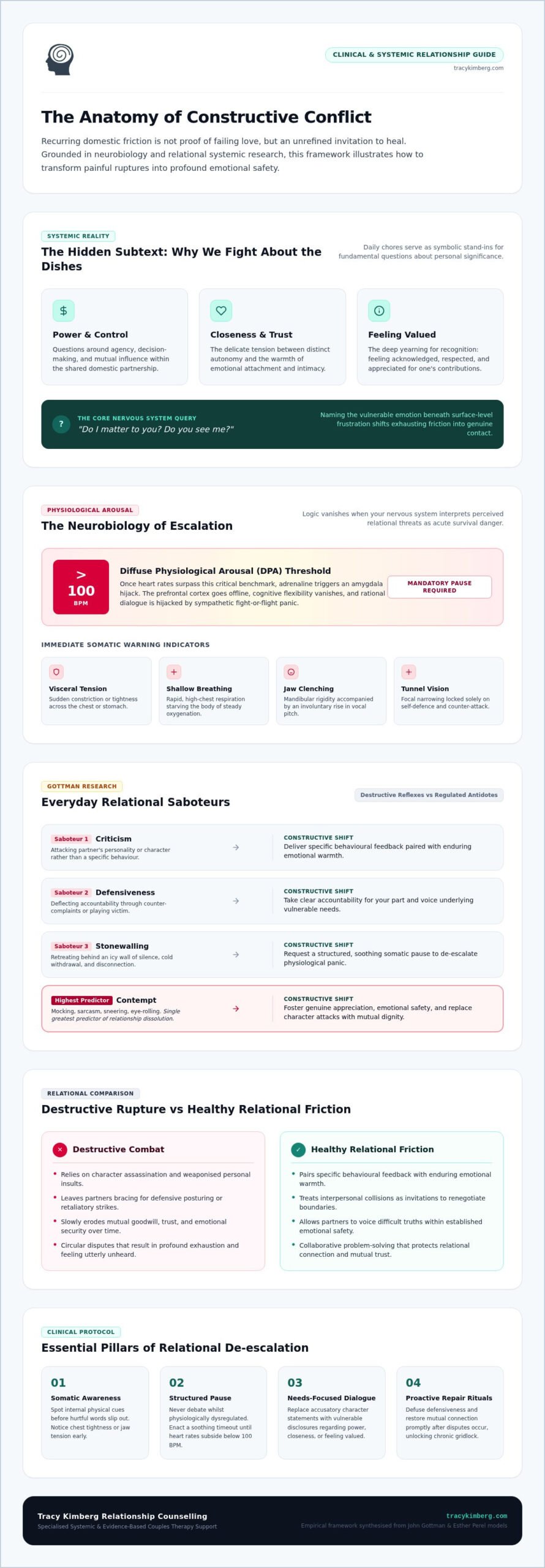
There is a profound difference between productive friction and destructive combat. Destructive exchanges rely on character assassination, weaponised insults, and contemptuous sneering, slowly eroding mutual goodwill over time. In contrast, healthy friction pairs specific behavioural feedback with enduring emotional warmth. You might challenge your partner’s specific choice whilst reassuring them of your care. Leaning into collaborative conflict resolution styles builds emotional safety, allowing both partners to speak difficult truths without bracing for defensive posturing or retaliatory strikes.
The Hidden Subtext: Why We Fight About the Dishes
Rarely is a domestic squabble actually about an unemptied dishwasher or clothes dropped on the floor. In systemic therapy, daily chores serve as symbolic stand-ins for fundamental questions about personal significance. Domestic friction usually centres on Perel’s core triad: power and control, closeness and trust, and feeling valued. When a petty disagreement flares, your underlying nervous system is often asking: Do I matter to you? Do you see me? Learning how to argue constructively with your partner requires looking beneath surface-level frustration to name the vulnerable feeling hiding underneath. Expressing that softer emotion changes an exhausting battle into genuine contact.
The Neurobiology of Escalation: Why Heated Arguments Derail Rational Thought
When a disagreement turns sour, logic is rarely the first casualty; your nervous system is. Perceived relational threats trigger an immediate sympathetic fight-or-flight response. Your body doesn’t distinguish between a saber-toothed tiger and an exasperated expression from the person you love. Both register as acute danger. Once your heart rate exceeds one hundred beats per minute, you enter what John Gottman terms Diffuse Physiological Arousal. At this threshold, cognitive flexibility vanishes, making it impossible to process nuance or practise how to argue constructively with your partner without intentional physiological grounding.
Diffuse Physiological Arousal and the Amygdala Hijack
Adrenaline surges during high-stakes disputes, effectively taking the prefrontal cortex offline. The primitive amygdala takes the wheel, prioritising immediate self-defence over relational connection. You may recognise telltale somatic warning signs:
- Sudden tightness across the chest or stomach
- Rapid, shallow breathing
- A clenched jaw or raised vocal pitch
- Tunnel vision that narrows focus solely on defending yourself
Continuing to debate while flooded guarantees mutual injury. You cannot resolve an emotional dilemma with a dysregulated nervous system; you must take a structured somatic pause first.
Gottman’s Four Horsemen: Identifying Everyday Relational Saboteurs
In standard domestic life, dysregulation breeds destructive communication reflexes. Gottman identified four distinct patterns that actively undermine partnership: criticism, defensiveness, stonewalling, and contempt. Criticism attacks your partner’s core personality rather than addressing a specific action. Defensiveness deflects accountability through counter-complaints, whilst stonewalling sees one partner retreat behind an icy wall of silence. Contempt, conveyed through mocking, eye-rolling, or sarcasm, remains the single greatest predictor of relationship dissolution. Replacing these habits requires trading character assaults for gentle, feeling-centred requests.
Childhood Wounds and Adult Triggers in Disagreement
Our adult reactions rarely originate in the present moment. Drawing on Gabor Maté’s trauma-informed insights, intense marital overreactions often represent adaptations to early developmental neglect or unresolved childhood wounds. An exasperated sigh from your spouse can unconsciously awaken deep-seated terrors of abandonment or inadequacy. If you notice these primal triggers continually derailing communication, exploring relationship counselling and coaching for couples offers a safe container to unpack survival patterns and master how to argue constructively with your partner over time.
Destructive Reflexes vs Constructive Habits: A Direct Comparison Framework
Old habits die hard, especially when relational tension spikes. When hurt or misunderstood, we instinctively reach for defensive weapons that alienate the very person we want to connect with. Learning how to argue constructively with your partner requires replacing automated, protective reflexes with intentional, intimacy-building habits. The table below illustrates how small linguistic and behavioural shifts completely reshape a disagreement.
| Destructive Reflex | Constructive Habit | Relational Impact |
|---|---|---|
| Sweeping Absolutes: “You always forget about me” or “You never help.” | Vulnerable Specifics: “I felt overwhelmed tonight when I handled dinner alone.” | Removes character attacks and invites empathy rather than retaliation. |
| Immediate Defensiveness: Justifying mistakes or counter-attacking to clear your name. | Curious Attunement: “Help me understand why that landed so painfully for you.” | Validates your partner’s subjective experience, disarming mutual hostility. |
| Escalating or Fleeing: Shouting louder or storming out without warning. | Somatic Pausing: “I’m feeling flooded. Let’s take twenty minutes to calm down and talk.” | Prevents physiological flooding while maintaining relational trust and safety. |
Shifting from Harsh Criticism to a Gentle Start-Up
Research from the Gottman Institute reveals that the way a conflict discussion begins predicts how it will end 96% of the time. Harsh start-ups laden with sarcasm almost guarantee conversational breakdown. You can master how to argue constructively with your partner by adopting a three-part formula: state how you feel, describe the specific situation without judgment, and state what you positively need. For instance, swap “You don’t care about my time” for “I feel anxious when you run late; I need a quick text so I can plan my evening.”
Replacing Defensive Justification with Curious Attunement
When your partner voices distress, rushing to defend your intentions feels like swift invalidation. It communicates that protecting your self-image matters more than acknowledging their pain. Attunement asks you to mirror their words before explaining yourself: “What I’m hearing is that you felt completely unsupported earlier today. Did I get that right?” Validating their emotional reality doesn’t mean agreeing with every detail; it simply signals that their inner world is safe with you.
Five Practical Steps to Argue Constructively with Your Partner
Mastering how to argue constructively with your partner requires a reliable, step-by-step roadmap when emotional currents run deep. When old wounds flare, good intentions quickly dissolve without structured rails to guide you back to safety. This sequential five-step process transforms combative exchanges into collaborative problem-solving, protecting your bond while addressing genuine issues.
- Regulate your nervous system: Ground your body before speaking.
- Open with a softened start-up: Describe the event without moral judgment.
- Practise non-defensive attunement: Listen solely to reflect what you hear.
- Validate emotional realities: Honour the emotional impact on your partner.
- Collaborate on workable repairs: Formulate small micro-agreements together.
Steps 1 and 2: Somatic Regulation and the Softened Opening
Never initiate a tender conversation while running on adrenaline. Take a mandatory twenty-minute physiological break using slow, diaphragmatic breathing to settle your pulse. Agree beforehand on a shared neutral phrase, like “time out”, that pauses escalation without triggering panic or abandonment. When you return, frame the problem as both of you united against the dilemma, using softer language that focuses on your internal state rather than their character flaws.
Steps 3 and 4: Empathic Attunement and Emotional Validation
Drop the mental courtroom trial. When your partner shares their pain, listen without assembling counter-arguments or mentally rehearsing your defence. Offer simple reassurance: “It makes complete sense that you felt overlooked when I stayed late at work.” Remember, validating their perspective doesn’t mean your experience is invalid. Two conflicting emotional realities can comfortably sit side by side in a loving partnership.
Step 5: Collaborative Problem-Solving and Intentional Repair
Once both nervous systems settle, negotiate practical micro-agreements. Instead of demanding massive personality overhauls, agree on small behavioural tweaks, such as checking in before leaving work or taking turns putting children to bed. Seal the conversation with intentional somatic repair: a gentle touch on the arm, a soft gaze, or a shared private laugh. If repetitive impasses continue to leave you drained, you can discover Tracy Kimberg’s 12-Week Relationship Recovery Process to rebuild practical communication foundations and learn how to argue constructively with your partner alongside an experienced guide.
When Self-Help Reaches Its Limits: How Professional Relationship Counselling Creates Lasting Repair
Even when you understand how to argue constructively with your partner in theory, visceral survival triggers and deep attachment wounds can stall independent progress. Research from the Gottman Institute reveals that 69% of relationship conflicts are perpetual problems; they stem from fundamental lifestyle preferences, personality differences, and core values rather than surface miscommunications. Seeking professional relationship counselling isn’t a shameful confession of defeat. It is a conscious, courageous investment in relational health. An experienced couples therapist serves as an emotionally grounded referee, helping both individuals step outside their habitual defensive cycles so they can truly hear one another.
Recognising Chronic Gridlock and Unhealed Relational Ruptures
Couples often find themselves trapped in recurring fight scripts where dialogue stalls into bitter, stubborn gridlock. When unaddressed emotional neglect, past betrayals, or unexpressed grief linger beneath the surface, minor disagreements quickly turn toxic. If silence replaces curiosity or contempt creeps into your conversations, self-help books are rarely enough. Stepping into a safe, therapeutic space halts the slow erosion of mutual goodwill, addressing the historical injuries that prevent present-day reconciliation before fond memories and admiration completely fade.
The 12-Week Relationship Recovery Process with Tracy Kimberg
Tracy Kimberg provides a structured, compassionate path designed to guide couples out of repetitive friction and into genuine connection. Integrating systemic therapy, Gottman methodologies, and adult attachment dynamics, her clinical approach normalises relationship tension whilst teaching tangible repair mechanisms. Through her signature 12-Week Relationship Recovery Process, partners unpack survival strategies, quiet defensive reflexes, and rebuild emotional trust step by step.
Whether you choose face-to-face therapy in the UK or access online therapy sessions from anywhere in the world, this dedicated work provides the tailored support needed to heal chronic divisions. Professional guidance shows you how to argue constructively with your partner, turning painful relational impasses into secure, lasting intimacy.
Moving from Domestic Combat to Compassionate Connection
Recurring disputes don’t signal the demise of love; they illuminate where your relationship seeks deeper safety and attunement. When you learn to soothe your nervous system before speaking, replace harsh criticism with gentle vulnerability, and honour your partner’s emotional reality, the entire dynamic shifts. Learning how to argue constructively with your partner isn’t about avoiding tension altogether, but discovering how to repair ruptures swiftly so affection remains intact.
When habitual fight scripts feel too entrenched to untangle on your own, expert guidance can help clear the fog. Drawing upon the clinical methodologies of John Gottman, Esther Perel, and Gabor Maté, book a consultation with Tracy Kimberg to begin transforming your communication patterns. Through her signature 12-Week Relationship Recovery Process, available via face-to-face UK therapy and global online coaching, you can dissolve persistent gridlock and build a secure, deeply fulfilling partnership.
Frequently Asked Questions
Is it normal for happy, loving couples to argue regularly?
Yes, regular disagreement is entirely normal in healthy relationships. Routine friction simply shows two distinct people maintaining their individuality rather than sliding into artificial compliance. The defining mark of a resilient partnership isn’t perpetual silence or avoiding conflict, but knowing how to argue constructively with your partner so inevitable ruptures lead to deeper understanding rather than lingering domestic resentment.
What is the single most destructive mistake couples make during arguments?
Displaying contempt is the most damaging mistake in any dispute. Conveyed through sarcastic remarks, eye-rolling, sneering, or mockery, contempt attacks your partner’s core worth from a position of perceived superiority. Research highlights contempt as the premier predictor of relational breakdown. It erodes emotional safety faster than heated anger alone. Treating your partner with fundamental dignity, even during sharp disagreements, protects the bond.
How do we stop an argument when my partner completely shuts down?
Stop pushing for an immediate answer and offer genuine physical space. When a partner shuts down or stonewalls, their autonomic nervous system is usually flooded with stress hormones. Demanding engagement only increases their internal panic, driving them deeper into protective withdrawal. Reassure them of your care: “I see you’re overwhelmed. Let’s take a break and resume talking in thirty minutes.”
What should I do if my partner refuses to communicate constructively?
Focus on regulating your own responses rather than policing their behaviour. You cannot force someone to change, but altering your half of the dance shifts the entire relational dynamic. Model vulnerability, drop accusatory language, and state your feelings plainly. When repetitive disputes feel entirely locked, exploring relationship counselling and coaching for couples provides an emotionally safe environment to learn how to argue constructively with your partner.
How long should a time-out last when a discussion becomes heated?
A constructive physiological time-out should last between twenty minutes and twenty-four hours. Your body requires at least twenty full minutes for heart rates to normalise and stress hormones to subside after flooding. Avoid breaks longer than a day, as prolonged silence easily mimics punitive stonewalling. Always explicitly agree on a specific return time so neither partner feels abandoned or anxious.
Can couples therapy help if we have had the same argument for years?
Yes, specialised couples counselling is specifically structured to untangle entrenched, years-long gridlock. Repetitive disputes rarely stem from practical logistics; they are anchored in conflicting core values, unmet attachment needs, and childhood sensitivities. A trained therapist acts as an objective, compassionate guide, helping you identify invisible emotional injuries. Structured programmes like the 12-Week Relationship Recovery Process help partners transform stubborn impasses into renewed affection.
What is the difference between active listening and emotional validation?
Active listening reflects words, whilst emotional validation honours the underlying feeling. Active listening focuses on repeating or paraphrasing statements to confirm comprehension: “You’re saying you felt stressed by dinner.” Emotional validation goes deeper by acknowledging that their emotional reaction makes complete sense given their perspective: “It makes total sense that you felt overwhelmed and alone.” Validation disarms defensiveness before problem-solving begins.

Article by
Tracy Kimberg
Tracy Kimberg is a Relationship Expert, Couples Therapist and Coach with a dedicated focus on helping couples and individuals rebuild connection, trust and emotional safety in their relationships. Drawing on the research of John and Julie Gottman, the relational insights of Esther Perel, and years of hands-on therapeutic experience, Tracy offers a warm, non-judgemental and deeply compassionate approach to modern relationships.
Based in Dorset, Tracy works with couples navigating communication breakdowns, betrayal, intimacy challenges, separation, family dynamics and life transitions. Known for creating a safe and grounded therapeutic space, she combines practical tools with emotional depth to help clients move beyond survival patterns and towards meaningful, lasting change.
With a reputation for empathy, professionalism and dedication to her clients’ growth, Tracy is passionate about helping people feel seen, understood and empowered — both within their relationships and within themselves.
Disclaimer
Disclaimer:
The information shared in this article is intended for educational and informational purposes only and should not be considered a substitute for professional therapeutic, psychological, medical or legal advice. Every individual and relationship is unique, and the perspectives offered are based on general therapeutic principles, research and professional experience.
Reading this article does not establish a therapist-client relationship with Tracy Kimberg. If you are experiencing significant emotional distress, relationship crisis, trauma, or mental health concerns, it is important to seek support from a qualified professional appropriate to your individual circumstances.
All content remains the intellectual property of Tracy Kimberg and may not be reproduced or distributed without permission.