

The fate of a high-stakes conversation is decided in your nervous system long before you speak a single word. When a sensitive topic spirals into criticism, defensiveness, or stony silence, you aren’t failing at love; your physiology is simply reacting to a perceived emotional threat. If you have ever felt your pulse race whilst longing to be heard without pushing your partner away, you know how quickly good intentions collapse. Truly mastering communication techniques for difficult conversations isn’t about memorising clever scripts; it begins with calming the internal biological alarms that hijack connection.
Drawing on the clinical insights of John Gottman, Esther Perel, and Gabor Maté, this guide reveals how to transform fraught disagreements into opportunities for genuine intimacy and mutual understanding. You’ll learn how to recognise the somatic triggers of conflict, disarm reflexive defensiveness before it derails your bond, and hold your most vulnerable discussions with emotional poise and respect.
Key Takeaways
- Understand how nervous system dysregulation sabotages connection, and learn how to recognise physiological flooding before a disagreement escalates.
- Discover practical communication techniques for difficult conversations, including the softened startup, that allow you to voice grievances without triggering defensiveness.
- Neutralise destructive relationship habits by replacing criticism, contempt, defensiveness, and stonewalling with grounded behavioural antidotes.
- Implement structured twenty-minute pauses that allow racing heart rates to settle without leaving either partner feeling emotionally abandoned.
- Reframe recurring disagreements into opportunities for vulnerability and deeper security through intentional post-conflict repair rituals.
Why Difficult Conversations Stall: Understanding the Relational Nervous System
When an argument erupts over an unwashed dish or a forgotten chore, you aren’t merely squabbling about household logistics. You are negotiating emotional safety, connection, and significance. Underneath familiar domestic friction lies an ancient neurobiological alarm system hardwired to preserve attachment at all costs. Drawing on the trauma-informed perspectives of Gabor Maté and the systemic insights of Esther Perel, we recognise that reactive defensiveness is rarely malicious. Instead, it represents an involuntary protective adaptation formed long before your adult relationship began.
Perceived emotional rejection or dismissiveness activates your nervous system just as fiercely as a physical threat. Survival instincts hijack the conversation, forcing partners into adversarial posturing. Applying effective communication techniques for difficult conversations requires addressing this somatic reactivity first, transforming defensive survival loops into conscious, grounded presence.
The Physiology of Fight, Flight, and Stonewalling
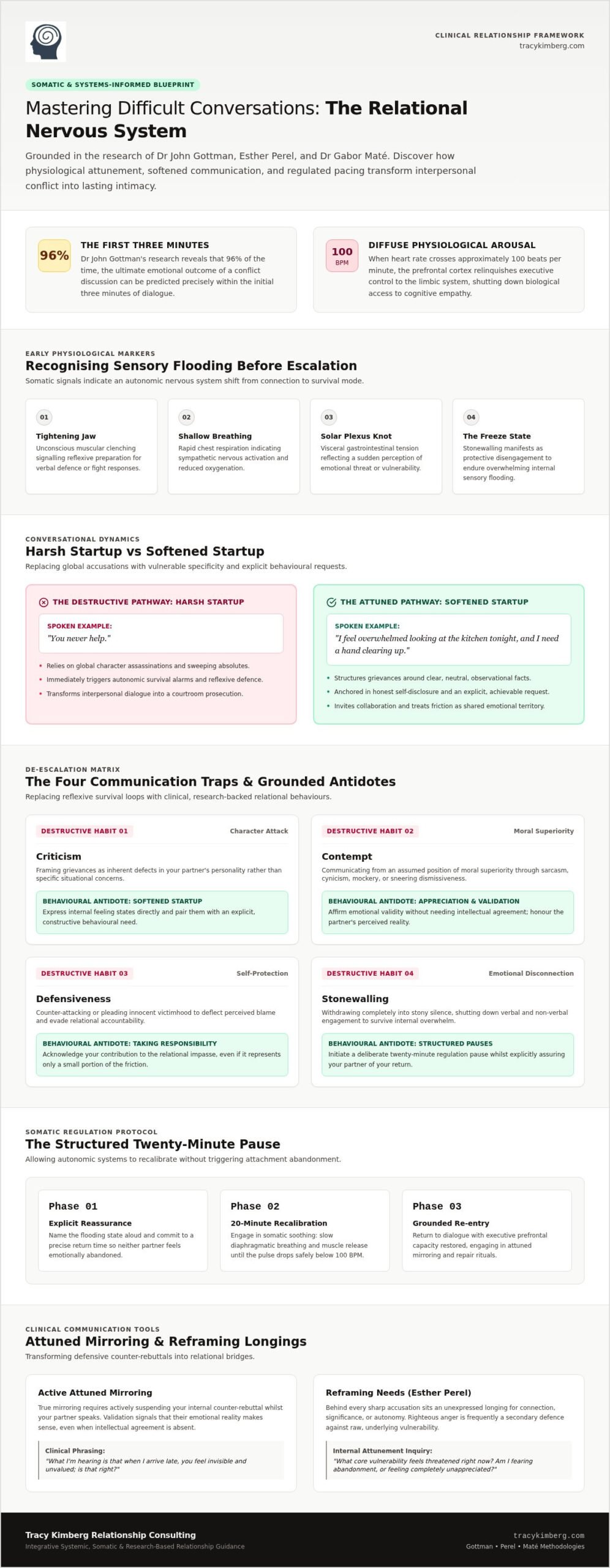
Dr John Gottman’s research highlights this bodily shift as Diffuse Physiological Arousal, triggered when a partner’s heart rate exceeds roughly 100 beats per minute. At this threshold, the prefrontal cortex loses executive bandwidth to the limbic system, rendering cognitive empathy and traditional active listening techniques biologically inaccessible. Stonewalling, often mistaken for callous apathy or passive aggression, is typically a protective freeze state; an overwhelmed partner disconnects simply to endure sensory flooding. Catching early somatic markers, such as a tightening jaw, shallow breathing, or a knot in the solar plexus, lets you intervene before dialogue turns into destruction.
Moving from Accusation to Vulnerable Self-Awareness
Behind every persistent criticism lives an unexpressed, tender longing for validation and intimacy. When quiet expectations go unspoken, they harden into resentment and sharp accusations. Transforming these destructive spirals begins with genuine self-attunement before speaking. Ask yourself what core vulnerability feels threatened in this moment. Are you dreading abandonment, or do you feel completely unappreciated? Grounding yourself in internal awareness turns communication techniques for difficult conversations from rehearsed scripts into an authentic bridge towards mutual understanding.
Core Communication Techniques for Difficult Conversations in Relationships
Translating physiological awareness into spoken dialogue requires deliberate conversational tools. Dr John Gottman’s research reveals that 96% of the time, the emotional outcome of a conflict discussion can be predicted within its first three minutes. A dialogue that begins aggressively will inevitably collapse, whilst a gentle opening invites partnership. Applying effective communication techniques for difficult conversations means stepping away from courtroom prosecution and stepping into collaborative inquiry, treating interpersonal friction as shared emotional territory.
Mastering the Softened Startup
A harsh startup immediately triggers autonomic alarm bells in your partner. To prevent this reflexive defence, structure grievances using neutral observations rather than global character assessments. Replace sweeping statements like “You never help” with clear, vulnerable specificity: “I feel overwhelmed looking at the kitchen tonight, and I need a hand clearing up.” By anchoring dialogue in honest self-disclosure and an explicit behavioural request, you embody the proven Four Horsemen and their antidotes, neutralising hostility before it takes root.
Attuned Mirroring and Emotional Validation
Validation does not require total intellectual agreement. It simply signals that your partner’s internal reality makes emotional sense to you. True mirroring requires actively suspending your internal counter-rebuttal whilst the other person speaks. Instead of calculating your defence, slow your breathing and summarise what you hear: “What I’m hearing is that when I arrive late, you feel invisible and unvalued; is that right?” Offering simple, steady acknowledgements creates safety, allowing rising conversational tensions to settle into mutual respect.
Reframing Accusations into Unmet Relational Needs
As Esther Perel often observes, behind every sharp accusation sits an unexpressed longing for connection or autonomy. Righteous anger is almost always a secondary emotion shielding tender feelings of grief, loneliness, or inadequacy. Swap rigid conclusions with gentle, explorative questions: “What feels most urgent for you right now?” If unravelling these entrenched cycles feels overwhelming, working through professional relationship counselling and coaching for couples can provide the compassionate structure needed to transform recurring arguments into profound understanding.
De-escalating the Four Destructive Communication Traps
Every long-term partnership encounters friction, but predictable corrosive habits determine whether friction deepens intimacy or fractures it. Across decades of observational research, Dr John Gottman identified four destructive relational habits, known clinically as the Four Horsemen: criticism, contempt, defensiveness, and stonewalling. When these behaviours take hold, they accelerate autonomic flooding, locking couples into rigid blame loops. In heterosexual laboratory studies, approximately 85% of stonewalling partners were men, linked to a male physiological tendency to flood faster and stay flooded longer. Deconstructing these automatic reactions requires actionable behavioural antidotes rather than good intentions alone.
Neutralising Criticism and Contempt with Appreciation
Gottman established that contempt, conveyed through sneering, mockery, or dismissive eye-rolling, acts as the single most lethal predictor of relationship breakdown. It communicates moral superiority, poisoning connection at its core. Research indicates that enduring partnerships maintain at least five positive interactions for every one negative interaction during active conflict. You can buffer your dialogue by embedding healthy relationship communication strategies into everyday life, actively voicing gratitude for small kindnesses whilst directing complaints strictly to isolated incidents rather than character flaws.
Dismantling Defensiveness Through Radical Accountability
Defensiveness is an instinctive shield, an indignant attempt to ward off perceived attack by playing the blameless victim or immediately counter-attacking. When you reply to a complaint with “I wouldn’t have forgotten if you reminded me,” you invalidate your partner’s experience. From a trauma-informed lens, this reflex often traces back to early childhood adaptations where admitting an error invited severe punishment or emotional withdrawal.
To dismantle this reflex, try these grounded communication techniques for difficult conversations:
- Own a microscopic piece of the issue: Agreeing with even 2% of your partner’s grievance disarms their limbic alarm bells instantly.
- Shift from indignation to enquiry: Replace “That isn’t true” with “Help me understand why you felt that way.”
- Soothe the impulse to strike back: Take a deep breath to remind your nervous system that taking accountability does not erase your worth.
Practising these small behavioural shifts transforms an exhausting courtroom battle into a collaborative partnership where both voices can safely land.
In-the-Moment Emotional Regulation and Conversational Repair
When biological flooding strikes, trying to resolve a conflict is like attempting to steer a boat through a tempest without a rudder. Adrenaline and norepinephrine flood your bloodstream, muting the rational parts of your brain responsible for perspective and patience. Research shows that it takes a minimum of 20 to 30 minutes of genuine, non-ruminative rest for your autonomic nervous system to return to baseline. Rushing this physiological recovery window guarantees escalation, no matter how many communication techniques for difficult conversations you have studied.
Implementing a Constructive Time-Out Protocol
Stepping away during an intense debate can easily trigger primal fears of abandonment in an anxious partner. To preserve relational safety, establish an agreed pause protocol during peaceful moments. Choose a neutral phrase and pair it with explicit attachment reassurance: “I love you and I want to hear you, but my body is overwhelmed. I’m stepping outside for twenty minutes, and I’ll return at half past four to finish this gently.”
During this disengagement, your task is physiological soothing, not internal courtroom litigation. If you spend your pause rehearsing grievances or cataloguing your partner’s faults, your cardiovascular system remains in defence mode. Instead, regulate your body through:
- Deep, lengthened diaphragmatic exhalations that activate your vagal brake.
- Sensory grounding, focusing on tactile physical sensations, ambient sounds, or cool water on your hands.
- Compassionate self-talk, reminding yourself that disagreement is not proof of incompatibility.
The Art of Relational Repair Attempts
Long before an argument detonates into emotional exhaustion, subtle windows of opportunity emerge to alter its trajectory. John Gottman calls these micro-moments repair bids: small, imperfect gestures designed to de-escalate tension. A repair bid might look like a soft smile, a tender touch on the forearm, or an immediate verbal reset: “I just spoke with an edge; forgive me, let me try that sentence again.”
Recognising and welcoming these clumsy peace offerings keeps communication techniques for difficult conversations rooted in living empathy rather than rigid mechanics. When chronic conflict leaves you feeling too depleted to find your way back to harmony, take a proactive step towards healing by exploring our specialised 12-Week Relationship Recovery Process.
Transforming Difficult Dialogues into Lasting Relational Closeness
Conflict is not a sign of relational failure; it is an unpolished invitation to grow. Dr John Gottman’s research revealed that 69% of relationship conflicts are perpetual, stemming from fundamental differences in personality, lifestyle preferences, and core emotional values. You will never completely eliminate disagreement, nor should that be the goal. When you view friction through Esther Perel’s systemic lens, a difficult conversation becomes a portal to deeper erotic and emotional intimacy. Implementing psychologically grounded communication techniques for difficult conversations allows couples to move past winning or losing, transforming recurring arguments into collaborative self-discovery.
Post-Conflict Reconnection and Integration
What happens after a rupture matters just as much as what transpires during the storm. Once nervous systems return to baseline, intentionally create a gentle debrief ritual. Pour a cup of tea, sit close together, and review the emotional process without relitigating the specific facts. Celebrate tiny conversational victories: a moment where your partner softened their voice, or an instance where you held back a sharp critique. Conclude by verbally reaffirming your shared attachment, anchoring the absolute certainty that your bond is resilient enough to hold uncomfortable truths.
When to Seek Professional Relationship Support
Even with sound personal strategies, some interpersonal dynamics become thoroughly calcified. Chronic gridlock often points to deeper unresolved trauma or historical attachment wounds that neither partner can untangle alone. When discussions consistently stall in contempt, exhausted withdrawal, or bitter despair, outside clinical guidance offers a safe container to break the cycle.
You might benefit from structured support if you notice:
- The same argument recurring for months or years without any emotional softening.
- Pervasive dread surrounding honest self-expression, leading to constant walking on eggshells.
- Emotional intimacy steadily eroding into polite, detached coexistence.
A compassionate, experienced specialist helps you safely decode hidden emotional scripts and rebuild mutual trust. If you are ready to move beyond survival mode into profound relational renewal, book a confidential consultation with Tracy Kimberg Relationship Coaching to begin restoring warmth, vitality, and emotional safety to your partnership.
Stepping into a New Era of Partnership and Emotional Safety
Navigating relationship conflict does not require emotional perfection or the complete absence of friction. Real transformation begins the moment you honour your nervous system, allowing racing pulses to settle before attempting to bridge the divide. By replacing instinctive defensiveness with softened openings and responsive repair bids, you turn tense standoffs into doorways for genuine intimacy. Grounded in the clinical wisdom of John Gottman and Esther Perel, these communication techniques for difficult conversations shift your partnership from reactive survival into mutual, heartfelt attunement.
If you find yourselves caught in recurring loops of silence or criticism, you don’t have to navigate the path forward alone. Guided support can gently illuminate hidden blind spots and restore emotional warmth. Whether through flexible online therapy across the UK and globally or our specialised 12-Week Relationship Recovery Process, take the first courageous step towards healing by booking a consultation with Tracy Kimberg Relationship Coaching today. Compassionate, lasting closeness is entirely within your reach.
Frequently Asked Questions
How do I start a difficult conversation with my partner without triggering an argument?
Begin with a gentle, appreciative observation about a specific event rather than evaluating your partner’s character. State how you feel using simple “I” statements, followed by an explicit, positive need. For example, say, “I feel disconnected lately, and I’d love an evening together without our phones,” instead of criticising their screen time. Soft startups disarm the nervous system immediately, creating safety before exploring sensitive emotional ground together.
What should I do if my partner completely shuts down or stonewalls during conflict?
Step back immediately and respect their silence as an involuntary biological freeze state rather than defiance or apathy. When someone shuts down, their nervous system is flooded with stress hormones. Pushing them to talk only deepens their panic. Offer quiet reassurance by saying, “I see you’re overwhelmed, so let’s take a break and talk in half an hour.” Giving them space to settle restores their capacity for empathy and connection.
How long should a cooling-off break last when an argument becomes too heated?
A productive cooling-off pause must last at least twenty to thirty minutes to allow autonomic nervous systems to reset. Rushing back sooner guarantees emotional re-flooding because adrenaline lingers in the bloodstream. However, breaks shouldn’t stretch past twenty-four hours, as prolonged avoidance triggers abandonment anxiety. Agree beforehand on an exact return time, and spend that period engaging in calming activities like walking or rhythmic breathing rather than mentally litigating grievances.
Why do small disagreements in our relationship quickly turn into explosive fights?
Minor squabbles escalate rapidly when they touch unhealed childhood attachment wounds or unexpressed historical resentments. Arguments over mundane domestic tasks are rarely about the chores; they represent deeper queries about whether you matter, feel safe, and are respected. When ancient protective adaptations are triggered, survival instincts hijack the conversation. Mastering somatic communication techniques for difficult conversations helps you recognise these underlying vulnerability triggers before trivial disputes erupt into relational catastrophes.
Can communication techniques help if only one partner is actively practising them?
Yes, unilateral changes in communication can disrupt entrenched negative relationship dynamics and invite reciprocal softening. Relationships operate as systemic feedback loops. When you trade defensive retorts for curious questions and gentle openings, your partner’s threat detection system naturally de-escalates. You cannot control your partner’s reactions, but altering your own behavioural input alters the entire interaction. Implementing communication techniques for difficult conversations often inspires your partner to drop their defences in return.
How do I express my emotional needs without sounding demanding or overly critical?
Frame your desires as invitations for closeness by expressing personal longing rather than pointing out your partner’s deficiencies. Criticism tells your partner what is wrong with them, whilst vulnerability reveals what you cherish and miss. Focus on clear, actionable requests rather than broad demands. Instead of saying, “You never pay attention to me,” try, “I love talking with you, and I would value having twenty uninterrupted minutes tonight to hear about your day.”
When does communication difficulty indicate that we need professional couples therapy?
Seek professional guidance when arguments become chronic, repetitive, and routinely contaminated by contempt, emotional numbness, or intense dread. If the same conflict persists for months without resolution, or discussions consistently descend into icy stonewalling, outside clinical guidance provides a safe container. Structured support, such as relationship counselling and coaching for couples or a specialised 12-week recovery process, helps unmask destructive cycles and rebuild healthy attachment patterns safely.

Article by
Tracy Kimberg
Tracy Kimberg is a Relationship Expert, Couples Therapist and Coach with a dedicated focus on helping couples and individuals rebuild connection, trust and emotional safety in their relationships. Drawing on the research of John and Julie Gottman, the relational insights of Esther Perel, and years of hands-on therapeutic experience, Tracy offers a warm, non-judgemental and deeply compassionate approach to modern relationships.
Based in Dorset, Tracy works with couples navigating communication breakdowns, betrayal, intimacy challenges, separation, family dynamics and life transitions. Known for creating a safe and grounded therapeutic space, she combines practical tools with emotional depth to help clients move beyond survival patterns and towards meaningful, lasting change.
With a reputation for empathy, professionalism and dedication to her clients’ growth, Tracy is passionate about helping people feel seen, understood and empowered — both within their relationships and within themselves.
Disclaimer
Disclaimer:
The information shared in this article is intended for educational and informational purposes only and should not be considered a substitute for professional therapeutic, psychological, medical or legal advice. Every individual and relationship is unique, and the perspectives offered are based on general therapeutic principles, research and professional experience.
Reading this article does not establish a therapist-client relationship with Tracy Kimberg. If you are experiencing significant emotional distress, relationship crisis, trauma, or mental health concerns, it is important to seek support from a qualified professional appropriate to your individual circumstances.
All content remains the intellectual property of Tracy Kimberg and may not be reproduced or distributed without permission.