

What if the argument you’re having about the unwashed dishes or the weekend schedule isn’t actually about the chores at all? It’s a question many couples find themselves asking after the third or fourth time they’ve circled the same painful drain in a single week. You likely feel exhausted by these repetitive cycles; perhaps you even fear that the frequency of your conflicts means the relationship is fundamentally broken. It’s a heavy burden to carry, especially when you’re both trying so hard to be heard. However, resolving recurring arguments is less about winning the debate and more about understanding the “protest of disconnection” happening beneath the surface.
We know how isolating it feels to be misunderstood whilst sitting right next to the person you love. The good news is that these loops are often biological responses to old wounds rather than signs of failure. This guide will help you identify the hidden emotional triggers behind your conflicts and implement research-based strategies to foster a sense of safety. We’ll explore how to break the cycle of reactivity, develop a practical repair toolkit, and move toward a partnership where you both feel truly validated and seen.
Key Takeaways
- Understand that repetitive conflicts are often a ‘protest of disconnection’, where your nervous system treats a lack of emotional safety as a survival threat.
- Identify your specific dance, whether it’s the ‘Pursue-Withdraw’ dynamic or the ‘Attack-Attack’ cycle, to move from mutual blame toward shared understanding.
- Discover how resolving recurring arguments requires pausing when physiological flooding occurs, allowing your heart rate to settle before attempting a repair.
- Master the ‘Softened Start-up’ to voice grievances without triggering your partner’s defences, ensuring your needs are heard rather than just your frustration.
- Recognise when arguments have become gridlocked and why a structured 12-week recovery process provides the necessary tools to break deep-seated loops.
Why We Get Stuck: Understanding the Anatomy of Recurring Arguments
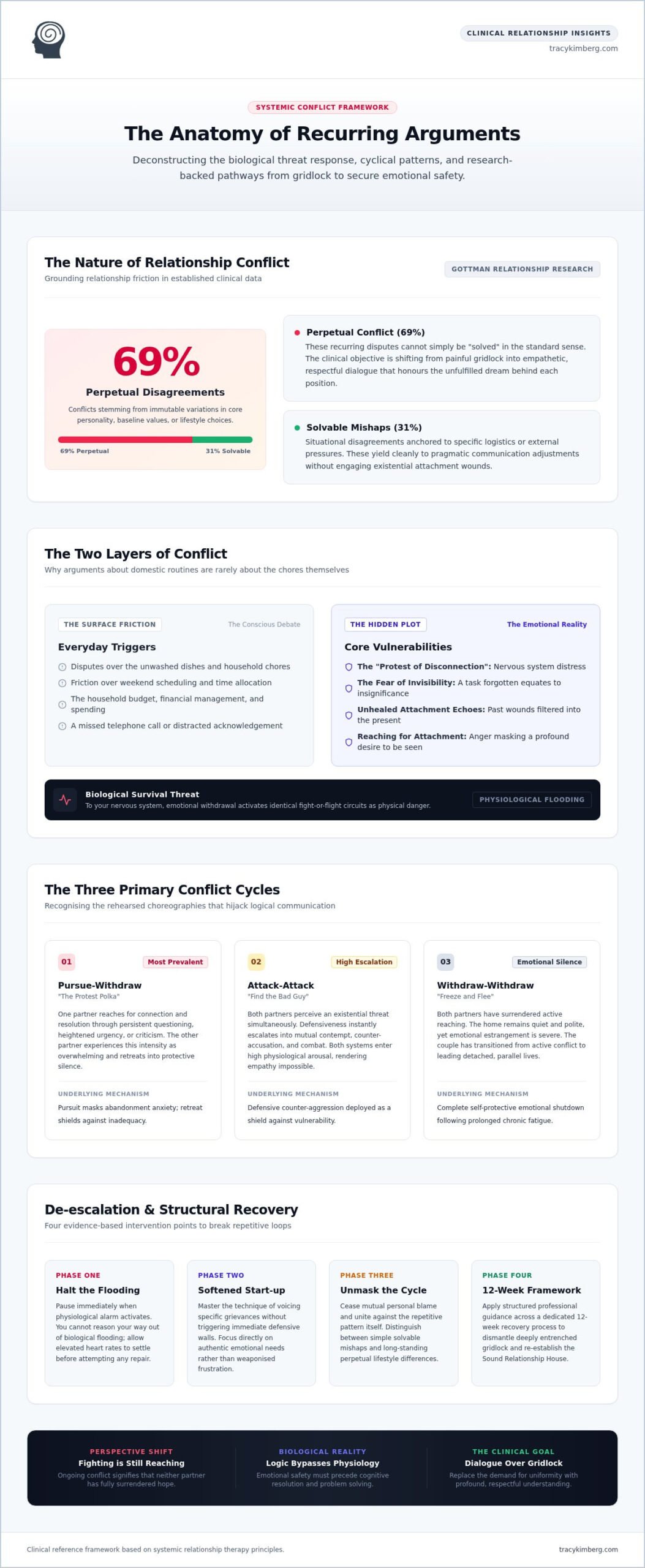
Recurring arguments often feel like being trapped in a circular maze. You know every turn, every dead end, and every sharp corner, yet you can’t seem to find the exit. These are “circular conflicts” that bypass our logical minds entirely. When you’re in the thick of it, the actual topic-be it the laundry, the budget, or a missed phone call-becomes secondary to the emotional storm. The brain doesn’t see a disagreement about chores; it perceives a “Protest of Disconnection.” To your nervous system, a perceived withdrawal from your partner feels like a survival threat, triggering the same fight-or-flight response as a physical danger.
It’s helpful to view these moments through the lens of a “hidden plot.” This is the underlying emotional theme that fuels the fire. One partner might be arguing about dinner plans, but the hidden plot is actually about a deep need for inclusion or respect. If you feel invisible, a forgotten task isn’t just a mistake; it’s a monument to your perceived insignificance. Validating these feelings is a vital part of resolving recurring arguments. Paradoxically, the fact that you are still fighting is often a sign that you haven’t given up. You are still reaching for each other, even if that reach feels more like a shove.
The Role of Unmet Emotional Needs
Our childhood attachment styles act as a filter for everything we hear in a relationship. As Gabor Maté often suggests, our intense reactions in the present are frequently echoes of unhealed wounds from the past. If you grew up in a home where your needs were ignored, a partner’s distracted “mm-hmm” can feel like a devastating rejection. In these moments, logic is your enemy. You cannot reason your way out of a physiological state of alarm. Whilst studying various conflict resolution models can provide a framework for better communication, the real work begins with identifying the core vulnerability hiding behind your anger.
The ‘Groundhog Day’ Effect in Relationships
Does it feel like you’re living the same fight every Tuesday? Whether the triggers are money, intimacy, or the “invisible” mental load, these repetitions can slowly erode the “Sound Relationship House.” John Gottman’s research reveals a startling truth: 69% of relationship conflicts are perpetual. They stem from fundamental differences in personality, values, or lifestyle. These aren’t problems to be “solved” in the traditional sense. Instead, the goal of resolving recurring arguments is to move from a state of painful gridlock to one of respectful dialogue. By recognising the difference between a solvable mishap and a perpetual difference, you can stop trying to change your partner and start understanding the dream behind their position.
Identifying Your Conflict Pattern: The Three Common Cycles
Every couple has a “signature dance.” When you find yourself in the middle of a familiar row, you aren’t just reacting to your partner; you’re playing a part in a well-rehearsed script. Understanding these patterns is the first step in resolving recurring arguments. Most couples fall into one of three primary cycles that bypass logic and target our deepest vulnerabilities. Identifying which dance you are currently performing allows you to stop blaming each other and start blaming the cycle itself.
- The Pursue-Withdraw Dynamic: Often called the “Protest Polka,” this is the most common cycle. One partner seeks closeness or resolution through intense questioning or criticism, whilst the other retreats into silence to avoid further conflict.
- The Attack-Attack Cycle: Here, both partners perceive an existential threat. It’s a “Find the Bad Guy” game where defensiveness escalates into mutual contempt. Both are in a state of high physiological arousal, leaving no room for empathy.
- The Withdraw-Withdraw Pattern: This is a state of “Freeze and Flee” where both partners have given up. The house is quiet, but the emotional disconnect is profound. It often indicates that the couple has moved from active conflict to parallel lives.
If you feel stuck in these loops, identifying your specific dance can help you step off the floor. Sometimes, a professional relationship coach can provide the external perspective needed to see the pattern clearly and guide you toward a new way of relating.
The Pursuer’s Perspective: A Cry for Connection
If you’re the one who pushes, you likely don’t see your behaviour as “nagging.” To you, it feels like an urgent attempt to be seen and valued. When your partner pulls away, it triggers a primal fear of abandonment. You raise your voice or repeat yourself because you’re desperately trying to bridge an emotional gap that feels like a chasm. By utilising evidence-based conflict resolution strategies, you can learn to voice your underlying longing-the “I miss you” or “I feel alone” behind the criticism-without triggering your partner’s alarm bells.
The Withdrawer’s Perspective: A Need for Safety
For the partner who shuts down, silence isn’t a weapon; it’s a shield. You might feel “flooded,” a state where your heart rate spikes and your brain’s logic centre effectively goes offline. You withdraw because you’re terrified of saying the wrong thing or failing yet again. You aren’t being indifferent; you’re trying to regulate your nervous system. Recognising that your silence feels like abandonment to your partner is vital for resolving recurring arguments. Learning to say, “I’m feeling overwhelmed and need twenty minutes to calm down, but I promise we’ll finish this,” creates the safety you both need to stay connected.
Shifting from Reactivity to Conscious Responsibility
To break a repetitive loop, we must move from a state of automatic reaction to one of conscious responsibility. This shift requires us to stop looking at what our partner is doing “wrong” and instead focus on our own internal weather. Developing “relational mindfulness” means learning to catch the physical sensations of a trigger, perhaps a tightening in your throat or a heat in your chest, before the explosion occurs. By taking responsibility for your own nervous system, you transition from being a victim of the “dance” to becoming an architect of your own peace.
One of the most vital tools in resolving recurring arguments is the 20-minute rule. When we’re in conflict, we often experience “flooding,” a state where our heart rate exceeds 100 beats per minute. In this state, your logical brain effectively shuts down; you’re physically incapable of hearing your partner’s perspective. You must take a break. It takes at least twenty minutes for your body to metabolise stress hormones and return to a state where you can engage in managing perpetual relationship conflicts with genuine empathy.
During these pauses, self-soothing is essential. This isn’t about stewing over your partner’s flaws; it’s about calming your body through deep breathing or a quiet walk. When you return, aim for “I” statements. In the British tradition of being polite but firm, saying “I feel overwhelmed when the house is cluttered” is far more effective than the accusatory “You never help.” It’s about owning your experience rather than attacking their character.
Esther Perel’s Insight: Power vs. Intimacy
Esther Perel often poses a challenging question to couples: “Do I want to be right, or do I want to be connected?” When we’re stuck in a loop, we’re often fighting for power to mask a lack of emotional safety. If you’re fighting to win, your relationship is losing. Shifting to a stance of curiosity can transform the dynamic. Instead of making an accusation, try asking a question. “Can you help me understand why this feels so important to you?” This simple change invites intimacy rather than defence.
Gottman’s ‘Four Horsemen’ in Action
John Gottman identified four behaviours that signal a relationship is in trouble: Criticism, Contempt, Defensiveness, and Stonewalling. Each has an antidote. Replace Criticism with a softened startup; meet Defensiveness by taking even a small bit of responsibility; and counter Stonewalling with physiological self-soothing. Contempt is the #1 predictor of relationship breakdown. To fight it, you must actively build a culture of appreciation, focusing on what your partner is doing right rather than where they are failing. This proactive approach is fundamental to resolving recurring arguments for the long term.
A Step-by-Step Guide to Resolving the Conflict
Turning a heated row into a constructive conversation isn’t about magic; it’s about method. When you’re committed to resolving recurring arguments, you need a roadmap that guides you through the emotional thicket. This process begins long before the first word is spoken and continues well after the tension has subsided. By following a structured approach, you can move from reactive combat to collaborative connection.
- Step 1: The Softened Start-up. How you begin a conversation determines its ending 96% of the time. Instead of leading with a character attack, start with a description of how you feel and what you need. “I’m feeling a bit anxious about our plans” works far better than “You always ruin the weekend.”
- Step 2: Active Listening. Before you defend your position, summarise what your partner has said. This proves you’ve actually heard them. It doesn’t mean you agree, but it signals that their perspective is valid and respected.
- Step 3: Finding the ‘Dream behind the Conflict’. Every repetitive fight hides a deeper wish. If you’re arguing about the budget, the dream might be a need for security or a desire for adventure. Ask, “What is the story behind this for you?”
- Step 4: Making a Genuine Repair Attempt. These are the small bids to de-escalate the tension. It could be a silly face, a gentle touch, or a simple “I’m sorry, I’m being a bit snappy.”
- Step 5: The Compromise. Find the “circle of safety.” These are the areas where you can both give a little without compromising your core values or personal integrity.
The Art of the Repair Attempt
Successful couples aren’t those who don’t fight; they’re those who repair well. A repair attempt is any statement or action that prevents negativity from spiralling out of control. However, these attempts only land if your “Emotional Bank Account” has a healthy balance of positive interactions. If you’ve been distant, a joke might feel like a mockery. If you’re the one receiving the repair, try to accept it, even if you’re still feeling a bit bruised. It’s a signal that your partner wants to come back to you. If you find your bank account is consistently empty, you might benefit from my 12-Week Relationship Recovery Process to rebuild that foundational trust.
Processing the Aftermath of a Fight
Once you’ve both reached a state of calm, it’s vital to revisit the rupture. This isn’t about litigating the “facts” of who said what or who started it. Instead, focus on the feelings. A helpful script is: “When we were arguing, I felt [emotion]. What I need from you next time is [request].” By focusing on the internal experience rather than the external events, you can create a plan for when the trigger inevitably arises again. This proactive approach turns a painful memory into a blueprint for resolving recurring arguments in the future.
When to Seek Professional Support: The 12-Week Path
Sometimes, even with the best intentions and a new set of tools, the weight of the past feels too heavy to lift alone. You might notice that your disagreements have become “gridlocked.” This is the point where the same argument has happened for years, the conversation leads nowhere, and you both end up feeling frustrated and lonely. When you reach this stage, resolving recurring arguments requires more than just a new communication technique; it requires a specialised, expert eye to help you see the patterns you’ve become blind to.
A structured programme differs significantly from traditional “talk therapy,” which can often feel like a weekly vent without a clear destination. By utilising research-based methods from the Gottman Institute and the insights of Esther Perel, we don’t just talk about the problem. We map the terrain of your relationship. This isn’t about “fixing” a broken partner. It’s about transforming the dynamic between you, moving from a place of combat to a place of collaboration.
The 12-Week Relationship Recovery Process
The 12-Week Relationship Recovery Process is a transformational journey designed for couples who are ready for deep change. It begins with a comprehensive assessment of your relationship’s strengths and vulnerabilities. From there, we move through stages of de-escalation and healing, specifically addressing the attachment injuries that keep you stuck in reactive loops. A defined timeframe helps you stay committed to the work, providing a clear roadmap toward a “new” relationship grounded in intimacy and trust. We focus on building something fresh rather than trying to patch up an old version of the partnership that no longer serves you.
Online vs. Face-to-Face Therapy in the UK
For busy British couples, finding the time for consistent support can be a challenge. Whether you prefer face-to-face therapy or the convenience of online sessions, the priority is creating a safe, non-judgemental space for vulnerability. Online therapy offers the flexibility to engage in this deep work from the comfort of your own home, which often makes it easier to be open and honest about your needs. If you’re ready to break the cycle and start a new chapter, book a discovery call to see if the 12-Week Process is right for you. This is your invitation to move toward a future where you feel heard, validated, and truly connected.
Reclaiming Your Emotional Connection
Breaking free from a repetitive cycle isn’t about becoming a couple that never disagrees. Instead, it’s about transforming those moments of friction into opportunities for deeper intimacy. You’ve learned that these rows are often biological protests of disconnection, and that the path to resolving recurring arguments lies in physiological self-soothing and the art of the repair attempt. By shifting from reactive blame to conscious responsibility, you can begin to see the “dream” behind your partner’s position rather than just the sting of their words.
If you find that your conflict feels gridlocked despite your best efforts, you don’t have to navigate this landscape alone. As a specialist in the Gottman Method and Perel-inspired coaching, I provide a safe, non-judgemental space within my UK-based practice to help you rebuild trust. You can start your 12-Week Relationship Recovery Process with Tracy Kimberg today to begin this transformational journey. It’s a proactive adventure that focuses on building a resilient, new version of your partnership.
Healing is possible, and the very fact that you’re seeking answers shows how much you still care. Your relationship isn’t defined by the frequency of your fights, but by your willingness to reach for each other once the storm has passed.
Frequently Asked Questions
Why do we keep having the same argument over and over?
Repetitive conflicts usually occur because the surface-level topic is merely a placeholder for an unmet emotional need. You aren’t actually arguing about the bins or the budget; you’re protesting a perceived lack of connection or respect. These cycles become ingrained when your brain treats a partner’s withdrawal as a survival threat. To break the loop, you must look past the facts of the row and identify the hidden emotional plot.
Is it normal to have recurring arguments in a healthy relationship?
It is perfectly normal. Research from the Gottman Institute shows that 69% of relationship conflicts are perpetual, stemming from fundamental differences in personality or lifestyle. Healthy couples don’t necessarily find a permanent solution to these issues. Instead, they learn to navigate them without contempt. The goal is to move from a state of gridlock to a dialogue where both partners feel heard and respected despite their differences.
How do I stop a recurring argument before it starts?
Success in resolving recurring arguments often starts with a softened start-up. If you feel a trigger rising, focus on describing your own feelings and a positive need rather than attacking your partner’s character. Catching the physical signs of physiological flooding early allows you to take a proactive pause. By stepping away before the heat intensifies, you take responsibility for your own nervous system and prevent the cycle from spiralling out of control.
What should I do if my partner refuses to talk about our arguments?
This refusal is often a sign of stonewalling, a physiological state where your partner feels too overwhelmed to engage. Instead of pursuing them with more questions, which often increases their need to withdraw, try to lower the emotional temperature. Lead with vulnerability and suggest a specific, calm time to talk later. If the silence becomes a permanent barrier, it might be time to seek a structured environment like a 12-week relationship recovery programme.
Can a relationship survive constant bickering and conflict?
Survival depends on the quality of your repairs rather than the absence of conflict. If you can maintain a ratio of five positive interactions to every one negative interaction during a disagreement, your bond can remain strong. However, chronic bickering without emotional repair leads to resentment and exhaustion. When conflict turns into a constant state of defensiveness or contempt, it begins to erode the foundation of trust that holds the relationship together.
How do I know if our arguments are a sign we should separate?
Conflict itself isn’t a sign to leave, but the presence of the Four Horsemen, especially contempt, can be a warning. If you find that you have both stopped trying to repair the ruptures or are living parallel lives in the same house, the connection may be fading. It’s often helpful to explore these dynamics in therapy before making a final decision, perhaps through a conscious approach to divorce and separation if needed.
What is the Gottman Method and how does it help with arguments?
The Gottman Method is a research-based framework that focuses on strengthening the Sound Relationship House. It provides couples with practical tools to identify and neutralise destructive communication patterns like defensiveness and stonewalling. By focusing on building a culture of appreciation and managing perpetual differences, this method offers a highly effective blueprint for resolving recurring arguments. It blends clinical precision with a warm, accessible approach that makes the therapeutic process feel manageable.
How long does it typically take to resolve a recurring conflict cycle?
Whilst every partnership is different, many couples find that a structured 12-week programme provides the necessary momentum for real change. This timeframe allows you to move beyond temporary fixes and work on the underlying attachment wounds that fuel your conflict. It offers a clear beginning, middle, and end to the recovery process, helping you stay committed whilst you build a new, more resilient version of your relationship together.

Article by
Tracy Kimberg
Tracy Kimberg is a Relationship Expert, Couples Therapist and Coach with a dedicated focus on helping couples and individuals rebuild connection, trust and emotional safety in their relationships. Drawing on the research of John and Julie Gottman, the relational insights of Esther Perel, and years of hands-on therapeutic experience, Tracy offers a warm, non-judgemental and deeply compassionate approach to modern relationships.
Based in Dorset, Tracy works with couples navigating communication breakdowns, betrayal, intimacy challenges, separation, family dynamics and life transitions. Known for creating a safe and grounded therapeutic space, she combines practical tools with emotional depth to help clients move beyond survival patterns and towards meaningful, lasting change.
With a reputation for empathy, professionalism and dedication to her clients’ growth, Tracy is passionate about helping people feel seen, understood and empowered — both within their relationships and within themselves.
Disclaimer
Disclaimer:
The information shared in this article is intended for educational and informational purposes only and should not be considered a substitute for professional therapeutic, psychological, medical or legal advice. Every individual and relationship is unique, and the perspectives offered are based on general therapeutic principles, research and professional experience.
Reading this article does not establish a therapist-client relationship with Tracy Kimberg. If you are experiencing significant emotional distress, relationship crisis, trauma, or mental health concerns, it is important to seek support from a qualified professional appropriate to your individual circumstances.
All content remains the intellectual property of Tracy Kimberg and may not be reproduced or distributed without permission.