

What if the money you can’t account for is less important than what neither of you feels able to say? An unfamiliar charge, unexplained debt or missing money can leave you wondering whether you’re seeing signs of financial infidelity, and whether asking about them will bring clarity or conflict. That uncertainty is understandable: money can touch security, independence and the agreements you share as a couple.
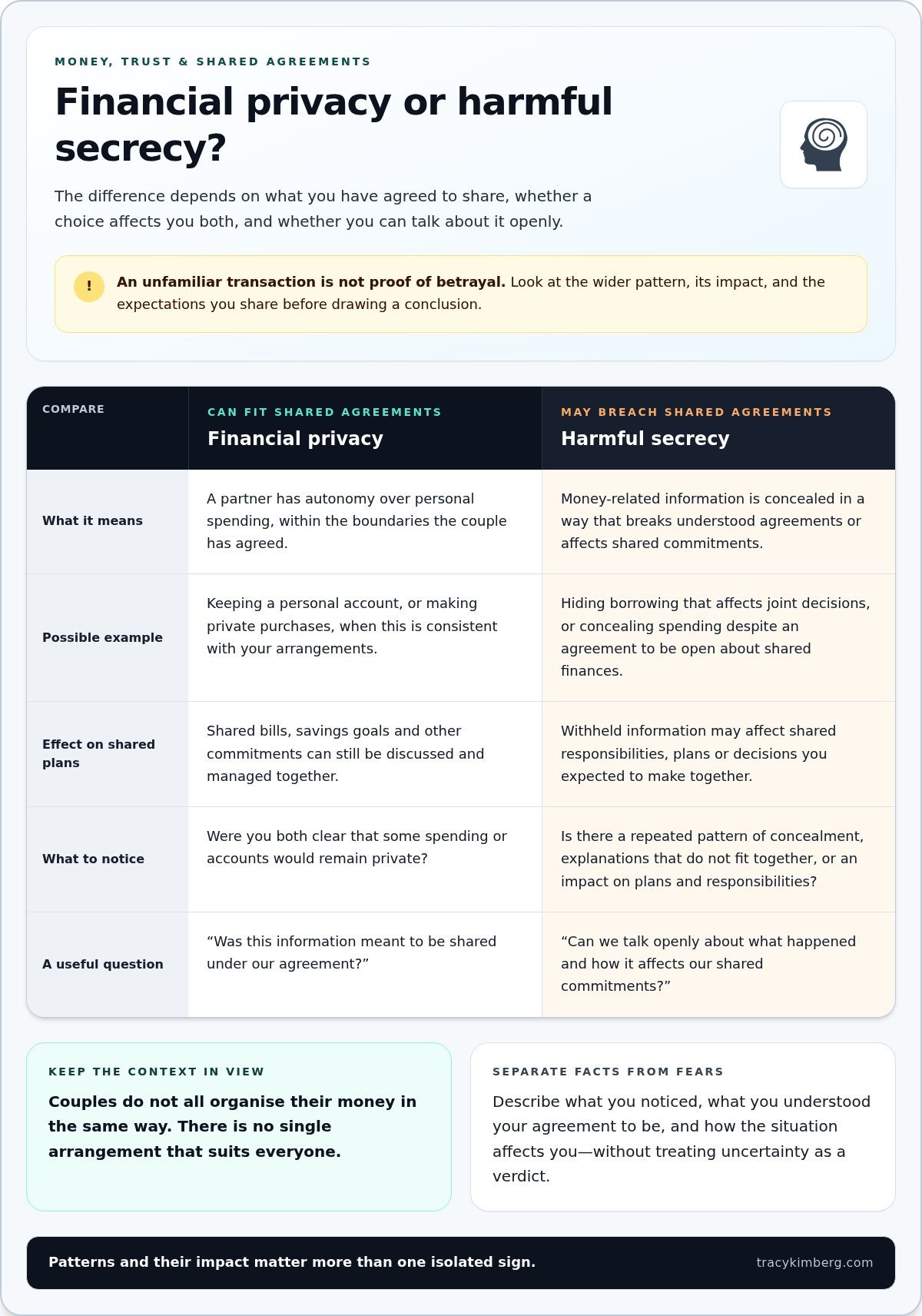
One behaviour on its own doesn’t prove betrayal. Some partners value financial privacy, while secrecy that breaks shared agreements or hides information affecting you both can undermine trust. The difference often lies in the pattern, the impact and what you’ve agreed together.
This article will help you recognise possible warning signs without jumping to conclusions, understand the distinction between privacy and harmful secrecy, and find a calmer way to raise your concerns. We’ll explore what may sit beneath hidden spending or debt, how to begin with curiosity rather than accusation, and what you might do if conversations keep stalling or escalating. The aim isn’t to assign blame, but to create space for greater honesty and a clearer understanding of what’s happening between you.
Key Takeaways
- Look at whether money-related behaviour conflicts with the agreements you share, rather than assuming every separate account or private purchase is a betrayal.
- Notice possible signs of financial infidelity as patterns, and consider how secrecy may affect trust and shared decisions.
- Separate a genuine money disagreement from agreed privacy or concealed information by reflecting on transparency and willingness to talk.
- When raising a concern, describe what you’ve noticed and how it affects you, then invite an open conversation instead of assigning blame.
- If discussions repeatedly stall or escalate, counselling can help you explore the impact of secrecy and clarify expectations together.
What Are the Signs of Financial Infidelity in a Relationship?
Financial infidelity involves money-related secrecy or deception that breaches the agreements a couple understands they share. It may include hiding spending, debt or an account, but the meaning depends on the relationship’s expectations. Some couples combine most of their finances; others keep separate accounts or agree that each person has money they can spend privately. There’s no single arrangement that suits every couple.
Financial infidelity is commonly associated with concealed purchases, debt or accounts. Still, an unexpected transaction isn’t proof of a lie or an intention to deceive. A charge might be unfamiliar for reasons neither partner has yet discussed. The concern becomes more significant when there’s a pattern of concealment or when information is withheld in a way that affects commitments you’ve agreed to manage together.
What behaviours may be signs of financial infidelity?
Possible warning signs include an undisclosed loan, a concealed bank or credit account, or spending hidden despite an agreement to be open about shared finances. Unexplained withdrawals, statements that appear to have been altered, or explanations that change over time may also leave you with questions.
These are reasons to seek clarity, not evidence on their own. Consider what you both agreed, whether the money affects shared plans or responsibilities, and whether your partner can discuss the concern openly. Context matters: keeping a personal account may be entirely consistent with your arrangements, whilst hiding borrowing that affects joint decisions may not be.
Is financial privacy the same as financial infidelity?
No. Privacy and honesty can coexist. A person may have autonomy over personal spending while still being transparent about shared bills, savings goals or other commitments the couple has agreed to manage together. Partners don’t have to disclose every purchase if they’ve mutually agreed that some spending is private.
The distinction is less about a universal rule for couples and more about the expectations between you. Ask yourself: was this information meant to be shared? Does keeping it private affect a joint decision or commitment? Can you talk about it without evasion or fear? A mismatch in assumptions may call for a clearer agreement, rather than a conclusion about betrayal.
If you feel unsettled, it’s reasonable to want an honest conversation. You can take that feeling seriously without treating it as proof. Start with what you’ve noticed and what you understood your agreement to be; your partner’s response and the wider pattern may help you understand what’s happening.
How Patterns of Money Secrecy Can Affect Trust Between Partners
Trust is shaped not only by what a couple decides, but by whether each partner feels included in decisions that affect them both. If one person repeatedly discovers financial choices after they’ve been made, shared plans can begin to feel uncertain. They may wonder whether the budget reflects the whole picture, or whether they can rely on what they’ve been told.
The emotional response can be complicated. A partner may feel anxious about future security, angry about being left out, ashamed that they didn’t notice, or confused about what is safe to ask. These reactions deserve care, but they don’t reveal the other person’s motive on their own. Secrecy might be connected to fear, conflict avoidance, different habits around money, or deliberate deception. Those possibilities aren’t interchangeable, and understanding what is happening takes an honest conversation.
Why can hidden money decisions feel like a breach of trust?
A concealed decision can raise questions beyond the amount involved: “Were we making this choice together?” “Did I have the information I needed?” “Are we working towards the same plans?” When money represents security or partnership, finding out about a hidden choice may feel like losing a place in the relationship’s shared story.
Partners can also have different ideas about fairness and independence. One may see separate spending as personal freedom; the other may expect openness about purchases that affect shared goals. Naming that difference can help you understand the hurt without assuming that both of you attach the same meaning to money.
When does a recurring behaviour become a relationship concern?
Pay attention to repetition, explanations that don’t fit together, and consequences for plans or responsibilities you share. For instance, if a savings goal keeps being delayed and you receive different accounts of why, it may be time to pause and clarify what you each understood the agreement to be. Had you discussed it? Did you both interpret it in the same way?
Patterns and their impact matter more than one isolated sign. A recurring concern warrants discussion, but it still doesn’t provide a complete explanation of why it’s happening. Try to separate what you know from what you fear, then describe the effect on you: “I’m feeling unsettled because our plan has changed, and I don’t understand what happened.” That opens a door to detail and dialogue without turning uncertainty into a verdict.
If money conversations repeatedly become tense or shut down, relationship counselling for couples can offer a supportive space to explore the impact of secrecy, different expectations and the trust between you.
Financial Infidelity or a Money Disagreement: How to Understand the Difference
Discomfort about money doesn’t always mean someone has been deceptive. One partner may want to save for future security, whilst the other feels spending on present needs matters more. The useful question is whether you’re facing an openly discussed difference in priorities, an agreed boundary around privacy, or information that’s been withheld in a way that affects shared decisions.
A disagreement is about different views; secrecy is about withheld information and the impact it has on shared trust and choices. The comparison below can help you reflect on what you’ve noticed. It isn’t a diagnostic test or a verdict about your partner’s intentions.
| What to consider | Money disagreement | Agreed privacy | Possible financial secrecy |
|---|---|---|---|
| Transparency | Both partners know what the decision or issue is. | Each understands what information or spending is private. | Relevant information may be concealed or explanations may not add up. |
| Shared expectations | Partners understand the agreement but have different preferences. | Privacy has been mutually understood or discussed. | One partner may believe an agreement has been broken or important expectations were bypassed. |
| Effect on joint decisions | Partners can consider the difference while making plans together. | Personal choices sit within agreed boundaries and don’t undermine shared commitments. | Withheld information may affect plans, responsibilities or choices made together. |
| Willingness to discuss | Both can explain their views, even if they don’t agree. | Both can talk about where privacy begins and ends. | Questions may be repeatedly avoided, or answers may remain inconsistent. |
Could different spending habits be mistaken for financial infidelity?
Yes. Partners may have different comfort levels with saving, spending or planning, shaped by their experiences and priorities. Disagreeing about a purchase isn’t the same as concealing it. The distinction may be whether the choice was disclosed and whether it broke an agreement that affected you both. Before assigning motive, ask what each of you understood the arrangement to mean.
What context should you consider before drawing conclusions?
Return to the agreement itself: what was discussed, and did you both understand it in the same way? Consider whether the behaviour affects shared commitments, plans or access to information you’d agreed to share. Your evidence may be incomplete; a calm conversation can bring forward context you don’t yet have. Possible signs of financial infidelity invite careful questions, not an automatic conclusion.
How to Talk About Suspected Financial Infidelity Without Starting with Accusations
Raising a concern about money can feel risky, especially if you’re worried the conversation will turn into an argument. You don’t need to begin with a label or have every detail figured out. The aim is to share what you’ve noticed, explain why it matters to you, and make room for both perspectives.
Before you speak, pause and consider what you know, what you’re interpreting, and what you want to understand. Then keep the conversation focused:
- Name the specific concern: describe an observation rather than a conclusion about intent.
- Explain its impact: use first-person language to share how it affects you.
- Invite discussion: ask for your partner’s perspective and listen to their response.
This approach doesn’t guarantee an easy conversation, but it can help reduce blame and keep the focus on clarity.
What can you say when you first raise a concern about money?
You might say, “I noticed we’re short of the amount we planned to set aside. I’m feeling worried because I don’t understand what changed. Can you help me understand how you see it?” This names an observation, expresses an emotion and invites a response without presenting suspicion as fact.
Try to avoid opening with “You’re hiding money” or demanding that your partner disclose everything immediately. If either of you feels overwhelmed, it’s reasonable to pause and agree on when to return to the conversation. A pause can create space to listen; it shouldn’t be used to dismiss the concern or leave it unresolved.
How can couples agree on clearer financial boundaries?
Use the conversation to make assumptions explicit. Discuss what information you consider shared, what each person can keep private, and which decisions need to be made together. You may also want to clarify how you’ll handle changes to plans or commitments. There’s no universal arrangement: the goal is one you both understand and can talk about openly.
Pay attention to whether you’re making a mutual agreement, not simply accepting one person’s rules. The signs of financial infidelity that concern you may point to a breach of trust, a difference in expectations, or both. Understanding that distinction can help you decide what honesty and reassurance would look like now.
If conversations about money repeatedly stall or become overwhelming, explore relationship counselling for couples as a supportive place to discuss trust, communication and shared expectations.
When Support May Help You Rebuild Trust After Financial Secrecy
Some couples can begin to repair trust through honest conversations and clearer agreements. At other times, attempts to talk keep ending in defensiveness, silence or the same unresolved questions. If money secrecy is affecting how safe you feel making decisions together, you don’t have to work out the next step alone.
Relationship counselling can offer a structured, supportive space to understand what has happened and how each partner has been affected. The aim isn’t to decide in advance that you must reconcile, or to prescribe one outcome. It’s to help you listen more clearly, explore the patterns between you and consider what an honest way forward could mean for both of you.
Can couples counselling help after financial infidelity?
A supported conversation may help each partner explain their experience and hear the other’s, including when trust has been shaken or important details are still difficult to discuss. Together, you can explore what boundaries were understood, where accountability is needed and what repair might involve.
For one couple, rebuilding trust may mean agreeing how to share information and make decisions. For another, the first step may be understanding the hurt and uncertainty before deciding what comes next. Counselling doesn’t guarantee reconciliation, and it doesn’t require you to remain together. It can help you approach the relationship’s needs and choices with greater care.
What might a first step towards relationship support look like?
Before beginning, it may help to name what you most want support to understand. Is it the impact of what was concealed, the difficulty of talking about money, or uncertainty about the agreements you share? You don’t need to have a complete account or a ready-made solution. A clear starting concern can help give the conversation direction.
Tracy Kimberg offers relationship counselling for couples online and face to face, with compassionate support for exploring trust, communication and the meaning of secrecy. If the signs of financial infidelity you’ve noticed have left you feeling stuck, you’re welcome to explore relationship counselling with Tracy Kimberg as one possible next step.
Take a thoughtful next step towards greater trust
The signs of financial infidelity are best understood in context. One unexplained transaction doesn’t prove deception; consider whether there’s a pattern, whether shared agreements have been affected, and how willing you both are to discuss what’s happened. Personal financial privacy can sit alongside honesty, but concealed information that shapes joint decisions may leave trust feeling uncertain.
You don’t need to begin with blame. Naming what you’ve noticed, how it affects you and what you’d like to understand can open a more constructive conversation. If talking keeps feeling difficult, relationship counselling can help you explore the impact of secrecy, clarify expectations and consider manageable next steps, without prescribing one outcome.
Tracy Kimberg specialises in relationship counselling and coaching for couples, including support with infidelity, relational breakdown and emotional disconnection. Sessions are available online and face to face. Explore relationship counselling with Tracy Kimberg if you’d like support to approach this together. A more honest conversation can begin with one careful question.
Frequently Asked Questions
What are the most common signs of financial infidelity?
Possible signs of financial infidelity include concealed accounts or borrowing, hidden debt, unexplained spending, or repeated inconsistencies about money. None proves deception on its own. Their meaning depends on your shared agreements, the wider context and whether the behaviour affects joint responsibilities or trust. Look for patterns rather than treating one event as a verdict. If you’re concerned, calmly describe what you’ve noticed and ask your partner to help you understand it.
Can keeping a bank account separate be financial infidelity?
Not necessarily. Separate accounts can be a mutually understood way to manage money, and personal financial privacy can coexist with shared responsibilities. Concern may arise if secrecy breaks an agreement, hides information that affects shared commitments, or prevents one partner from making informed joint decisions. Consider what you both agreed about accounts and disclosure, and how the arrangement affects your relationship. Couples don’t need identical finances, but clear and mutual expectations can reduce misunderstandings.
How can I tell if my partner is hiding debt?
You might notice unexplained financial pressure, inconsistent explanations, or information that doesn’t fit what you understood about shared commitments. These clues don’t confirm hidden debt by themselves; there may be context you don’t yet know. If you feel safe doing so, describe the specific discrepancy and ask an open question, such as, “I’m confused about how this affects our plan. Can you help me understand?” Focus on what affects you both, rather than trying to prove a conclusion before talking.
Is financial infidelity always intentional?
No. Money may be concealed because of shame, fear of conflict, different assumptions about privacy, or deliberate deception. These explanations aren’t interchangeable, and understanding the reason doesn’t automatically undo the impact on trust. It can, however, help you respond with more care and clarity. Consider what was kept from you, what agreements or expectations were involved, and how each of you understands the effect. A conversation can reveal context that wasn’t visible from the behaviour alone.
What should I do if I find evidence of financial infidelity?
Give yourself time to take in what you’ve found before deciding what it means. Identify the specific concern and consider how it relates to agreements or responsibilities you share. If you feel safe, choose a calm moment to ask for an explanation, using observations and your own feelings rather than accusations. You don’t need to settle the future of the relationship in one conversation. Counselling may provide a supportive space to explore what happened and consider next steps.
Can couples counselling help with financial infidelity?
Couples counselling can provide a supportive setting to discuss secrecy, hurt, accountability and differing expectations about money. A therapist can help partners hear one another and explore what rebuilding trust might mean for each of them. Tracy Kimberg specialises in relationship counselling and coaching for couples, including support for infidelity and emotional disconnection. Counselling doesn’t guarantee a particular outcome; it can help you understand your options and consider what feels constructive for your relationship.
How do we rebuild trust after money has been hidden?
Begin by making space for an honest conversation about what happened and how it affected each partner. Rebuilding trust may involve clarifying financial boundaries, making shared expectations explicit and allowing time for questions and feelings. There’s no single timetable that fits every couple, and repair doesn’t mean ignoring the impact of secrecy. If discussions repeatedly stall or escalate, relationship support may help you slow the conversation down and find manageable steps towards greater honesty.

Article by
Tracy Kimberg
Tracy Kimberg is a Relationship Expert, Couples Therapist and Coach with a dedicated focus on helping couples and individuals rebuild connection, trust and emotional safety in their relationships. Drawing on the research of John and Julie Gottman, the relational insights of Esther Perel, and years of hands-on therapeutic experience, Tracy offers a warm, non-judgemental and deeply compassionate approach to modern relationships.
Based in Dorset, Tracy works with couples navigating communication breakdowns, betrayal, intimacy challenges, separation, family dynamics and life transitions. Known for creating a safe and grounded therapeutic space, she combines practical tools with emotional depth to help clients move beyond survival patterns and towards meaningful, lasting change.
With a reputation for empathy, professionalism and dedication to her clients’ growth, Tracy is passionate about helping people feel seen, understood and empowered — both within their relationships and within themselves.
Disclaimer
Disclaimer:
The information shared in this article is intended for educational and informational purposes only and should not be considered a substitute for professional therapeutic, psychological, medical or legal advice. Every individual and relationship is unique, and the perspectives offered are based on general therapeutic principles, research and professional experience.
Reading this article does not establish a therapist-client relationship with Tracy Kimberg. If you are experiencing significant emotional distress, relationship crisis, trauma, or mental health concerns, it is important to seek support from a qualified professional appropriate to your individual circumstances.
All content remains the intellectual property of Tracy Kimberg and may not be reproduced or distributed without permission.