

What if the quieter house isn’t a sign that your relationship has lost its purpose, but an invitation to discover how you belong together now? Surviving the empty nest stage as a couple can bring relief, sadness and uncertainty, sometimes all at once. The parenting routines that once filled your days may be gone, leaving more space for each other and for feelings you haven’t had time to notice.
If you and your partner are experiencing this change differently, you’re not alone. One of you may be ready to embrace new plans, whilst the other misses family life as it was. Old tensions or distance can also feel more visible when parenting no longer takes centre stage. These reactions don’t mean you’ve failed as a couple. They can be part of adjusting to a significant change.
This article explores how an empty nest can reshape your relationship, with practical ways to talk about what each of you needs, hopes for and worries about. You’ll also find manageable ideas for reconnecting and ways to consider whether additional support could help you move forward.
Key Takeaways
- Understand the empty nest as a family transition, not a diagnosis or a verdict on your relationship.
- Notice how fewer parenting demands may bring established patterns and different hopes for the future into sharper focus.
- Explore how surviving the empty nest stage as a couple can involve making room for both opportunities and difficult feelings.
- Use a simple conversation sequence: name the change, share your perspectives, find a shared priority and agree one next step.
- Consider couples counselling as a supportive space to understand recurring conflict or avoidance and discuss what each of you needs.
What changes for a couple when the children leave home?
The empty nest stage begins as children move out and family life changes shape. It isn’t a diagnosis, and it doesn’t tell you whether your relationship is strong or struggling. It’s a transition in the family system: the children’s place in everyday life shifts, and parents begin adjusting to new roles, routines and ways of relating.
There’s no single correct emotional response. You might feel proud of your children and relieved to have fewer practical demands, whilst also missing the noise, shared meals or familiar reasons to check in with one another. Uncertainty can sit alongside excitement. Mixed feelings don’t cancel each other out, and feeling loss doesn’t mean you regret becoming a parent or raising your children.
For years, your relationship may have been woven through the work of parenting: coordinating schedules, making decisions, sharing concerns and showing up for family rituals. These tasks can create a strong sense of shared purpose, even when there’s little time for romance or unhurried conversation. As that structure changes, each partner may need to rediscover what connects you beyond the practical business of family life.
More time together can create room for conversation, affection and new shared experiences, but closeness doesn’t automatically follow from having fewer demands. You may need to learn each other’s current habits and hopes again. The change can make the relationship feel unfamiliar for a while, without proving that something is irreparably wrong.
Why can a welcome change still feel unsettling?
Everyday life may have been organised around school, work, meals, visits or family plans. When those patterns alter, even small moments can feel different: an evening that once involved helping with homework may now stretch ahead without an obvious plan. A familiar role can recede before a new source of purpose has taken shape. Quiet can make feelings easier to hear, including sadness, restlessness or concerns that family demands once left little room to notice.
What does the empty nest stage mean for the relationship?
Partners can experience the same change at different speeds. One may look forward to spontaneous plans, whilst the other wants to hold on to family rituals or needs time to process the loss. Neither response is automatically a problem. The term Empty nest syndrome is often used for emotional responses to children leaving home, but those responses vary; the phrase shouldn’t be treated as a relationship diagnosis.
For couples, the empty nest stage is a family transition that invites partners to adjust their roles and rediscover how they want to connect. It may bring opportunity, discomfort or both. Surviving the empty nest stage as a couple doesn’t require you to feel the same way or find an instant new rhythm. It starts with recognising that you’re responding to a shared change, even if it means something different to each of you.
How the empty nest stage can reshape couple dynamics
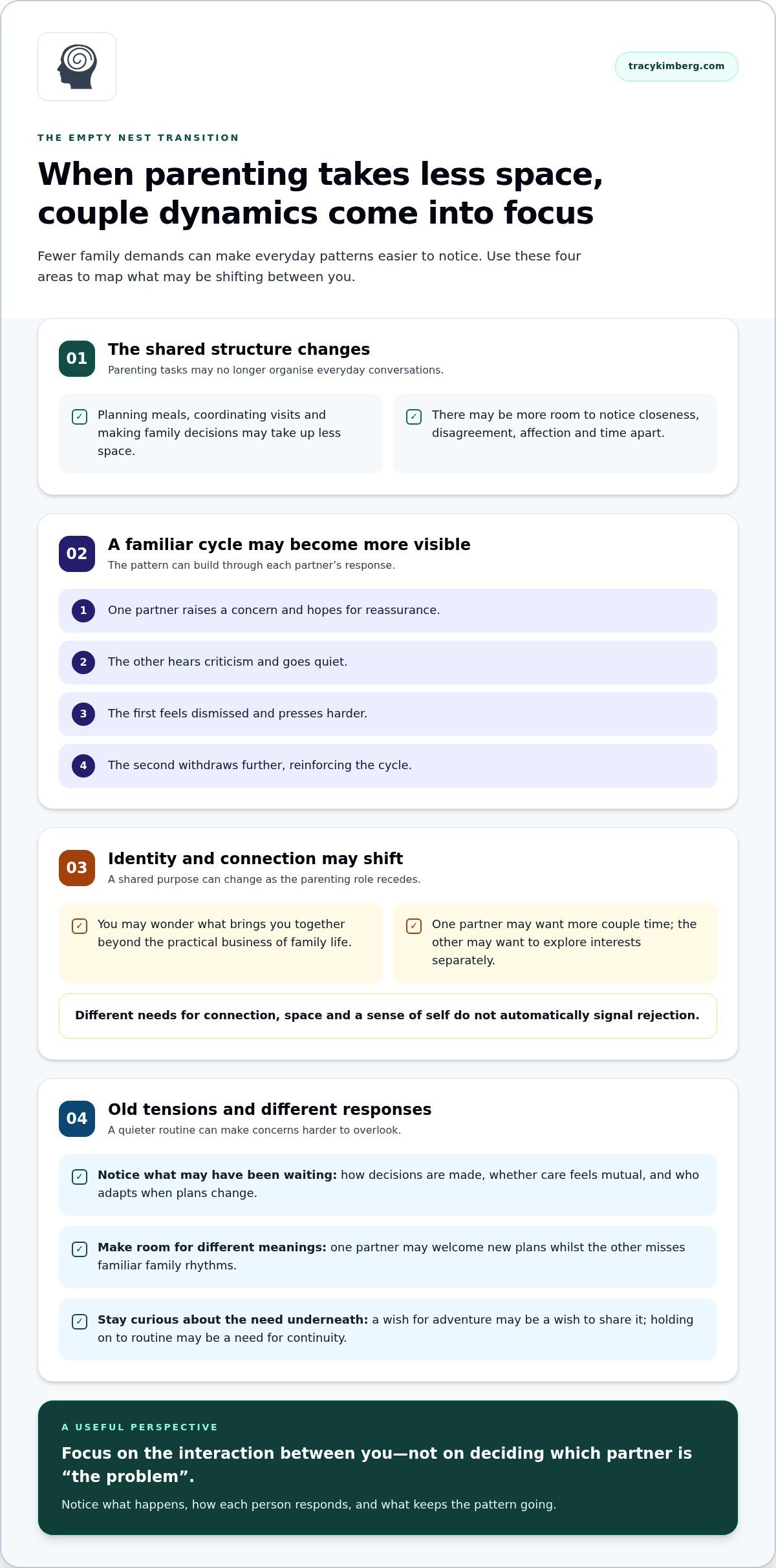
When parenting takes up less space in daily life, the way partners relate can become easier to see. Tasks that once gave you a shared focus, such as planning meals, coordinating visits or making family decisions, may no longer structure your conversations. That doesn’t mean the connection between you has disappeared. It may mean there’s more room to notice how you handle closeness, disagreement, affection and time apart.
Sometimes the change exposes a familiar cycle. One partner raises a concern and hopes for reassurance; the other hears criticism and goes quiet. The first feels dismissed and presses harder, whilst the second withdraws further. With fewer family demands competing for attention, that pattern may feel louder. The cycle matters more than deciding which partner is “the problem”: each person’s response can unintentionally reinforce the other’s.
Identity can shift, too. If being parents has shaped much of your shared purpose, you might wonder what now brings you together, or how much independence you each want. One partner may seek more couple time, whilst the other wants to explore interests separately. Neither preference automatically signals rejection. It can reflect different needs for connection, space and a sense of self.
Why might old tensions feel louder now?
Busy family life can leave practical or emotional concerns waiting in the background: how decisions are made, whether care feels mutual, or who adapts when plans change. The quieter routine doesn’t necessarily create those tensions; it can make them harder to overlook. A systemic perspective shifts the focus from blame to the interaction between you: what happens, how each person responds, and what keeps the pattern going.
What if one partner adjusts differently?
One of you may feel ready for new plans, whilst the other misses the old rhythm or feels unsure what comes next. Friction can grow when either partner assumes the other should feel grateful, excited or equally sad. Curiosity offers a different starting point: what might this change mean to each of you, and what need could be underneath your different reactions?
That curiosity can make room for a fuller picture. A partner eager to travel might be seeking shared adventure, not trying to escape the relationship. Someone who wants to keep familiar routines might be holding on to continuity, not refusing to move forward. Changes in intimacy or a sense of relief can also be part of adjustment rather than evidence that the relationship has failed. What matters is how you make sense of those changes together.
Surviving the empty nest stage as a couple doesn’t require matching feelings or identical plans. It asks you to notice the patterns shaping your responses and make space for each partner’s changing identity. If those patterns are difficult to understand alone, relationship counselling for couples can offer a supportive space to explore what’s happening between you and what each of you needs.
Is the empty nest stage a relationship crisis or a turning point?
The empty nest stage is a transition, not proof that your relationship is in crisis. It may open up new choices: more room for shared interests, unhurried time or individual pursuits. It may also bring grief, uncertainty or a sense of disconnection. Sometimes these experiences arrive together. None of them, on its own, tells the whole story of your relationship.
There’s a common assumption that once parenting responsibilities ease, couples will naturally turn towards each other and reconnect. But having more time together doesn’t automatically create emotional closeness. You may need to work out how to spend that time and what each of you wants from the relationship now. A turning point is possible, but it’s something you shape through attention and shared choices, not a result guaranteed by the change itself.
It’s also worth distinguishing difficult feelings from signs that something needs more care. Missing family life or feeling unsure about the future can be part of adjustment. Persistent distress deserves attention too, especially if it’s affecting how safe, heard or connected you feel with one another. Taking it seriously doesn’t mean labelling normal sadness as a disorder or deciding too quickly what the relationship means.
How can couples tell adjustment from persistent disconnection?
There’s no checklist that can diagnose a relationship. Instead, notice how you respond to the difficulty over time. Uncertainty may coexist with a willingness to talk, listen and stay curious about each other, even if you don’t have answers yet. That openness can help you begin finding a new rhythm.
Recurring conflict that never reaches understanding, or sustained emotional distance that leaves one or both partners feeling alone, may signal that the strain needs attention. Consider whether you can raise concerns without the same painful cycle taking over, and whether attempts to reconnect feel possible. These observations aren’t a verdict; they can help you decide whether a conversation, a change in routine or additional support might be useful.
Why is it not too late to pay attention to the relationship?
Years together can make a pattern feel fixed, but familiarity isn’t the same as inevitability. If one person reaches for connection and the other withdraws, both may end up feeling rejected or pressured. Seeing that sequence as a pattern between you, rather than a flaw in one partner, can create room to respond differently. Even a small shift, such as pausing to understand what the other person may be protecting or asking for, can change the direction of a conversation.
A life-stage challenge is a moment to understand your relationship, not a verdict on what it can become. Surviving the empty nest stage as a couple doesn’t require certainty about the future straight away. It can begin with noticing what feels hard, what still matters to each of you and whether you’re willing to keep meeting one another with care.
How to navigate the empty nest stage together, one conversation at a time
You don’t have to agree on what this new chapter should look like before you begin talking. A useful conversation can be modest: understand what the change means to each of you, then decide on one manageable step. Try this sequence:
- Name the transition: acknowledge that family life has changed and you’re both adjusting.
- Share your perspectives: say what you miss, welcome or feel unsure about, without expecting your partner to feel the same.
- Find a shared priority: identify something you both want to protect or make room for, such as feeling connected or having time to yourselves.
- Agree one next step: choose a small action to try, then return to the conversation and see how it felt.
Listen for the meaning and emotion beneath the words before moving into solutions. A wish to make plans might express a hope for adventure; a preference for quiet could be a need to recover. Check your understanding by reflecting back what you heard, rather than preparing a reply or trying to persuade your partner. The aim isn’t to settle every question at once. It’s to make the next exchange feel more open than the last.
How can you talk about what this change means to each of you?
Choose a calm moment, not the middle of an argument or a rushed exchange. First-person language can help you speak from your experience without assigning motives: “I feel uncertain about our evenings, and I’d like us to talk about what we want them to look like.” Then give your partner room to respond. Before offering your view, reflect back what you understood and invite them to clarify anything you missed.
If one person becomes defensive or the conversation starts to spiral, pause rather than pushing for a resolution. You might agree to return to the topic when you can both listen more fully. That pause isn’t avoidance if you come back to it; it can protect the conversation from turning into a contest over whose feelings are more reasonable.
How can you make room for shared and individual lives?
There’s no single right balance between time as a couple and time apart. Talk about what would feel nourishing: perhaps a regular shared meal, separate hobbies, time with friends or space for unplanned days. Include practical expectations about contact with adult children, visits and family traditions, without treating one arrangement as the standard every family must follow.
Needs may shift as circumstances change. A plan that works now might need adjusting if a child returns home, family responsibilities alter or either partner’s priorities evolve. Treat agreements as conversations you can revisit, not promises that can never change. This leaves room for both connection and independence.
Keep expectations gentle. A first conversation doesn’t need to create an instant relationship reset; it can simply help you understand each other a little better and choose what to try next. If you’d value support with those conversations, explore couples relationship counselling with Tracy Kimberg. Surviving the empty nest stage as a couple can begin with one honest conversation, followed by another.
When couples counselling can help with the empty nest transition
Couples counselling may be helpful when attempts to talk about life after parenting repeatedly end in arguments, silence or avoidance. You don’t need to wait until the relationship feels beyond repair. Support can be useful when the same conversation keeps looping, when one partner feels unheard, or when you’re unsure how to approach each other without reigniting tension.
A counsellor offers a space to slow those interactions down and understand what may be happening underneath them. The aim isn’t to decide who is right or to treat the transition as a problem with one partner. Instead, both of you can explore how this change is affecting the relationship and what might help you feel understood as you work out what comes next.
What can couples explore with a counsellor?
You might look at how parenting roles shaped your communication, decision-making and sense of partnership, and how those habits feel now that family life has changed. For instance, one person may have become the organiser whilst the other relied on them to manage plans. Counselling can help make such patterns visible without turning either partner into the problem.
Together, you can examine the cycle between you: what tends to happen, how each person responds and what each may be needing or protecting. That understanding can make room for different responses. It can also help you clarify whether you want to rebuild connection, renegotiate expectations or consider another way forward. The work is collaborative, centred on your circumstances and choices rather than a guaranteed outcome.
What support can Tracy Kimberg offer couples?
Tracy Kimberg provides relationship counselling and coaching for couples, informed by relationship research. This support can help you discuss changes in your relationship, understand recurring patterns and give each partner room to express what they need. You don’t have to arrive with a shared explanation or a complete plan; beginning with the concerns you each bring can help shape the work together.
For couples who want a more structured form of support, Tracy also offers a 12-Week Relationship Recovery Process. It’s one option for working through relationship concerns with a clear structure, without implying that every couple needs the same approach or will reach a particular outcome. Sessions are available online and face to face.
Surviving the empty nest stage as a couple doesn’t mean you have to resolve every question alone. If you’re ready to explore support for your relationship, connect with Tracy Kimberg about couples counselling.
Choose what you want to grow together
Your relationship doesn’t have to return to the version of itself that existed when parenting filled the day. This stage can be a chance to decide, with care and without rushing, what you want to make room for now: more tenderness, greater independence, fresh shared experiences, or simply a way of speaking that feels safer and more honest.
Surviving the empty nest stage as a couple isn’t about finding a perfect plan. It’s about staying open to one another as your needs evolve, and letting small choices show you what kind of connection feels meaningful in this chapter. You can begin before you have all the answers.
If you’d like a supportive space to consider your next steps, explore relationship counselling and coaching for couples. A thoughtful beginning can help you meet this change with greater understanding and move towards a future that feels more your own.
Frequently Asked Questions
How long does the empty nest stage last?
There’s no single timeline for adjusting after children leave home. The change itself may happen on a particular day, whilst settling into different routines can take longer and unfold unevenly. Each partner’s response may be shaped by family circumstances, ongoing responsibilities and what the departure brings up. Rather than measuring progress against a deadline, notice whether daily life is gradually finding a workable rhythm.
Is it normal to feel sad when your children leave home?
Yes, sadness can sit alongside pride in your child, relief about having fewer responsibilities or excitement about what may come next. A familiar role can change, and everyday moments, such as setting the table or hearing someone come through the door, may feel different. Those feelings don’t mean you’ve parented badly or that your relationship is unhappy. They’re an understandable response to a meaningful change.
Can couples grow closer after their children leave home?
Yes, some couples find new ways to connect, though additional free time doesn’t create closeness by itself. Surviving the empty nest stage as a couple may involve getting to know each other’s current interests and rhythms, rather than trying to recreate an earlier version of your partnership. For example, you might discover that one of you wants regular plans whilst the other prefers spontaneity, then find a balance that feels shared.
What if my partner seems happy about the empty nest whilst I feel lonely?
Both responses can be genuine, and different feelings don’t mean either partner cares less. Try describing loneliness as your experience, for example, “I’ve been missing our family evenings and would like to feel closer,” rather than assuming your partner is glad to be rid of family life. Make room to hear what the change means to them, too. If this difference repeatedly turns into conflict or silence, support may help.
Can the empty nest stage affect intimacy between partners?
It can. Changes in routines, emotions and expectations may influence emotional or physical intimacy, but couples respond in different ways. More time alone together doesn’t necessarily mean desire or affection will return automatically. A gentle conversation about what feels changed, what you miss and what kind of closeness feels comfortable now can help you understand each other. There’s no need to assume that intimacy must look exactly as it did before.
What if an adult child moves back home after leaving?
A child returning home can reshape household routines and bring up different expectations for each partner. Discuss practical matters together, such as privacy, shared responsibilities, visits and how family decisions will be handled, whilst treating your adult child as a person with their own needs. You don’t have to settle every arrangement at once. Keep communication open and revisit what you’ve agreed if the living situation or anyone’s circumstances change.
When should a couple consider counselling during the empty nest stage?
Consider counselling if recurring conflict, avoidance or emotional distance feels difficult to shift together, rather than waiting for a crisis. A counsellor can help you slow down familiar interactions, understand what each partner needs and explore how the change is affecting your relationship. Seeking support isn’t a verdict on your partnership, and it can’t promise a particular outcome. It can offer a considered space to work out what you want to do next.

Article by
Tracy Kimberg
Tracy Kimberg is a Relationship Expert, Couples Therapist and Coach with a dedicated focus on helping couples and individuals rebuild connection, trust and emotional safety in their relationships. Drawing on the research of John and Julie Gottman, the relational insights of Esther Perel, and years of hands-on therapeutic experience, Tracy offers a warm, non-judgemental and deeply compassionate approach to modern relationships.
Based in Dorset, Tracy works with couples navigating communication breakdowns, betrayal, intimacy challenges, separation, family dynamics and life transitions. Known for creating a safe and grounded therapeutic space, she combines practical tools with emotional depth to help clients move beyond survival patterns and towards meaningful, lasting change.
With a reputation for empathy, professionalism and dedication to her clients’ growth, Tracy is passionate about helping people feel seen, understood and empowered — both within their relationships and within themselves.
Disclaimer
Disclaimer:
The information shared in this article is intended for educational and informational purposes only and should not be considered a substitute for professional therapeutic, psychological, medical or legal advice. Every individual and relationship is unique, and the perspectives offered are based on general therapeutic principles, research and professional experience.
Reading this article does not establish a therapist-client relationship with Tracy Kimberg. If you are experiencing significant emotional distress, relationship crisis, trauma, or mental health concerns, it is important to seek support from a qualified professional appropriate to your individual circumstances.
All content remains the intellectual property of Tracy Kimberg and may not be reproduced or distributed without permission.