

What if the distance between you isn’t proof that your relationship is over, but a sign that you’re both exhausted by the way things have been going? You may feel lonely even when you’re together, or find yourselves repeating the same arguments, withdrawing, then trying to reconnect without lasting change. It can be hard to understand these patterns, especially when you’re unsure whether you both want support. Counselling for relationship burnout can give you space to explore what is happening between you without making either person the problem.
This article looks at how relationship burnout may show up, why ongoing stress and unresolved tension can leave a couple depleted, and how counselling can help you recognise recurring patterns and talk about what you need. You’ll also find practical ways to prepare for a first conversation, including what you can do if one partner feels ready before the other. Support can help you work towards repair or reach a clearer decision together.
Key Takeaways
- Emotional exhaustion and disconnection can signal strain in a relationship, but they don’t prove that love is gone or that either partner is to blame.
- Look at how stress, unmet needs and misunderstandings shape a cycle between you, rather than treating conflict as one person’s fault.
- Counselling for relationship burnout can help you notice recurring patterns and talk about what each of you needs, even if you’re not at breaking point.
- Before counselling, choose one repeated moment you’d like to understand differently instead of preparing a case against your partner.
- Support can be relevant for couples and individuals. Tracy Kimberg offers relationship counselling and coaching online and face to face.
What relationship burnout can feel like, and what it does not prove
You may still care deeply about your partner and feel worn down by the effort of being together. Perhaps you’re lonely in the same room, unsure how to raise a concern, or tired of trying to reconnect only to find yourselves back in familiar tension. That exhaustion deserves attention, but it doesn’t make either of you the problem.
Relationship burnout is an everyday way to describe sustained emotional depletion within a partnership. It isn’t a diagnosis, and no checklist can establish what is happening in your relationship. The general account of Burnout describes emotional exhaustion as one aspect of burnout. In a relationship, the term may help name a sense of having little energy left for closeness or difficult conversations. Each couple’s experience is different.
How relationship burnout may show up day to day
Distance can arrive quietly. You might ask fewer questions about each other’s inner lives, or find that sharing good news feels less natural. Everyday exchanges become practical: who is picking something up, what needs organising, what time to leave. The tasks get done, but the sense of being companions in them feels faint.
For some couples, strain is loud: small disagreements quickly gather old grievances. For others, one or both partners go quiet, avoid vulnerable topics or retreat into separate routines. You may feel unseen despite explaining yourself, while your partner feels overwhelmed or unsure how to respond. Even attempts to reconnect can feel effortful when neither of you knows what would make contact feel safe or welcome. These are possible experiences, not a checklist or proof that a relationship is beyond repair.
Burnout is a signal to understand, not a verdict
Relationship strain can show that something needs attention; it cannot, by itself, prove that love or commitment has disappeared. A difficult period may be shaped by accumulated pressures, changes in each person’s capacity, or responses that have become hard to shift. One painful week, argument or stretch of distance does not decide your relationship’s future.
Instead of asking, “Who caused this?”, notice what tends to happen between you. Is there a moment when one person reaches for reassurance and the other hears criticism? Does a conversation about a practical issue leave either of you feeling dismissed? These questions aren’t a clinical assessment. They can help you become curious about context and interaction rather than assigning blame. Counselling for relationship burnout can create room to explore those patterns with care, without assuming in advance whether the next step is repair or a clearer decision.
Why couples become depleted: the patterns beneath relationship burnout
Exhaustion in a relationship rarely has just one explanation. Work demands, caring responsibilities, health concerns or financial pressure may leave less energy for patience and attention. At the same time, an important need can go unspoken or be expressed in a way the other person struggles to hear. When misunderstandings repeat without repair, each one can add weight to the next.
It can help to look beyond who started an argument. One person’s response may make sense in the moment and still affect the other in ways neither intended. A recurring couple pattern is shaped by the interaction between partners, the context they’re living in and each person’s individual experience. Keeping all three in view makes room for compassion without excusing hurtful behaviour or assuming what either person has lived through.
The pursue-withdraw cycle and other repeated interactions
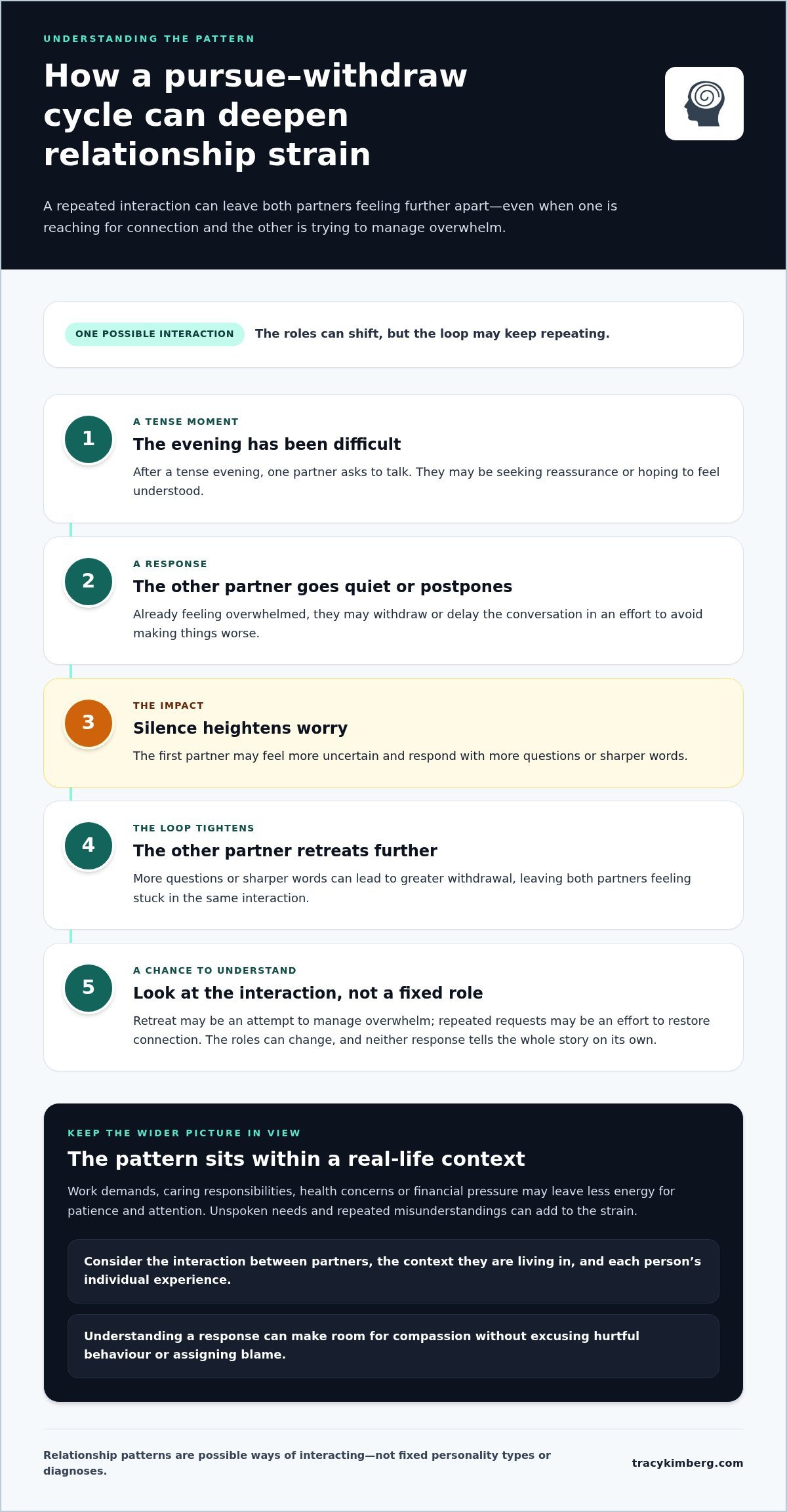
Imagine one partner asking to talk after a tense evening. They may be seeking reassurance or hoping to feel understood. The other, already overwhelmed, may go quiet or postpone the conversation to avoid making things worse. That silence can heighten the first partner’s worry, prompting more questions or sharper words. In turn, the other may retreat further.
The roles can shift, and couples can get caught in other loops, such as both becoming defensive or each waiting for the other to make the first move. These are possible interaction patterns, not fixed personality types or diagnoses. Retreat may be an attempt to manage overwhelm; repeated requests may be an effort to restore connection. Understanding the purpose and impact of each response can show where the cycle might be interrupted.
How life pressures can leave less room for connection
Connection needs time and attention, both of which can become scarce when daily life is demanding. A partner juggling work and caring responsibilities might experience quiet time as essential recovery. The other may interpret that quietness as disinterest and seek more conversation. Neither interpretation is necessarily the whole story: the gap may reflect different expectations about support, closeness or rest.
There may be no single event to point to. Instead, pressure accumulates: plans are postponed, practical conversations crowd out personal ones, and each partner adapts in their own way. Ask yourself what has changed around the relationship, what each of you needs more or less of, and what you tend to do when connection feels uncertain. Treat these as questions to explore, not conclusions about blame or hidden causes.
Relationship counselling and coaching with Tracy Kimberg offers a collaborative space to examine how context and interactions are affecting your relationship, and to consider what might help you respond differently.
Can counselling for relationship burnout help if you feel stuck?
You don’t have to wait until a relationship reaches breaking point to seek support. Counselling can help when you’re caught in familiar conversations, unsure how to raise a need, or concerned that distance is growing. You don’t need to arrive with a clear explanation or agreement about what should happen next. Starting with uncertainty is still a place to begin.
Counselling for relationship burnout isn’t about deciding who is at fault or promising that you’ll stay together. It offers a supported space to understand what’s happening between you, explore each person’s experience and consider possible changes. Greater understanding, renewed connection or clarity about the relationship’s future may each be meaningful outcomes to work towards.
What counselling can offer when conversations go in circles
When a conversation becomes reactive, it can be difficult to hear the need beneath the words. In counselling, partners can slow the exchange down, describe what a moment felt like and listen to how it landed for the other person. A complaint might carry a wish for more consideration; silence might reflect overwhelm rather than a lack of care. Exploring those possibilities doesn’t dismiss the impact of either response.
Rather than searching for a single culprit, you can become curious about what happens between you: what tends to set a difficult exchange in motion, how each person responds, and what might help interrupt the familiar sequence. This isn’t about making every action equal. It’s about seeing the pattern clearly enough to discuss responsibility, needs and choices with greater care.
What if one partner is unsure about attending?
Readiness often differs. A hesitant partner may feel anxious about being blamed, doubt that talking will help, or simply need time to consider the idea. Their uncertainty doesn’t, by itself, prove indifference. You can explain what you’re hoping to understand and invite a conversation, while recognising that you can’t decide for them or guarantee they’ll take part.
If your partner isn’t ready, individual counselling can still give you space to explore your own experience of the relationship. You might reflect on what you feel, what you need, how you respond during difficult moments and what choices are within your control. This isn’t a way to diagnose your partner or make them change. It can help you approach the relationship with more understanding and decide what feels like a constructive next step for you.
Couples counselling can support a shared exploration when both partners choose to attend. Whether you come together or begin by reflecting individually, the aim is not to force a decision, but to make room for a more considered one.
How to prepare for counselling when your relationship feels exhausted
Preparing doesn’t mean building a case against your partner or finding the perfect words for everything that hurts. It can simply help you arrive with one moment you’d like to understand better. You don’t need to agree on what caused the strain, or even describe it in the same way, before beginning counselling for relationship burnout.
A useful aim for a first conversation is to describe a recurring pattern, how it affects you and what you hope to understand about it. That gives you a place to start without demanding an immediate solution. Bring notes if they help, but your thoughts don’t need to be polished or complete.
What to reflect on before the first conversation
Take a little time to consider when distance or tension feels strongest. Is it around a particular conversation, a busy time of day or after one of you has tried to ask for support? Notice what tends to happen beforehand, without deciding that one person is responsible. The aim is to identify a moment worth exploring, not to explain the whole relationship at once.
You might also ask yourself what you miss, what you need and what feels difficult to say aloud. Perhaps you miss sharing unhurried time, or need reassurance but worry it will sound like criticism. Choose one small, realistic hope for counselling, such as understanding why a particular exchange leaves you feeling alone. Keep it open enough for new perspectives to emerge.
- Recall one recurring moment that feels important.
- Notice what you feel and need in that moment.
- Consider what you’d like to understand, rather than what you want to prove.
How to make room for a more honest conversation
In the conversation itself, try describing your experience rather than judging your partner. “I feel shut out when we stop talking after an argument” leaves room to explore your feelings and the interaction. “You never listen” can make it harder for either of you to stay curious. This isn’t about censoring strong emotions; it’s about expressing them in a way that makes dialogue more possible.
Listening doesn’t require immediate agreement. You can try to understand what a moment meant to your partner, even if you experienced it differently. A pause can help you take in what you’ve heard before responding or looking for a fix. If a subject feels too vulnerable to approach all at once, say so. Sensitive disclosures can unfold at a manageable pace, with space to notice what feels safe enough to discuss now.
You don’t have to prepare perfectly or arrive with a shared account of the problem. If you’re ready to explore what’s happening between you, begin relationship counselling with Tracy Kimberg as a supported step towards greater understanding.
Counselling for relationship burnout with Tracy Kimberg: a supported next step
When a relationship feels depleted, deciding what to do can seem as daunting as the strain itself. You may hope to reconnect, want to understand why you feel so far apart, or simply need room to think. You don’t have to arrive with a final decision. Tracy Kimberg provides relationship counselling and coaching for couples dealing with emotional disconnection and relational breakdown, creating space to explore what is happening without prescribing what the outcome should be.
A collaborative space to understand your relationship patterns
Counselling brings both partners’ perspectives into the conversation. Rather than treating one person as the problem, the work can focus on understanding the relationship dynamics you experience together: what happens between you, how it affects each of you and what you might want to approach differently. Being heard can feel hopeful, and sharing honestly can also feel vulnerable. Both reactions are understandable.
You don’t need to agree on every detail to explore a pattern. One partner may experience a conversation as an attempt to solve a problem, whilst the other experiences it as criticism. Making room for each account can help you understand the difference between intention and impact, and consider how you want to respond to one another. It’s a process of exploration, not a guarantee that the relationship will be repaired or that you’ll reach the same conclusion.
Choose a next step that feels manageable
Seeking clarity doesn’t commit you to staying together or separating. It means giving yourself space to consider what matters, what feels possible and what decision you can make with greater understanding. Tracy offers relationship support online and face to face.
For couples who want a structured option, Tracy also offers a 12-Week Relationship Recovery Process. It provides a framework for exploring the next step without assuming what your relationship should become. Individual support can also help someone navigating relational breakdown or emotional disconnection.
Change can begin with a willingness to look at what’s happening, even if you’re not yet sure where it will lead. Explore relationship counselling with Tracy and take a supported step towards understanding what comes next.
Take one thoughtful step towards clarity
You don’t have to settle the whole future of your relationship today. A next step can be smaller: naming what you want to understand, making space for an honest conversation, or acknowledging that the current pattern is no longer working for you. The aim isn’t to force certainty, but to approach what comes next with greater care and awareness.
Counselling for relationship burnout can help you explore questions that feel difficult to hold alone, whether you’re hoping to move towards one another or seeking clarity about your direction. You can begin without perfect words or knowing what the outcome should be. A willingness to look honestly at your experience is enough to start.
If you’re ready to explore support, explore relationship counselling with Tracy. Take the first step towards understanding what is happening between you.
Frequently Asked Questions
Can relationship burnout happen even if you still love your partner?
Yes. Love and the energy to express it don’t always move in step. You may feel affection but have little capacity for gestures of care during a demanding stretch. Rather than using one difficult moment to measure your feelings, notice what forms of warmth still feel genuine, even if small. A shared joke or a kind check-in can offer information about how you relate without needing to prove what the relationship means.
How can I tell whether this is relationship burnout or a difficult period?
Notice whether the strain shifts when circumstances change. If tension eases when a particular demand passes, that may tell you something about the pressure surrounding the relationship. If the same unease appears across different situations, consider what else might be contributing. You could jot down a few observations about when you feel more settled or more strained. This isn’t a diagnostic test, but it may help you describe your experience if you seek support.
How long does counselling for relationship burnout take?
The length varies with your concerns, aims and circumstances, so there’s no guaranteed timeframe. Tracy’s structured 12-Week Relationship Recovery Process is one defined option, but its duration isn’t a prediction of what any couple will need or achieve. As counselling progresses, it can help to revisit what you hope to work on so the focus reflects your circumstances rather than an assumed timetable.
Will relationship counselling tell us whether we should stay together?
No automatic verdict is given. If you’re uncertain, each partner could privately consider what they would need in order to feel willing to continue, and what would be difficult to compromise on. You can then bring those reflections into a conversation without treating them as demands or expecting identical answers. This may help you understand where your hopes overlap and where you need to think more carefully.
Can counselling help if my partner does not want to come?
You can seek individual relationship counselling and use the space to clarify what you want to say or do next. If you invite your partner to attend, choose a calm moment, explain one reason it matters to you and ask what concerns them. Try not to make attendance a test of love or commitment. They may still decline, and you can consider your own choices without deciding for them.
Can relationship burnout affect emotional and physical intimacy?
Yes, it can influence closeness, though partners’ experiences differ. One person may find a hug reassuring whilst the other wants more space; sexual connection may also change. Neither response means the same thing for everyone. Try asking what kinds of affection feel welcome at present, and make it clear that either person can pause a conversation or say what they’re comfortable with.

Article by
Tracy Kimberg
Tracy Kimberg is a Relationship Expert, Couples Therapist and Coach with a dedicated focus on helping couples and individuals rebuild connection, trust and emotional safety in their relationships. Drawing on the research of John and Julie Gottman, the relational insights of Esther Perel, and years of hands-on therapeutic experience, Tracy offers a warm, non-judgemental and deeply compassionate approach to modern relationships.
Based in Dorset, Tracy works with couples navigating communication breakdowns, betrayal, intimacy challenges, separation, family dynamics and life transitions. Known for creating a safe and grounded therapeutic space, she combines practical tools with emotional depth to help clients move beyond survival patterns and towards meaningful, lasting change.
With a reputation for empathy, professionalism and dedication to her clients’ growth, Tracy is passionate about helping people feel seen, understood and empowered — both within their relationships and within themselves.
Disclaimer
Disclaimer:
The information shared in this article is intended for educational and informational purposes only and should not be considered a substitute for professional therapeutic, psychological, medical or legal advice. Every individual and relationship is unique, and the perspectives offered are based on general therapeutic principles, research and professional experience.
Reading this article does not establish a therapist-client relationship with Tracy Kimberg. If you are experiencing significant emotional distress, relationship crisis, trauma, or mental health concerns, it is important to seek support from a qualified professional appropriate to your individual circumstances.
All content remains the intellectual property of Tracy Kimberg and may not be reproduced or distributed without permission.