

The therapy label may matter less than whether its ideas help you recognise and change the patterns keeping you stuck. If you’re exploring Gottman method couples therapy UK, you may be wondering what happens in a session, whether either of you will feel blamed, and what it means if one partner is more ready to begin than the other. Those are understandable questions. Therapy should make room for both perspectives.
This guide explains the principles and practical shape of Gottman-informed couples work, then compares them with Imago Relationship Therapy, which uses structured dialogue to support understanding and connection. You’ll see how the approaches differ without assuming that one is right for every couple. A named method can offer useful tools, but the way a therapist helps you explore your relationship matters too. Tracy Kimberg’s research-informed couples counselling and coaching draws inspiration from John Gottman and other relationship experts; it isn’t presented as Gottman certification. The aim is to help you consider what might fit your relationship, at a pace that feels thoughtful rather than pressured.
Key Takeaways
- Gottman method couples therapy UK can help couples notice recurring patterns in communication and conflict, rather than decide who is to blame.
- Sessions may involve sharing concerns, exploring needs and considering different responses, though the process isn’t a fixed script.
- Gottman-informed work and Imago both offer ways to explore relationship difficulties, but their focus and session experiences can differ.
- You don’t need to agree on every issue before starting. Different levels of readiness can be discussed openly and without blame.
- Research-informed relationship counselling and coaching can offer a considered next step when connection feels strained.
What Gottman Method couples therapy in the UK is designed to help couples understand
Choosing therapy can feel vulnerable, especially when you and your partner tell different stories about what’s wrong. One of you may feel shut out, whilst the other feels criticised or overwhelmed. That difference doesn’t mean either person is at fault. It can be a starting point for understanding how each of you experiences the relationship.
Gottman Method Couples Therapy is a research-informed approach that helps couples explore relationship patterns, including how they communicate, manage conflict and maintain emotional connection. The Gottman Institute describes the research behind its approach. Those findings can inform the work, but they can’t predict what will happen for any individual couple. Gottman method couples therapy UK is best understood as a framework for exploring a relationship, not a promise of a particular result.
What happens to friendship, conflict and emotional connection?
Alongside difficult conversations, a therapist may explore the friendship within your relationship: how you show interest, respond to one another and make space for closeness. The focus isn’t on scoring each partner’s behaviour. It’s on understanding the interaction between you and what each person may be trying to express or protect.
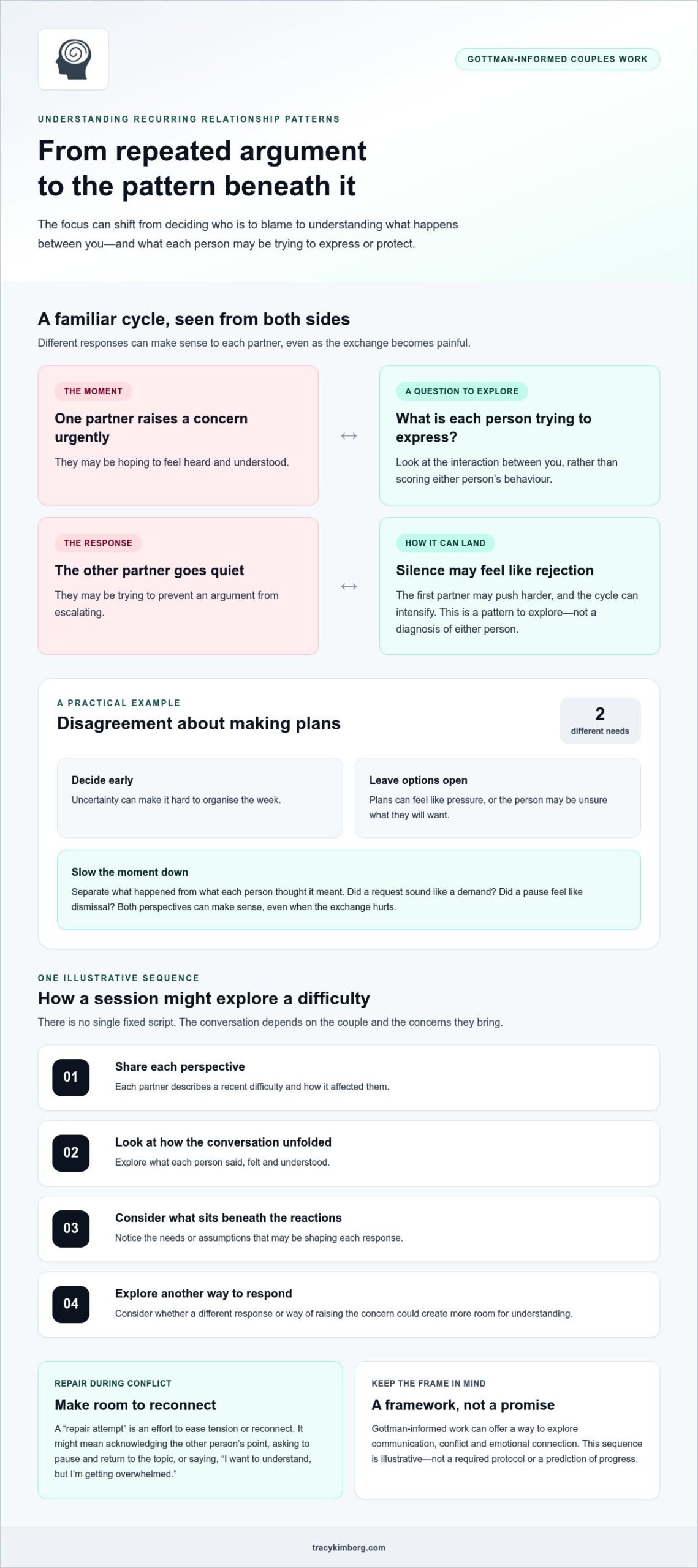
For instance, one partner might raise a concern urgently, hoping to feel heard; the other might go quiet to prevent an argument from escalating. That silence can then feel like rejection, prompting the first partner to push harder. This is a pattern to explore, not a diagnosis of either person or a prediction about your relationship. Your own experience gives the conversation its meaning.
Conflict can also be considered in context: what tends to trigger it, how each of you responds, and whether you can reconnect afterwards. The Couples therapy overview offers broader context for how different approaches, including Gottman and Imago, sit within the field.
What the name does, and doesn’t, tell you
A therapy model describes ideas and practices that may shape the work. It doesn’t, by itself, tell you a practitioner’s qualifications, experience or formal training status. Training and certification are separate from using research or concepts as inspiration, so the label alone shouldn’t be taken as evidence that someone holds a particular credential.
That distinction matters here. Tracy Kimberg’s research-informed couples counselling and coaching is inspired by relationship experts including John Gottman and Esther Perel; this isn’t a claim of Gottman certification. The useful question is how the approach helps you both speak honestly and examine shared patterns without either person being cast as the problem. Therapy can make room for different perspectives, with curiosity and care at the centre of the conversation.
How Gottman-informed couples therapy can explore recurring relationship patterns
A repeated argument can start to feel like evidence that one of you is unreasonable or that the relationship is beyond repair. A more curious question is: what happens between us when this subject comes up? Gottman-informed work can shift attention from winning the point to understanding the interaction, including the feelings and needs that may be driving each response.
There isn’t one fixed script for a session. Depending on the couple and the concerns they bring, exploration might move through several stages:
- Each partner shares their view of a recent difficulty and how it affected them.
- Together, you look at how the conversation unfolded, including what each person said, felt and understood.
- You consider the needs or assumptions beneath those reactions.
- You explore whether another response or a different way of raising the concern might create more room for understanding.
This is an illustrative sequence, not a required protocol or promise of progress. The Gottman Method describes an approach shaped by relationship research. In therapy, the value lies in considering what a pattern means for the couple in front of the therapist.
From a repeated argument to the pattern beneath it
Imagine a disagreement about making plans. One partner wants to decide early because uncertainty makes it hard to organise the week. The other prefers to leave options open, perhaps because plans can feel like pressure or because they’re unsure what they’ll want. If the first person pushes for an answer and the second postpones, each may interpret the other’s response as disregard. Both perspectives can make sense, even as the exchange becomes painful.
In Gottman method couples therapy UK, a therapist might help you slow the moment down and separate what happened from what each person thought it meant. Did a request sound like a demand? Did a pause feel like dismissal? These questions aren’t a diagnosis, and this example doesn’t predict how your relationship works. They’re prompts for examining the meanings each of you brings to a familiar disagreement.
Making room for repair and new conversations
Once the pattern is clearer, you might practise noticing when a conversation is escalating and trying a different way to stay engaged. In Gottman-informed work, a “repair attempt” means an effort to ease tension or reconnect during conflict. It could mean acknowledging the other person’s point, asking to pause and return to the topic, or saying, “I want to understand, but I’m getting overwhelmed.” A therapist can help you consider what feels genuine and useful to both of you.
These moments aren’t magic words. A phrase that feels caring to one partner may not land that way for the other, and a tool won’t resolve every disagreement. Change is more often a process of noticing, reflecting and trying again. If you’d value support exploring these interactions together, relationship counselling and coaching can offer space for collaborative reflection, without making either partner the problem.
Gottman Method and Imago Relationship Therapy: what is different?
Gottman-informed work and Imago Relationship Therapy both invite couples to look beyond the surface of an argument, but they bring different ideas into focus. One may feel more practical to you; another may offer a kind of dialogue that helps you feel heard. Neither approach is a universal winner. They offer different lenses, and what feels helpful depends on your relationship, your concerns and the way the work is facilitated.
Broad focus
Gottman-informed work: Relationship patterns, friendship, communication and how conflict unfolds. A therapist may explore how partners connect, respond to one another and manage disagreement.
Imago Relationship Therapy: Structured dialogue and the ways earlier experiences may influence how partners relate in the present. The intention is to support understanding and connection, rather than simply settle who is right.
Session experience
Gottman-informed work: Conversation may include examining a recurring interaction and considering practical ways to respond differently. These are possible areas of exploration, not guaranteed steps in every session.
Imago Relationship Therapy: Partners may use guided dialogue in which one speaks and the other listens and reflects back what they have heard. This can slow the exchange and make room to understand each person’s perspective.
Questions each approach may raise
Gottman-informed work: What happens between us during conflict? How do we sustain friendship and emotional connection?
Imago Relationship Therapy: What might this interaction bring up for each of us? How could listening with curiosity change how we understand one another?
What each approach tends to bring into focus
Gottman-informed work may draw attention to how everyday interactions shape connection, including how partners respond to one another’s attempts to engage. Imago dialogue offers a structure for speaking and listening, with attention to how past experiences might colour present reactions. Neither description is a fixed treatment recipe. Individual practitioners may adapt their work or draw on more than one influence, depending on the couple’s needs.
These are broad distinctions, not a promise that every practitioner uses the same session format. The name of an approach can help you understand its guiding ideas, but it doesn’t tell you exactly how a therapist will work with you.
How couples can think about fit without choosing a “winner”
Consider what you most want support with right now. Are you hoping to understand patterns and explore practical ways to communicate, or would a more deliberately structured dialogue help you slow down and listen? Perhaps both matter. Your answers can clarify what you’d like therapy to make space for, without requiring you and your partner to agree on every issue first.
For couples considering Gottman method couples therapy UK, a useful starting point is to name the change you hope to work towards, such as feeling more understood during difficult conversations. That preference can guide a conversation about approach, while leaving room for the therapist to respond to the people and relationship in the room.
Choosing couples therapy in the UK when you are unsure about the approach
You don’t need to settle on a therapy model before asking for support. It can be enough to recognise that something between you feels painful or distant, even if you disagree about why. Start by describing what you hope might feel different: perhaps conversations could feel less tense, affection could return, or decisions could become easier to discuss. You can begin with that shared hope without agreeing on every detail of the problem.
Readiness may be uneven. One partner might be keen to begin, whilst the other feels wary, doubtful or simply unsure what therapy involves. That difference is worth talking about, not treating as proof that one person cares less. Ambivalence can point to a need for reassurance, a fear of being blamed, or uncertainty about what change might ask of each of you. Naming it openly can help the conversation start with honesty rather than pressure.
Questions to help you describe what is happening
Before a first conversation about therapy, each of you might reflect separately, then share what feels comfortable. Try to describe your own experience rather than prepare a case against your partner:
- What keeps repeating between us, and when does it tend to happen?
- What do I miss about our relationship, or wish we had more room for?
- What would I hope therapy could help us understand or make possible?
- What makes me hesitant, and what might help me feel safer taking part?
You don’t need matching answers. Hearing that one person wants to feel closer whilst the other wants less conflict can reveal different needs, not competing agendas. If one of you isn’t ready, a first step might simply be listening to what feels difficult about beginning. That doesn’t guarantee agreement, but it allows both partners’ concerns to be part of the discussion.
Considering online or face-to-face support
Tracy Kimberg offers couples relationship support online and face to face. Choosing a format is a practical decision, not a test of commitment. Consider where each of you can speak privately, which setting feels more comfortable, and what fits around work, caring responsibilities or travel. A familiar room may feel grounding for one couple; meeting online may fit more easily into another couple’s routine. Neither format is inherently more effective for every relationship.
If you’re weighing up Gottman method couples therapy UK or a broader counselling approach, start with the kind of support you want and the questions you hope to explore. Tracy’s research-informed relationship counselling and coaching draws inspiration from John Gottman and Esther Perel, with space to consider the concerns that matter to you as a couple. When you feel ready, explore couples counselling with Tracy as a considered next step, without needing to have everything worked out first.
How Tracy Kimberg’s relationship counselling can support your next step
Understanding therapy models can help you name what you’re looking for, but you don’t need to select a method before asking for support. What matters is having room to talk about the relationship you’re living in now: the distance that has grown, the hurt that remains, or the sense that you’ve lost your way as a couple.
Tracy Kimberg offers relationship counselling and coaching for couples facing relational breakdown or emotional disconnection. The work can help you bring your different experiences into the conversation and consider what each of you wants to understand or change. It isn’t about deciding in advance whether the relationship can be repaired, but creating space to explore what is happening and what choices feel possible.
A research-informed approach centred on your relationship
Couples often arrive with different hopes. One partner may want to rebuild trust, whilst the other wants to understand why they feel withdrawn. Both experiences can be part of the conversation. Rather than asking you to agree on a single account, counselling can help you notice how your responses affect one another and what remains difficult to say.
For couples who would value a defined structure, Tracy also offers a 12-Week Relationship Recovery Process. It provides a framework for working on relationship concerns, without promising a particular outcome.
Taking a first step together
You don’t have to resolve every disagreement before seeking support. It’s enough to begin with an honest concern, a question you can’t answer together, or a wish to understand what has changed. If one of you feels uncertain, that hesitation can be part of the conversation rather than a reason to have everything figured out first.
If you’re ready to explore what support could look like for your relationship, Explore couples relationship support. A considered first step can begin with simply making space for a new conversation.
Let your next conversation begin with curiosity
You don’t have to settle every question about therapy before taking a step. Instead, consider what you’d like to understand about the relationship, and what might help you feel safe enough to explore it together. A small shift in focus, from proving who is right to getting curious about what each of you needs, can open a different kind of conversation.
Gottman method couples therapy UK is one framework for thinking about relationship support, but a label can’t capture the whole experience of working with a therapist. What matters is having space for both partners’ perspectives and for the patterns shaping your connection. You can begin with uncertainty, mixed feelings or a hope that’s still taking shape. There’s no need to arrive with a perfect plan.
If you’re ready to explore a thoughtful next step, explore couples relationship support. A more open conversation can start with one honest question, and you can discover where it leads together.
Frequently Asked Questions
Is Gottman Method couples therapy available in the UK?
Yes, couples in the UK can seek therapists who use the Gottman Method. The phrase Gottman method couples therapy UK can describe a range of services, so the label alone won’t tell you how sessions are organised or what they’ll focus on. Consider what you hope to work on, such as feeling more like a team or making decisions together, and use that as your starting point.
Can couples therapy help if one partner is unsure about attending?
It can be worth exploring support even if you’re not equally enthusiastic about starting. Rather than trying to secure a firm yes straight away, agree on a small question to discuss, such as what each of you would want a therapist to understand about a recent difficulty. This can make the idea more concrete and give the hesitant partner room to express reservations without being pushed into a decision.
How does Gottman Method therapy differ from Imago Relationship Therapy?
The main difference is in the lens and structure each may bring to the work. If you’re comparing them, ask yourselves what kind of conversation you want help having: one that examines how interactions unfold, or one with a more defined listening and reflecting format. These preferences can help you discuss fit without needing to decide that one approach is universally better or commit to a label in advance.
What happens in a first couples therapy session?
A first session gives you an opportunity to set out what you’d like help with and hear how the therapist proposes to work with you. Beforehand, you could each choose one question you hope the sessions will address, such as how to make a difficult decision without it turning into a stand-off. You don’t need to prepare a full history. A clear, manageable starting point is enough.
Can couples therapy help when we keep having the same argument?
It may help to bring one recent example rather than trying to recount every disagreement. Afterwards, each of you could note what the argument was about, what you wanted your partner to understand, and what you found hardest to say. This gives you specific material to discuss, without turning preparation into a list of your partner’s mistakes. The aim is to make the conversation more useful, not to prove who started it.
Is online couples therapy suitable for relationship counselling?
Online sessions can suit couples who can both take part comfortably and speak without being overheard. Before meeting, choose a private space, check that you can both hear and see the conversation clearly, and agree how you’ll handle interruptions. If you’re joining from separate places, it may help to decide beforehand how you’ll avoid talking over one another. These practical arrangements can make it easier to stay present.
Does a therapist inspired by Gottman have to be Gottman-certified?
No. Being inspired by Gottman’s ideas and holding a Gottman certification are not the same claim. Certification refers to a formal credential; inspiration describes an influence on a practitioner’s approach. Neither label alone tells you what a particular session will feel like or what results to expect. Tracy Kimberg describes her relationship work as research-informed and inspired by John Gottman, without claiming Gottman certification.

Article by
Tracy Kimberg
Tracy Kimberg is a Relationship Expert, Couples Therapist and Coach with a dedicated focus on helping couples and individuals rebuild connection, trust and emotional safety in their relationships. Drawing on the research of John and Julie Gottman, the relational insights of Esther Perel, and years of hands-on therapeutic experience, Tracy offers a warm, non-judgemental and deeply compassionate approach to modern relationships.
Based in Dorset, Tracy works with couples navigating communication breakdowns, betrayal, intimacy challenges, separation, family dynamics and life transitions. Known for creating a safe and grounded therapeutic space, she combines practical tools with emotional depth to help clients move beyond survival patterns and towards meaningful, lasting change.
With a reputation for empathy, professionalism and dedication to her clients’ growth, Tracy is passionate about helping people feel seen, understood and empowered — both within their relationships and within themselves.
Disclaimer
Disclaimer:
The information shared in this article is intended for educational and informational purposes only and should not be considered a substitute for professional therapeutic, psychological, medical or legal advice. Every individual and relationship is unique, and the perspectives offered are based on general therapeutic principles, research and professional experience.
Reading this article does not establish a therapist-client relationship with Tracy Kimberg. If you are experiencing significant emotional distress, relationship crisis, trauma, or mental health concerns, it is important to seek support from a qualified professional appropriate to your individual circumstances.
All content remains the intellectual property of Tracy Kimberg and may not be reproduced or distributed without permission.