

Could a relationship recovery programme UK couples can take part in help you understand what’s happening between you, rather than decide who is right? Reaching for support doesn’t mean your relationship has failed. It can give you space to slow familiar patterns down, listen more openly and explore what each of you needs. You may still be wondering whether you can both take part honestly, or how a structured programme differs from occasional counselling. Those questions are a natural place to begin.
This guide explains what a relationship recovery programme can offer, how to assess whether it fits your circumstances and what taking part may involve. The aim isn’t to promise a particular outcome. It’s to help you see the challenges more clearly and consider possible next steps together.
Tracy Kimberg offers a structured 12-Week Relationship Recovery Process, with caring, non-judgemental support to explore relationship patterns and personal growth. Online sessions are one-to-one for couples worldwide, while face-to-face sessions are available locally in Dorchester. Read on to understand how the process differs from occasional counselling and how to consider the kind of support that may suit you both.
Key Takeaways
- A relationship recovery programme UK couples consider should offer space to explore distress and possible change, without assuming the relationship must continue.
- Consider whether you share aims, what concerns you want to explore and how comfortable you feel with structured support.
- You don’t need to have decided the future of your relationship before seeking support. Uncertainty can be part of the conversation.
- Preparing can be simple: reflect on your own, share concerns, name your hopes and discuss practical arrangements together.
- Noticing recurring situations and feelings can help you describe what’s troubling you without turning those patterns into a diagnosis.
What does a relationship recovery programme in the UK mean for a couple?
A relationship recovery programme gives couples structured support to explore distress, understand patterns between them and consider whether change is possible. When conversations at home keep circling back to the same argument, a regular, dedicated space can help you look more closely at what is happening. A relationship recovery programme UK couples consider should support reflection without dictating what they ought to decide.
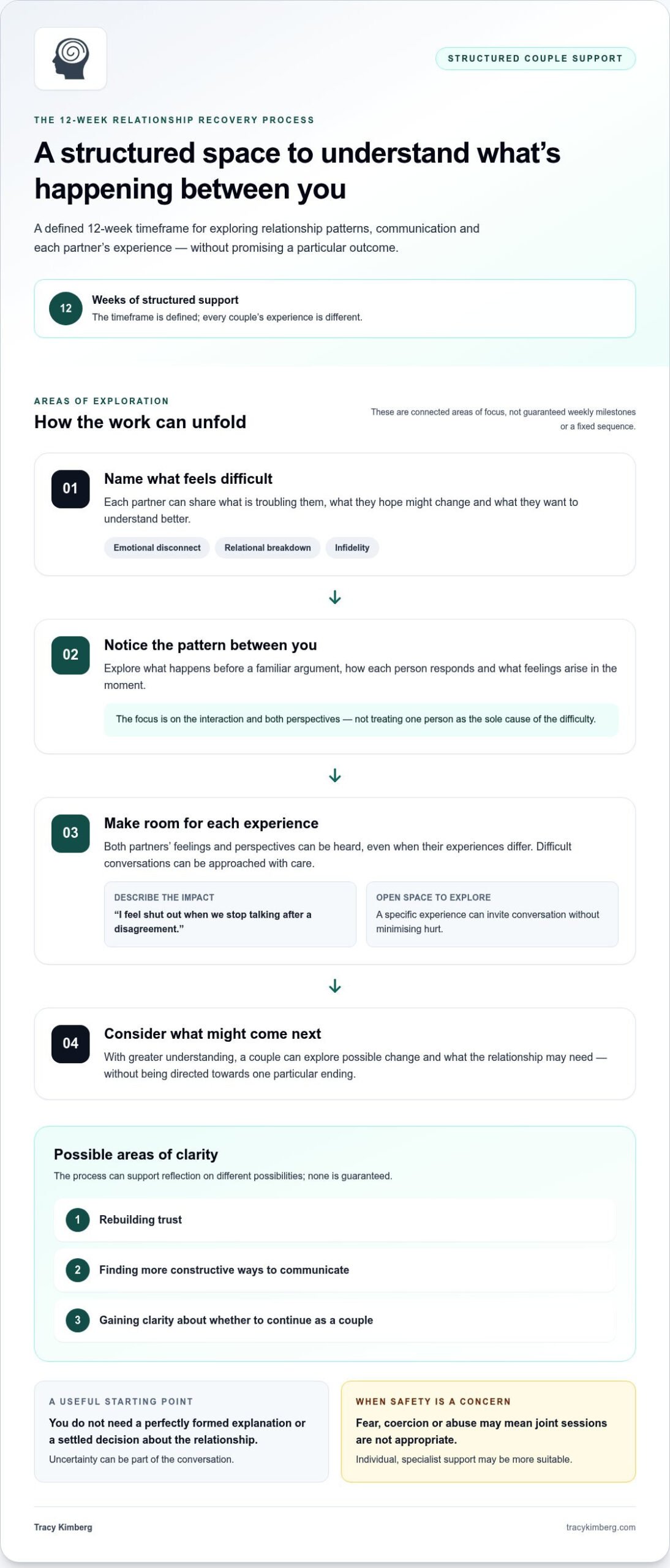
“Relationship recovery support is a structured space for a couple to understand distress, explore possible change and consider what comes next; it does not guarantee that they will stay together.” Recovery might mean rebuilding trust or finding more constructive ways to communicate. It could also mean gaining clarity about whether to continue as a couple. The aim is not to force a particular ending, but to help both partners consider their experience with greater understanding.
This couple-focused work differs from individual support after a break-up, which centres on one person’s experience of loss and adjustment. It is also distinct from specialist recovery support for people affected by domestic abuse. Those situations may call for individual, safety-focused help rather than shared relationship work. The right kind of support depends on the circumstances and on whether taking part together feels safe.
When might couples begin looking for relationship recovery support?
Couples may seek support when the same argument keeps returning, emotional closeness has faded, trust feels uncertain or conversations quickly become defensive or hurtful. Both partners can end up feeling unheard, even when each is trying to protect something important. Relationship strain isn’t proof of failure. It can be a reason to pause and explore what the pattern is communicating.
You don’t have to agree on the long-term future of the relationship before beginning. One partner may hope to reconnect while the other is unsure. Both can still want a calmer space to understand what has brought them here. Starting with uncertainty is different from arriving with a settled decision. It gives the conversation room to develop.
How does couple-focused support differ from other recovery programmes?
Couple-focused support looks at the relationship dynamic, with both partners’ perspectives in view. Rather than treating one person as the sole cause of the difficulty, it can help you notice how each person’s responses shape the interaction. This differs from individual post-break-up support, where the focus is one person’s adjustment, and specialist domestic-abuse recovery, where safety and the survivor’s needs are central.
Couples therapy is a broad field, and its approaches vary. Couples therapy on Wikipedia provides an overview. No single format suits every situation. Where there is fear, coercion or abuse, joint sessions may not be appropriate, and individual specialist support may be more suitable. Recognising that difference helps couples seek support suited to their circumstances, rather than assuming every kind of relationship distress calls for the same response.
What to expect from a structured relationship recovery process
Tracy Kimberg’s 12-Week Relationship Recovery Process offers couples structured support to explore what is happening between them. The process has a defined 12-week timeframe, while recognising that every couple’s experience is different. The work can include exploring relationship patterns, communication and the different experiences each partner brings to the relationship.
A structured relationship process can create dedicated space to explore concerns, understand each partner’s experience and consider possible change, without promising a particular outcome. It’s an opportunity to approach difficult conversations with care, rather than expecting everything to be resolved in one discussion. The value lies in making room for reflection and understanding, not in guaranteeing that a couple will reach a specific decision.
What can couples bring into relationship recovery work?
There’s no need to arrive with a perfectly formed explanation. Each partner can begin by naming what feels difficult, what they hope might change and what they want to understand better. One person might feel lonely despite living together; the other might feel that every attempt to talk turns into criticism. Both experiences matter, even when they differ.
Couples may bring concerns about emotional disconnect, relational breakdown or infidelity. These experiences can stir up grief, anger, confusion or fear, sometimes all at once. A useful starting point is curiosity: what happens before a familiar argument, what each person feels in that moment and what they wish their partner could hear? Listening can be an intention, not a result anyone can guarantee.
It may help to describe an experience before drawing a conclusion about it. “I feel shut out when we stop talking after a disagreement” opens a different conversation from “You never care”. The first names an impact and creates room to explore it. It doesn’t require either partner to minimise their hurt.
What does a supportive therapeutic space look like?
A caring, non-judgemental space makes room for difficult feelings without reducing either person to a fault or a label. Both partners’ perspectives can be heard, including when their memories or interpretations don’t match. This doesn’t mean every action has the same impact, or that accountability is unimportant. It means exploring the interaction with care rather than beginning from blame.
Tracy’s process offers structured support for couples, not a promise that painful experiences will disappear or trust will automatically return. For a broader example of relationship counselling in the UK, Marriage Care’s relationship counselling services offer useful context about the support available to couples. If you’re considering a guided process, you can explore Tracy Kimberg’s relationship support as a possible starting point.
How can you assess whether a UK relationship recovery programme fits?
Fit is about more than a programme’s name or duration. Consider its purpose, whether it gives space to both partners’ experiences and whether the format feels manageable. A relationship recovery programme UK couples explore should make clear what the support is intended to do, without relying on promises about how the relationship will end.
You don’t need to arrive with a shared decision to stay together. One partner may hope to rebuild closeness while the other is unsure. What matters at the outset is whether you can both consider taking part and what you each want help to understand. Your aims can differ. Naming that difference may itself clarify what needs attention.
What do you both hope to understand or change?
Think about recurring moments when you feel distant, stuck in conflict or unable to reconnect. Each of you might ask: what happens in those moments, what do I feel, and what would a meaningful next step look like? The answers needn’t match. One person may want to communicate without arguments escalating, while the other hopes to understand why closeness has faded. These reflections can help you discuss whether shared support feels relevant.
Look beyond a programme’s label and consider what it is designed to address. Couple-focused relationship work explores the dynamics between partners. Individual recovery after a break-up centres on one person’s adjustment, while specialist abuse recovery focuses on the needs and safety of people affected by abuse. These are related topics, but their purposes differ.
| Type of support | Main focus |
|---|---|
| Couples’ relationship support | Exploring the relationship and both partners’ perspectives. |
| Individual post-break-up support | One person’s feelings, adjustment and next steps after a relationship ends. |
| Specialist abuse recovery | Support centred on the experience and safety needs of someone affected by abuse. |
This distinction isn’t a judgement about which experience matters more. It recognises that different circumstances may call for different forms of support. If fear or abuse is present, prioritise safety and seek support suited to that situation rather than assuming joint work is the right fit.
Which support format feels practical and comfortable?
Online sessions can make it easier to take part from home, while face-to-face support offers the experience of meeting locally. Tracy Kimberg offers one-to-one online sessions for couples worldwide and face-to-face sessions locally in Dorchester. Her group masterclasses address common issues such as anxiety or overwhelm. They are a separate group option, not a substitute for couples’ sessions.
As you consider formats, think about privacy, travel and whether you can both speak openly in that setting. The practical choice should support honest participation, not add another source of pressure.
How to prepare for relationship recovery support without pressure
Preparing doesn’t mean rehearsing a case against your partner or arriving with a complete plan. It’s a way to notice what has been weighing on you and make it easier to begin talking about it. If you’re considering a relationship recovery programme UK, a few small steps can help you organise your thoughts. Uncertainty is still a valid starting point.
Try this simple sequence, either separately or together:
- Reflect individually. Notice what feels difficult and what you wish your partner understood about your experience.
- Share concerns. Choose one or two things you’re ready to say, rather than trying to cover every unresolved issue.
- Identify hopes. Consider what you’d like to understand or what a helpful next step might look like.
- Discuss the practical format. Think about whether online or local face-to-face support would feel more comfortable and manageable for you both.
What can each partner reflect on before starting?
Writing things down can help you find words for experiences that feel tangled. You might note a recurring situation, what you felt in that moment and what you wanted your partner to hear. Keep it curious, not prosecutorial. The aim isn’t to build a list of faults or diagnose the relationship, but to notice what matters to you and what questions may be difficult to raise together.
For instance, you could ask yourself: “What do I tend to do when I feel unheard?” or “What am I afraid might happen if I speak honestly?” Such questions bring your own reactions into view alongside your partner’s behaviour. You don’t need polished answers. Even a few notes can help you begin from personal experience rather than blame.
How can couples make the first conversation easier?
Choose a calm moment when neither of you is already in the middle of an argument or rushing elsewhere. Speak from your own perspective: “I’ve been feeling distant, and I’d like us to understand why” is more likely to invite conversation than an accusation. Agree that the aim is to listen and explore support, not settle every question about your future in one sitting.
It’s all right if the conversation feels awkward or incomplete. One partner may be ready to explore change while the other is still unsure. You can acknowledge that difference without forcing agreement. A first conversation can simply establish that something feels difficult and that you’re considering whether support might help you approach it together.
Practical arrangements can make participation feel more possible. Tracy Kimberg offers one-to-one online sessions for couples worldwide and face-to-face support locally in Dorchester. Talk together about privacy, travel and which setting would help you speak openly. You don’t have to decide everything before exploring the option. Focus on what feels workable now.
If you’re ready to take a gentle next step, explore Tracy Kimberg’s relationship recovery support and consider what you’d like help understanding.
Explore Tracy Kimberg’s relationship recovery programme in the UK
If you’re looking for structured support to explore what’s happening in your relationship, Tracy Kimberg’s 12-Week Relationship Recovery Process offers a defined way to begin. It’s for couples who want space to understand their relationship patterns, talk through what feels difficult and consider possible next steps. The process provides a framework for reflection, not a promise that every couple will reach the same conclusion.
Support is available in different formats, so couples can consider what feels practical for their circumstances. Online sessions are one-to-one and available to couples worldwide. Face-to-face sessions are available for couples local to Dorchester. Tracy is based in Dorchester and serves clients in Bournemouth, Poole, Christchurch, Weymouth, London & beyond.
What support formats does Tracy Kimberg offer?
Alongside the 12-Week Relationship Recovery Process, Tracy offers Couples Therapy and Relationship Counselling. These options provide a caring, non-judgemental space to explore each partner’s experience and the patterns shaping the relationship. The focus is on understanding and personal growth, without assuming that the right outcome is already decided.
Tracy also offers group masterclasses addressing common issues such as anxiety or overwhelm. These are a separate group option, rather than a replacement for one-to-one couples’ sessions. For ongoing support, the Mastering Your Relationships Group is a Facebook community.
How can couples take a first step?
Taking the first step doesn’t mean you’ve committed to a particular decision about your relationship. You might simply want to ask a question, explain what has been happening or understand whether support could feel helpful. Use the site’s Let’s Talk contact option to begin that conversation without pressure. You don’t need to arrive with a complete account of what’s wrong or agreement on every detail.
Tracy has worked in this field since 2005. Trusted by over 266 Couples & Teenagers along with their parents, worldwide.
Whether you’re unsure how to begin, concerned about speaking honestly together or ready to understand your options, reaching out can start with one question. Take the conversation at a pace that feels manageable and consider whether Tracy’s relationship recovery support is a suitable next step for you both.
Make space for the next conversation
The next step doesn’t have to settle the future of your relationship. It can simply be a chance to speak honestly about what feels difficult and what you’d like to understand. A relationship recovery programme UK couples consider is most useful when it helps them approach that conversation with care, rather than pressure to reach a particular outcome.
You might begin by asking yourselves what would make support worthwhile: being able to speak without shutting down, understanding a recurring tension, or finding clarity about what comes next. Your answers may differ, and that’s all right. Sometimes the first meaningful change is not agreement, but a greater willingness to hear what each of you is trying to express.
If you’d like to explore whether support could suit your circumstances, take a small first step and Let’s Talk about what support could look like for you. You can begin with a question and take the conversation from there. There is room to move forward with care, at a pace that feels manageable.
Frequently Asked Questions
What is a relationship recovery programme?
It’s a planned way for couples to engage with support around their relationship. Before beginning, each partner might write down one question they want to explore, such as “How do we handle disagreements differently?” or “What helps me feel heard?” Bringing separate questions can make the first conversation more grounded, even if you don’t yet know how to answer them together.
Can a relationship recovery programme help if only one partner feels ready?
It can be useful to start by talking about the hesitation itself. Rather than pushing for a yes, ask what would help the less-ready partner feel able to consider support, or what worries them about taking part. You might agree to revisit the conversation after each has had time to reflect. The aim is to make room for an honest response, not secure agreement at any cost.
How long does a relationship recovery programme take?
Tracy Kimberg’s Relationship Recovery Process runs for 12 weeks. To consider whether that commitment feels manageable, think about how it fits alongside work, caring responsibilities and time together. You might also discuss what you want to pay attention to during the process, without turning it into a checklist of results you must achieve by a particular point.
Can couples take part in relationship recovery sessions online in the UK?
Yes. Tracy offers one-to-one online sessions for couples worldwide. Before a session, consider where you’ll each be joining from and whether you can speak privately without interruptions. If you’re in the same home, you might agree to put phones aside and choose a time when you won’t be overheard. These small arrangements can help you arrive more settled and give the conversation your attention.
Is a relationship recovery programme the same as domestic abuse recovery?
No. If either partner feels unable to speak freely in the other’s presence, pause before arranging a joint conversation and consider what support would feel safe and private. You don’t need to explain or resolve everything together first. The immediate priority is having space to think clearly about your circumstances and what kind of help feels appropriate to you.
Does a relationship recovery programme guarantee that a couple will stay together?
No. Rather than measuring the experience only by whether you stay together, consider what you want to understand or express more clearly. For example, you may want to recognise what happens when a difficult topic comes up, or identify what you need in order to make a thoughtful decision. Those reflections can help you assess what feels meaningful to you.
How much does Tracy Kimberg’s relationship recovery programme cost?
Pricing for Tracy Kimberg’s relationship recovery programme isn’t disclosed. If cost is part of your decision, raise it as a practical question through the site’s contact option. You can also consider what you’d want to know before deciding whether the programme suits you.

Article by
Tracy Kimberg
Tracy Kimberg is a Relationship Expert, Couples Therapist and Coach with a dedicated focus on helping couples and individuals rebuild connection, trust and emotional safety in their relationships. Drawing on the research of John and Julie Gottman, the relational insights of Esther Perel, and years of hands-on therapeutic experience, Tracy offers a warm, non-judgemental and deeply compassionate approach to modern relationships.
Based in Dorset, Tracy works with couples navigating communication breakdowns, betrayal, intimacy challenges, separation, family dynamics and life transitions. Known for creating a safe and grounded therapeutic space, she combines practical tools with emotional depth to help clients move beyond survival patterns and towards meaningful, lasting change.
With a reputation for empathy, professionalism and dedication to her clients’ growth, Tracy is passionate about helping people feel seen, understood and empowered — both within their relationships and within themselves.
Disclaimer
Disclaimer:
The information shared in this article is intended for educational and informational purposes only and should not be considered a substitute for professional therapeutic, psychological, medical or legal advice. Every individual and relationship is unique, and the perspectives offered are based on general therapeutic principles, research and professional experience.
Reading this article does not establish a therapist-client relationship with Tracy Kimberg. If you are experiencing significant emotional distress, relationship crisis, trauma, or mental health concerns, it is important to seek support from a qualified professional appropriate to your individual circumstances.
All content remains the intellectual property of Tracy Kimberg and may not be reproduced or distributed without permission.