

What if protecting your marriage isn’t about watching for every possible threat, but about staying curious about one another? Affair proofing your marriage can’t guarantee that neither partner will ever cross a boundary. It can mean caring for the trust and closeness you build together, and making space to talk when something feels uncertain.
If you’re worried that distance or secrecy could grow unnoticed, it can be hard to raise the subject without sounding controlling or accusatory. Couples don’t always share the same understanding of what counts as crossing a line. Those concerns deserve an honest conversation, not blame or guesswork.
This guide explores what affair proofing can and can’t mean, and offers practical ways to nurture connection, discuss boundaries and name unmet needs. You’ll also find guidance on when support from a couples therapist may help you talk more safely and constructively. The goal isn’t to create a perfect set of rules; it’s to strengthen a relationship where both partners can speak openly and feel heard.
Key Takeaways
- Affair proofing your marriage is shared care for trust and connection, not a guarantee; each partner remains responsible for their choices.
- Use relationship strain as a reason to talk about unspoken needs or withdrawal, not as an explanation that excuses betrayal.
- Choose a calm moment to share concerns, listen to each other and agree what commitment and boundaries mean to you both.
- Small moments of appreciation, shared time and emotional responsiveness can help nurture closeness in everyday life.
- Couples therapy may offer a supportive space to explore difficult patterns and communicate with more care.
What does affair-proofing your marriage really mean?
The phrase can sound like a promise: follow the right rules and infidelity can never happen. But no couple can remove every uncertainty from a relationship. Affair proofing your marriage is better understood as shared care for the conditions that help trust and connection grow: honesty, emotional responsiveness and a willingness to talk about what matters before silence becomes the norm.
That care is mutual, but responsibility for a choice is personal. Relationship difficulties may be part of the context a couple explores, but they don’t make one partner responsible for another’s decision to deceive or cross an agreed boundary. If an affair has happened, the hurt partner didn’t cause it by being insufficiently attentive, attractive or vigilant.
Protecting a relationship means tending to trust together, not controlling one another or promising that no breach can occur.
Can any marriage be made completely affair-proof?
No partner can guarantee another person’s future choices. You can make room for honesty, discuss attractions or discomfort, and reduce avoidable secrecy. You can’t monitor someone into genuine commitment or foresee every situation in which trust might be tested. Care can shape the relationship you share, but it can’t take away either person’s agency.
Feeling anxious about distance or secrecy is understandable, especially if trust has been hurt before. Yet checking devices, demanding constant updates or treating ordinary privacy as evidence can turn fear into surveillance. Those strategies may offer brief reassurance, but they don’t create the openness or emotional safety that trust depends on. A more useful question is, “What would help us speak honestly about this?”
Reducing secrecy is not the same as preventing every possible breach. A couple can agree to be transparent about a friendship that feels emotionally charged, for example, while recognising that an agreement can’t control what either person ultimately chooses. If a boundary is crossed, the person who crossed it is accountable for that decision. Relationship strain may help explain what needs attention; it doesn’t excuse betrayal or prove why it happened.
What are couples trying to protect?
Trust is more than the absence of a secret. It’s the felt experience of being able to speak, listen and respond with care in ordinary moments. When one partner shares a worry, the other doesn’t need to agree straight away. Showing interest rather than dismissing it can help both feel less alone. Emotional responsiveness is part of closeness, alongside affection and physical intimacy.
Couples are also protecting emotional safety: the sense that difficult subjects can be raised without ridicule, punishment or an immediate assumption of guilt. That safety makes it easier to name unmet needs and repair misunderstandings. It doesn’t require agreeing on everything. It asks each partner to take the other’s experience seriously, even when their interpretations differ.
Commitment has no single definition that fits every marriage. One couple may see private messages with an ex as crossing a line; another may be comfortable with that friendship and focus on whether anything is hidden. The useful work is to make assumptions speakable. Shared understanding grows when both partners can explain what fidelity, privacy and honesty mean to them, then listen for where their expectations align or need discussion.
How emotional distance and secrecy can affect trust in a marriage
Distance often grows quietly. A couple may become caught in recurring arguments, stop sharing small details of the day or avoid a conversation because they expect it to end in conflict. Unspoken needs can then feel harder to voice, and withdrawal may leave both partners guessing about what the other is thinking. These patterns can weaken connection, but they don’t, by themselves, explain why an affair happens.
Relationship difficulties may invite reflection and conversation, but they never make one partner responsible for another’s infidelity. If betrayal has occurred, the person who chose to cross a boundary remains accountable for that choice. Understanding the relationship context can help a couple decide what needs attention; it shouldn’t become a way to blame the hurt partner or excuse deception.
Privacy and secrecy aren’t identical. Privacy can mean having personal thoughts, friendships and space without reporting every detail. Secrecy becomes more concerning when information is deliberately concealed in a way that conflicts with an understanding the couple has agreed to, or when hiding it affects the other partner’s ability to make informed choices. The meaning depends on the couple’s own agreements, not a universal rule about every message or friendship.
When does a friendship begin to feel like a boundary concern?
A close friendship with a colleague or former partner isn’t automatically a threat to a marriage. It may be worth talking about if emotional intimacy is being hidden, if a partner feels misled about the nature of the contact, or if the friendship is consistently displacing time the couple has agreed to protect. Rather than label the friendship, explore its impact and whether both partners feel their shared expectations are being honoured.
HelpGuide.org offers practical guidance on setting healthy boundaries in relationships. Couples can use that kind of reflection to describe what feels respectful to each of them, without turning a personal preference into a rule for all relationships.
How can couples notice growing distance without jumping to conclusions?
A change in routine, less conversation or increased time spent apart can have many explanations. Treat what you notice as a reason to check in, not as proof of infidelity. Try naming your experience without presenting an assumption as fact: “I’ve been feeling disconnected since we stopped having breakfast together. How have you been feeling about us?”
Then make room for an answer. Covertly checking a partner’s messages or building a case from ambiguous details can deepen mistrust and make honest conversation harder. If you keep getting stuck in accusation and defensiveness, couples therapy may offer a supportive place to explore the pattern with care.
How to agree relationship boundaries without blame or surveillance
Boundaries work best as shared agreements, not rules one partner imposes to manage the other. A calm conversation can help you understand what commitment means to each of you and where expectations differ. If you’re thinking about affair proofing your marriage, focus on being clear and considerate, rather than trying to eliminate uncertainty through monitoring.
Try this sequence:
- Choose a calm time. Avoid starting the conversation in the middle of an argument or when either of you feels rushed.
- Share your concern. Describe what you’ve noticed and how it affects you, without presenting a fear as proof.
- Listen to each other. Ask what trust and commitment mean to your partner, then make room for a different perspective.
- Agree on what feels respectful. Make the agreement specific and reciprocal, so both partners understand what they’re committing to.
- Revisit it together. Expectations can need a fresh conversation as circumstances change. Adjust by mutual agreement, not through pressure.
How can you raise a concern without accusing your partner?
Use first-person language that connects a specific observation with your own feeling. For example: “I felt unsettled when our plans changed and I didn’t understand why. Can you tell me how you saw it?” This opens a conversation rather than putting your partner on trial. Ask what the situation means to each of you before deciding what it means for the relationship. Listening doesn’t require dismissing your own discomfort.
If one partner feels worried and the other feels unfairly suspected, acknowledge both reactions. You might say, “I can hear that this feels intrusive to you, and I’d still like us to talk about why it has been bothering me.” If either person becomes overwhelmed, pause and agree when to return to the subject. A boundary conversation should invite honesty, not demand an immediate confession or reassurance.
What boundaries can couples discuss together?
Choose topics that reflect your actual lives, rather than applying a universal checklist. You might discuss what you each consider appropriate to share privately with a friend, whether certain messages would feel uncomfortable if hidden, or how to protect time you’ve set aside together. If attraction develops or a situation feels unclear, agree how you’d bring it up and what kind of openness you’d both want.
Keep the agreement mutual and voluntary. Expecting both partners to share the same standard is different from demanding access to devices, tracking someone’s whereabouts or requiring constant updates. Those are forms of monitoring, not a substitute for trust. A useful agreement explains what each person will do, why it matters, and how you’ll revisit it if it stops feeling fair or workable.
If these conversations keep turning into blame or shutdown, couples counselling for relationship boundaries can offer a supportive space to explore what each of you needs and find a more constructive way to talk.
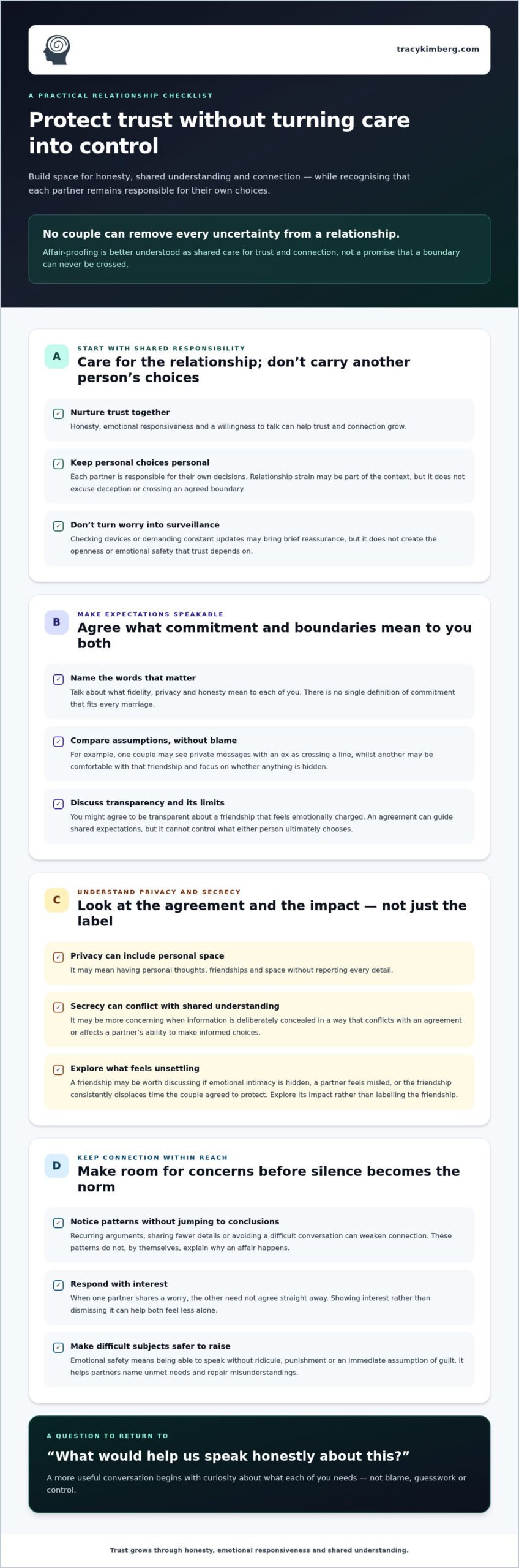
Everyday ways to nurture closeness and make honest repair easier
Closeness is built in ordinary moments, not only during date nights or serious conversations. A warm greeting, a genuine thank you or a few minutes of undistracted attention can help each partner feel noticed. These gestures won’t prevent every difficulty, but they can make it easier to turn towards one another when life gets demanding. That’s part of affair proofing your marriage: tending to your connection, without treating closeness as a guarantee.
Intimacy is broader than physical affection. It also includes sharing what’s happening inside you and responding with interest when your partner does the same. A brief exchange such as, “What’s taking up most of your energy today?” can create room for a real answer. Try to stay curious about stress, change and unmet needs instead of assuming you already know what your partner feels.
How can couples stay emotionally connected during busy periods?
Find a small practice that fits your actual lives. You might put phones aside while having a cup of tea, share a walk when your schedules overlap, or send a thoughtful message during a demanding day. The point isn’t to follow a fixed routine. It’s to make space for attention and warmth in a way that feels possible for both of you.
Appreciation can be specific and simple: “I noticed you made time to call when I was worried. That meant a lot.” If one of you is tired or distracted, ask what kind of connection would feel welcome rather than treating a missed moment as rejection. Choose one manageable practice together, try it for a while, then talk about whether it’s helping you feel more connected. Adjust it if it isn’t.
What does repair look like after a difficult conversation?
Repair doesn’t require pretending the disagreement was unimportant. It can begin with acknowledging the impact of your words or actions: “I can see that I interrupted you and you didn’t feel heard.” Then listen to how your partner experienced the moment, clarify what each of you needs next, and consider what might help you return to the conversation with more care.
Sometimes the next step is a pause, a clearer explanation or an apology. It isn’t necessarily immediate forgiveness. Repair is an invitation to reopen communication while recognising that the original hurt or disagreement still matters. Both partners can take responsibility for their part without being expected to carry equal responsibility for every action or impact.
If the same argument keeps returning, or one of you feels unable to speak freely, a supportive space may help you understand the pattern and hear each other differently. Explore couples therapy for relationship support if you’d like help working through difficult conversations together.
When couples therapy can support trust, communication and connection
Couples therapy can offer a structured, supportive space to talk about concerns that feel difficult to manage alone. With a therapist helping the conversation stay thoughtful and balanced, you can explore recurring patterns, understand how each partner experiences them, and practise communicating with more care. This can support the work of affair proofing your marriage, but it can’t guarantee that infidelity will never happen or make one partner responsible for the other’s choices.
Therapy isn’t about deciding who is the problem. It can help each person take responsibility for their own behaviour while making room for both perspectives. If trust has been damaged, a therapist may help you discuss what happened and what each of you needs next. Any repair still depends on the choices and effort of the people in the relationship.
When might it help to speak with a relationship therapist?
You might consider support when the same argument keeps resurfacing, when distance is growing, or when one partner’s concerns are met with defensiveness and the other’s with silence. You don’t need to be in crisis, and seeking help doesn’t mean you’ve decided to separate. Sometimes couples simply want a calmer space to understand one another before frustration becomes more entrenched.
There doesn’t have to be a clear culprit. One person may feel anxious about a friendship, while the other feels mistrusted; both experiences can be explored without assuming either partner is at fault. If conversations quickly become heated or shut down, a therapist can help you slow the exchange, listen for what lies beneath each reaction and find a more constructive way to talk.
What support does Tracy Kimberg offer couples?
Tracy Kimberg offers Couples Therapy with a caring, intuitive and non-judgemental approach. Sessions can provide room to discuss trust, emotional distance and boundaries, without promising a particular outcome. Online one-to-one sessions are available to couples worldwide, and face-to-face sessions are available to couples local to Dorchester. Support is also offered across Bournemouth, Poole, Christchurch, Weymouth, London & beyond.
Tracy has been practising since 2005 and is trusted by over 266 couples and teenagers, along with their parents, worldwide. These details reflect experience, not a guarantee of what will happen in any one couple’s therapy. The work begins with your relationship as it is, and the concerns you both bring to the conversation.
If you’re finding it hard to talk about trust or connection together, couples therapy can offer a supportive place to begin. You don’t need to have all the answers before reaching out.
Take one honest step towards greater closeness
You don’t have to solve every uncertainty about your relationship today. A meaningful next step might be asking your partner what helps them feel close, or sharing one thing you’ve found difficult to say. Let the conversation be an invitation to understand each other, rather than a test either of you has to pass.
Affair proofing your marriage isn’t about securing certainty. It’s about choosing, again and again, to meet uncertainty with honesty, care and personal responsibility. If you’d like support finding a way forward together, let’s talk about how to support your relationship.
Frequently Asked Questions
Is it possible to affair-proof a marriage completely?
No. There’s no way to make a marriage completely immune to an affair. Instead of looking for certainty, notice whether difficult subjects are becoming easier to raise, whether both partners understand the agreements they’ve made, and whether actions feel consistent with those agreements. These can help you reflect on the relationship you’re building now, without treating them as proof of what either person will choose in the future.
Does being attracted to someone else mean you are having an affair?
No. Attraction alone doesn’t tell you how someone is behaving or what it means for their relationship. If you’re unsure how to respond to a new attraction, consider what you’re hoping to get from it and whether your choices fit the commitments you’ve made. For example, are you seeking a moment of excitement, feeling understood, or something else? That reflection may help you decide whether a conversation with your partner is needed.
Can a close friendship become an emotional affair?
A close friendship isn’t automatically an emotional affair, and couples may use that label differently. To explore your concern, consider what has shifted for you: do you feel less included in your partner’s inner life, or are you uneasy about the kind of emotional reliance that has developed? Naming the specific change, rather than debating a label, can make it easier to understand what each of you is responding to.
How do you talk about boundaries without sounding controlling?
Try beginning with the purpose of the conversation: “I want us to understand each other better, not to dictate what you can do.” Then name one situation you’d like to discuss and ask your partner what feels fair to them. If you’re worried about becoming demanding, pause and check whether you’re asking for a shared understanding or trying to remove all uncertainty. That distinction can help keep the conversation respectful.
Should couples share passwords to prevent an affair?
No. Password sharing can’t establish what is happening in a relationship or guarantee that a breach won’t occur. If a password request follows a particular incident, focus first on the question beneath it: what information are you seeking, and what would it help you understand? A direct answer to that may point towards a more relevant conversation than exchanging access to private accounts.
Can couples therapy help before there has been an affair?
Yes. Couples can bring a concern to therapy before it has become a major rupture. To prepare, each partner could privately note what they hope the other will understand, what they find hard to say, and what a useful conversation would look like. Bringing different hopes into the room is not a problem to hide; it can give you a clear starting point for exploring what matters to each of you.
What if my partner does not want to discuss relationship boundaries?
You can ask what makes the conversation difficult, without assuming you already know the reason. Try offering a choice: “Would it feel easier to talk after we’ve both had time to think, or would you rather start with one specific concern?” If your partner still isn’t ready, be clear about why the issue matters to you and what support you need. You can’t force a conversation, but you can name your own needs honestly.

Article by
Tracy Kimberg
Tracy Kimberg is a Relationship Expert, Couples Therapist and Coach with a dedicated focus on helping couples and individuals rebuild connection, trust and emotional safety in their relationships. Drawing on the research of John and Julie Gottman, the relational insights of Esther Perel, and years of hands-on therapeutic experience, Tracy offers a warm, non-judgemental and deeply compassionate approach to modern relationships.
Based in Dorset, Tracy works with couples navigating communication breakdowns, betrayal, intimacy challenges, separation, family dynamics and life transitions. Known for creating a safe and grounded therapeutic space, she combines practical tools with emotional depth to help clients move beyond survival patterns and towards meaningful, lasting change.
With a reputation for empathy, professionalism and dedication to her clients’ growth, Tracy is passionate about helping people feel seen, understood and empowered — both within their relationships and within themselves.
Disclaimer
Disclaimer:
The information shared in this article is intended for educational and informational purposes only and should not be considered a substitute for professional therapeutic, psychological, medical or legal advice. Every individual and relationship is unique, and the perspectives offered are based on general therapeutic principles, research and professional experience.
Reading this article does not establish a therapist-client relationship with Tracy Kimberg. If you are experiencing significant emotional distress, relationship crisis, trauma, or mental health concerns, it is important to seek support from a qualified professional appropriate to your individual circumstances.
All content remains the intellectual property of Tracy Kimberg and may not be reproduced or distributed without permission.