

What if the miles aren’t the hardest part of being apart? It may be the conversations that keep getting postponed, or the recurring tension around how often to talk, what trust means and where the relationship is heading. Relationship counselling for long-distance couples can help you look beneath those disagreements and understand the patterns shaping how you connect.
It’s understandable to wonder whether counselling can help when you can’t sit in the same room, or what you’d actually discuss in a session. Living apart doesn’t make your relationship less worthy of support. Online counselling can give you a shared space to talk through difficult moments, listen to each other with more care and explore what each of you needs.
In this guide, you’ll learn what couples counselling can help you explore, how online sessions might fit your circumstances and what to consider when choosing support that feels relevant to both partners. Tracy Kimberg’s research-based relationship counselling and coaching offers a supportive setting to understand recurring dynamics and identify a manageable first step towards feeling more connected.
Key Takeaways
- Distance can heighten uncertainty without meaning the relationship is failing. Counselling can help you clarify shared needs and goals.
- Relationship counselling for long-distance couples can explore how a concern moves from trigger to interpretation, emotion and response.
- When considering online sessions, weigh access, shared participation, privacy and your preferred way of communicating.
- Before your first meeting, each partner can name one recurring difficulty and one change they hope to explore.
- Tracy Kimberg’s research-based couples counselling and coaching offers space to understand relationship dynamics and consider a meaningful next step.
Relationship counselling for long-distance couples: when can it help?
Living apart can make uncertainty feel louder. A delayed reply may carry more meaning than intended; a difficult visit can leave both partners wondering what comes next. That doesn’t mean the relationship is failing. It may mean that distance is making existing needs and differences harder to understand.
Relationship counselling offers a supported space to notice how a couple’s patterns, needs and shared goals interact, so both partners can understand what’s happening and consider what they’d like to change. Couples don’t need to wait for a crisis. They might seek support because the same disagreement keeps returning, closeness feels harder to maintain, or they want to discuss the future without the conversation turning into conflict. Relationship counselling for long-distance couples can bring attention to the interaction between partners, not just the miles between them.
Which long-distance challenges might bring a couple to counselling?
Messages and calls can leave room for interpretation. One partner might read a short text as irritation, whilst the other thought they were being efficient. A call missed because of work or time-zone differences might feel like rejection to one person and a practical inconvenience to the other. Neither response makes someone unreasonable. The meaning each partner gives the moment can shape what happens next.
Couples may also have different expectations about how often to be in contact, how much reassurance feels helpful, or how much independence each person needs. One may want regular check-ins to feel connected; the other may experience frequent messages as pressure. Visits can bring tension too, particularly if partners expect different balances of shared time and personal space. These concerns may sit alongside uncertainty about the future: how long the arrangement will last, or whether both people imagine a similar next chapter.
When is distance part of the problem, rather than the whole story?
Distance can amplify differences in emotional expression, conflict and repair. If one partner tends to seek immediate discussion whilst the other needs time to settle, a video call ending abruptly may feel especially painful when there’s no chance to reconnect in person later that day. The setting can intensify a pattern without being its only cause. As the overview of a long-distance relationship suggests, separation is one circumstance couples may manage, not a verdict on their bond.
It can help to separate the practical problem from the emotional need underneath it. A cancelled visit is a logistical frustration; repeated arguments about cancelled visits may also point to a need for reliability, reassurance or a clearer sense of shared direction. Counselling can help partners explore both, without treating geographical separation as inherently unhealthy or judging the relationship by its circumstances.
Try asking: if the practical obstacle changed, would the same hurt or disagreement still appear? You don’t need a perfect answer. Noticing whether tension centres on scheduling or returns to trust, closeness or feeling prioritised can offer a clearer starting point for understanding the pattern.
What happens in relationship counselling for couples living apart?
A first conversation can begin with each partner describing the concern in their own words: what feels difficult, when it tends to arise and what they hope could change. One person might want to feel more included in the other’s daily life; the other may want their need for space to be understood. A counsellor can help both perspectives be heard without deciding that one is right and the other is wrong.
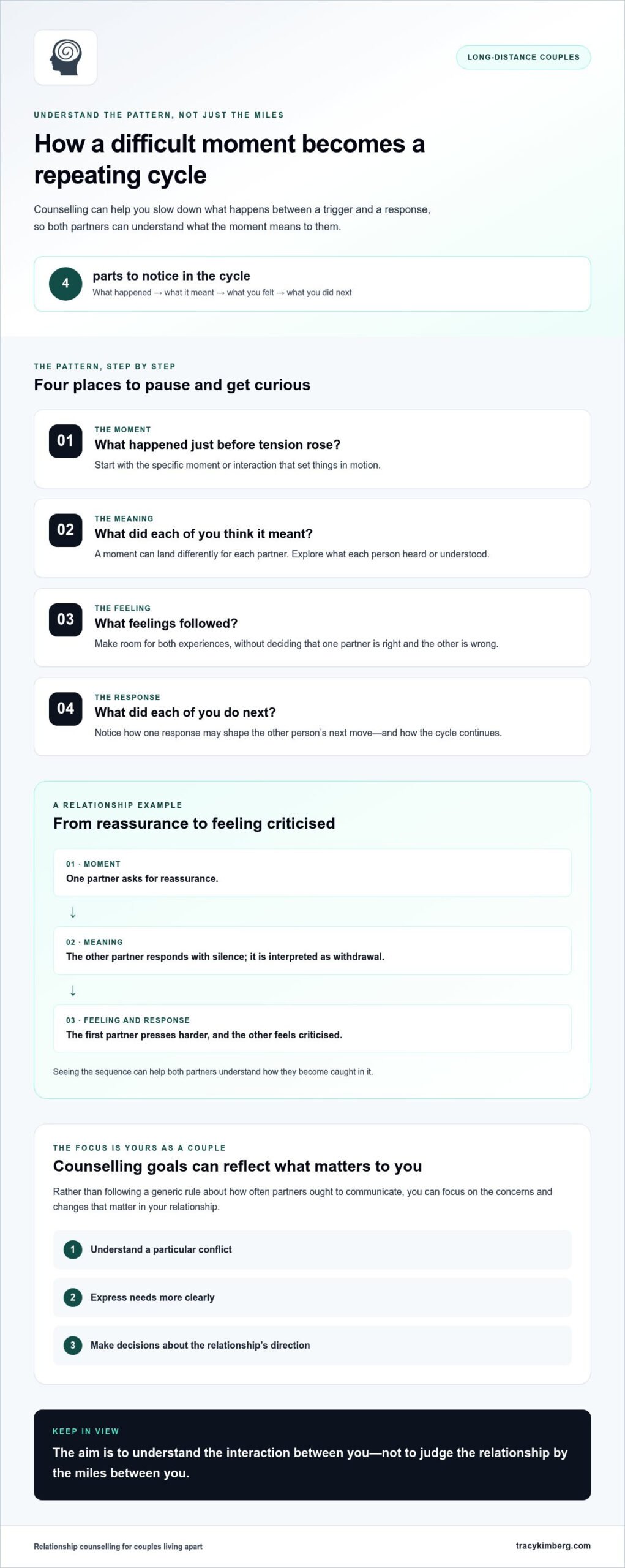
From there, you can look at the cycle that forms between you. What happened just before tension rose? What did each of you think that moment meant? What feelings followed, and what did you do next? For instance, a request for reassurance might be met with silence, which the first partner interprets as withdrawal. That partner may then press harder, leaving the other feeling criticised. Seeing the sequence can make it easier to understand how both people become caught in it.
Counselling goals should reflect what matters to you as a couple, rather than a generic idea of how often partners ought to communicate. The focus might be understanding a particular conflict, expressing needs more clearly or making decisions about the relationship’s direction. The work starts with your lived experience, not a set of rules about what a long-distance relationship should look like.
How can counselling explore communication and conflict at a distance?
Messages don’t carry the full context of a face-to-face conversation. A brief reply may sound dismissive when the sender is simply busy; a pause on a call may be read as disinterest rather than a moment to think. A counsellor can help slow down a disagreement and explore what each person heard, felt and needed, including how timing and missing non-verbal cues shaped its meaning.
That pause can create room to practise listening and notice opportunities for repair, such as recognising the impact of a comment or returning to a conversation with curiosity. These aren’t instant fixes or prescribed scripts. They’re areas couples can explore together. Dr Dena DiNardo’s discussion of online long-distance relationship counselling also considers how couples can use counselling to work with concerns specific to their relationship.
Can sessions address trust, intimacy and different expectations?
Yes. Partners can explore what commitment, boundaries and reassurance mean to each of them, and how those meanings have been shaped by their experiences and circumstances. Intimacy is broader than physical contact: it can include feeling known, sharing uncertainty and trusting that your inner world matters to the other person. A systemic, compassionate approach considers each partner’s response and its effect on the relationship, rather than assigning blame.
If you’d like support exploring these patterns together, Tracy Kimberg’s couples counselling and coaching offers a space to clarify what you both want to work towards. Relationship counselling for long-distance couples isn’t about making every interaction perfect. It’s an opportunity to understand the cycle and consider a more connected way forward.
How to decide whether online relationship counselling is right for you
Online sessions can make it easier to meet together when you live apart, but convenience isn’t the only measure of fit. Consider whether both of you can speak openly, stay engaged and feel included through a screen. Remote counselling can make room for meaningful conversation and reflection. What matters is whether the format and counsellor support the kind of work your relationship needs. It won’t feel identical to meeting face to face, and either format may suit you better.
Use these questions to compare how online sessions might work for you as a couple:
| Consideration | Online sessions may help when… | Think about… |
|---|---|---|
| Access | Travelling to the same place is difficult, and meeting remotely makes shared participation more practical. | Whether the agreed time works across both partners’ routines and locations. |
| Shared participation | You can both join the session and have a clear opportunity to contribute. | Whether either person tends to dominate, withdraw or feel overlooked during video conversations. |
| Privacy | Each partner can speak without being overheard or interrupted. | Whether your surroundings allow you to discuss personal matters with enough comfort and discretion. |
| Communication style | You’re comfortable listening and responding through a screen. | Whether pauses, facial expressions and turn-taking feel clear enough for both of you. |
These aren’t pass-or-fail tests. A practical concern, such as an unreliable connection or a shared living space, may be manageable with planning, but it can affect your focus. Notice how you both feel after discussing the format. Does it seem possible to give the conversation your attention? Can each of you imagine speaking honestly there?
What should couples look for in a counsellor?
Look for an approach that speaks to your concerns, whether you’re trying to understand repeated conflict, emotional distance or uncertainty about your future together. A supportive counsellor should make room for each partner’s experience and help you look at the relationship as a shared dynamic, rather than taking sides. Consider what you’d like to work towards and whether the practical arrangements feel workable. Feeling heard as individuals and understood as a couple matters.
When might online sessions feel workable for both partners?
Think about the conditions you can create for a focused conversation. Reliable internet and a quiet, uninterrupted setting can help you stay present, though they can’t guarantee that every session will feel easy. If one partner has less privacy or finds video calls emotionally exposing, name that concern rather than pushing past it. You might also discuss how the counsellor will support turn-taking and help both voices remain part of the conversation.
For relationship counselling for long-distance couples, the best choice is not simply the format that removes the most travel. It’s the one that feels accessible, relevant and emotionally safe enough for both partners to take part honestly.
How to prepare for your first long-distance couples counselling session
You don’t need to arrive with a polished explanation or agree on everything before you begin. Preparation is simply a way to help each person bring their experience into the conversation, especially when you’ll be joining remotely and may have different hopes for counselling.
Agree what you each want help with
Start separately if that feels easier, then compare notes if you’re comfortable. Each partner can name a concern in their own words before trying to find a shared goal. One person may want fewer conversations to end in silence; the other may hope to feel less pressured during difficult discussions. Both perspectives can be true at once.
It can also help to separate an immediate hope, such as having calmer conversations, from a broader hope about the relationship’s future. You don’t have to settle the bigger question before the first session. If one of you feels ready to explore change and the other feels unsure, note that difference without trying to persuade or resolve it in advance.
Gather a few useful starting points
Use this preparation sequence together or on your own. Keep it brief. You’re bringing starting points, not a case to prove who is at fault.
- Name one recurring difficulty. Describe what tends to happen, rather than labelling your partner. For example, “We struggle to reconnect after a tense call” gives you a shared event to explore.
- Choose one change you hope to explore. This might be understanding each other’s reactions, making room for difficult topics or finding a way to repair after conflict. It’s a hope to discuss, not a demand for an instant solution.
- Recall a concrete example. Note what happened, what you felt and what you needed in that moment. Include your own response too, so the conversation can explore the pattern between you rather than become a list of your partner’s mistakes.
- Write down questions or feelings. Stress can make thoughts harder to retrieve. A short note can help you remember what matters without needing to read from a script.
Bring one recurring difficulty, one hoped-for change, a specific example and curiosity about each other’s experience.
Make remote sessions easier to focus on
Before the meeting, choose a private, quiet place and a device that lets you see and hear one another comfortably. If you share a home with others, think about how to reduce interruptions. Reliable internet can support the conversation. If the connection pauses, agree to rejoin or take a moment to settle rather than treating the interruption as part of the disagreement.
You might also talk about what could help if emotions rise: pausing briefly, asking for a moment to think or naming that you’re feeling overwhelmed. These are possibilities to discuss, not rules you must follow. A counsellor can help make space for both partners and support turn-taking, so neither person has to carry the conversation alone.
Preparing for relationship counselling for long-distance couples doesn’t mean rehearsing every answer. It means arriving with enough clarity to begin. Book relationship counselling with Tracy Kimberg to start exploring what you’d like to change together.
Explore relationship counselling for long-distance couples with Tracy Kimberg
Choosing support doesn’t require you to have every answer. You can begin by noticing the pattern that keeps returning, considering what each of you hopes could change, and choosing a way to start that feels manageable. One partner might want more openness; the other may hope to feel less caught in the same disagreement. You don’t need identical reasons for seeking help to begin exploring them together.
Relationship counselling for long-distance couples can offer a space to look beyond the latest difficult message or call and understand what happens between you over time. The focus is not on deciding which person is at fault. It’s on making sense of each partner’s experience and considering what could help the relationship feel more connected and understood.
What kind of relationship support does Tracy Kimberg offer?
Tracy Kimberg offers relationship counselling and coaching for couples navigating relational breakdown or emotional disconnection. Sessions can focus on the concerns you bring, the patterns you notice and your hopes for the relationship. That might mean exploring how conflict unfolds, what each partner needs to feel heard, or where your expectations about the future differ. The aim is to make room for both perspectives while exploring the relationship as a shared dynamic.
Tracy’s work is research-based and inspired by John Gottman and Esther Perel. Couples can choose online or face-to-face therapy, making it possible to consider the format alongside the concerns they want to bring. Online sessions may be especially practical when partners live apart, while face-to-face support may feel more natural for couples who prefer meeting in person. The right starting point is one that feels workable and relevant to both of you.
Choose a next step that feels manageable
Before deciding, each partner could reflect on a simple question: what would I like support to help me understand or change? Your answers may overlap, or they may be different. Either way, they can help shape a first conversation. You might want to understand why a familiar disagreement escalates, make space for more honest conversations, or explore whether you share a direction for the relationship. You don’t have to settle every question before reaching out.
Taking a step towards counselling doesn’t mean you’ve failed or that you must already know how the relationship will unfold. It can be a way to pause, listen with support and get clearer about what matters to each of you. If you’re ready to explore that possibility, you can Explore relationship counselling with Tracy and learn about a supportive next step together.
Take one thoughtful step towards feeling closer
You don’t have to solve every question about your future before seeking support. A useful beginning can be smaller: naming what feels difficult, what you hope to understand and what kind of conversation you want to have with each other. Even if you’re not equally ready or don’t want exactly the same thing, making room for both perspectives can help you approach the next step with greater care.
Relationship counselling for long-distance couples isn’t about proving that your relationship is in trouble. It can be a way to get curious about what happens between you, and to explore whether new ways of listening, responding and making shared decisions feel possible. Progress may begin with a clearer conversation, rather than a sweeping promise about where the relationship will lead.
If you’re ready to explore support at a pace that feels right for you, explore relationship counselling with Tracy. You can begin with the questions you already have and take it one conversation at a time.
Frequently Asked Questions
Can long-distance couples attend relationship counselling online?
Yes. Online sessions can give partners living apart a shared place to talk with support. Relationship counselling for long-distance couples can also address concerns beyond separation, including trust, communication and feeling emotionally connected. Before you begin, consider whether you can each join with privacy and attention. It may help to agree on one topic you’d like to understand better, such as how a recent conversation affected you both.
Is relationship counselling only for long-distance couples in crisis?
No. You can seek support before a crisis, for example when small disagreements are starting to affect how you feel before or after calls. Counselling may help you understand what those moments mean to each of you and what you’d like to be different. You don’t need to present the same concern: one partner might feel lonely, whilst the other feels conversations have become tense. Both experiences can be explored.
Can counselling help if only one partner is ready to attend?
Yes, one partner can begin by reflecting on their own experience, even if the other feels hesitant. Try describing what you miss or find difficult without making attendance a test of commitment. Tracy also offers individual relationship support, which can give you space to consider your needs and choices. That reflection doesn’t require you to decide the future of the relationship straight away.
Can relationship counselling help when partners disagree about the future?
It can provide space to understand what each person wants, fears and values, without forcing a decision or promising a particular outcome. For instance, you may be able to clarify whether a disagreement is about timing, commitment or the kind of life each partner imagines. Naming what feels most important can make a difficult conversation more specific and help you consider a thoughtful next step.
What if our arguments mainly happen during visits?
That can be worth exploring. A visit may bring hopes for closeness alongside practical plans and limited time together. You could each note what tends to change in your mood as the visit approaches, whilst you’re together and after you part. This may reveal whether the tension centres on a particular expectation or reflects a broader concern. Counselling can help you examine the pattern without turning the conversation into a search for blame.
Do we need to have the same goals before starting couples counselling?
No. Different priorities can be part of the conversation, rather than a reason to postpone it. One partner might want to feel more secure, whilst the other wants fewer arguments about plans. Each of you could finish the sentence, “I hope counselling helps me understand…” and share your answer. You may discover a common starting point, such as wanting to speak more openly, even if your bigger hopes differ.

Article by
Tracy Kimberg
Tracy Kimberg is a Relationship Expert, Couples Therapist and Coach with a dedicated focus on helping couples and individuals rebuild connection, trust and emotional safety in their relationships. Drawing on the research of John and Julie Gottman, the relational insights of Esther Perel, and years of hands-on therapeutic experience, Tracy offers a warm, non-judgemental and deeply compassionate approach to modern relationships.
Based in Dorset, Tracy works with couples navigating communication breakdowns, betrayal, intimacy challenges, separation, family dynamics and life transitions. Known for creating a safe and grounded therapeutic space, she combines practical tools with emotional depth to help clients move beyond survival patterns and towards meaningful, lasting change.
With a reputation for empathy, professionalism and dedication to her clients’ growth, Tracy is passionate about helping people feel seen, understood and empowered — both within their relationships and within themselves.
Disclaimer
Disclaimer:
The information shared in this article is intended for educational and informational purposes only and should not be considered a substitute for professional therapeutic, psychological, medical or legal advice. Every individual and relationship is unique, and the perspectives offered are based on general therapeutic principles, research and professional experience.
Reading this article does not establish a therapist-client relationship with Tracy Kimberg. If you are experiencing significant emotional distress, relationship crisis, trauma, or mental health concerns, it is important to seek support from a qualified professional appropriate to your individual circumstances.
All content remains the intellectual property of Tracy Kimberg and may not be reproduced or distributed without permission.