

What if trusting again doesn’t mean forgetting what happened or telling yourself to stop feeling afraid? Overcoming trust issues from past relationships can begin with recognising that your caution may once have helped protect you. Yet when an old betrayal echoes in a new relationship, reassurance may bring only brief relief before the same worries return. That doesn’t make you jealous, controlling or overly sensitive. It may mean something in you is asking to feel safe.
You can honour that need without letting the past decide what’s true today. This guide explores how earlier hurt can shape present reactions, and how to consider whether a fear reflects a current concern or an old wound. You’ll find practical ways to talk about your feelings without accusation or self-blame, and to set boundaries that matter to you. Trust isn’t rebuilt by forcing yourself to believe. It grows through mutual, consistent actions over time.
Key Takeaways
- Past hurt can shape what you expect and notice in a relationship. Recognising the pattern can help you respond with greater care.
- Separate what the present situation shows from what an earlier experience brings to mind, and look for patterns over time.
- When overcoming trust issues from past relationships, pause, name the feeling and consider the evidence before choosing how to respond.
- Ask for reassurance or transparency clearly and specifically, without making constant proof the price of feeling secure.
- Couples Therapy can offer a non-judgemental space to explore recurring dynamics and understand each person’s needs.
Why past relationship experiences can make trust feel difficult now
Feeling cautious after being hurt doesn’t mean you’re incapable of love. You may have learnt to watch carefully for signs that closeness could become painful. Trust difficulties can involve a pattern of worry, guardedness or doubt that gets in the way of emotional closeness. They aren’t a diagnosis, and one moment of hesitation doesn’t prove anything is wrong with you or your relationship.
Trust involves some confidence in another person and a willingness to depend on them. The social science perspective on trust offers a useful starting point: trust is part of how people manage dependence and uncertainty in relationships. After being betrayed or let down, uncertainty may feel more threatening. Past experiences can shape what you expect and notice, but they don’t tell the whole story of a present relationship. This relationship deserves to be understood through its own evidence.
“Understandable caution is a response to what you’ve lived through, not a fixed flaw in who you are.”
What can trust difficulties look like in a relationship?
They might look like asking for reassurance repeatedly, withdrawing when a conversation becomes vulnerable, or finding it hard to share what you need. The same behaviour can mean different things in different situations. Wanting clarity after a partner has broken an agreement may reflect a real concern. Going quiet might mean you feel overwhelmed, need time, or fear being dismissed. Look at the wider pattern, not one behaviour in isolation.
For one person, checking in often may feel like a way to stay connected. For their partner, it might feel like pressure, especially if neither has explained what the behaviour means to them. Rather than labelling yourself jealous or your partner uncaring, get curious about what each of you is responding to. Context, past agreements and how you treat one another over time all matter.
Why can an old experience feel present again?
A present-day reminder can stir up feelings associated with earlier hurt, even when the situation isn’t the same. Imagine your partner takes longer than expected to reply to a message. If someone once used silence to conceal a betrayal, that gap might bring a rush of fear or suspicion. It doesn’t automatically mean your current partner is at fault, or that your reaction is unreasonable. It signals that something feels familiar.
Try meeting that reaction with a question rather than a judgement: “What did this moment bring up for me?” You might notice the immediate event, the memory or expectation it touched, and the feeling that followed. That curiosity can create space between the trigger and your next response. It doesn’t require you to dismiss a genuine concern. It helps you explore what belongs to the present, what may echo from the past, and what you need in order to feel heard.
This distinction is a useful first step in overcoming trust issues from past relationships. You don’t have to force yourself to feel safe straight away. You can acknowledge the history you carry while staying open to learning what this relationship shows you, one interaction at a time.
How past hurt shapes trust, expectations, and emotional reactions
Experience can teach us what to look out for. After repeated criticism, for instance, someone may become especially alert to changes in tone. After a partner has broken promises, they may place greater weight on follow-through. These expectations can help make sense of uncertainty, but they can also shape what stands out, what you fear might happen next, and what feels reassuring. A caring gesture may soothe you briefly, while an unanswered question or missed agreement carries extra weight.
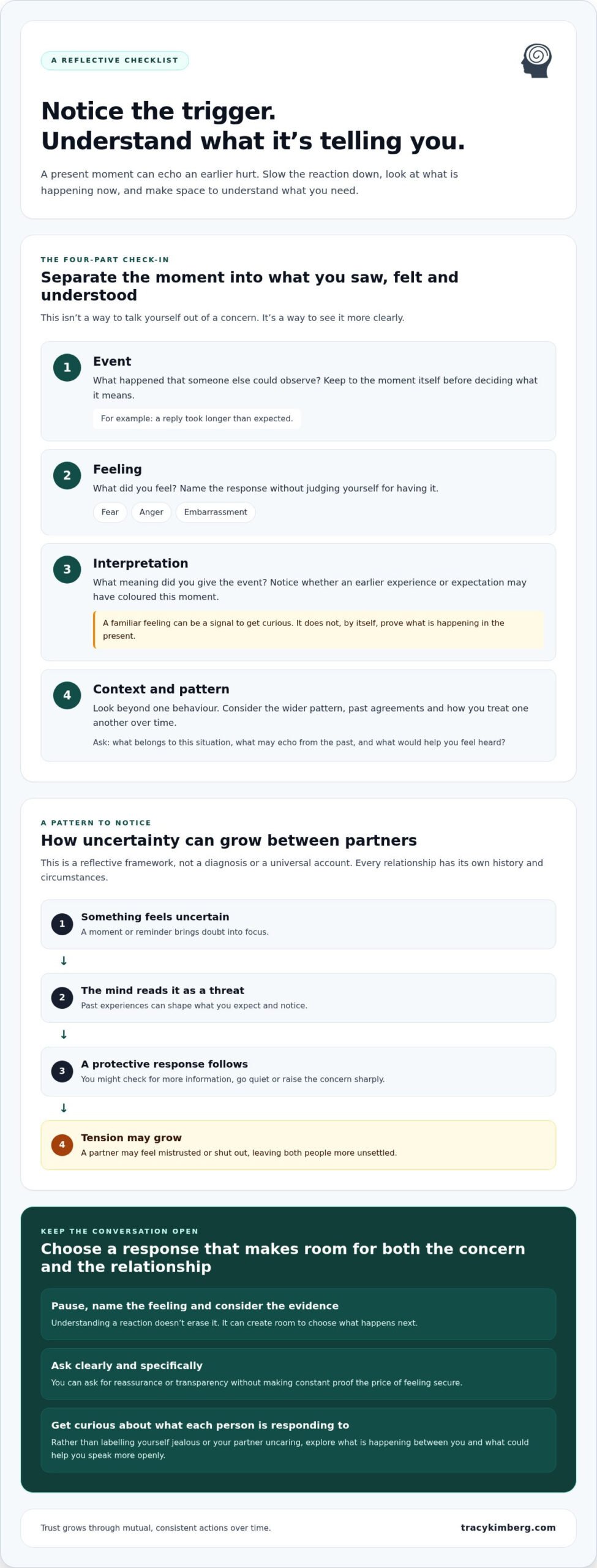
One possible cycle is that something feels uncertain, the mind interprets it as a threat, a protective response follows, and tension grows between partners. That response might be checking for more information, going quiet, or raising the concern sharply. The partner may then feel mistrusted or shut out, leaving both people more unsettled. This is a reflective framework, not a diagnosis or a universal account. Every relationship has its own history and circumstances.
Understanding a reaction doesn’t erase it. It can create room to choose what happens next.
How protective responses can affect closeness
Checking, withdrawing, testing a partner, or avoiding a difficult conversation may offer a sense of protection in the moment. Yet if one person hides a worry to avoid conflict, the other may not know closeness is needed. If someone tests a partner instead of asking directly, the response may be hard to interpret. These strategies don’t make someone controlling or irrational. They may be attempts to manage uncertainty. Still, over time, they can make honest connection harder.
Consider a couple who disagree about plans. One partner repeatedly asks whether the arrangement is still happening, hoping to feel secure. The other experiences the questions as pressure and becomes less forthcoming. Each response makes sense from that person’s position, but together they can deepen the uncertainty both are trying to ease. Noticing this interaction can shift the question from “Who’s at fault?” to “What’s happening between us, and what would help us speak more openly?”
How to notice a trust trigger without dismissing yourself
Try separating four parts of a difficult moment. This isn’t a way to talk yourself out of a concern. It’s a way to see it more clearly.
- Event: What happened that someone else could observe?
- Feeling: What did you feel, such as fear, anger, or embarrassment?
- Interpretation: What meaning did you give the event?
- Need: What would help you feel respected, informed, or heard?
Then consider both sides of the picture: does your interpretation connect with an earlier experience, and what does your partner’s present-day behaviour show? Look for repeated actions and responses to concerns, rather than using the past to explain away everything happening now. Current dishonesty or disrespect deserves to be taken seriously. It shouldn’t be reduced to a “trigger”. If this pattern feels difficult to untangle together, relationship counselling can provide space to explore what each of you is experiencing.
Taking this kind of pause can be part of overcoming trust issues from past relationships. The aim isn’t to blame yourself for reacting or excuse another person’s choices. It’s to understand the reaction, stay attentive to present evidence, and make room for a response that protects your needs and the possibility of honest connection.
How to tell the difference between an old fear and a present concern
Doubt can hold more than one truth: an old hurt may intensify your alarm, and something happening now may still need attention. You don’t have to choose between blaming yourself for feeling afraid and assuming the worst about your partner. Set out what you can observe alongside what the moment brings to mind. This comparison isn’t a verdict. It’s a way to make space for a clearer conversation.
What the current situation shows
Describe what happened in specific terms: an agreement was missed, plans changed without a message, or your partner answered a question openly. Note whether this has happened before and how the two of you responded afterwards.
What an earlier experience brings to mind
Name the memory, fear or prediction the situation stirred up. Perhaps a changed plan recalls a former partner who often concealed the truth. That connection matters, but it isn’t, by itself, proof that your current partner is doing the same.
Past hurt deserves attention, and present concerns deserve an honest look. Holding both perspectives can help you stay compassionate towards yourself without dismissing evidence or treating fear as certainty.
Questions to ask when doubt appears
Before raising a difficult concern, consider writing a few notes. What happened, as plainly as you can describe it? What meaning did you give it? What information is still unknown? Then ask whether this resembles a repeated pattern or could be an isolated misunderstanding. Writing can help you distinguish what you know from what you’re imagining, so the conversation begins with curiosity rather than accusation.
For example, “They cancelled dinner” is an observation; “They don’t care about me” is an interpretation. There may be information you haven’t heard yet. You could ask, “Can you help me understand what changed?” If similar cancellations keep happening, discuss the pattern and its impact rather than making the whole conversation about one evening.
When trust concerns may need direct attention
Repeated dishonesty, broken agreements or a partner repeatedly dismissing your concerns are not automatically echoes of the past. They are present-day behaviours worth addressing directly. Notice whether your partner takes responsibility, listens to the impact, and follows through over time. Reassuring words may matter, but consistent actions provide important evidence of whether an agreement is being honoured.
Boundaries can help you name what you need to feel respected, such as honesty about plans or a conversation when an agreement is broken. They differ from trying to control a partner’s thoughts, friendships or movements. A boundary describes what you will do to care for yourself. It isn’t a demand that someone surrender their independence. You’re allowed to take your judgement seriously, seek support and decide what feels safe for you. No reflection exercise requires you to excuse harmful behaviour or remain in an unsafe relationship.
Overcoming trust issues from past relationships doesn’t mean doubting every feeling or accepting every fear as fact. It means making room for both your history and what’s unfolding now, then responding to the clearest picture you can build.
Practical ways to rebuild trust without rushing or self-blame
Trust isn’t restored by demanding that fear disappear. It can grow as you and your partner meet difficult moments with care, honesty and actions you’ve both agreed on. If worry rises, use this sequence to consider what might help:
- Pause. Give yourself a moment before reacting. A few steady breaths or a short break can help you speak from what you need, not only from the intensity of the feeling.
- Name the feeling. Try to identify whether you feel hurt, anxious, angry or uncertain. A clear name can make the experience easier to explain.
- Check what’s happening now. Separate what you know from what you fear, and consider whether a current action or repeated pattern needs addressing.
- Choose a response. Decide whether to ask a question, make a specific request, set a boundary or return to the conversation when you feel ready.
This isn’t a test you have to pass perfectly. It’s a way to create a little space for choice. A request for reassurance might be, “Could you let me know if your plans change? It helps me feel considered.” That gives your partner something clear to respond to, without requiring constant updates or proof.
How to talk about trust without turning it into an accusation
Use first-person language to connect your feeling with the present situation and a practical request. For example: “I felt unsettled when I didn’t hear that the plans had changed. Could we agree to tell each other when that happens? I want us to feel more connected.” This names an impact and invites collaboration without claiming to know your partner’s intentions.
Then make room for their experience, too. Listen to understand before preparing a defence, and ask what they heard you say. Your partner may have felt overwhelmed or may not have realised the change mattered to you. Hearing that doesn’t require you to dismiss your own feelings. Both experiences can be real, and both deserve a respectful conversation.
How boundaries and repair can support progress
A boundary clarifies what you need to feel respected and emotionally safe. It might mean asking for honest communication about plans, or saying you’ll pause a conversation if it becomes hurtful and return to it when you can both speak calmly. A boundary is about your needs and choices, not controlling your partner’s thoughts, friendships or movements.
Repair goes beyond an apology. It involves acknowledging the impact of what happened, listening to one another, and agreeing on meaningful next steps. Trust is strengthened through repeated actions that both partners understand and accept, not a single intense conversation or promise. Notice whether the agreement is followed in everyday life, and revisit it if it isn’t working for either of you.
There’s no need to rush or abandon your limits to prove you’re trying. Overcoming trust issues from past relationships can be a gradual process of practising honesty, repair and mutual care. If you’d value help exploring these conversations together, connect about Couples Therapy.
When relationship counselling can help you move forwards together
Sometimes a couple understands that trust has been strained but finds it hard to talk without falling into the same argument. One person may seek answers, whilst the other becomes defensive or goes quiet. Relationship counselling can offer a steadier space to notice this pattern, understand what each partner is experiencing and practise communicating with greater care. Neither person needs to arrive with all the answers.
Couples Therapy offers a non-judgemental space to explore needs, feelings and recurring relationship dynamics. The focus isn’t on deciding who is right. It’s on making room for each person’s perspective, including how earlier experiences may influence expectations today, without assigning blame. A therapist can help you slow a conversation down and hear what sits beneath repeated misunderstandings or moments of emotional distance.
What couples may bring to a supported conversation
You might want to understand why a familiar disagreement keeps returning, why openness feels risky, or how to talk about a broken agreement without becoming caught in accusation and defence. You can explore how past hurt shapes present expectations while also looking honestly at what is happening between you now. Communication difficulties, emotional distance and repeated misunderstandings are all possible starting points.
There’s no single outcome that counselling should impose. It can’t promise to restore trust or determine whether you should stay together. Instead, the work can help you understand each other more clearly and consider what feels respectful, safe and possible for you as a couple.
Taking a first step with Tracy Kimberg
Tracy Kimberg has supported clients since 2005. Her warm, non-judgemental approach offers couples a place to explore trust, communication and the patterns that may be keeping them stuck. Trusted by over 266 Couples & Teenagers along with their parents, worldwide.
Tracy offers one-to-one Online Sessions for couples worldwide, as well as Face-to-Face Sessions for local couples. Beginning a conversation doesn’t mean you have to know exactly what you need or make a decision about your future together. It can simply be a chance to talk through what’s been happening and whether support might help.
If you’d like to explore relationship support with Tracy, you’re welcome to take a gentle first step through Let’s Talk.
Let trust grow at a pace that feels safe
You don’t have to settle every doubt today or prove that you’re ready to trust. A meaningful next step might be one honest conversation, a boundary you name clearly, or a moment spent noticing how you feel when your partner responds. Overcoming trust issues from past relationships isn’t about erasing your history. It’s about allowing new experiences to matter while continuing to honour what you need to feel respected and secure.
If you and your partner keep finding yourselves caught in painful conversations, you don’t have to work it all out alone. Support can help create room to listen, understand what each of you is carrying and consider what moving forwards might look like. You’re welcome to take that step in your own time.
Let’s Talk about relationship support. Small, thoughtful steps can open the way to a more connected future.
Frequently Asked Questions
Can you learn to trust again after a painful relationship?
Yes, trust can become possible again, though it doesn’t need to happen all at once. Start by noticing where you already feel comfortable being open, then take a small step towards sharing more. You might tell a new partner what helps you feel considered, without asking them to guarantee that you’ll never be hurt. Overcoming trust issues from past relationships can also include rebuilding confidence in your own ability to recognise what feels respectful and respond when it doesn’t.
How do I know whether my trust issues come from the past or my current relationship?
Sometimes both are involved. Ask yourself whether the concern began after a specific recent event, whether similar behaviour has happened repeatedly, and whether your partner responds constructively when you raise it. For example, a late reply may stir up memories, whilst repeated evasiveness about agreed plans is a present pattern to discuss. You don’t need to decide immediately which explanation is correct. Gather information and take your feelings seriously.
Can a new relationship help heal trust issues from a past relationship?
A caring new relationship can offer experiences of mutual respect and reliability, but your partner can’t do all the healing for you. Trust develops through both people’s choices, while you also practise expressing needs and keeping boundaries that matter to you. If you notice yourself relying on your partner to prevent every anxious feeling, consider what support or self-reflection might help you feel steadier. A new relationship can be part of growth, not a promise that old pain will disappear.
How can I talk to my partner about trust without accusing them?
Choose a calm moment and describe one specific situation, its effect on you, and what you’d like to happen next. For instance: “I felt left out when I heard about the weekend plans afterwards. Could we talk about plans together next time?” This is clearer than guessing your partner’s motives. Then let them explain how they experienced the situation. You can listen without agreeing with everything, and ask questions if something remains unclear.
Should I check my partner’s phone if I have trust issues?
Checking their phone without agreement is unlikely to create lasting security and may further damage openness between you. Before acting, ask what you hope to find and whether looking would answer the real concern. If you’re worried about a particular change in behaviour, raise that directly and discuss what transparency you both consider fair. If there has been dishonesty, you can address it without treating secret monitoring as the only way to protect yourself.
Can couples therapy help when only one partner has trust issues?
Yes, couples therapy can be useful even if one person feels more affected by trust concerns. The therapist can help both partners understand how the issue is experienced, what responses follow, and where communication gets stuck. One partner’s past may be part of the conversation, while the other can share how the present dynamic affects them. The aim isn’t to make either person the problem, but to explore what each can contribute to a more respectful conversation.

Article by
Tracy Kimberg
Tracy Kimberg is a Relationship Expert, Couples Therapist and Coach with a dedicated focus on helping couples and individuals rebuild connection, trust and emotional safety in their relationships. Drawing on the research of John and Julie Gottman, the relational insights of Esther Perel, and years of hands-on therapeutic experience, Tracy offers a warm, non-judgemental and deeply compassionate approach to modern relationships.
Based in Dorset, Tracy works with couples navigating communication breakdowns, betrayal, intimacy challenges, separation, family dynamics and life transitions. Known for creating a safe and grounded therapeutic space, she combines practical tools with emotional depth to help clients move beyond survival patterns and towards meaningful, lasting change.
With a reputation for empathy, professionalism and dedication to her clients’ growth, Tracy is passionate about helping people feel seen, understood and empowered — both within their relationships and within themselves.
Disclaimer
Disclaimer:
The information shared in this article is intended for educational and informational purposes only and should not be considered a substitute for professional therapeutic, psychological, medical or legal advice. Every individual and relationship is unique, and the perspectives offered are based on general therapeutic principles, research and professional experience.
Reading this article does not establish a therapist-client relationship with Tracy Kimberg. If you are experiencing significant emotional distress, relationship crisis, trauma, or mental health concerns, it is important to seek support from a qualified professional appropriate to your individual circumstances.
All content remains the intellectual property of Tracy Kimberg and may not be reproduced or distributed without permission.