

What if the most helpful first step isn’t finding your teenager more friends, but understanding how they feel about the friendships they have, or don’t have? Watching them spend time alone can leave you worried and unsure whether to step in or give them space. If you’re wondering what to do when your teenager has no friends, it’s natural to want to fix things quickly. But pressure or assumptions can make it harder for them to open up.
Your teenager may feel lonely, or they may be content with a small social circle. They could also be dealing with rejection, anxiety, changing friendships or something else they haven’t found the words to explain. Start with curiosity rather than conclusions. Listening without judgement can help you understand their experience before offering solutions.
This guide explores gentle ways to talk with your teenager, support connection without taking over, and recognise when extra help may be useful. You don’t have to have all the answers straight away. A calm, caring conversation can help your teenager feel less alone, whatever comes next.
Key Takeaways
- Having few friends, feeling lonely and enjoying time alone aren’t the same thing. Understanding your teenager’s experience can help you respond with care.
- If you’re unsure what to do when your teenager has no friends, choose a calm moment, ask an open question and listen before offering solutions.
- Changes in mood, routines, school experiences or willingness to connect can be gentle prompts for conversation, not proof of a particular problem.
- Explore small, interest-led ways to meet people together, while letting your teenager choose what feels manageable.
- Therapy can offer a non-judgemental space to explore feelings and relationships, without promising friendship or labelling your teenager as having a problem.
When your teenager has no friends: understand what the concern means
Your concern matters. Hearing your teenager say, “I have no friends,” can stir worry, but those words alone don’t tell you exactly what’s happening. They might be describing a painful sense of exclusion, a recent change in their social life, or simply having fewer friends than they think they should. Before deciding what to do when your teenager has no friends, try to understand what those words mean to them.
Friendship circumstances describe who is around; loneliness describes how connected someone feels. A teenager may have a small circle and feel close to the people in it, or spend time alone by choice without feeling lonely. Another may see classmates every day yet feel isolated or misunderstood. These experiences can overlap, but one doesn’t automatically prove another. This distinction is central to understanding social isolation in teenagers and helps keep the conversation focused on both their social circumstances and their feelings.
Friendship patterns can shift during adolescence. Interests change, social groups evolve, and a transition to a new school or a friendship fallout can unsettle a teenager’s sense of belonging. That doesn’t mean every change is a crisis, but it also doesn’t make distress less real. What matters is how your teenager is experiencing the change.
What might “I have no friends” mean to your teenager?
Begin with the moment behind the words. You might ask, “What’s been making you feel that way?” or “When you say ‘friends’, what would you want that to look like?” These open questions invite your teenager to explain without having to defend themselves. Give them time to answer, and resist the urge to turn their first response into a plan.
Listen for what they say about feeling lonely, excluded or misunderstood, as well as whether they’re comfortable with limited company. A teenager might have someone to chat with in class but no one they trust with personal worries. Another may enjoy their own company and feel no need for a larger circle. A small friendship group isn’t, on its own, evidence that something is wrong.
Why friendship changes can feel so significant
Friendships can be an important source of belonging, so a change may feel bigger than it looks from the outside. A teenager who has moved schools might miss familiar routines, whilst someone who has had a falling-out may feel unsure whom to trust. Even when a new interest leads them towards a different group, they might feel excited and unsettled at the same time.
The same situation can land differently for different teenagers. One may welcome a quieter social life; another may long for company but feel anxious about approaching people. Try not to measure their experience against siblings or classmates, or assume that a busy social calendar means someone feels connected. Stay curious about what has changed for your teenager and what the change means to them. That understanding gives you a steadier place from which to offer support.
How to talk with a teenager who feels friendless
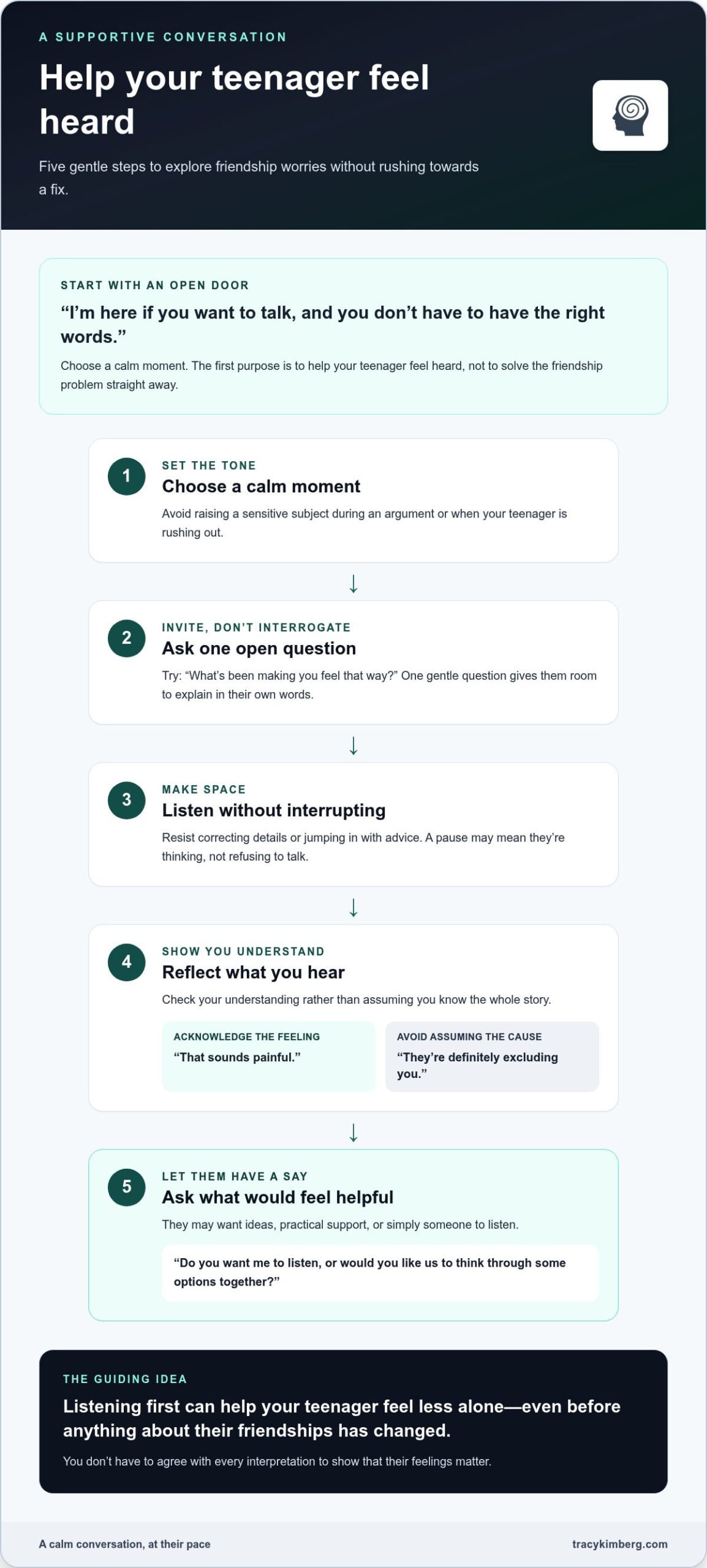
A conversation doesn’t need to solve the friendship problem. Its first purpose is to help your teenager feel heard, rather than examined or hurried towards a fix. If you’re thinking about what to do when your teenager has no friends, begin with a calm moment when neither of you is rushing. You might say, “I’ve been thinking about what you said. I’m here if you want to talk, and you don’t have to have the right words.”
Keep the conversation simple and let your teenager set the pace:
- Choose a calm moment. Avoid raising a sensitive subject during an argument or when they’re rushing out.
- Ask one open question. Invite them to share, rather than asking several questions in a row.
- Listen without interrupting. Resist the urge to correct details or jump in with advice.
- Reflect what you hear. Check your understanding instead of assuming you know the whole story.
- Ask what would feel helpful. They may want ideas, practical support or simply someone to listen.
Listening first can help your teenager feel less alone, even before anything about their friendships has changed. You don’t need to agree with every interpretation to show that their feelings matter. “That sounds painful” acknowledges the hurt; “They’re definitely excluding you” assumes a cause you may not yet understand.
Questions that invite an honest conversation
Try a gentle, specific prompt: “How have things felt with people at school lately?” or “What are weekends like for you at the moment?” You could ask, “Is there someone you wish you felt closer to?” Then pause. Silence may mean they’re thinking, not refusing to talk. A walk or car journey can feel less intense than sitting face-to-face. If they’d rather answer later, leave the door open.
How to respond without adding pressure
Acknowledge the feeling before exploring what might help: “It sounds like you’ve been carrying this on your own. Do you want me to listen, or would you like us to think through some options together?” This gives your teenager a say in what happens next. If they start sharing, try not to compare their experience with yours, label them as shy or assume they’re being left out on purpose.
Be careful with reassurance that promises a quick outcome, such as “You’ll have loads of friends soon.” It may be meant kindly, but can make a teenager feel that their current pain hasn’t been understood. Instead, say, “I can see this matters to you. We can take it one step at a time.” If they become uncomfortable, respect a request to stop: “That’s OK. We can pause, and I’m here if you want to come back to it.”
If talking feels difficult at home, a caring, non-judgemental space can give a teenager room to explore feelings and relationships at their own pace. Teen therapy support can be one option to consider together, without making friendship the test of whether support is working.
How to understand whether friendship difficulties need more attention
A difficult day or a quiet weekend doesn’t reveal the whole story. To understand what may be happening, notice the pattern over time and how your teenager feels about it. A change is worth exploring if they seem increasingly distressed, their usual routines shift, or they’re less willing to take part in things they once enjoyed. These observations aren’t diagnostic signs, and they don’t prove a particular cause. They’re invitations to check in with care.
If you’re weighing what to do when your teenager has no friends, look beyond a count of who they see. Notice whether the situation is affecting their sense of wellbeing or making everyday life feel harder. Your teenager’s own account matters most. Ask what they’ve noticed and what, if anything, they’d like to change.
Look at the wider pattern, not one social snapshot
Consider whether the difficulty feels new, has continued over time, or seems connected to a particular change. You might gently ask, “Has this been on your mind for a while, or has something shifted?” The aim isn’t to set a deadline for making friends. It’s to understand what the experience is like for them and whether it’s weighing on them.
Social connection can look different in different settings. A teenager might feel out of place at school but enjoy talking with someone through a shared online interest, or feel comfortable at an activity but isolated during lunch breaks. Ask whether there’s anywhere they feel included, understood or at ease. Their answers can help you see where connection is present, where it feels difficult and what kind of support they might welcome.
It may help to notice changes in mood, routines, school experience and willingness to connect, without turning home life into an investigation. For instance, you could mention that they’ve stopped going to an activity, then ask how they feel about it rather than concluding that friendship problems caused the change. Keep the focus on impact: are they troubled by what’s happening, or are others more concerned than they are? In cases where significant withdrawal is paired with marked changes in mood or perception, educational resources from organisations like Pand Health can offer helpful insight into complex mental health conditions that may affect social connection.
When to bring in another trusted adult
If your teenager links the difficulty to school, ask whether they’d be comfortable involving a suitable member of staff, such as a pastoral contact or tutor. Explain what you hope the conversation might help with, and invite your teenager to shape what is shared. They may prefer to speak themselves, have you alongside them, or wait while you discuss possible next steps together.
A trusted relative or another familiar adult may also offer a listening ear, if your teenager welcomes their involvement. Respect their privacy by sharing only what’s needed and being clear about who you plan to speak with. Being attentive doesn’t mean drawing conclusions or taking control. It means staying alongside your teenager, noticing whether the situation is affecting them, and making support a conversation you have with them, not simply about them.
Practical ways to help your teenager build connection without forcing friendship
Connection is more likely to grow when a teenager has some choice in how and where they meet people. Rather than signing them up for an activity as a solution, invite them to explore what feels genuinely interesting. If you’re wondering what to do when your teenager has no friends, think of options as a menu, not a prescription. They can choose one, suggest something else or decide they’re not ready yet.
Create low-pressure opportunities to meet people
Ask what they enjoy doing, or what they’ve been curious about, without making every interest a route to new friends. Shared activities can give conversation a natural starting point, but the activity should be worthwhile to them even if a friendship doesn’t immediately develop.
- Explore a club, class, volunteering opportunity or creative activity that matches an interest they already have.
- Look at what an activity involves together before they decide whether to attend or commit.
- Offer practical help, such as a lift, or ask whether they’d like you to go with them at first.
- Agree on a small first step, such as finding out when a group meets, then check how they feel before planning more.
Keep the invitation open: “Would you like to have a look at a few options, or would you rather leave it for now?” If they say no, try not to treat that answer as a rejection of your support. They may need time, or the suggested activity may simply not feel right. Ask what would make a first step easier, if anything.
Support connection whilst respecting their autonomy
Sometimes a new group isn’t the only possibility. Your teenager may want to reconnect with someone they already know. You can help them think through a small gesture, such as sending a message about a shared interest or asking whether the other person wants to spend time together. Let your teenager choose their words and whether to reach out. Avoid contacting the other young person or managing the friendship on their behalf unless your teenager asks for specific help.
Offer reassurance that doesn’t make popularity the goal. A full diary or a wide friendship circle isn’t a measure of someone’s worth, and a quiet social life isn’t automatically a problem. Encourage your teenager to notice the relationships and activities that feel meaningful to them, whilst making room for their individual way of connecting. You might say, “You don’t have to become someone else to find people you feel comfortable with.”
If your teenager would value a space to explore feelings, relationships and personal growth without pressure to make friends, explore Teen Therapy with Tracy Kimberg. Therapy can support self-understanding; it can’t promise a particular friendship outcome. Keep the decision centred on your teenager’s needs and involve them in considering whether support feels right.
When professional support may help a teenager who feels alone
Parents can offer care and make room for connection, but they don’t have to carry every worry alone. If your teenager seems distressed by their relationships, wants someone impartial to talk to, or finds it hard to share what’s going on at home, therapy may be worth considering. There’s no need to wait until the situation feels like a crisis, and seeking support doesn’t mean you’ve decided there’s something wrong with your teenager.
For a parent asking what to do when your teenager has no friends, therapy can be one possible source of support, not a way to produce a particular social result. It can offer a non-judgemental space to explore emotions and relationships at a pace that suits the young person. Friendship may be part of the conversation, but it doesn’t have to be the only focus.
What a supportive therapy space can offer
A teenager may find it easier to talk when they’re not managing a parent’s worry at the same time. In therapy, they can describe what relationships feel like from their point of view, consider what they want from friendships and explore feelings that are difficult to put into words. The aim is not to decide in advance what the problem is or prescribe a social solution.
Support works best when it takes the teenager’s needs and willingness seriously. You might say, “You don’t have to decide now, but would talking with someone outside the family feel useful?” Invite questions and listen to any hesitations. Therapy doesn’t guarantee new friendships, and a teenager doesn’t need to be labelled as having a problem to benefit from a space for reflection and personal growth.
Explore Teen Therapy with Tracy Kimberg
Tracy Kimberg offers Teen Therapy, also referred to as Teenager Therapy, with a caring, non-judgemental approach focused on personal growth. Online sessions are one-to-one and available to teenagers worldwide. Face-to-face sessions are available for local clients in Dorchester.
As a parent, you can help by making the possibility known without insisting that your teenager agrees immediately. Ask what would help them feel comfortable exploring support, and keep the conversation centred on their experience rather than on a goal of making friends. If they’re open to taking the next step, you can talk with Tracy about Teen Therapy and whether it may suit your teenager’s needs.
Take the next step at your teenager’s pace
You don’t need a perfect plan before you can be supportive. A steady willingness to listen, stay curious and keep connection open can matter, even if your teenager isn’t ready to talk or accept help straight away. Let them know they can return to the conversation when they’re ready. Small, thoughtful steps can make support feel possible without turning friendship into a problem they must solve for you.
If you’re still wondering what to do when your teenager has no friends, you don’t have to work it all out on your own. It may help to talk through your concerns and consider what kind of support would feel right for your teenager. Keep their perspective at the centre, and allow space for their own pace and choices.
Let’s talk about support for your teenager. A caring conversation can be a hopeful first step towards feeling more understood and supported.
Frequently Asked Questions
Is it normal for a teenager to have no close friends?
There isn’t one social pattern every teenager needs to follow. Some feel content with a small circle or casual connections, while others miss having someone they can confide in. Rather than judging by how many friends they have, ask what they’d like their social life to feel like. A teenager might say they want one person to sit with at lunch, not a larger group or a busier calendar.
Can online friendships count as real friendships for teenagers?
Yes, online friendships can be meaningful. Ask what your teenager values about those connections and whether they feel listened to, respected and supported. You could also talk about age-appropriate online safety together, such as what personal information they feel comfortable sharing and what they’d do if an interaction made them uneasy. Keep the conversation open rather than treating online relationships as automatically less genuine or assuming they meet every social need.
Should I contact my teenager’s school if they have no friends?
You can consider involving the school if your teenager’s worry relates to lessons, break times or feeling left out in a particular setting. Before contacting anyone, agree with your teenager what you’ll share and what they hope could change. For instance, they may want help feeling more comfortable during group work, rather than attention drawn to their friendships. A clear, limited purpose can help keep the conversation respectful and constructive.
What if my teenager says they prefer being alone?
Take them at their word and ask what they enjoy about having time to themselves. You might gently wonder whether solitude feels relaxing, or whether there are particular moments when they’d welcome company. Their preferences can change from day to day, so there’s no need to press for a different answer. Let them know you’re available if their feelings shift, then show that you respect their need for space.
How can I help if my teenager will not talk about having friends?
You can keep support available without making every interaction about friendships. A brief message such as “I care about you, and I’m here if you want me” may feel less exposing than another direct question. Keep ordinary shared moments going, too, without expecting them to open up. If they choose to talk later, listen without demanding a full explanation or treating their silence as proof of what they feel.
When might therapy help a teenager who feels lonely?
Therapy may be worth exploring if your teenager wants a space to make sense of loneliness, relationships or personal growth, or if these feelings are weighing on them. It doesn’t mean they’re at fault or require a label, and it can’t guarantee new friendships. You might ask what they’d want help talking through and what would make support feel comfortable. Tracy Kimberg offers Teen Therapy; the decision can centre on your teenager’s needs.

Article by
Tracy Kimberg
Tracy Kimberg is a Relationship Expert, Couples Therapist and Coach with a dedicated focus on helping couples and individuals rebuild connection, trust and emotional safety in their relationships. Drawing on the research of John and Julie Gottman, the relational insights of Esther Perel, and years of hands-on therapeutic experience, Tracy offers a warm, non-judgemental and deeply compassionate approach to modern relationships.
Based in Dorset, Tracy works with couples navigating communication breakdowns, betrayal, intimacy challenges, separation, family dynamics and life transitions. Known for creating a safe and grounded therapeutic space, she combines practical tools with emotional depth to help clients move beyond survival patterns and towards meaningful, lasting change.
With a reputation for empathy, professionalism and dedication to her clients’ growth, Tracy is passionate about helping people feel seen, understood and empowered — both within their relationships and within themselves.
Disclaimer
Disclaimer:
The information shared in this article is intended for educational and informational purposes only and should not be considered a substitute for professional therapeutic, psychological, medical or legal advice. Every individual and relationship is unique, and the perspectives offered are based on general therapeutic principles, research and professional experience.
Reading this article does not establish a therapist-client relationship with Tracy Kimberg. If you are experiencing significant emotional distress, relationship crisis, trauma, or mental health concerns, it is important to seek support from a qualified professional appropriate to your individual circumstances.
All content remains the intellectual property of Tracy Kimberg and may not be reproduced or distributed without permission.