

Social media can bring partners closer and leave them feeling overlooked in the same moment. The impact of social media on relationships depends less on the apps themselves than on how people use them, and whether online habits support or interrupt emotional connection. It can help couples share daily life across distance, but comparison, jealousy and distraction can also create tension.
If you’ve ever felt that your phone is competing for your partner’s attention, or wondered what a post or message means, those feelings deserve a thoughtful response, not blame. Social media can offer connection and reassurance, but it can also stir up uncertainty when expectations aren’t shared.
This article explores how online interactions shape closeness, why comparison and phone use can cause strain, and how social media can help long-distance partners stay involved in each other’s lives. You’ll also find ways to discuss digital boundaries and protect time for the conversations and experiences that help a relationship feel present and understood.
Key Takeaways
- Agree on phone-free moments together so everyday scrolling doesn’t crowd out meaningful conversation.
- Notice when idealised posts trigger comparison, and bring the underlying feelings into a kind, honest conversation.
- Use social media to share daily moments across distance, while making space for more personal connection too.
- If digital habits are feeding ongoing conflict or disconnection, relationship counselling can help you understand the pattern and work towards change.
Annoyance about a partner’s phone and social media use
When a partner scrolls during dinner, the other person may feel ignored, even while sitting together. The impact partly depends on what each partner believes phone use says about attention and care.
Phone use and partner annoyance
Phone-related frustration can build when a partner’s screen repeatedly interrupts time together. If one person checks notifications during dinner, the other may feel less seen or valued. The same habit can mean different things: one person may see a quick work reply, while the other experiences it as withdrawal. Name what’s happening and agree on phone-free meals to make expectations clear.
Jealousy over online interactions
Online jealousy is unease about a partner’s likes, comments or conversations with other people. Among U.S. partnered adults ages 18 to 29 whose partner used social media, 34% said they had felt jealous or unsure about their relationship because of their partner’s social media interactions, according to Pew Research Center. Rather than treating every interaction as proof of disloyalty, discuss what each person considers flirtatious, private or acceptable. Specific examples make the conversation less accusatory.
Checking a partner’s phone
Checking a partner’s phone without their knowledge may be an attempt to find reassurance, but it crosses a privacy boundary, whether that boundary was discussed or assumed. Finding an ambiguous message can raise more questions, while finding nothing may ease suspicion only briefly. If you feel tempted to look, pause and name your concern directly. For example, say, “I felt unsettled by that comment. Can we talk about what it meant?”
Giving online interactions the benefit of the doubt
Giving the benefit of the doubt means allowing for unclear tone or intent before deciding what a post or message means. A brief reply may seem cold in writing, even if the sender intended no rejection. Ask for context before reacting, and explain what you noticed without presenting an assumption as fact. Agree on what social media means to each of you, including boundaries around public posts, private messages and contact with former romantic partners.
How does social media affect relationships?
Social media can help couples share moments, but it can also interrupt attention and create uncertainty. The impact of social media on relationships depends partly on the platform and pattern of use: frequent checking can displace conversation, whilst purposeful contact can help partners stay connected.
Online contact and face-to-face time
Balancing online contact with face-to-face time means making room for digital exchanges and undistracted attention. A message during the day can help partners feel included, while scrolling through dinner can make time together feel secondary. Agree on moments to put phones away, such as during meals or a walk. The goal isn’t to reject social media, but to protect in-person conversation.
Online communication and relationship anxiety
Online communication can stir anxiety when a delayed reply, brief message or visible activity seems like evidence of distance. Without tone or context, it’s easy to fill the gaps with assumptions, especially when you’re already feeling insecure. Before reacting, separate what you observed from what you fear it means. Asking, “Can we talk about your message?” invites clarity without turning uncertainty into an accusation.
Digital boundaries and expectations
Digital boundaries are shared understandings about how partners use social media and communicate online. One person may see a public anniversary post as affectionate; another may prefer to keep the relationship private. Discuss expectations around posting, messaging, response times and time offline, then revisit them as circumstances change. Clear agreements help both partners understand each other’s needs instead of expecting one person’s habits to suit them both.
Platform and usage differences
Social platforms offer different ways to interact, from private messages and public posts to dating profiles. Dating platforms can broaden opportunities to meet potential partners, while social networks help people maintain existing connections. The impact of social media on relationships also depends on how someone uses it and how that activity fits within the partnership. Notice whether it supports connection or repeatedly draws attention away, whatever the platform.
If digital expectations keep leading to the same conflict, relationship counselling for couples can help partners explore the pattern and agree on boundaries that work for both.
Idealized portrayals and relationship comparison
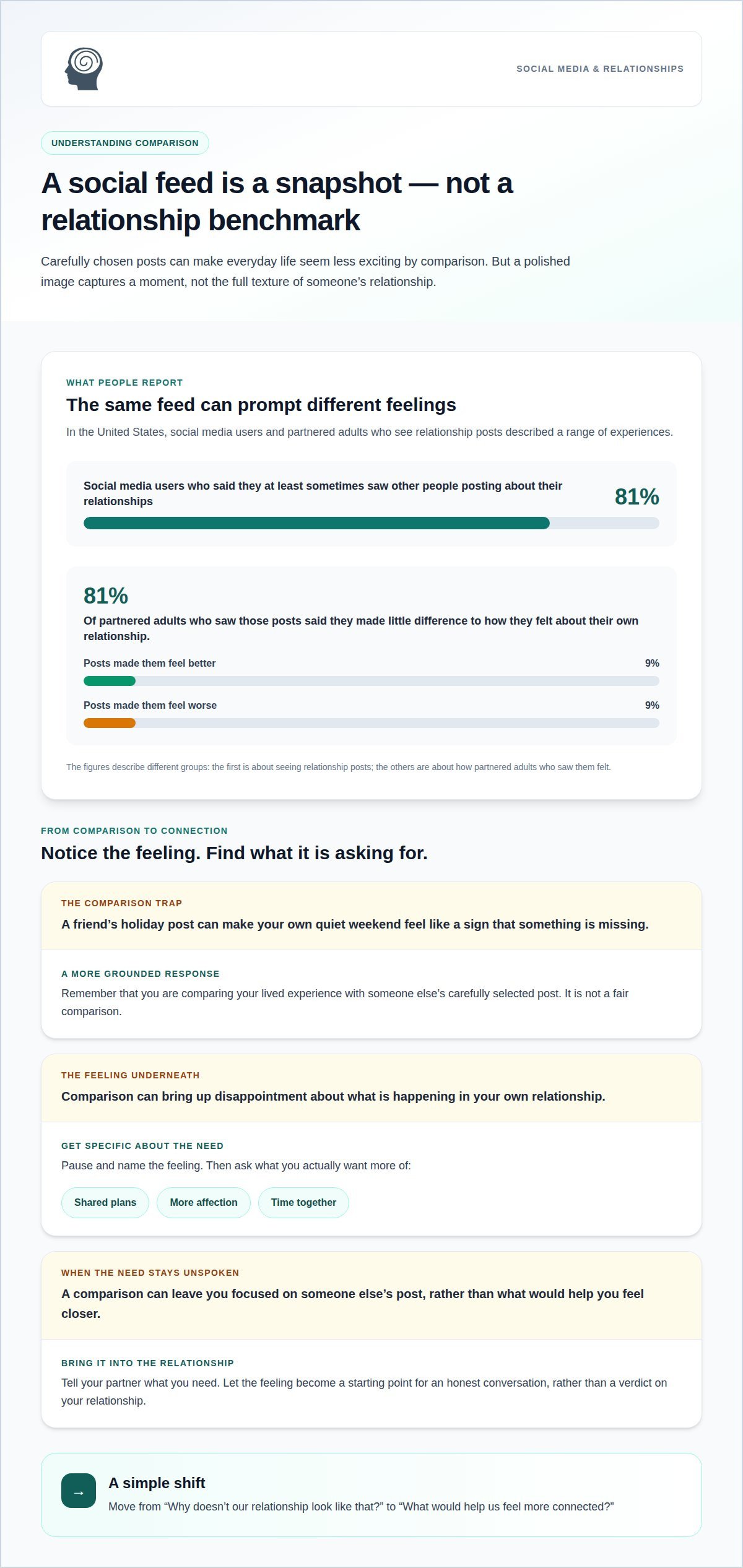
A polished anniversary photo captures a moment, not the full texture of a relationship. Social media feeds often feature celebrations, affectionate captions and carefully chosen images, while leaving ordinary routines and disagreements out of view. Comparing your relationship with that edited picture can make a quiet evening seem like a sign of failure. It’s not a fair comparison: you’re weighing your lived experience against someone else’s carefully selected post.
Exposure to relationship posts doesn’t affect everyone in the same way. In the United States, 81% of social media users said they at least sometimes saw other people posting about their relationships. Among partnered adults who saw those posts, 81% said they made little difference to how they felt about their own relationship. Meanwhile, 9% said the posts made them feel better, and 9% said they felt worse. The same feed can prompt different responses.
Notice what comparison brings up before acting on it. If a friend’s holiday post leaves you disappointed with your own weekend, name the feeling and identify what you actually want: shared plans, more affection or simply time together. Then tell your partner what you need. This turns comparison into useful information, rather than a verdict on whether your relationship measures up.
Jealousy can also grow when a post prompts assumptions about intimacy or commitment. Before responding by arguing, making a pointed comment or withdrawing, pause and separate what you saw from the story you’ve attached to it. A photo of a romantic dinner, for example, doesn’t show how the couple treats each other day to day. Curate your feed if certain accounts repeatedly unsettle you, and talk with your partner about the need beneath that reaction.
Social media and long-distance relationships
For partners living apart, social media can make everyday life feel more visible and shared. A photo of a meal, a voice note from a commute or a quick video call can help each person feel included between visits. These small windows into everyday routines can nurture closeness when distance limits spontaneous time together.
Online contact works best when it opens the door to meaningful conversation. Rather than sending updates all day, share a detail that invites a fuller exchange: “What was the best part of your afternoon?” A voice or video call can add warmth that a short message may lack. These habits help partners stay involved without expecting digital contact to replace other forms of connection.
Distance can also make silence feel loaded. If one partner expects an immediate reply and the other is busy, a delay may be read as disinterest. Agree on practical expectations, such as when each person is usually available and how to signal a busy day. Clear agreements can reduce avoidable conflict and leave less room for anxious guesswork.
Share online with care. A public post may feel affirming to one partner but too exposing to the other, so discuss what feels comfortable before sharing personal updates. If a message lands badly, move the conversation to a call instead of trying to resolve the hurt through a long text exchange. Hearing each other’s tone can make intentions easier to understand.
Plan connection beyond the screen as well. Set aside time for a focused call, watch the same programme while talking, or share a meal over video. These rituals give each partner something to anticipate and create a sense of participation in daily life. If distance is amplifying disconnection or recurring conflict, take a step towards relationship support.
Tracy Kimberg
Tracy Kimberg helps people explore how online habits affect closeness, trust and communication. If social media repeatedly triggers conflict, counselling can give partners space to understand what each needs and agree on boundaries that feel fair. Tracy’s Relationship Counselling and Coaching for Couples can support partners who want to address these patterns together. Individual therapy may also help when anxiety or past experiences shape how online interactions feel.
Support can help when conversations keep circling the same worries, phone use affects time together, or distance makes connection harder to sustain. The aim is to understand the pattern and find a more thoughtful way forward, without blame. If you’d like help with what social media is bringing up in your relationship, contact Tracy Kimberg.
Choose connection with intention
The next step isn’t to make social media disappear. Notice what happens between you when a screen enters the moment, then choose a response that brings you closer to the conversation you want to have. That pause can turn an automatic reaction into a clearer expression of what matters. The impact of social media on relationships is easier to address when both partners can talk openly about attention, trust and boundaries that feel right.
If these conversations keep ending in the same painful place, support can help you explore the pattern together. Tracy Kimberg offers Relationship Counselling and Coaching for Couples, as well as a 12-Week Relationship Recovery Process. Therapy for Teenagers is also available for young people navigating relationship and emotional challenges.
Contact Tracy Kimberg to take a considered next step towards more understanding and connection.
Frequently Asked Questions
How does social media affect romantic relationships and intimacy?
Social media can shape intimacy by influencing how partners share affection, attention and private moments. A thoughtful message or shared playlist may feel personal, while frequent public posts can leave one partner feeling exposed. Discuss which moments you want to keep private and how each of you prefers to receive affection. These conversations help make online gestures meaningful instead of assumed.
How does social media influence friendships and family relationships?
Social media can help friends and relatives keep in touch across busy schedules or distance, for example, by sharing photos in a family group chat. It can also lead to misunderstandings when a message is read without context or someone feels excluded from an online conversation. Consider discussing sensitive topics on a direct call, and avoid using public posts to resolve private disagreements.
What do studies say about social media use and relationship satisfaction?
Research does not point to one outcome for every couple. A study may find an association between a particular pattern of use and relationship satisfaction, but that does not prove social media caused the change. What matters includes how people use it, how it affects time together and whether partners feel heard. Relationship quality also depends on communication and expectations beyond the screen.
How can social media use cause jealousy, conflict, or trust issues in relationships?
Jealousy or conflict can arise when partners interpret the same online interaction differently. One may see a private message as harmless, while the other sees it as intimate. Repeated secrecy or unclear expectations may deepen mistrust. Rather than treating a like or follow as proof, talk about the specific behaviour and what it means to each of you. Agreeing on what feels respectful gives both partners a clearer basis for trust.
How does social media use affect communication and emotional connection between partners?
Digital communication can keep partners in touch, but it may not convey tone, facial expression or the reassurance of being heard. Use messages for simple updates and save emotionally charged subjects for a conversation where both people can respond fully. For example, discuss a difficult decision by phone or in person rather than trying to settle it through brief replies.
What are the effects of social media on relationships among teenagers and young adults?
For teenagers and young adults, social media can be a place to express identity, maintain friendships and explore romantic interest. It can also make feedback, visibility and peer expectations feel especially personal. A supportive conversation can focus on how online experiences affect mood, confidence and boundaries, without shaming someone for using an app. Adults can listen first, then help young people consider their options.

Article by
Tracy Kimberg
Tracy Kimberg is a Relationship Expert, Couples Therapist and Coach with a dedicated focus on helping couples and individuals rebuild connection, trust and emotional safety in their relationships. Drawing on the research of John and Julie Gottman, the relational insights of Esther Perel, and years of hands-on therapeutic experience, Tracy offers a warm, non-judgemental and deeply compassionate approach to modern relationships.
Based in Dorset, Tracy works with couples navigating communication breakdowns, betrayal, intimacy challenges, separation, family dynamics and life transitions. Known for creating a safe and grounded therapeutic space, she combines practical tools with emotional depth to help clients move beyond survival patterns and towards meaningful, lasting change.
With a reputation for empathy, professionalism and dedication to her clients’ growth, Tracy is passionate about helping people feel seen, understood and empowered — both within their relationships and within themselves.
Disclaimer
Disclaimer:
The information shared in this article is intended for educational and informational purposes only and should not be considered a substitute for professional therapeutic, psychological, medical or legal advice. Every individual and relationship is unique, and the perspectives offered are based on general therapeutic principles, research and professional experience.
Reading this article does not establish a therapist-client relationship with Tracy Kimberg. If you are experiencing significant emotional distress, relationship crisis, trauma, or mental health concerns, it is important to seek support from a qualified professional appropriate to your individual circumstances.
All content remains the intellectual property of Tracy Kimberg and may not be reproduced or distributed without permission.