

Keeping the family home unchanged can make separation more complicated, not less. In a nesting arrangement during separation in the UK, children stay in the family home while their parents take turns living there. Familiar surroundings may offer continuity, but sharing a home this way asks a great deal of both parents.
If you’re drawn to the idea of sparing your children an immediate move, that makes sense. Their rooms, routines and school life can stay familiar while the adults adjust to a new family structure. Yet nesting doesn’t automatically reduce costs: maintaining separate places for the parents as well as the family home can mean paying for several living spaces.
This guide explains how nesting works, when it may offer short-term financial advantages, and why privacy, boundaries and unresolved conflict can make it emotionally demanding. It will help you weigh the practical trade-offs against your children’s need for stability, and consider whether this shared arrangement feels workable for your family.
Key Takeaways
- Understand how nesting works: children stay in the family home while parents take turns living there, with clear arrangements for schedules and household tasks.
- Consider whether keeping familiar rooms, school routines and daily patterns could offer your children stability during separation.
- Weigh any short-term housing savings against the cost of maintaining multiple living spaces and the practical demands of sharing a home.
- Think carefully about communication, privacy and emotional boundaries, and explore support for approaching separation with care.
What are nesting arrangements?
A nesting arrangement during separation in the UK keeps children in the family home while parents take turns living there. After separation or divorce, this can preserve familiar routines, but it depends on clear boundaries and ongoing cooperation as co-parents.
Risks to parents and children
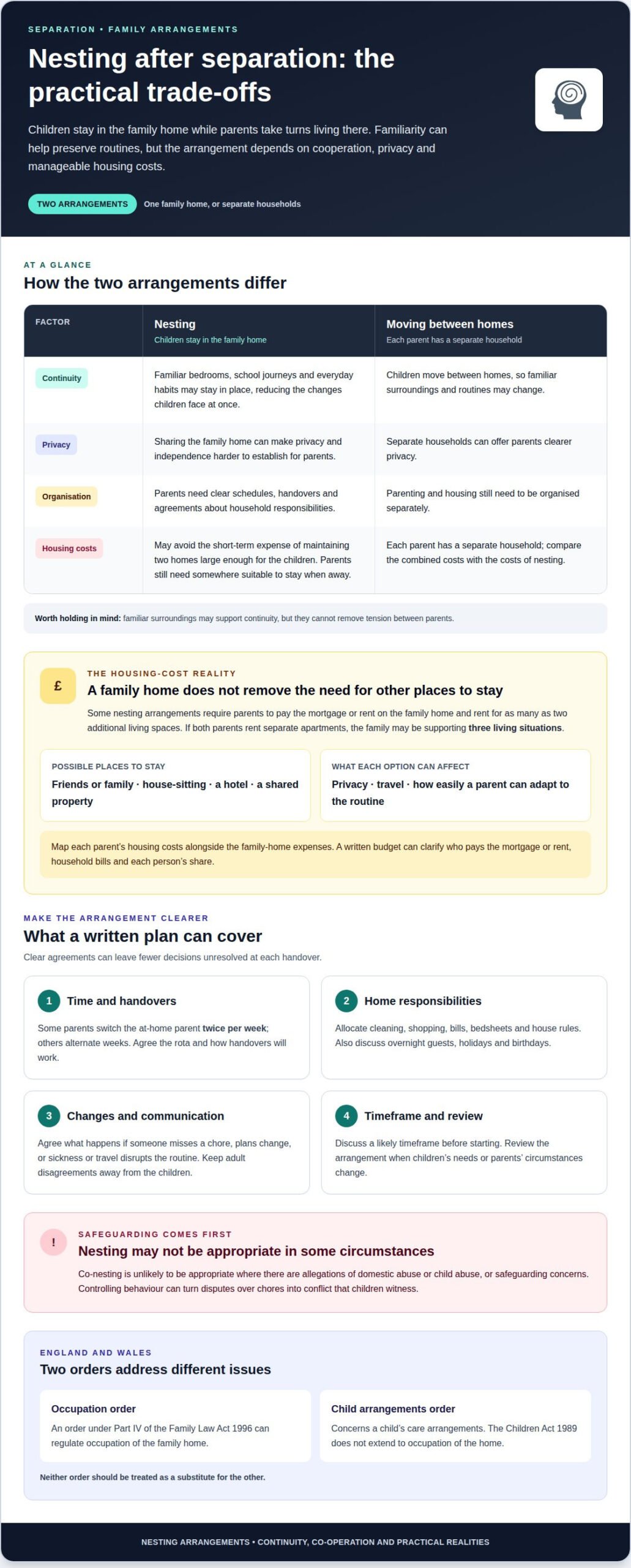
Risks to parents and children are emotional or practical harms that can arise when former partners share a home. Children may experience tension, while a parent can feel exposed or unable to settle elsewhere. Co-nesting is unlikely to be appropriate where there are allegations of domestic abuse or child abuse, or safeguarding concerns. Controlling behaviour can turn disputes over chores into conflict that children witness.
Parenting time and household tasks
Parenting time and household tasks are the agreed rota for who stays in the home and manages daily responsibilities. Some parents switch the at-home parent twice per week; others alternate weeks. A written agreement can allocate cleaning, shopping, bills, bedsheets and house rules. It should also cover overnight guests, holidays, birthdays, and unexpected sickness or travel problems, so each handover involves fewer unresolved decisions.
Communication and cooperation
Communication and cooperation mean sharing decisions respectfully and following agreed routines at each handover. Before a nesting arrangement during separation in the UK begins, discuss expectations, boundaries and a likely timeframe. For example, agree how to raise a missed chore without involving the children, and what to do if plans change. Regular reviews can help you recognise when the children’s needs or parents’ circumstances mean the arrangement no longer feels workable.
Benefits of keeping children in the family home
A nesting arrangement during separation in the UK keeps children in one home, while moving between homes gives each parent a separate household. Nesting may preserve familiar routines, but can make privacy and independence harder to establish.
Stability and routine for children
Stability means children can keep familiar surroundings while their parents adjust to separation. Staying in the family home may help preserve bedrooms, school journeys and everyday habits, reducing the changes they face at once. In an England and Wales case, the father argued that nesting gave his children a stable base and kept them together in the only home they had known, according to the UK Government. Familiarity can help, but it cannot remove tension between parents.
Explaining temporary nesting
Explaining temporary nesting means giving children a clear, age-appropriate account of what will change and what will stay the same. Before telling them, agree on the basic plan, including who will be at home and how handovers will work. Choose a calm, neutral setting, such as a spare room, and explain that the arrangement is temporary without promising a precise end date. Invite questions and make space for feelings; children shouldn’t feel responsible for deciding the plan.
Nesting compared with moving between homes
Choosing a nesting arrangement during separation in the UK may suit families prioritising continuity, while moving between homes can offer parents clearer privacy. Nesting may reduce disruption to school routines, but it doesn’t remove the need to organise parenting and housing separately. In England and Wales, an occupation order under Part IV of the Family Law Act 1996 can regulate occupation of the family home. A child arrangements order concerns a child’s care arrangements; the Children Act 1989 doesn’t extend to occupation of the home. These orders address different issues, so neither should be treated as a substitute for the other.
Potential short-term financial advantages
Nesting may ease immediate housing pressure by keeping children in one family home. Whether it helps financially depends on the parents’ other accommodation and shared costs.
Shared housing and financial costs
Shared housing means children stay in the family home while parents arrange somewhere to live during their time away. This can avoid the short-term expense of maintaining two homes large enough for the children. But housing costs don’t disappear: parents still need somewhere suitable to stay, and the arrangement only eases pressure if those combined costs remain manageable.
Some parents stay with friends or family, house-sit, use a hotel, or share a property. Each option affects privacy, travel and how easily a parent can adapt to the routine. A written budget can set out who pays the mortgage or rent and other household bills, and how costs are divided. Shared responsibility needs a clear agreement, not assumptions.
Housing and financial constraints
Housing constraints arise when parents cannot afford or find suitable places to stay away from the family home. Some nesting arrangements require parents to pay the mortgage and rent for as many as two additional living spaces. If both parents rent separate apartments, the family may be supporting three living situations, so the apparent saving can quickly narrow.
Before settling on a schedule, map each parent’s housing costs alongside the family-home expenses. For example, staying with relatives may reduce immediate spending but mean less privacy or a longer journey to school. If separate accommodation is needed for both parents, compare the combined cost with two smaller homes. Nesting can offer a short-term financial advantage when it is affordable, workable and free from control or abuse issues; emotional strain can still make that saving costly.
Emotional and practical drawbacks
One parent reported that nesting ended after about 8 months because it had become distressing and privacy was a concern. Sharing the family home can keep former partners emotionally entangled, even when each has time away. After a marriage ends, entering the same kitchen or bedroom may blur the boundary between co-parent and former partner.
Domestic routines can become flashpoints. If one parent expects a spotless kitchen and the other leaves the washing-up, each handover may revive old conflict. Agreeing on written standards for cleaning, laundry and shopping can reduce ambiguity, but cannot resolve deeper control issues. Children may also notice tension around these everyday tasks.
Even an amicable relationship after separation needs boundaries when parents share a home. One parent, for example, may welcome overnight guests while the other feels exposed by their ex-partner’s belongings or presence. Discussing privacy, personal space and access before nesting begins can show whether cooperation is practical, rather than simply hoped for.
Before agreeing, each parent should consider whether they can co-exist with their ex-partner for at least half the time. Where there are allegations of domestic abuse or child abuse, or safeguarding concerns, co-nesting is unlikely to be appropriate. A clear review point and plan for ending the arrangement can help parents respond if distress grows. The key test is whether the arrangement supports children without making home feel unsafe or emotionally tense.
Tracy Kimberg: Conscious Approached Divorce and separation
Conscious Divorce and Separation support offers a supportive next step when decisions about nesting are affecting your relationship, communication or emotional wellbeing. Separation can bring grief, uncertainty and practical pressure all at once. A space to understand these responses can help you approach conversations with greater awareness, rather than letting every discussion become another argument about schedules or the family home.
This support may be useful when you and your former partner are struggling to discuss boundaries, explain changes to your children or decide whether nesting remains workable. It focuses on the emotional and relational experience of separation, helping you reflect on what matters to you and how you want to relate as co-parents. That can include noticing when old patterns shape present conversations, and considering what a more thoughtful response might look like.
It doesn’t decide who lives in the property, settle financial arrangements or replace legal advice. Those practical questions sit alongside the emotional work, rather than being answered by it. If you’re unsure whether to continue nesting, this support can help you explore the effects on your wellbeing and family relationships, and bring more intention to the choices ahead. The aim is not to force agreement or promise a particular outcome, but to make room for clearer reflection during a demanding transition.
You can take a gentle first step by contacting Tracy Kimberg to discuss support around divorce and separation.
Frequently Asked Questions
Can co-nesting work long-term?
Co-nesting can continue long-term, but it may keep former partners closely connected and make it harder to establish separate lives. One reported family continued nesting until their children reached adulthood, showing that arrangements differ. That example isn’t a guarantee of sustainability. Regular reviews can help parents notice whether the arrangement still serves the children or is delaying necessary changes.
What are the downsides of birdnesting?
Birdnesting can blur the distinction between living together and separating, leaving children unsure about what has changed. Parents may also find it difficult to establish privacy or emotional distance when belongings and shared spaces remain intertwined. If children interpret both parents returning to the same home as a reconciliation, for example, a calm, consistent explanation can help them understand the arrangement without creating false expectations.
How can co-parents nest successfully?
Co-parents can make nesting more workable by agreeing how to handle changes, not just the usual routine. A shared calendar can record handovers, school events and appointments; one agreed communication channel can keep updates in one place. Decide how much notice to give for a proposed change and how urgent messages will be handled. These small steps reduce avoidable misunderstandings when plans shift.
How will birdnesting affect your children?
Children may value having one familiar base, yet they can also feel unsettled by changes in their parents’ relationship. Their response may differ by age, temperament and understanding of the separation. Give each child room to ask questions privately, rather than expecting them to speak for siblings. If a child worries that the separation is their fault, reassure them clearly that adult decisions are not their responsibility.
Is birdnesting divorce a good idea?
Birdnesting may suit separating parents who can cooperate, afford the arrangement and keep children’s needs central. It’s less suitable where safety concerns, controlling behaviour or persistent conflict make shared access to the home distressing. Consider what the arrangement is meant to achieve, and what would signal that it needs to change. A clear purpose helps distinguish a thoughtful transition from an open-ended pause.
Why should you choose nesting separation?
Nesting may be worth considering if a move would add disruption during an already demanding transition. For example, one parent used a time-limited arrangement to support two eldest children through an exam year. The potential benefit is continuity during a particular period, not a promise that nesting will suit every family. Parents can weigh that value against the demands of maintaining the arrangement.

Article by
Tracy Kimberg
Tracy Kimberg is a Relationship Expert, Couples Therapist and Coach with a dedicated focus on helping couples and individuals rebuild connection, trust and emotional safety in their relationships. Drawing on the research of John and Julie Gottman, the relational insights of Esther Perel, and years of hands-on therapeutic experience, Tracy offers a warm, non-judgemental and deeply compassionate approach to modern relationships.
Based in Dorset, Tracy works with couples navigating communication breakdowns, betrayal, intimacy challenges, separation, family dynamics and life transitions. Known for creating a safe and grounded therapeutic space, she combines practical tools with emotional depth to help clients move beyond survival patterns and towards meaningful, lasting change.
With a reputation for empathy, professionalism and dedication to her clients’ growth, Tracy is passionate about helping people feel seen, understood and empowered — both within their relationships and within themselves.
Disclaimer
Disclaimer:
The information shared in this article is intended for educational and informational purposes only and should not be considered a substitute for professional therapeutic, psychological, medical or legal advice. Every individual and relationship is unique, and the perspectives offered are based on general therapeutic principles, research and professional experience.
Reading this article does not establish a therapist-client relationship with Tracy Kimberg. If you are experiencing significant emotional distress, relationship crisis, trauma, or mental health concerns, it is important to seek support from a qualified professional appropriate to your individual circumstances.
All content remains the intellectual property of Tracy Kimberg and may not be reproduced or distributed without permission.