

What if the question isn’t whether your marriage is in trouble, but whether you’re both willing to face that trouble together? The signs your marriage is worth saving don’t promise that everything will return to how it was. They point to care, respect and a willingness to take responsibility, even when trust has been shaken.
It makes sense to feel torn. Love can exist alongside resentment, exhaustion or emotional distance, and one partner’s effort can’t sustain a relationship indefinitely. Yet a difficult season, a setback in counselling or an affair doesn’t, by itself, determine what happens next.
This article will help you consider each partner’s willingness to work, what emotional withdrawal may mean, how to approach stalled counselling, and how to face painful issues without minimising them. You’ll find a clearer way to weigh whether support could help you rebuild safety and connection, or whether continued effort is costing too much.
Key Takeaways
- Look beyond an affair, loss of intimacy or thoughts of leaving to understand what each partner still wants from the relationship.
- Notice whether distance reflects a difficult period or a deeper loss of care, connection and willingness to engage.
- Consider what counselling setbacks reveal about the work still needed, and whether both partners can contribute to a safer relationship.
- Explore how trust, respect and honest communication could shape your next steps, including whether couples counselling may help.
What About an Affair, a Sexless Marriage, or Wanting Out?
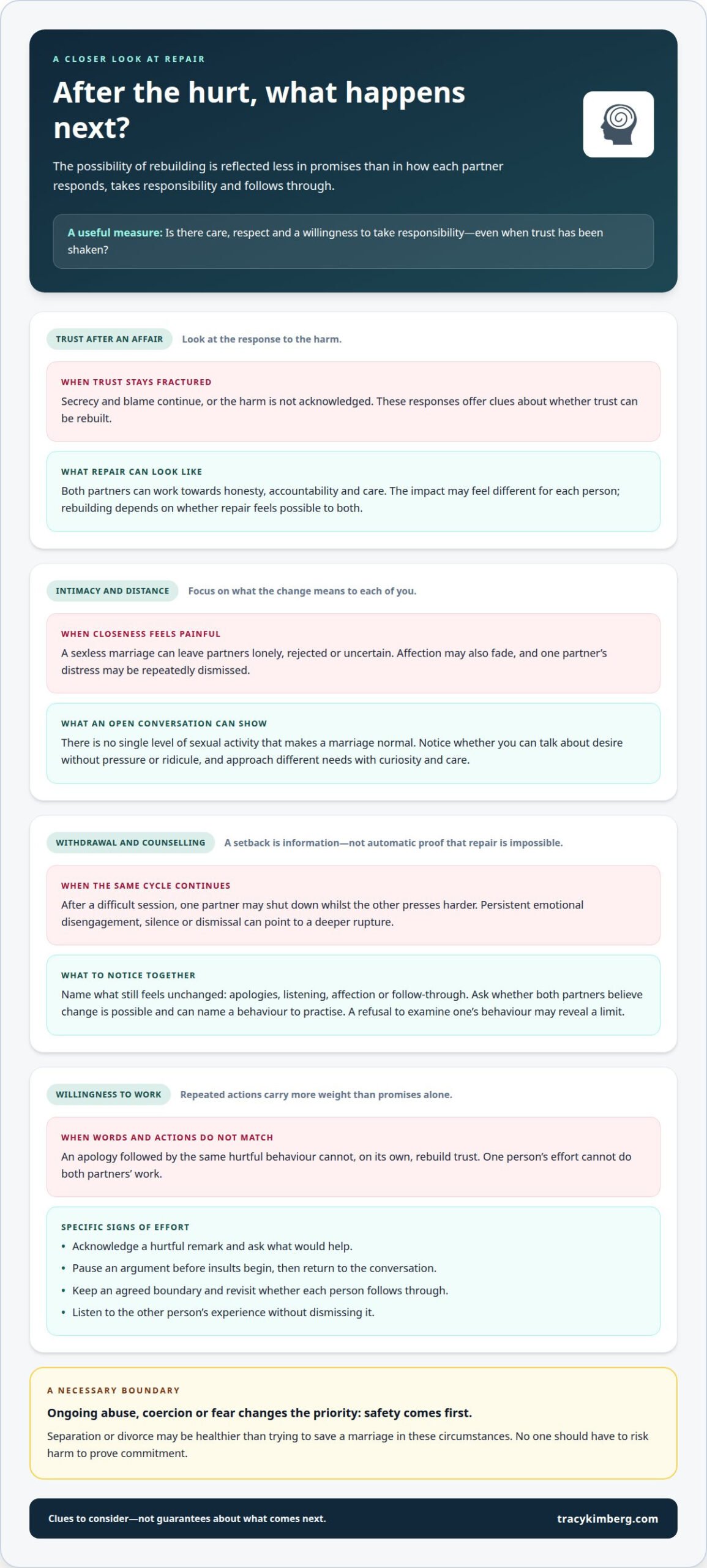
An affair can fracture trust, but it doesn’t decide a marriage’s future on its own. Look at what follows: does your partner acknowledge the harm, answer honestly and take responsibility? Or do secrecy and blame continue? These responses offer clues about whether rebuilding trust is possible. Shared accountability and care can be signs your marriage is worth saving, especially when both partners are willing to repair the damage. The affair’s impact matters, too. One person may feel the relationship has ended; another may want to understand what happened and whether repair feels possible.
A sexless marriage can leave both partners feeling lonely, rejected or uncertain. There’s no single level of sexual activity that makes a marriage normal. Instead, consider what the change means to each of you. Has affection faded alongside sex? Can you talk about desire without pressure or ridicule? Different needs can be explored through honest communication. If one partner’s distress is repeatedly dismissed, that tells you something different. Whether this is among the signs your marriage is worth saving depends partly on whether both people can approach intimacy with curiosity and care.
Imagining life apart can bring relief, grief or both. Picture an ordinary evening after separation: what feels lighter, and what would you miss? Then imagine life alone, beyond the immediate quiet. Are you moving towards a life you genuinely want, or away from exhausting arguments? Finally, imagine a future together that differs from today. What would need to change, and would each partner take part? These imagined futures aren’t predictions; they help reveal your needs and hopes. Divorce may change the direction of pain without ending it, so consider what would remain unresolved. If both of you can name specific changes and work towards them, the relationship may be worth fighting for. If only one person is willing, that matters too. Wanting out deserves attention, not shame. It may signal a clear decision, or a need for space, safety or a different way of relating.
Emotional withdrawal and failed counselling
A rough patch and an unhealthy marriage differ less in how often you argue than in what happens afterwards. After a disagreement about household tasks, can you both come back, listen and repair? During a rough patch, communication may be strained, but attempts to reconnect still matter. Persistent emotional disengagement or indifference can point to a deeper rupture. Notice whether each partner can name the hurt and respond with care.
Therapy or counselling can feel disappointing when the same conflict follows you home. After a difficult session, one partner might shut down while the other presses harder. That cycle can leave both feeling unheard, even when each hoped for change. Identify what still feels unchanged: apologies, listening, affection or follow-through. Setbacks are information, not automatic proof that repair is impossible. If one partner refuses to examine their behaviour, counselling may reveal that limit.
Emotional and physical intimacy can fade together, but not always. One partner may stop sharing small details, avoid touch and no longer ask about the other’s day. Losing that sense of longing can be especially painful when practical routines continue. Consider whether either of you still reaches for connection, perhaps with a kind message or a shared meal. Small bids matter when they show genuine interest, rather than duty or fear.
Conflict can still carry emotional pain: a partner may argue because the relationship matters or because they want to be understood. Indifference looks different. If your distress repeatedly meets silence, dismissal or no effort to respond, take that pattern seriously. Feeling hopeless after counselling deserves attention, too. Ask whether both people believe change is possible and can name one behaviour they’ll practise. Sustained withdrawal and distance, rather than conflict alone, may signal a deeper disconnection.
Willingness to work on the relationship
Look at what each person does after a painful conversation, not only what they promise. A willing partner might acknowledge a hurtful remark, ask what would help and follow through. The other person may need time, but honest effort shows in repeated actions. If one partner apologises yet repeats the same harm, words alone can’t rebuild trust. A relationship needs both people to be willing and able to make changes that support safety and respect. One person can start seeking help, but can’t do both people’s work.
Separation or divorce may be healthier than trying to save a marriage when there’s ongoing abuse, coercion or fear. Safety comes first; no one should have to risk harm to prove commitment. If a partner refuses help or change after causing harm, consider whether staying together is safe.
During a crisis, willingness shows in specific choices: pausing an argument before insults begin, returning to the conversation or keeping an agreed boundary. These actions don’t erase past hurt, but they show responsibility in the present. Ask whether your partner can hear your experience without dismissing it, even when they see events differently. Caring about your pain matters; agreeing with every interpretation isn’t necessary. Rebuilding trust requires both partners to be willing and able to take part.
Picture the relationship after meaningful change, not simply a return to familiar routines. What would each of you do differently during conflict? For example, could one person listen without interrupting while the other speaks plainly about their needs? A useful next step is to name one behaviour each person will practise, then revisit whether it happens. If only one partner makes these efforts, that imbalance is important evidence. Separation may offer space to understand what each person wants, rather than keeping the marriage intact at any cost. Choosing divorce can also be a considered response when safety, respect or mutual effort is absent.
How important are trust, respect, and communication in a marriage worth saving?
Trust grows through small, reliable actions, not declarations alone. If a partner promises to collect a prescription, following through matters. After a breach, openness about plans and consistent answers can restore predictability. Trust doesn’t mean accepting every explanation without question. It means raising concerns and receiving an honest, accountable response. Notice whether words and actions begin to align.
Respect protects each person’s dignity, especially during disagreement. A partner can dislike your decision and still speak without ridicule or threats. For example, discussing household spending respectfully means addressing the budget, not attacking someone’s character. Respect also includes boundaries: a request for time to cool down shouldn’t become punishment or silent retaliation. The pattern matters more than one imperfect exchange.
Communication helps couples understand what lies beneath a conflict. “You never listen” often shuts down a conversation; “I felt alone when you checked your phone” gives it a clearer starting point. Try describing what happened, naming its impact, then asking what each person understood. This doesn’t guarantee agreement. It creates room for both perspectives without turning the conversation into a contest.
Look at what happens after a misunderstanding. Does the partner who forgot an important commitment acknowledge its impact and discuss how to prevent it happening again? Can the hurt partner explain what would help without being mocked or dismissed? Repair depends on both people engaging. A sincere apology matters most when it leads to changed behaviour, such as keeping the next agreed commitment.
Trust, respect and communication work together; one can’t fully replace another. Honest words without follow-through may leave trust fragile. Kind gestures without a clear conversation can leave the original hurt untouched. Consider a specific disagreement: can both partners speak openly, stay respectful and make a practical agreement? When communication breaks down, external conflict resolution services like conflictmanager.com.au can provide structured guidance to help families de-escalate tension and resolve practical disputes. Repeated efforts to do so suggest a foundation for repair, even if difficult feelings remain. If fear or coercion shapes those conversations, safety must come first.
Tracy Kimberg
Tracy Kimberg’s Relationship Counselling and Coaching for Couples may be a helpful next step if you’re unsure whether to keep trying or need help understanding recurring conflict and distance. It offers space to examine those patterns, clarify what each person wants and consider what repair would ask of both. You can explore the relationship with care, rather than making a decision from fear or exhaustion alone.
If you’re ready to work together, the 12-Week Relationship Recovery Process provides a structured way to address relationship difficulties. It may be worth considering when painful patterns keep repeating, trust feels fragile, or earlier attempts to talk haven’t helped you move forward. The important question isn’t whether you can avoid every disagreement, but whether both of you can engage honestly with what needs to change.
Sometimes the strain affects more than the couple. Individual Therapy for Adults can offer support as you make sense of your feelings and choices. Therapy for Teenagers may help when a young person needs support of their own during difficult family changes. These are distinct forms of therapy for different needs; they aren’t substitutes for deciding what feels safe and sustainable in your relationship.
You don’t need to arrive with a final decision. You might begin by describing what has happened, what you hope could change and what feels impossible right now. That conversation can help clarify whether you’re seeking support to reconnect, understand your options or find steadier ground during uncertainty. Taking time to explore the question is a meaningful step, even if the answer isn’t clear yet.
If you’d like to explore support, contact Tracy Kimberg.
Frequently Asked Questions
Should I try to save my marriage?
Explore repair only if you can do so without sacrificing your safety or wellbeing. Consider whether both of you can discuss what must change, rather than simply preserve the marriage as it is. Signs your marriage is worth saving can include a shared willingness to address problems honestly. If fear, coercion or ongoing harm is present, prioritise safety over saving the relationship.
Want a clearer way forward?
Write down what you want to protect, what needs to change and what you can no longer accept. For instance, you may value shared parenting but need disagreements to happen without insults. Then separate what you can influence from what depends on your partner. This reflection can help you name your needs clearly, whether you choose to seek support, keep trying or consider separation.
What are signs a marriage can be repaired?
Repair becomes more possible when both partners recognise their part in a recurring problem and respond differently. One of the signs your marriage is worth saving may be a growing ability to resolve practical issues together. For example, after a disagreement about family plans, each person might acknowledge their impact and discuss a fairer approach. Look for follow-through, not perfect conversations.
What signs suggest both spouses are willing to work on the marriage?
Willingness shows in choices that make room for change. One spouse might raise a difficult subject calmly; the other stays present rather than ending the conversation. Both can agree on a specific action, such as reviewing how household responsibilities are shared, and return to it later. A shared effort is clearer when each person contributes without constant reminders or pressure.
Can a marriage recover after infidelity or betrayal?
Some couples rebuild after betrayal by facing its impact openly and making room for the injured partner’s questions. Recovery involves more than ending secrecy; it also means understanding what each person needs to feel emotionally secure. For example, they might agree on boundaries around contact with someone involved. The betrayed partner’s pace matters, and forgiveness should never be demanded as proof of commitment.
How effective is marriage counselling, and when should couples seek it?
Marriage counselling gives couples structured support to understand recurring patterns and practise new ways of relating. It may help when private conversations repeatedly become arguments, when partners feel stuck or when trust has been shaken. Seeking support before resentment becomes entrenched can create space to address concerns earlier. Both partners need room to speak honestly and engage with the process.

Article by
Tracy Kimberg
Tracy Kimberg is a Relationship Expert, Couples Therapist and Coach with a dedicated focus on helping couples and individuals rebuild connection, trust and emotional safety in their relationships. Drawing on the research of John and Julie Gottman, the relational insights of Esther Perel, and years of hands-on therapeutic experience, Tracy offers a warm, non-judgemental and deeply compassionate approach to modern relationships.
Based in Dorset, Tracy works with couples navigating communication breakdowns, betrayal, intimacy challenges, separation, family dynamics and life transitions. Known for creating a safe and grounded therapeutic space, she combines practical tools with emotional depth to help clients move beyond survival patterns and towards meaningful, lasting change.
With a reputation for empathy, professionalism and dedication to her clients’ growth, Tracy is passionate about helping people feel seen, understood and empowered — both within their relationships and within themselves.
Disclaimer
Disclaimer:
The information shared in this article is intended for educational and informational purposes only and should not be considered a substitute for professional therapeutic, psychological, medical or legal advice. Every individual and relationship is unique, and the perspectives offered are based on general therapeutic principles, research and professional experience.
Reading this article does not establish a therapist-client relationship with Tracy Kimberg. If you are experiencing significant emotional distress, relationship crisis, trauma, or mental health concerns, it is important to seek support from a qualified professional appropriate to your individual circumstances.
All content remains the intellectual property of Tracy Kimberg and may not be reproduced or distributed without permission.