

Have you ever wondered why you feel a sudden urge to pull away just as a relationship starts to get serious, or why a partner’s brief silence feels like an impending heartbreak? These reactions often feel like personal failings, but they are actually echoes of an internalised map created long ago. I see many people who feel trapped in circular arguments or struggle to trust whilst deeply craving closeness. This is why attachment style therapy is so transformative; it allows us to look beneath the surface of our reactions to find the logic in our distress.
I want you to know that you aren’t broken; you’re simply operating from an old blueprint. This journey is about reclaiming your agency in the present rather than being a passenger to your past. By understanding the intricacies of your specific attachment style, you can develop practical tools for emotional regulation. In this article, I’ll guide you through identifying these patterns and show you how to move towards a secure, resilient way of relating to those you love.
Key Takeaways
- Recognise that your current relational struggles are often echoes of an “internal working model” developed to ensure safety and connection during your early years.
- Identify the specific internal triggers of the four primary attachment styles to understand why you might feel “needy” or “suffocated” in your partnership.
- Learn how attachment style therapy facilitates the journey toward “earned secure attachment,” allowing you to build trust and emotional resilience.
- Unpack the “Anxious-Avoidant Dance” to transform repetitive arguments into opportunities for deeper understanding and mutual support.
- Discover how a structured 12-Week Relationship Recovery Process can help you and your partner navigate complex emotional landscapes with professional, research-based guidance.
What is Attachment Style Therapy? Beyond the Childhood Blueprint
Attachment style therapy is a process of identifying and reorganising the emotional scripts we learned in childhood. It isn’t a backward-looking exercise in assigning blame or “parent-bashing.” Instead, we look at your history with a lens of compassionate curiosity. We want to understand your “internal working model,” which is the subconscious set of rules you’ve developed about how love, safety, and reliability work. When you understand these rules, you can begin to rewrite them.
The core goal of this work is to help you build a “secure base” within yourself. In a healthy partnership, this base allows you to explore the world and your own emotions, knowing you have a safe harbour to return to. By using attachment style therapy, we move away from reactive, fear-based patterns and toward a way of relating that feels grounded and intentional. It’s about transforming your relationship from a source of anxiety into a place of profound support.
The Legacy of John Bowlby and Mary Ainsworth
The foundations of this work have deep British roots, beginning with the pioneering observations of psychologist John Bowlby in London. He realised that humans are biologically wired for connection; it’s a survival mechanism as vital as food or air. Later, Mary Ainsworth expanded this through her “Strange Situation” experiment. She observed how infants reacted to being briefly separated from their caregivers and, crucially, how they behaved during the reunion.
These early studies formed the basis of Attachment Theory, which provides the clinical framework we use today. Ainsworth noticed that some children were easily comforted, whilst others remained distressed or appeared indifferent. These weren’t “bad” behaviours; they were intelligent adaptations to the care they received. Modern therapy takes these insights and applies them to adult intimacy, helping us see why a partner’s silence might feel like a threat to our very survival.
Why Understanding Your Style is a Superpower
Self-awareness is the ultimate tool for emotional freedom. When you name your attachment pattern, you immediately reduce the shame surrounding behaviours you once labelled as “needy” or “distant.” You begin to see these reactions as protective strategies that simply outlived their usefulness. This clarity is what Esther Perel describes as “relational intelligence,” the ability to perceive the invisible dynamics that dictate how we connect and collide.
By engaging with attachment style therapy, you gain the ability to make conscious choices during a conflict. Instead of being swept away by a wave of panic or a sudden urge to withdraw, you can pause. You learn to recognise the old script and choose a new response. This shift allows you to express your needs clearly rather than acting them out through protest or avoidance. It turns every interaction into an opportunity for growth rather than a repetitive argument.
The Four Pillars: Identifying Your Unique Attachment Pattern
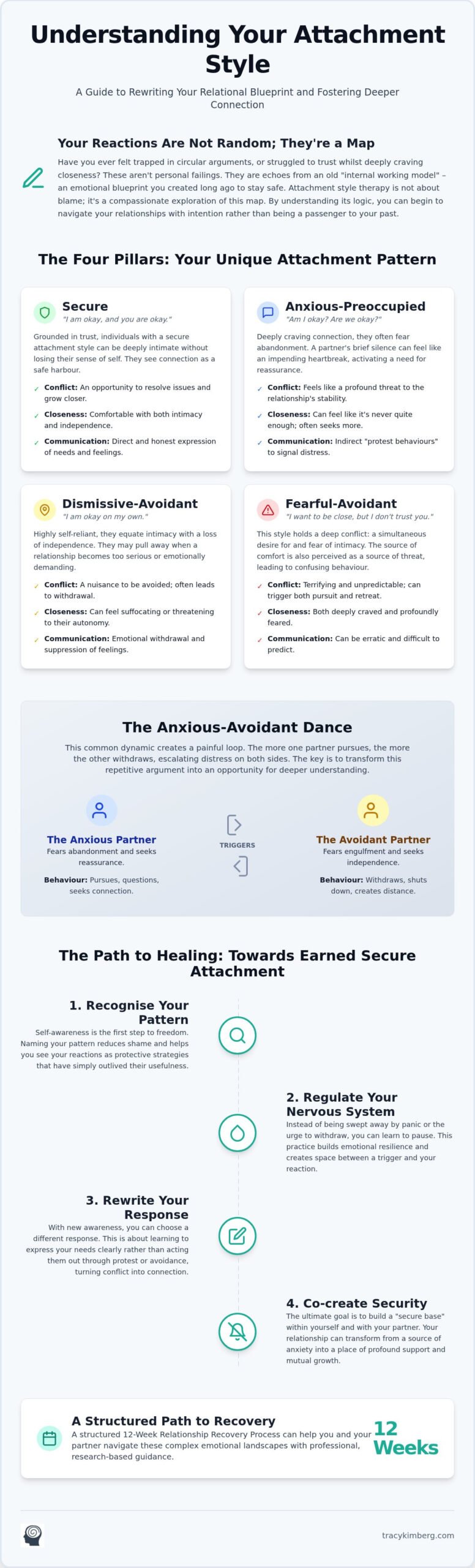
Your attachment style is not a fixed personality trait or a diagnosis. It’s better understood as a strategy for survival. Whilst these patterns often take root in our early years, they remain fluid and context-dependent. You might feel perfectly secure with a close friend but find yourself spiralling into anxiety with a romantic partner. Understanding these pillars through attachment style therapy helps you recognise that your reactions aren’t “crazy”; they are learned responses to perceived threats to your connection.
| Feature | Secure Attachment | Insecure Attachment |
|---|---|---|
| View of Conflict | An opportunity to resolve issues and grow closer. | A terrifying threat to the bond or a nuisance to avoid. |
| Need for Closeness | Comfortable with both intimacy and independence. | Often feels either suffocating or never quite enough. |
| Communication | Direct expression of needs and feelings. | Indirect “protest” behaviours or emotional withdrawal. |
Secure Attachment: The Gold Standard of Connection
The internal experience of a secure individual is grounded in the belief that “I am okay, and you are okay.” They can be deeply intimate without losing their sense of self. When conflict arises, they don’t see it as the beginning of the end. Instead, they trust that the relationship can withstand the friction. Crucially, even if you didn’t start here, you can develop “earned secure attachment.” Through the process of attachment style therapy, you learn to provide yourself with the validation you once sought from others, creating a stable foundation for your partnerships.
The Insecure Spectrum: Anxious, Avoidant, and Disorganised
Insecure styles are simply different ways the body tries to manage the fear of loss. Clinical research into Attachment-Based Psychotherapy suggests these patterns are intelligent, if outdated, adaptations to our environment.
- Anxious-Preoccupied: “I feel unsafe when I can’t feel your presence.” This style often involves a hyper-vigilance toward a partner’s moods and a constant, aching need for reassurance to soothe the fear of abandonment.
- Dismissive-Avoidant: “I feel unsafe when you get too close.” Here, intimacy is equated with a loss of autonomy. The internal script says that relying on others is dangerous, leading to emotional distancing when things get “too heavy.”
- Fearful-Avoidant (Disorganised): “I want you, but I’m terrified of you.” Often rooted in trauma, this style creates a painful “come here, go away” dynamic where the person craves closeness but finds it fundamentally threatening.
If you recognise these patterns in your own life, exploring them within specialised relationship counselling can provide the clarity needed to change your narrative.
How Insecure Attachment Manifests in Adult Relationships
In the heat of a disagreement, it rarely feels like you’re discussing childhood blueprints. Yet, attachment styles are the hidden guest in every relationship argument, whispering interpretations of your partner’s intent into your ear. These styles act as filters. If you lean toward anxiety, a partner’s late reply isn’t just a busy moment; it’s a sign of fading interest. For the avoidant partner, a request for more quality time isn’t an invitation to connect; it’s a threat to their independence. These distortions turn neutral moments into triggers for old, deep-seated fears.
When these fears are triggered, we often resort to “protest behaviour.” This is a subconscious attempt to re-establish a sense of security, though it often has the opposite effect. You might pick a fight over something trivial just to get your partner to engage with you, or you might go silent for days to see if they’ll chase you. Research on How Attachment Styles Influence Romantic Relationships shows that these actions are actually desperate cries for safety. Through attachment style therapy, you learn to recognise these protests for what they are: a desire for connection that has lost its way.
The Push-Pull Dynamic and Emotional Disconnect
This leads to the “Anxious-Avoidant Dance,” a cycle Tracy Kimberg frequently addresses when helping couples navigate a profound emotional disconnect. In this dynamic, one partner pursues for reassurance whilst the other withdraws to find air. The avoidant partner feels suffocated by the “neediness,” whilst the anxious partner feels neglected and abandoned by the “coldness.” Gabor Maté highlights how this stress is a physiological response to a perceived loss of attachment. In attachment style therapy, we work to identify this dance before it leads to a total relational breakdown, helping both partners see the vulnerability behind the wall or the chase.
Conflict as a Cry for Connection
John Gottman’s research suggests that most conflict is actually about failed bids for connection. When you’re shouting about the household chores, you’re often actually asking, “Are you there for me?” Attachment-based work helps you reframe this anger as a fear of losing the person you love. By “softening” your approach, you can express the underlying hurt instead of the defensive spike. This shift allows you to move from a place of combat to a place of shared understanding, where your partner can finally hear your heart instead of just your volume.
The Therapeutic Process: Moving Towards Earned Secure Attachment
Moving from a state of reactive insecurity to one of stable connection requires more than just intellectual understanding. It’s an active journey of Awareness, Regulation, and Re-patterning. Through attachment style therapy, we don’t just talk about your past; we use the therapeutic relationship itself as a laboratory for change. This process allows you to develop “Earned Security,” which is a robust, healthy way of relating that you build intentionally in your adult life, regardless of your childhood starting point.
In this setting, the therapist acts as a “temporary secure base.” This provides what we call a “corrective emotional experience.” When you share a vulnerability and receive a non-judgemental, empathetic response, your nervous system begins to learn that closeness doesn’t have to be dangerous. It’s about creating a safe space where you can experiment with new ways of being before taking them back into your primary relationship.
Step 1: Identifying Your Relational Triggers
The first step is learning to spot the physical sensations of an attachment “alarm.” You might notice a racing heart, a tightness in your chest, or a sudden urge to check your phone. These are signals that your old blueprint is taking over. By mapping these triggers back to early experiences, you can begin to see them as historical echoes rather than present-day truths. This awareness creates a crucial gap, allowing you to pause for a breath before reacting to a partner’s perceived distance or mood shift. By integrating attachment style therapy into your self-reflection, you gain the power to respond rather than react.
Step 2: Developing Emotional Regulation Tools
Once you can identify the alarm, you need practical techniques to soothe your activated system. This involves moving away from “protest behaviour” and toward “conscious communication.” Instead of picking a fight to get attention, you learn to say, “I’m feeling a bit disconnected right now; could we spend some time together?” This shift requires a high level of self-regulation, which we develop through research-based methods like those championed by John Gottman and Esther Perel. It’s about learning to stay present even when the old scripts are screaming for you to run or fight.
If you’re ready to move beyond repetitive cycles, the 12-Week Relationship Recovery Process offers a structured, supportive environment to facilitate this deep re-patterning work.
Transforming Your Bonds with Professional Relationship Coaching
Healing your relational patterns isn’t a static treatment; it’s an active, evolving experience that requires both courage and a compassionate guide. Tracy Kimberg offers a specialised approach to attachment style therapy that bridges the gap between clinical insight and the raw reality of daily partnership. By blending the research-based wisdom of the Gottman Method and Esther Perel’s systemic perspective, she helps you move beyond the “why” and into the “how” of lasting change. Whether you are working through these patterns individually or as a couple, the focus remains on the possibility of healing. We work together to transform your blueprint for connection into one that supports intimacy rather than triggering defence.
The 12-Week Relationship Recovery Journey
The 12-Week Relationship Recovery Process is designed to provide the structured environment necessary for deep emotional work. When we experience relational breakdown, symptoms like anxiety, depression, or the fallout from infidelity often take centre stage. However, these are frequently indicators of underlying attachment ruptures rather than isolated problems. Within this 12-week framework, you’ll have the safety to explore these deep-seated patterns without fear of judgement. This structured journey ensures that you aren’t just managing crises but are actively re-patterning your way of relating. It turns the therapeutic process into a proactive and positive adventure where you reclaim your agency.
A Safe Space for Transformation
Tracy creates a safe, non-judgemental environment that welcomes both adults and teenagers into a supportive conversation. This is a space where your potential anxiety is acknowledged and met with immediate comfort. Understanding that adult life transitions and interpersonal challenges are multifaceted, she offers the flexibility of both online therapy and face-to-face sessions within the UK. This accessibility ensures that you can begin your journey towards “earned security” in a way that feels manageable and grounded. Sentences are concise and purposeful, inviting you into a conversation that values your long-term emotional health.
Engaging with attachment style therapy is an act of profound optimism. It is a commitment to the belief that your history does not have to dictate your future happiness. By working with a specialist who understands the intricacies of human behaviour, you can begin to navigate your emotional landscape with newfound clarity. I invite you to take the first step towards a more secure future and reach out to discuss how we can collaborate on your journey towards fulfilling, resilient bonds.
Reclaiming Your Narrative for a More Secure Future
You’ve seen how your early blueprint doesn’t have to be a life sentence. By identifying your triggers and the “dance” you perform with your partner, you move from reactive fear to intentional connection. Attachment style therapy is the bridge between understanding your history and building a resilient, fulfilling bond in the present. It turns the “hidden guest” in your arguments into an opportunity for profound intimacy and mutual understanding.
If you’re ready to navigate relational breakdown or infidelity with expert support, I’m here to help. Using research-based methods from Gottman and Perel, my signature 12-Week Relationship Recovery Process offers a structured path toward healing and “earned security.” Book a consultation with Tracy Kimberg to begin your journey to secure connection.
You deserve a relationship that feels like a safe harbour. Taking this first step is a powerful act of hope for your future self and your partnership. Your capacity for deep, secure love is already within you; we are simply here to help you find the way back to it.
Frequently Asked Questions
What exactly is an attachment style in therapy?
An attachment style is the subconscious relational blueprint formed in early life that dictates how you respond to intimacy and perceived threats in adulthood. In attachment style therapy, we view this as an “internal working model” that influences your expectations of others. It isn’t just a label; it’s a map of how you seek safety and connection in your most important bonds.
Can my attachment style actually be changed through therapy?
Yes, you can develop what psychologists call “earned secure attachment” through consistent therapeutic work. Whilst your early blueprint is influential, it isn’t a life sentence. Therapy provides the corrective emotional experiences needed to rewire your nervous system. By learning to self-soothe and communicate needs directly, you can shift from a reactive state of insecurity to a more grounded, stable way of relating to your partner.
How do I know if I have an anxious or avoidant attachment style?
You can identify your style by observing your internal response to relational shifts. If a partner’s silence triggers an urgent need for reassurance, you likely lean toward an anxious style. If closeness feels like a threat to your autonomy and you feel a “suffocating” urge to pull away, you may have an avoidant style. These patterns act as defensive filters for how you interpret your partner’s actions.
Is attachment therapy only for people with “bad” childhoods?
Not at all. Attachment patterns are formed by how your needs were met, even in loving homes where caregivers might have been occasionally inconsistent. Attachment style therapy is for anyone who finds themselves repeating painful relational cycles or struggling with emotional disconnect. It is about understanding the logic of your current reactions rather than diagnosing your past. It provides a compassionate lens for anyone seeking deeper, more resilient intimacy.
How long does attachment-based therapy usually take to show results?
The timeline varies for everyone, but many clients begin to feel a shift in their awareness within the first few sessions. A structured approach, such as the 12-Week Relationship Recovery Process, is designed to provide a safe environment for deep re-patterning. Whilst profound change is an evolving experience, having a clear framework helps you move from initial awareness to practical emotional regulation more efficiently than open-ended talk therapy might traditionally allow.
What is the difference between attachment therapy and regular talk therapy?
Regular talk therapy often focuses on processing events, whilst attachment-based work specifically targets the “how” of your connections. We look at the somatic triggers and the immediate dynamics between you and your partner. It is more process-oriented and research-based, drawing on the work of experts like John Gottman. The therapist acts as a secure base, helping you practice new ways of being rather than just discussing your problems.
Can attachment therapy help with infidelity recovery?
Infidelity is often a symptom of a profound attachment rupture or an unmet need for connection that went unexpressed. Therapy helps couples look beneath the betrayal to understand the “hidden guests” that led to the disconnect. By addressing the insecure patterns that contributed to the crisis, couples can build a more resilient bond. It provides a roadmap for healing the hurt whilst creating a more secure foundation for the future.
Is attachment style therapy suitable for teenagers?
Yes, it is incredibly beneficial for teenagers as they navigate their first significant relational transitions outside the family. Early intervention helps them understand their emotional needs and develop healthy boundaries before insecure patterns become deeply entrenched. By creating a non-judgemental environment, therapy allows younger people to build the self-regulation tools they need for long-term emotional health. It empowers them to approach their future adult relationships with confidence and a grounded sense of self-awareness.

Article by
Tracy Kimberg
Tracy Kimberg is a Relationship Expert, Couples Therapist and Coach with a dedicated focus on helping couples and individuals rebuild connection, trust and emotional safety in their relationships. Drawing on the research of John and Julie Gottman, the relational insights of Esther Perel, and years of hands-on therapeutic experience, Tracy offers a warm, non-judgemental and deeply compassionate approach to modern relationships.
Based in Dorset, Tracy works with couples navigating communication breakdowns, betrayal, intimacy challenges, separation, family dynamics and life transitions. Known for creating a safe and grounded therapeutic space, she combines practical tools with emotional depth to help clients move beyond survival patterns and towards meaningful, lasting change.
With a reputation for empathy, professionalism and dedication to her clients’ growth, Tracy is passionate about helping people feel seen, understood and empowered — both within their relationships and within themselves.
Disclaimer
Disclaimer:
The information shared in this article is intended for educational and informational purposes only and should not be considered a substitute for professional therapeutic, psychological, medical or legal advice. Every individual and relationship is unique, and the perspectives offered are based on general therapeutic principles, research and professional experience.
Reading this article does not establish a therapist-client relationship with Tracy Kimberg. If you are experiencing significant emotional distress, relationship crisis, trauma, or mental health concerns, it is important to seek support from a qualified professional appropriate to your individual circumstances.
All content remains the intellectual property of Tracy Kimberg and may not be reproduced or distributed without permission.