

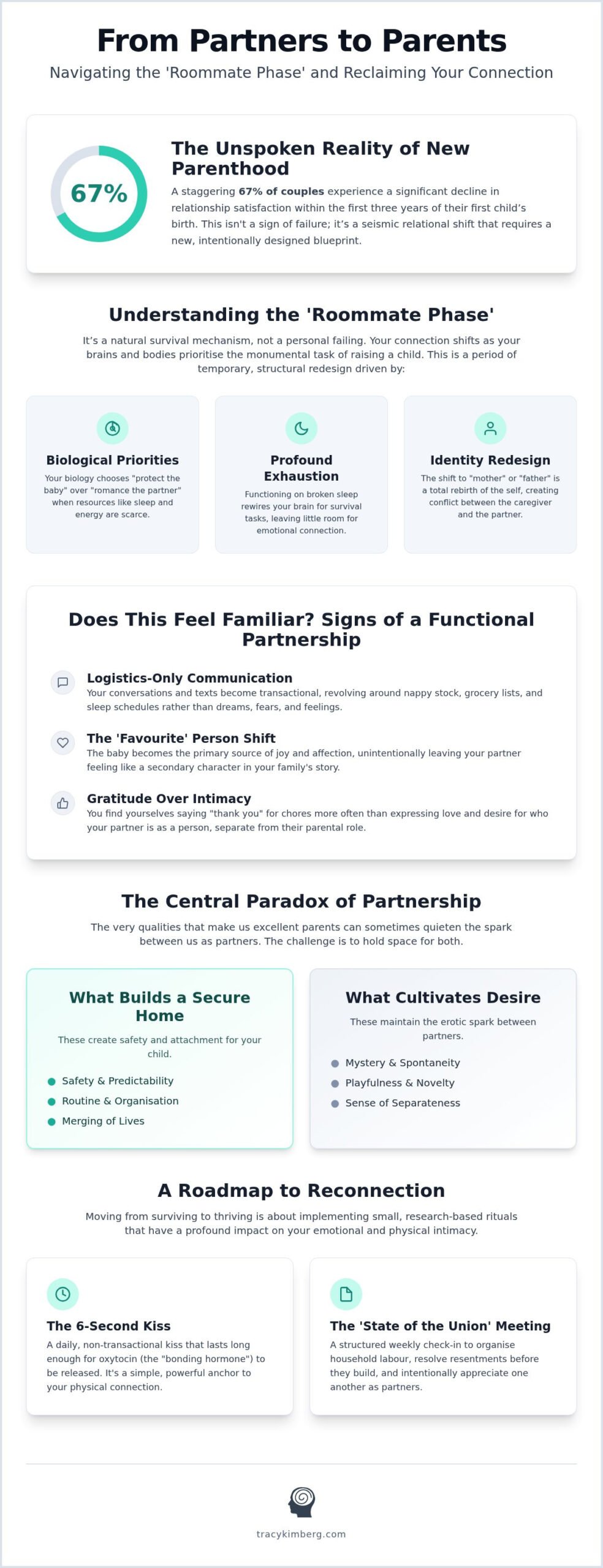
Did you know that approximately 67% of couples experience a significant decline in relationship satisfaction within the first three years of their first child’s birth? It’s a staggering figure that highlights a quiet truth: the transition to parenthood is often a total relational redesign rather than a simple addition to the family. When sleep deprivation and resentment over invisible labour begin to overshadow your connection, seeking couples coaching for new parents isn’t a sign of failure. Instead, it’s a proactive way to provide professional architecture for the changing structure of your home.
You likely feel more like roommates than lovers right now, passing like ships in the night between nappy changes and broken sleep. It’s exhausting to feel unseen by the person who should know you best, and it’s natural to miss the ease you once shared. In this article, you’ll discover how to move beyond this “roommate phase” and rebuild the emotional intimacy that feels so out of reach. We’ll explore a roadmap for reducing conflict and improving communication, ensuring you both feel appreciated whilst honouring the beautiful, yet demanding, challenges of early parenthood.
Key Takeaways
- Understand why the “roommate phase” is a natural survival mechanism and how the tension between domesticity and desire impacts your emotional connection.
- Discover why proactive couples coaching for new parents provides a stronger relational blueprint than traditional crisis therapy during the exhausting early years.
- Learn to implement simple, research-based rituals like the “6-second kiss” to maintain physical grounding and intimacy amidst the chaos of childcare.
- Master the art of the “State of the Union” meeting to organise household labour and resolve resentment before it becomes a permanent barrier.
- Explore how a structured recovery process can transform your transition into parenthood into a lasting legacy of healthy attachment for your child.
From Partners to Parents: Why the “Roommate Phase” is a Natural Transition
The transition from being a duo to a trio is perhaps the most seismic shift any relationship will ever endure. Suddenly, the person who was your primary source of comfort and desire becomes a co-worker in a high-stakes startup: the survival of your infant. This “roommate phase” isn’t a sign that you’ve fallen out of love. It’s actually a clever survival mechanism. Your brains are chemically and neurologically prioritising the needs of a vulnerable human, often at the expense of your own connection. When you’re both functioning on four hours of broken sleep, your biology chooses “protect the baby” over “romance the partner” every single time.
Central to this shift is the concept of “Matrescence,” the developmental transition into motherhood. Much like adolescence, it’s a time of hormonal upheaval and identity restructuring that pulls the mother’s focus inward and toward the child. The “we” that defined your relationship suddenly becomes a “three,” and the resulting loss of spontaneity can feel like a mourning process. Engaging in couples coaching for new parents allows you to see this period as a temporary structural redesign. It helps you understand that the transition to parenthood is a biological event that requires a new set of relational tools to navigate successfully.
The Identity Shift: Who Are We Now?
Becoming a parent is a rebirth of the self. You aren’t simply adding a new member to the family; you’re becoming someone entirely different. This creates a deep internal conflict between the caregiver, who must be selfless and vigilant, and the romantic partner, who needs to be seen, heard, and desired. This identity shift is often messy. If one partner is struggling with low mood or the heavy weight of invisible labour, those emotional ripples move through the partnership. It’s difficult to feel like a lover when you’re still trying to figure out who you are in this new skin.
Signs You Are Drifting into a Functional Marriage
You might notice your conversations have become entirely transactional. This “functional marriage” is efficient for raising a child, but it can be starving for the adults involved. Common signs include:
- Logistics-only communication: Your texts are only about grocery lists, nappy stock, or sleep windows.
- The “Favourite” Person Shift: The baby has become the primary source of joy and affection, leaving the partner feeling like a secondary character.
- Gratitude over Intimacy: You find yourself saying “thank you” for chores more often than “I love you” for who your partner is as a person.
Validation is vital here. You are exhausted, and your brain is doing exactly what it was designed to do. However, staying in this functional mode indefinitely can lead to deep-seated resentment. Recognising these patterns through couples coaching for new parents is the first step toward moving from being just “parents” back to being “partners.”
The Relational Architecture of New Parenthood: Insights from Gottman and Perel
Think of your relationship as a structure that needs regular maintenance. John Gottman’s “Sound Relationship House” offers a vital blueprint for this, focusing on building deep friendship and managing conflict with grace. However, Esther Perel reminds us that the very things that make us good parents, like safety and predictability, can sometimes stifle the erotic spark. This is the central paradox of the transition. We crave the security of a co-parent but miss the mystery of a lover. Caretaking requires a merging of lives, whilst desire often requires a sense of separateness. Seeking couples coaching for new parents can help you navigate this complex relational architecture, ensuring your foundation remains solid whilst the house grows.
Gabor Maté often speaks about how a child’s development is shaped by the emotional environment provided by the parents. When stress levels are high, it’s not just the couple that suffers; it’s the family’s entire attachment system. High cortisol levels in a parent can ripple through the home, affecting how you bond with each other and your child. Understanding these key transition issues for new parents helps you realise that your stress is a systemic response, not a personal failing. It’s about building emotional attunement to prevent resentment from taking root during these demanding years.
Building Your “Love Map” Amidst the Chaos
Chaos is the new normal, but that shouldn’t mean your partner becomes a stranger. You need to update your “Love Map” constantly. Your partner isn’t the same person they were a year ago; their fears, dreams, and even their favourite ways to relax have likely shifted. Small rituals of connection are your best defence against emotional drift. A six-second kiss or a text that isn’t about the baby can be a powerful “bid” for connection. When your partner makes a bid for your attention, even if you are exhausted, “turning towards” them rather than away builds a bank of goodwill for the harder days.
The Shadow of Resentment: Managing the Invisible Labour
In many UK households, the “invisible labour” often falls disproportionately on one person. This cognitive load, the mental list of when the next feed is or where the spare vests are kept, creates deep resentment if left unaddressed. It’s easy to descend into a “Who is more tired?” competition, but this has no winners. Instead of using “You” statements that trigger blame, try “I” statements to express your needs:
- Instead of: “You never help with the washing.”
- Try: “I feel overwhelmed by the laundry and I need some help to feel supported.”
- Instead of: “You’re always on your phone.”
- Try: “I miss our chats and would love ten minutes of focused time together.”
If these patterns feel too ingrained to shift alone, professional Relationship Counselling and Coaching for Couples can provide the safe, non-judgemental space needed to recalibrate your partnership and rediscover each other.
Choosing the Right Support: Why Coaching Outperforms Generic Advice
Generic advice often suggests you “just need to talk,” but when you’re both operating on four hours of broken sleep, talking can quickly descend into a forensic audit of who is more exhausted. This “tit-for-tat” scorekeeping is a natural response to feeling overwhelmed, yet it rarely leads to resolution. Instead, it creates a cycle of defensiveness. Professional couples coaching for new parents offers a different path. It provides a neutral third party to act as a relational architect, helping you de-escalate these circular arguments before they become the permanent soundtrack of your home.
In the UK, the traditional “village” of extended family has largely vanished. Many parents find themselves isolated, living miles away from grandparents, whilst navigating paternity leave that is often too brief to allow for a true transition. This creates a systemic pressure that “just talking” cannot fix. According to research from The Gottman Institute, the decline in relationship satisfaction post-baby is significant, but it isn’t inevitable. A proactive, structured approach is far more effective than waiting for a crisis to hit. By focusing on the present and the future, coaching helps you build the necessary skills to handle the unique stressors of the early years.
Coaching vs. Traditional Therapy: A Framework for Growth
While traditional therapy often looks backward to unearth the roots of behaviour, coaching is unapologetically goal-oriented. It’s about rebuilding the relationship “muscle” through actionable homework and communication scripts. During the high-intensity phase of early parenting, you don’t always have the emotional bandwidth to dig into the past. You need tools for tomorrow. A structured, 12-week approach provides a clear beginning, middle, and end, making the work feel manageable rather than like another endless chore on your to-do list.
The Value of Online Coaching for New Families
The logistical nightmare of finding a babysitter just to attend a session often prevents couples from seeking help. Online coaching removes this barrier entirely. British parents are increasingly turning to digital-first support because it fits into the reality of their lives. You can connect from your own living room, in a safe, non-judgemental space, without the stress of travel or the cost of childcare. It allows the work to happen where your life actually happens, making the transition to a healthier partnership feel seamless and sustainable.
Practical Strategies to Organise Your New Relational Life
Finding time for each other shouldn’t feel like another item on an exhausting to-do list. When you are deep in the trenches of newborn care, the idea of a formal date night can feel more like a burden than a blessing. Instead, focus on small, manageable rituals that require almost zero preparation. One of the most effective tools we use in couples coaching for new parents is the “6-Second Kiss”. It’s long enough to trigger a release of oxytocin and create a moment of physical grounding, yet short enough to fit between a nappy change and a nap. This tiny window of connection tells your nervous system that your partner is still a safe harbour.
To keep the logistics of life from swallowing your romance, try scheduling a weekly “State of the Union” meeting. To ensure this doesn’t feel like a chore, keep it brief and structured. Use this time to organise the upcoming week’s labour, so that your other interactions don’t have to be purely transactional. Combine this with a daily “Appreciation Audit”. Before you sleep, share one specific thing your partner did well today. These small acknowledgements act as a vital buffer against the resentment that often builds when labour feels invisible.
Micro-Connections: Reclaiming Intimacy in 10 Minutes
Chaos is your new normal, but it doesn’t have to be the end of your closeness. Reclaiming intimacy often happens in the margins of the day. A few moments of sustained eye contact or a hand on a shoulder whilst the kettle boils can be more restorative than a missed dinner out. Use digital intimacy to your advantage; send a text that builds anticipation or shares a private joke rather than just asking them to buy milk. By redefining intimacy as physical closeness and emotional safety rather than just sex, you create a safety net that supports you both through the fatigue.
Navigating Conflict whilst Sleep-Deprived
Arguments are inevitable when you are running on empty, but how you start them matters. Using a “Softened Start-up” involves bringing up a problem without blame. Instead of saying “You never help,” try “I’m feeling overwhelmed by the kitchen mess, could we tackle it together?”. Recognising the “Four Horsemen”, such as criticism or defensiveness, in your late-night disagreements is crucial. If you feel your temper rising, call a “Time Out”. Stepping away for twenty minutes to calm your heart rate prevents you from saying words that are difficult to take back later.
If you find that your arguments are becoming circular and exhausting, engaging in Relationship Counselling and Coaching for Couples can provide you with the specific communication scripts needed to break the cycle and find your way back to each other.
Designing Your Future: How Professional Coaching Transforms the Early Years
The transition to parenthood is often described as a storm to be weathered, but it’s actually a profound opportunity to redesign your relationship from the ground up. Whilst the early months are naturally consumed by survival, the years that follow should be about thriving as a family unit. Engaging in couples coaching for new parents isn’t just about resolving current conflicts; it’s about creating a legacy of healthy attachment for your child. When you and your partner are in sync, you provide the regulated, secure environment that is so critical for a child’s emotional development. You aren’t just fixing a marriage; you are building a home.
Reclaiming your partner’s status as your “favourite” person is a deliberate, beautiful act. It requires moving past the functional logistics of childcare and re-centring your emotional bond as the heart of the family. By investing in professional support, you stop being just co-parents and start being allies and lovers again. This shift transforms the atmosphere of your home, replacing the “roommate” tension with a sense of calm optimism and shared purpose. It allows you to see the process of growth as an active, evolving experience rather than a static struggle.
The 12-Week Path to Relational Healing
The 12-Week Relationship Recovery Process offers a structured, research-based journey designed specifically for couples who have lost their way in the fog of new parenthood. You can expect an expert-led programme that moves you from emotional disconnect to a place of profound understanding. Unlike generic advice, this process utilises proven methods to address the tension between caretaking and desire, helping you rebuild your friendship from the inside out. It provides a safe, non-judgemental environment where you can discuss difficult topics without fear. We view this work as a proactive adventure into the next chapter of your life together.
Your Next Step: Booking a Discovery Call
Taking the first step toward change is often the hardest part of the journey, yet it is undeniably the most rewarding. You might feel anxious about opening up, but we focus on making the therapeutic process feel manageable and supportive from the very first moment. During an initial consultation with Tracy Kimberg, you’ll have the space to explore your unique challenges and discover how a tailored approach can work for your specific family dynamics. This is an open invitation to connect and begin working toward a collaborative solution. Your relationship is the foundation of your family. When that foundation is strong and nurtured, everything else begins to fall into place.
Reclaiming Your Partnership in the New Chapter
Parenthood is a profound redesign of your relational world. While the “roommate phase” is a natural survival response to the demands of a newborn, it doesn’t have to be your permanent reality. By implementing small, intentional rituals and addressing the weight of invisible labour, you can move from surviving to thriving as a couple. Your connection is the heartbeat of your home, and its health is the greatest gift you can give your child whilst you navigate these early years together.
Seeking couples coaching for new parents provides the professional architecture needed to navigate this transition with grace. Tracy Kimberg offers a research-based approach, inspired by the methodologies of Gottman and Perel, through her signature 12-Week Relationship Recovery Process. These safe, online sessions are available across the UK, allowing you to focus on your intimacy without the logistical stress of travel. We invite you to Book your Relationship Discovery Call with Tracy Kimberg today and begin this proactive adventure. You deserve to feel seen, appreciated, and deeply connected in this beautiful new stage of your lives.
Frequently Asked Questions
Is it normal to hate my partner after having a baby?
It is completely normal to feel intense frustration or even temporary “hatred” towards your partner during the early months of parenthood. This is often a physiological response to extreme sleep deprivation and the sudden shift in your relational centre. Your brain is in a survival state, making you more prone to “fight or flight” reactions. Coaching helps you understand that these feelings are usually a symptom of exhaustion rather than a sign that your love has ended.
How is couples coaching different from traditional marriage counselling?
Couples coaching for new parents differs from traditional counselling by being more proactive and goal-oriented. While counselling might spend significant time exploring your childhood or past traumas, coaching focuses on providing you with immediate, actionable tools to handle today’s challenges. It’s about building the “muscles” of communication and intimacy through structured exercises and scripts that work even when you are both feeling completely depleted.
We are too tired for sex; can coaching help with physical intimacy?
Coaching helps you rebuild physical intimacy by first removing the pressure of performance and redefining what closeness looks like. We explore the tension between your roles as caregivers and your identities as lovers. By implementing small, non-sexual rituals of touch and eye contact, you create a sense of safety. This foundation makes it easier to eventually reclaim your erotic life once your nervous systems feel more regulated and less overwhelmed.
How long does it take to see results from relationship coaching?
You can often feel a shift in your communication style after just the first session as you begin to feel heard and validated. However, creating lasting change and moving beyond the “roommate phase” typically takes longer. My signature 12-Week Relationship Recovery Process is designed to guide you through a complete cycle of healing, ensuring that the new habits you form become a permanent part of your relational architecture.
Can we do couples coaching online with a newborn?
Online therapy is actually the preferred method for many new families because it removes the logistical barrier of finding childcare. You can attend sessions from the comfort of your own living room, even if the baby is napping nearby. This flexibility makes couples coaching for new parents much more accessible, allowing you to focus on your relationship without the added stress of travel or the anxiety of leaving your newborn.
What if my partner is reluctant to attend coaching sessions?
It’s common for one partner to feel hesitant about the therapeutic process. I suggest framing coaching as a “proactive adventure” or a family reboot rather than a clinical necessity to fix something broken. Focus on the desired outcome, such as less arguing or feeling more appreciated. Often, once a partner realises the environment is safe, research-based, and non-judgemental, their resistance shifts into a genuine investment in the process.
How much does couples coaching for new parents cost in the UK?
The cost of relationship support in the UK varies depending on whether you choose individual sessions or a structured programme. Online platforms often provide more affordable entry points, whilst specialist coaching with an established expert reflects a higher level of clinical experience. It’s best to check individual practitioner websites for their current rates. Investing in your partnership now can prevent the much higher emotional and financial costs of a long-term relational breakdown.
Does coaching help with postpartum resentment over housework?
Postpartum resentment often stems from the “invisible labour” and the unequal distribution of the cognitive load. Coaching provides a structured way to address these chores without it descending into a “Who is more tired?” competition. We use specific communication tools to help you express your needs clearly and organise your household labour. This ensures both partners feel seen and valued, which is essential for maintaining long-term emotional intimacy.

Article by
Tracy Kimberg
Tracy Kimberg is a Relationship Expert, Couples Therapist and Coach with a dedicated focus on helping couples and individuals rebuild connection, trust and emotional safety in their relationships. Drawing on the research of John and Julie Gottman, the relational insights of Esther Perel, and years of hands-on therapeutic experience, Tracy offers a warm, non-judgemental and deeply compassionate approach to modern relationships.
Based in Dorset, Tracy works with couples navigating communication breakdowns, betrayal, intimacy challenges, separation, family dynamics and life transitions. Known for creating a safe and grounded therapeutic space, she combines practical tools with emotional depth to help clients move beyond survival patterns and towards meaningful, lasting change.
With a reputation for empathy, professionalism and dedication to her clients’ growth, Tracy is passionate about helping people feel seen, understood and empowered — both within their relationships and within themselves.
Disclaimer
Disclaimer:
The information shared in this article is intended for educational and informational purposes only and should not be considered a substitute for professional therapeutic, psychological, medical or legal advice. Every individual and relationship is unique, and the perspectives offered are based on general therapeutic principles, research and professional experience.
Reading this article does not establish a therapist-client relationship with Tracy Kimberg. If you are experiencing significant emotional distress, relationship crisis, trauma, or mental health concerns, it is important to seek support from a qualified professional appropriate to your individual circumstances.
All content remains the intellectual property of Tracy Kimberg and may not be reproduced or distributed without permission.