

You stand outside their bedroom door, hand hovering near the wood, wondering if a knock will invite a conversation or ignite another shouting match. It’s exhausting to live in a home that feels like a battlefield, where the “silent treatment” has replaced the vibrant child you once knew. You might feel a deep-seated guilt, wondering where things went wrong, but the truth is that most parents find themselves lost in this difficult transition. Seeking specialised counselling for parents of troubled teens is not an admission of failure. It’s an act of profound love that acknowledges the complexity of your child’s evolving emotional world.
You deserve a home where everyone feels heard and safe. We’ll explore how to move from constant power struggles to meaningful connection by understanding the psychological roots of your bond. By mastering the art of emotional repair and regulating your own behaviour, you can create a space where your teenager feels safe enough to open up again. This guide provides a compassionate look at the intricacies of parent-teen dynamics and offers a structured path toward a more peaceful, unified family life.
Key Takeaways
- Learn why the adolescent brain remains biologically wired for connection and how you can leverage neuroplasticity to heal deep relational fractures.
- Discover how your teenager’s behaviour might be mirroring your own unresolved patterns and how to neutralise the “Four Horsemen” that stall communication.
- Understand why active repair is more vital than avoiding conflict, and how professional counselling for parents of troubled teens helps clear “relational debt.”
- Master the transition from being your child’s “Manager” to becoming their “Consultant,” allowing for healthy autonomy whilst maintaining a secure emotional base.
- Identify the specific red flags that signal a need for external guidance to restore peace and safety within your home environment.
Understanding the Heart of the Parent-Teen Bond
The relationship you share with your child isn’t just a social arrangement; it’s a biological imperative. Even as your teenager pushes for independence, they still require you to be their “secure base.” This concept, rooted in attachment science, suggests that for a teen to explore the world with confidence, they must know they have a safe harbour to return to when things get difficult. Many families seeking counselling for parents of troubled teens feel this base has crumbled, but the architecture of the adolescent brain offers a surprising reason for hope.
During these years, the brain undergoes a radical process of neuroplasticity. It’s a second window of opportunity where the neural pathways are being pruned and reshaped. Because the brain is so plastic, it’s uniquely primed for relational healing. Think of your bond as a living entity that requires consistent nourishment rather than just crisis management. If you only attend to the garden when there is a drought or an infestation, the plants will struggle. Consistent, small acts of attunement are the water and sunlight that allow the relationship to survive. A secure bond remains the primary predictor of your teenager’s future emotional health and resilience.
The Science of Adolescent Attachment
John Bowlby, the father of attachment theory, believed that our early bonds create a blueprint for all future relationships. In the teenage years, this doesn’t disappear; it evolves. Connection is maintained through attunement, which is the simple yet profound process of being emotionally in sync with your teen. When you truly see and hear them, you reinforce their sense of worth. Secure attachment is the internalised sense of safety a teen carries into the world.
Why Traditional Discipline Often Fails Connection
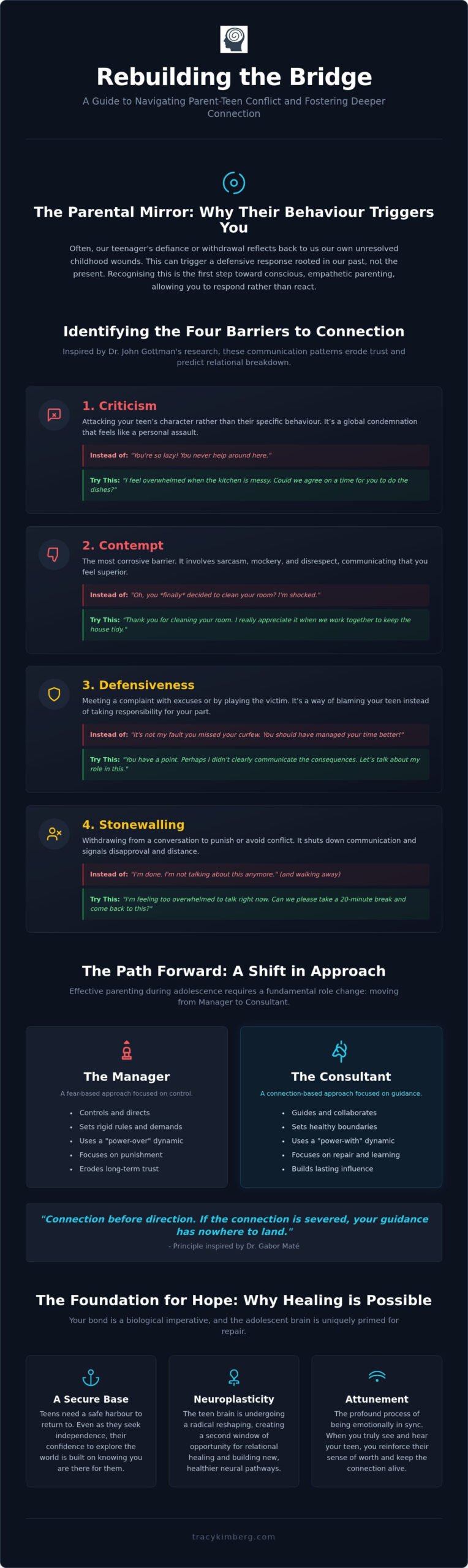
When tensions rise, it’s tempting to lean into “power-over” parenting. We set strict rules and demand compliance, often out of a desperate fear for our child’s safety. However, fear-based behaviour management often erodes long-term trust and fuels the very rebellion we’re trying to prevent. Shifting toward “power-with” dynamics allows you to collaborate rather than control.
Gabor Maté often emphasises the principle of “connection before direction.” If the connection is severed, your guidance has nowhere to land. Professional counselling for parents of troubled teens helps you bridge this gap, ensuring that your influence is built on a foundation of mutual respect rather than the threat of punishment. By prioritising the relationship over the immediate behaviour, you invite your teenager back into a space of safety and cooperation.
Identifying the Barriers to Genuine Connection
Our teenagers are often the most profound mirrors we will ever encounter. They reflect back to us not just our current frustrations, but our unresolved childhood wounds. This “Parental Mirror” is a powerful concept; when your teen rebels or withdraws, it may trigger a defensive response rooted in your own past. If you grew up in a home where your voice was suppressed, your child’s defiance can feel like a personal attack rather than a developmental milestone. This internal friction is a primary reason families seek counselling for parents of troubled teens, as it’s nearly impossible to lead a child through a storm whilst you are being tossed about by your own emotional waves.
John Gottman’s research identifies four specific behaviours, known as the “Four Horsemen,” that predict the breakdown of any relationship. In a family setting, these look like:
- Criticism: Attacking your teen’s character rather than their specific behaviour.
- Contempt: Using sarcasm or mockery to make them feel inferior.
- Defensiveness: Meeting their complaints with excuses or playing the victim.
- Stonewalling: Withdrawing from the conversation to “punish” or protect yourself.
Even in loving homes, barriers can grow through “emotional neglect,” which is often a lack of presence rather than a lack of care. You can provide every material comfort but still be emotionally out of reach. If you find yourself stuck in these cycles, exploring professional relationship support can help you identify the invisible scripts running your household and replace them with authentic presence.
Understanding Your Own Triggers
When an argument escalates, your body likely enters a state of “flooding.” Your heart rate spikes, your breathing becomes shallow, and your logical brain effectively shuts down. In this state, you cannot parent effectively. You are simply reacting from a place of survival. To break this cycle, try this reflection whilst you are calm: “When my teenager does [behaviour], I feel [emotion] because it reminds me of [past experience].” Understanding this link is the first step toward regulating your own behaviour during a crisis.
The Role of Digital Distraction
Modern family life is plagued by “technoference,” the way digital devices interrupt our face-to-face interactions. Being physically present but emotionally absent, such as scrolling through your phone whilst your teen is in the room, sends a subtle but damaging message: the screen is more interesting than they are. This erodes their sense of worth and kills spontaneous connection. To combat this, establish “digital-free connection zones.” The dinner table or the car can become sacred spaces where phones are put away, allowing for the quiet, unscripted moments where teenagers are most likely to open up.
Mastering the Art of Active Repair
Many parents believe that a “good” relationship is one defined by a lack of arguments. In reality, the most resilient bonds are those that have been broken and mended multiple times. The act of repair is actually more significant than the initial conflict because it proves the relationship can survive a storm. When we ignore a blowout or a slammed door, we accumulate “relational debt.” This debt manifests as a cold, growing distance or sudden, inexplicable outbursts of resentment weeks later. By prioritising the mend, you show your child that their mistakes do not define their worth or your love. This shift is a central theme in effective counselling for parents of troubled teens.
It’s vital for the parent to take the lead in this process. You are the emotional architect of the home. Even if your teenager “started it” with a sharp word or a lack of respect, your willingness to reach out first models emotional maturity. Taking the first step isn’t about admitting you were wrong about the rules; it’s about admitting that the connection matters more than the conflict. This teaches them essential life skills for their own future adult relationships, showing them that being right is often less important than being connected.
Five Steps to a Meaningful Relational Repair
Repairing a fracture isn’t about winning an argument; it’s about restoring a sense of safety. Follow these steps to bridge the gap effectively:
- Regulate yourself first: You cannot offer peace whilst you are in a state of fight-or-flight. Take ten minutes to breathe and settle your nervous system before approaching them.
- Acknowledge the rupture: Simply state what happened without blame. “That got heated very quickly, didn’t it?”
- Listen with curiosity: Ask them how it felt for them. Channel Gabor Maté’s approach by looking for the pain or the need hidden behind their anger.
- Offer a sincere apology: Apologise for your specific behaviour, such as raising your voice or being dismissive, even if they were also at fault.
- Co-create a plan: Ask, “How can we handle it differently next time?” to involve them in the solution.
Dialogue Starters for Difficult Conversations
Using the right language can disarm a defensive teenager. Instead of pointing fingers, use “I” statements to own your experience. For example, “I felt quite overwhelmed when the room was left untidy” sounds very different to “You are being incredibly selfish again.” Ownership of your feelings prevents the teen from feeling attacked and retreating into silence.
If a conversation goes south, try using “The Do-Over.” This is a practical family tool for immediate correction. You might say: “I didn’t like how I spoke to you earlier; can we try that again?” This simple phrase provides a reset button for both of you, preventing the build-up of resentment and keeping the lines of communication open for the future. Engaging in counselling for parents of troubled teens often provides the space to practice these scripts until they feel natural.
Navigating the Adolescent Shift: Connection vs Autonomy
As your child transitions into adolescence, the nature of your connection must undergo a fundamental shift. In early childhood, you were the “Manager,” overseeing every detail of their schedule, diet, and safety. However, a teenager’s primary developmental task is to establish autonomy. If you try to maintain the manager role, you will likely meet fierce resistance. The goal now is to become a “Consultant.” A consultant is available, knowledgeable, and supportive, but they respect the other person’s agency. This transition is often the hardest part of the journey, and it’s a frequent focus in counselling for parents of troubled teens.
Esther Perel often speaks about the inherent tension in all human relationships: the need for security versus the desire for adventure. Your teenager is currently caught in this tug-of-war. They need the security of home and your love, but they are biologically driven to seek the adventure of independence and peer belonging. Recognising this tension helps you realise that their “troubled” behaviour isn’t always a rejection of you. It’s often a clumsy, albeit painful, attempt to find out who they are outside of you. Whilst the method of connection changes, their need for a “felt sense of safety” remains constant.
Listening for the Feeling Beneath the Shrug
Teenagers are notorious for the non-verbal “no.” The eye-roll, the heavy sigh, or the defensive shrug are all forms of communication. When they push you away, they are often testing the strength of the bond. Can you handle their anger? Can you stay steady whilst they are volatile? To maintain a bridge of connection, you must learn to listen for the feeling beneath the shrug. Instead of reacting to the disrespect of an eye-roll, try to see the overwhelm or the insecurity it masks. You can respect their privacy whilst still being emotionally present, letting them know that the door is always open when they are ready to talk.
Creating Shared Moments of Connection
Connection doesn’t always require deep, meaningful conversations. In fact, many teenagers find direct, face-to-face emotional talks intimidating. Instead, focus on “micro-connections” – the small, everyday bids for attention. This might be a shared laugh over a video, a brief comment about a song, or simply sitting in the same room whilst they play a game. These low-pressure moments celebrate their unique personality without the weight of expectation. When they do share a difficult emotion, your job is to hold space for it. Resisting the urge to “fix” it immediately shows them that you trust their ability to navigate their own world. If you find it difficult to step back from the manager role, you can book a session for specialised support to help navigate this transition.
Professional Support: The Path to Family Harmony
Living in a state of perpetual high alert is exhausting for everyone involved. When conflict becomes the primary language of your home, it’s easy to feel like you’ve lost the map. You might notice red flags like a total withdrawal into digital worlds, explosive reactions to minor requests, or a heavy, persistent silence that fills the dinner table. These aren’t just “phases” to endure alone; they are signals that the current system is under too much pressure. Recognising that your family needs external support is a sign of immense strength. It shows a commitment to the relationship that outweighs the discomfort of asking for help. Engaging in specialised counselling for parents of troubled teens provides the neutral, safe space required for both you and your teenager to be heard without the fear of immediate escalation. It’s about finding a guide who understands the complexities of both the parent and the teen perspective.
The Transformational Power of Family Therapy
Therapy acts as a lens, helping you uncover the “hidden patterns” that often run beneath the surface of daily life. Sometimes, these are generational cycles; ways of reacting that were passed down to you and are now being mirrored by your child. For teenagers struggling with anxiety, depression, or a profound sense of disconnect, having a dedicated professional to facilitate these conversations can be life-changing. Tracy Kimberg offers a safe and non-judgemental environment where these delicate sessions can unfold. It’s a space where the “troubled” label is discarded in favour of understanding the underlying needs. By drawing on research-based methods from experts like John Gottman and Gabor Maté, we can address the systemic health of the family to alleviate the individual symptoms of the child.
Taking the Next Step: Your Path to Reconnection
Healing doesn’t have to be a chaotic or endless process. A structured approach, like the 12-Week Relationship Recovery Process, allows parents to lead the change from the front. This programme provides a clear, manageable path through the crisis, moving from reactive survival to proactive connection. This form of counselling for parents of troubled teens helps you regulate your own emotional responses whilst gaining the tools to invite your teen back into a secure bond. You’ll learn to move beyond the weight of the problems and focus on the possibility of a positive outcome. For busy UK families, the convenience of online therapy ensures that support is accessible without the added stress of a long commute. You don’t have to wait for a total breakdown to seek a breakthrough.
Book a consultation with Tracy Kimberg to begin your journey of family reconnection.
Reclaiming the Connection Your Family Deserves
You now understand that the adolescent brain is biologically primed for relational healing and that the act of active repair is far more significant than the initial conflict. By shifting your stance from a manager to a consultant, you create the space your teenager needs to grow whilst maintaining the secure base they crave. The “silent treatment” and power struggles don’t have to be the permanent soundtrack of your home. Instead, they can be the catalysts for a deeper, more resilient bond.
Professional counselling for parents of troubled teens provides the neutral ground and expert insight needed to navigate these complex transitions. By utilising the research-based methodologies of Gottman, Perel, and Maté, I offer a safe and non-judgemental environment for your family to thrive. Through the specialised 12-Week Relationship Recovery Process, you can move from a state of reactive crisis to a place of calm, sustainable harmony.
Start your family’s healing journey with Tracy Kimberg today. Healing is not just a clinical necessity; it’s a proactive adventure that begins with your willingness to lead the way. You have the strength to rebuild this bridge, and you don’t have to do it alone.
Frequently Asked Questions
Is it ever too late to improve my relationship with my troubled teenager?
It is never too late to begin the process of reconnection. Because the adolescent brain is uniquely primed for relational healing through neuroplasticity, the potential for change remains high throughout the teenage years. Even if you have experienced years of distance or conflict, shifting your own behaviour can invite a new response from your child. Healing is a proactive adventure that depends on the quality of the repair rather than the length of the rupture.
How can I stop shouting at my child when I feel overwhelmed and stressed?
Stopping the cycle of shouting starts with recognising your own physiological “flooding” before you speak. When you feel your heart rate spike or your breathing become shallow, you must give yourself a “time-out” to regulate your nervous system. Taking ten minutes to breathe or walk away isn’t a sign of weakness; it’s an essential tool for emotional regulation. By staying calm, you model the very behaviour you want to see in your teenager.
My teenager refuses to speak to me; what is the first step I should take?
The first step is to remove the pressure for a deep conversation and focus on “micro-connections” instead. If your teen is stonewalling, they may be using silence as a shield to protect themselves from perceived criticism. Try offering low-pressure bids for connection, such as leaving a favourite snack or sending a kind text without expecting a reply. These small acts signal that you are still a secure base, waiting for them when they are ready.
How do I balance being a supportive friend and an authoritative parent?
Balancing these roles requires a shift from being a “Manager” who controls to a “Consultant” who guides. Your teenager doesn’t need another peer; they need a parent who provides a felt sense of safety and clear boundaries whilst respecting their growing autonomy. You can be deeply empathetic and supportive of their feelings without wavering on essential house rules. This delicate balance is often a core focus in counselling for parents of troubled teens.
What are the primary signs of a breakdown in the parent-child relationship?
A breakdown is often marked by the presence of Gottman’s “Four Horsemen,” particularly contempt and stonewalling. If conflict has become the primary mode of communication or if you’ve stopped attempting to repair after arguments, the bond is likely fractured. Other signs include a total lack of shared joy, persistent secrecy that goes beyond a normal need for privacy, and a feeling that you are walking on eggshells in your own home environment.
How does my own mental health and history affect my relationship with my teen?
Your own history acts as a lens through which you view your teenager’s behaviour. If you have unresolved childhood wounds, your teen’s rebellion might trigger a defensive survival response in you rather than a compassionate one. This “Parental Mirror” means that your emotional health is the foundation of the relationship. Working on your own triggers through counselling for parents of troubled teens allows you to respond to your child with clarity instead of reacting from past pain.
What is the difference between family therapy and individual counselling for my teen?
Individual counselling provides your teenager with a private, safe space to process their personal challenges, such as anxiety or depression. Family therapy, however, focuses on the “relational space” between you. It looks at the systemic patterns, communication styles, and generational cycles that affect everyone in the household. Often, the most effective approach involves a combination of both, ensuring the teenager feels supported whilst the family system itself is being healed and reorganised.
How often should I try to have one-on-one time with a teenager who pulls away?
Consistency is more important than the duration of the time spent together. Aim for small, daily moments of “attunement” rather than forced, long outings. Even five minutes of genuine presence, where you are listening for the feeling beneath the shrug without trying to fix anything, can build a bridge. If they pull away, don’t take it personally. Continue to offer the invitation consistently, showing them that your love isn’t contingent on their immediate participation.

Article by
Tracy Kimberg
Tracy Kimberg is a Relationship Expert, Couples Therapist and Coach with a dedicated focus on helping couples and individuals rebuild connection, trust and emotional safety in their relationships. Drawing on the research of John and Julie Gottman, the relational insights of Esther Perel, and years of hands-on therapeutic experience, Tracy offers a warm, non-judgemental and deeply compassionate approach to modern relationships.
Based in Dorset, Tracy works with couples navigating communication breakdowns, betrayal, intimacy challenges, separation, family dynamics and life transitions. Known for creating a safe and grounded therapeutic space, she combines practical tools with emotional depth to help clients move beyond survival patterns and towards meaningful, lasting change.
With a reputation for empathy, professionalism and dedication to her clients’ growth, Tracy is passionate about helping people feel seen, understood and empowered — both within their relationships and within themselves.
Disclaimer
Disclaimer:
The information shared in this article is intended for educational and informational purposes only and should not be considered a substitute for professional therapeutic, psychological, medical or legal advice. Every individual and relationship is unique, and the perspectives offered are based on general therapeutic principles, research and professional experience.
Reading this article does not establish a therapist-client relationship with Tracy Kimberg. If you are experiencing significant emotional distress, relationship crisis, trauma, or mental health concerns, it is important to seek support from a qualified professional appropriate to your individual circumstances.
All content remains the intellectual property of Tracy Kimberg and may not be reproduced or distributed without permission.