

A marriage that ends isn’t necessarily a failed marriage. Sometimes, it’s a relationship that has reached its natural conclusion, and acknowledging this truth is the first step toward a healthier future. If you feel overwhelmed by the thought of an adversarial legal battle or worry about the psychological toll on your teenagers, you aren’t alone. With divorce rates for first marriages typically sitting between 40% and 50%, many couples are looking for a more humane way to say goodbye. Understanding the benefits of conscious separation can transform a period of crisis into a structured journey of growth, helping you preserve your dignity whilst protecting the people you love most.
It’s natural to feel a sense of grief or even shame when a partnership dissolves, yet an ending can also be an act of profound respect that honours your shared history. This guide offers a compassionate roadmap for those seeking an amicable exit. You’ll discover practical tools to manage conflict, insights into the emotional benefits of an intentional split, and the reassurance that a “good ending” is entirely possible. We’ll look at how to navigate these complex emotional landscapes with the wisdom of a guide, ensuring that your transition is defined by clarity and care rather than conflict.
Key Takeaways
- Learn how to view the end of a partnership as a transformation of identity rather than a failure, allowing you to honour your shared past whilst moving forward.
- Discover the core psychological benefits of conscious separation, including research-based methods to de-escalate conflict and protect your emotional health.
- Understand why addressing the “emotional estate” of your relationship before engaging with the legal system is vital for long-term family stability.
- Gain practical techniques for regulating your nervous system and establishing mindful boundaries during the transition.
- Explore how a structured programme for conscious separation can provide the safety and clarity needed to achieve a respectful closure.
Defining Conscious Separation: Beyond the Buzzwords
When a relationship ends, the cultural narrative often shifts toward blame, bitterness, and the cold mechanics of legal paperwork. Conscious separation offers a different path. It’s a mindful framework for ending a partnership that prioritises emotional health over adversarial conflict. Instead of viewing the split as a failure, we look at it as a relationship that has reached its natural conclusion. One of the primary benefits of conscious separation is the ability to end a chapter without needing to “villainise” the person you once chose to build a life with. It’s about moving forward with integrity rather than resentment.
This process shifts the focus toward what we call the “relational estate”. This isn’t about who gets the car or the house; it’s about the shared history, the children, and the emotional bonds that don’t simply vanish when the romantic contract ends. Conscious separation is a psychological transition that honours the past whilst organising the future.
The Distinction Between Uncoupling and Traditional Divorce
Traditional divorce models are frequently built on a foundation of “winning” and “losing”. They rely on a legal system designed for dispute, which often forces couples into opposing corners. This adversarial approach can escalate conflict, leaving both parties emotionally depleted. In contrast, conscious separation focuses on psychological closure and the preservation of self-respect. While the term Conscious uncoupling gained fame through pop culture, the therapeutic reality is about managing the emotional “estate” before the legalities even begin. The goal is a “good ending” that allows both individuals to heal more rapidly, rather than spending years recovering from the trauma of a courtroom battle.
Why Awareness is the Foundation of an Amicable Exit
Awareness is the anchor of this process. It’s easy to get lost in the chaos of a split, but being “conscious” means recognising your own triggers and reactive behaviours amongst the noise. It requires a difficult but rewarding shift from reflexive blame to personal responsibility. You aren’t just looking at what your partner did wrong; you’re examining your own part in the dynamic. By understanding the “why” of the breakdown now, you ensure you don’t carry the same painful patterns into your next chapter. This level of insight is what makes an amicable exit possible, as it replaces the impulse to attack with the capacity to understand.
The Psychological Benefits: Healing, Growth, and Integrity
Ending a relationship is rarely just about the logistics of moving out or dividing assets. It’s an internal earthquake. Esther Perel often observes that an ending is a transformation of identity, not just a loss. When we approach a split with awareness, we allow ourselves to grieve the relationship whilst simultaneously birthing a new version of ourselves. This shift is where the psychological benefits of conscious separation become deeply personal. You aren’t just finishing a story; you’re deciding how the next chapter begins.
To keep this transition healthy, we look to John Gottman’s research to identify and de-escalate “The Four Horsemen”: criticism, contempt, defensiveness, and stonewalling. These behaviours are the primary drivers of psychological distress during a split. By consciously naming these patterns, you can reduce relational trauma and establish a stable emotional baseline for everyone involved. Gabor Maté’s perspective further enriches this by helping us understand how our past wounds might be driving the intensity of our current reactions. It’s often the case that the pain we feel isn’t just about the person leaving, but about the echoes of our history. Recognising this allows for a more compassionate, less reactive exit.
Preserving the Dignity of Both Partners
Maintaining respect prevents the “shame spiral” that so often accompanies a relationship breakdown. When we villainise a partner, we inadvertently cast ourselves as victims, which is a disempowered state. One of the core benefits of conscious separation is the commitment to “honouring the story” of the relationship rather than erasing it. This involves creating a shared narrative of the ending that both partners can live with. It’s a way of saying, “We didn’t work out as a couple, but the time we spent together still matters.” This dignity is the foundation for long-term healing. Engaging in specialised support for conscious separation can provide the neutral space needed to process these complex dynamics safely.
Attachment Styles and the Separation Journey
A breakup is a massive trigger for our attachment systems. If you have an anxious attachment style, the separation might feel like a literal threat to your survival. If you’re avoidant, you might shut down or bolt. Therapy helps you hold your centre whilst your partner may be acting out of fear. The goal is to move from an “enmeshed” identity, where your sense of self is entirely tied to the couple, to a secure and independent sense of self. This psychological independence is vital. It allows you to navigate the split without losing your core identity amongst the emotional noise.
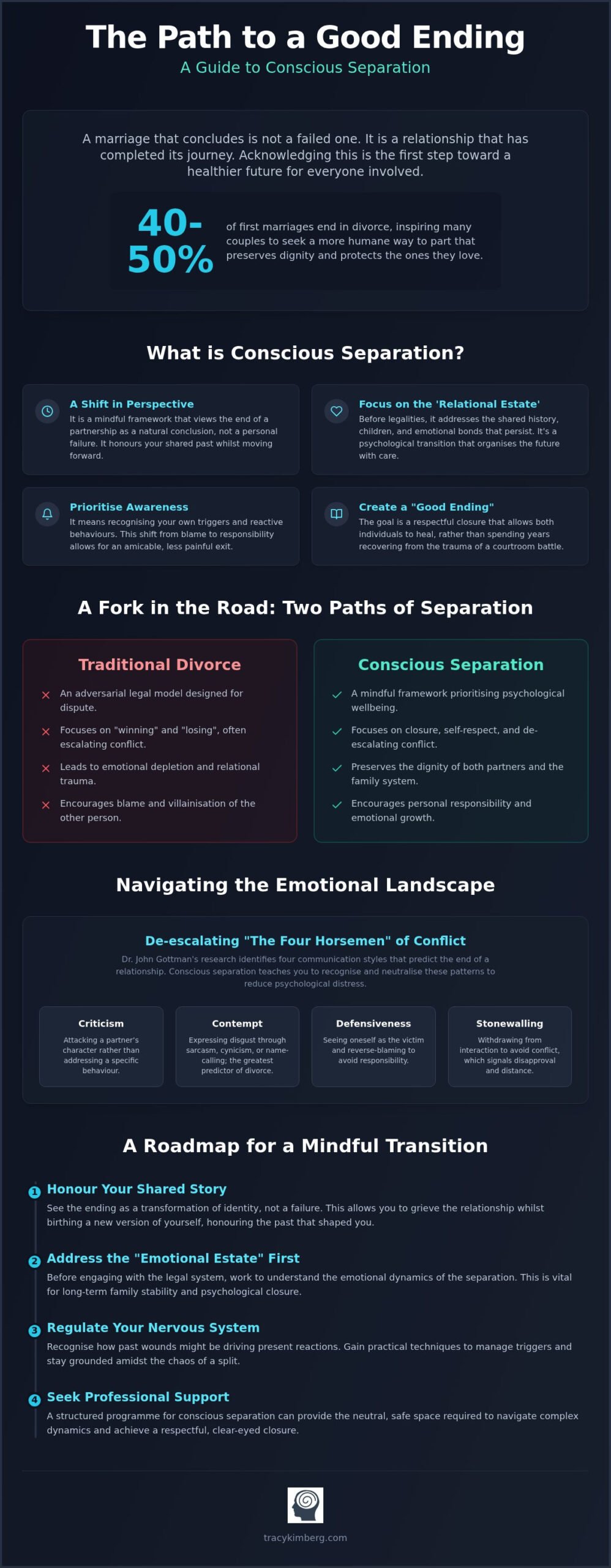
Conscious Separation vs. Traditional Divorce: A Comparison
Traditional divorce often feels like a battleground where the legal system is tasked with solving deeply emotional problems. It’s a structure built for property disputes and contract breaches, not for the delicate untangling of a human heart. When we look at the benefits of conscious separation, we see a shift away from this adversarial mindset. Instead of rushing to solicitors to secure a “legal win,” couples work with relationship coaching to manage the emotional “estate” first. This proactive approach addresses the underlying hurt and resentment before any paperwork is signed. It’s vital to remember that it is the presence of high conflict, rather than the separation itself, that acts as the primary source of psychological damage to children.
The Adversarial Model vs. The Relational Model
The legal system operates on a binary of winner and loser. This is fundamentally ill-equipped for the nuances of heartbreak. In an adversarial model, every concession feels like a defeat, which naturally breeds defensiveness and contempt. The relational model, however, prioritises the systemic health of the family unit, regardless of whether that family lives in one household or two. By focusing on mutual respect and clear communication, couples often find they can reach agreements much faster. This isn’t just an emotional relief; it’s a practical one. Research from 2026 indicates that contested divorces requiring litigation average between $15,000 and $30,000, whilst those who settle amicably through direct negotiation save significantly on both time and legal fees. Choosing a conscious path protects your financial future as much as your emotional one.
Long-term Outcomes for Teenagers and Children
A conscious exit provides your children with a blueprint for how to handle life’s most difficult transitions with grace. When parents “villainise” each other, children often experience a painful sense of “split loyalty,” feeling as though loving one parent is a betrayal of the other. One of the greatest benefits of conscious separation is the reduction of this internal pressure. By modelling healthy conflict resolution, you teach your teenagers that even when a relationship ends, respect can remain. This sets a foundation for functional co-parenting that will last for decades, ensuring that future milestones like graduations or weddings aren’t clouded by the ghosts of an old battle. It’s an investment in your children’s long-term emotional baseline that pays dividends for a lifetime.
Practical Steps to Organise a Mindful Transition
Moving from the theory of an amicable exit to the daily reality of a split requires a deliberate shift in how you handle your internal world. The first step is to regulate your nervous system. You cannot make sound decisions about your future whilst in a state of “fight or flight.” Practising self-soothing techniques before engaging in logistics ensures you approach the table with clarity rather than reactivity. Once you’re stable, you can begin to establish mindful boundaries. This involves organising your physical and emotional space with absolute clarity. These boundaries aren’t meant to be walls; they are the containers that allow both parties to feel safe during a time of immense vulnerability.
Compassionate communication serves as the engine of this process. It involves using “I” statements to express your needs and committed active listening to understand your partner’s perspective, even amongst the pain. When you finally craft the unified narrative for your family, you must do so in a way that provides immediate security. Children and teenagers need to hear a consistent, non-blaming story that doesn’t force them to choose sides. One of the primary benefits of conscious separation is the ability to provide this emotional safety net, ensuring the family structure evolves rather than dissolves.
Navigating Differing Readiness Levels
It’s common for one partner to be emotionally further ahead in the journey. If you’re the “initiator,” you may have had months or even years to process the ending, whilst the “respondent” might be stuck in shock or anger. A conscious exit requires you to allow time for the other person to catch up. You must maintain your own integrity even if your partner is being reactive. You don’t have to attend every argument you’re invited to. By staying grounded, you create the space for the other person to eventually move toward a more cooperative stance.
Creating a Co-Parenting Charter
Transitioning from romantic partners to professional co-parents is a vital psychological milestone. A co-parenting charter helps you establish clear rules of engagement, such as agreeing not to vent via text or use children as messengers. By keeping your child’s stability as the “North Star” for all decision-making, you transform your relationship into a functional partnership that survives the split. If you find yourself struggling to navigate these complex steps alone, engaging in a 12-Week Relationship Recovery Process can provide the professional structure and neutral ground needed to reach a healthy resolution.
Navigating the Journey with Professional Support
Ending a relationship is one of life’s most taxing transitions, and attempting to do it alone often leads to the very conflict you’re trying to avoid. A relationship coach acts as a “neutral third pole,” providing a steadying influence that keeps the separation on its conscious track. This professional guidance ensures that the conversation doesn’t devolve into a repetitive loop of blame. By focusing on the benefits of conscious separation, you can move away from the pain of the past and toward the possibility of a reclaimed future. It turns a period of crisis into a managed process of transformation.
The 12-Week Relationship Recovery Process provides the necessary structure for this healthy ending. It offers a clear timeline and specific milestones, which can be incredibly grounding amongst the emotional chaos. For families, this support extends to the younger generation. Therapy for teenagers is a vital component of a successful transition, offering them a safe, non-judgemental environment to process their own grief and confusion. When the adults are supported, the children are protected. This holistic approach ensures that the entire family system can find its footing in a new reality.
The Safe Space of Relationship Coaching
One of the hardest parts of uncoupling is processing the “death” of the relationship without falling into the “victim” trap. It’s easy to feel as though life is happening to you, rather than you being the architect of your own change. Relationship Coaching for Couples can facilitate a peaceful transition by helping you develop the emotional intelligence needed for the heavy logistics of separation. It provides the tools to manage triggers in real-time, allowing you to handle financial or domestic discussions with a level head. This specialised care ensures that your integrity remains the priority throughout the split.
Reclaiming Your Individual Life After the Transition
Separation is not just an end; it is the beginning of a new chapter of self-discovery. As you untangle your life from your partner’s, you have the opportunity to reclaim your favourite parts of yourself that may have been sidelined during the marriage. Individual therapy can be a powerful tool during this phase, helping you hold your centre as you build a new, independent life. The ultimate goal of this mindful journey is to walk away with your heart intact and your dignity preserved. You aren’t just surviving a breakup; you are consciously choosing how you want to show up for the rest of your life. This reclaimed future is the ultimate reward for the hard work of a conscious exit.
Choosing Your Legacy of Closure
Choosing to end a relationship with awareness is one of the most courageous acts of love you can perform for your family. By prioritising the emotional estate over adversarial legal battles, you transform a painful ending into a foundation for individual growth. We’ve explored how identifying destructive communication patterns and honouring your shared history can prevent long-term trauma for both you and your teenagers. One of the greatest benefits of conscious separation is the preservation of your dignity, ensuring that you walk away with a reclaimed sense of self rather than a narrative of failure.
This journey doesn’t have to be walked alone. With a research-based approach and a safe, non-judgemental environment, specialised support is available to guide your transition. Whether you need closure-focused coaching for yourselves or therapy for your teenagers during family transitions, there is a path to a peaceful resolution. Book a discovery call with Tracy Kimberg to discuss your path to a conscious separation. You deserve an ending that honours your past whilst protecting your future. It’s time to move toward healing with clarity and care.
Frequently Asked Questions
Is conscious separation just a fancy name for divorce?
Conscious separation is a mindful psychological framework rather than a legal status. Whilst divorce focuses on the dissolution of a contract, this approach prioritises emotional health and the preservation of dignity. One of the primary benefits of conscious separation is that it addresses the “relational estate” first. This ensures that the legal process becomes a secondary formality rather than the main event, allowing both individuals to heal more effectively.
Can we consciously separate if my partner is high-conflict?
You can still choose a conscious path even if your partner is reactive. Whilst a mutual commitment is ideal, your own emotional regulation acts as a “neutral pole” that can de-escalate tension. By refusing to engage in the adversarial “Four Horsemen” of criticism and contempt, you protect your own mental health. This process allows you to maintain your integrity regardless of your partner’s behaviour, providing a stable baseline for any children involved.
How do we tell our teenagers about the separation without traumatising them?
Teenagers require a unified, non-blaming narrative that provides immediate security. It’s vital to explain the change honestly without forcing them to choose sides or listen to parental venting. Focus on the fact that whilst the romantic partnership is ending, the family structure is simply evolving. Using specialised therapy for teenagers can also offer them a safe, non-judgemental space to process their grief away from the intensity of the parental dynamic.
Does conscious separation mean we have to stay friends?
Friendship is not a requirement for a successful conscious exit. The goal is respect, integrity, and functional cooperation, especially if you are transitioning into a co-parenting role. You are moving from romantic partners to a professional-style partnership focused on the family’s well-being. Whilst some couples eventually find a deep friendship, the immediate priority is ensuring that neither party is villainised and that the “shame spiral” of a messy split is avoided.
How long does the conscious separation process typically take?
The timeline varies for every couple, but structured support often provides a clearer path. For example, a 12-Week Relationship Recovery Process offers a specific framework to navigate the most intense emotional milestones. Unlike traditional divorce, which can drag on through years of litigation, this mindful approach focuses on rapid emotional healing. By addressing the psychological estate early, you often find that the subsequent legal and logistical steps move much more swiftly.
Do we still need a solicitor if we choose a conscious separation?
Yes, you will still need legal professionals to formalise the dissolution of your marriage and handle asset division. However, the benefits of conscious separation mean you arrive at the solicitor’s office with a clear, agreed-upon plan. This significantly reduces the time spent in adversarial negotiations, which can lower legal fees. By handling the emotional “heart” of the split through coaching, you prevent the legal system from being used as a weapon.
What if I am the only one who wants to separate consciously?
A conscious exit is still possible even if you are the only one committed to it. You cannot control your partner’s reactions, but you can control your own responses and boundaries. By staying grounded and refusing to engage in reflexive blame, you stop the cycle of conflict from your side. This personal commitment to integrity protects your nervous system and ensures you walk away with your self-respect and dignity fully intact.
How can relationship coaching help if we have already decided to split?
Coaching provides the neutral ground needed to manage the transition from “we” to “I.” Even if the decision to split is final, you still need to untangle your emotional lives and establish new rules of engagement. A coach acts as a guide through this messy middle, helping you de-escalate triggers and “honour the story” of your relationship. This ensures the ending is a transformation of identity rather than a traumatic loss.

Article by
Tracy Kimberg
Tracy Kimberg is a Relationship Expert, Couples Therapist and Coach with a dedicated focus on helping couples and individuals rebuild connection, trust and emotional safety in their relationships. Drawing on the research of John and Julie Gottman, the relational insights of Esther Perel, and years of hands-on therapeutic experience, Tracy offers a warm, non-judgemental and deeply compassionate approach to modern relationships.
Based in Dorset, Tracy works with couples navigating communication breakdowns, betrayal, intimacy challenges, separation, family dynamics and life transitions. Known for creating a safe and grounded therapeutic space, she combines practical tools with emotional depth to help clients move beyond survival patterns and towards meaningful, lasting change.
With a reputation for empathy, professionalism and dedication to her clients’ growth, Tracy is passionate about helping people feel seen, understood and empowered — both within their relationships and within themselves.
Disclaimer
Disclaimer:
The information shared in this article is intended for educational and informational purposes only and should not be considered a substitute for professional therapeutic, psychological, medical or legal advice. Every individual and relationship is unique, and the perspectives offered are based on general therapeutic principles, research and professional experience.
Reading this article does not establish a therapist-client relationship with Tracy Kimberg. If you are experiencing significant emotional distress, relationship crisis, trauma, or mental health concerns, it is important to seek support from a qualified professional appropriate to your individual circumstances.
All content remains the intellectual property of Tracy Kimberg and may not be reproduced or distributed without permission.