

What if emotional distance isn’t proof that love has disappeared, but a pattern you can begin to understand together? Couples therapy for emotional intimacy in the UK gives partners a structured space to talk about what feels difficult, recognise the cycles that leave them disconnected and practise new ways of responding to each other.
It makes sense if opening up feels daunting, especially when conversations about trust, conflict or closeness have become tense or gone quiet. Counselling isn’t about deciding who is right; it can help each partner feel heard and explore the needs and feelings beneath recurring disagreements. With time and careful support, couples can work towards more open communication and a stronger emotional bond.
This guide explains what couples counselling involves and how it may support communication, trust, conflict resolution and intimacy. You’ll also learn what the process can look like, so you can decide whether this support feels like a useful next step for your relationship.
Key Takeaways
- Understand how couples counselling can use different therapeutic approaches to explore relationship difficulties.
- Recognise how recurring conflict patterns can affect trust and make conversations about intimacy harder.
- Explore practical ways to build emotional connection, communicate needs and create shared expectations.
- Learn when relationship counselling and coaching may help you work towards greater emotional intimacy together.
What is couples counselling?
Couples counselling gives partners a structured setting to understand relationship difficulties and practise different ways of relating. The therapist helps identify what keeps disconnection or conflict going, rather than deciding who is to blame.
Therapy approaches for couples
Approaches differ, so look for one that addresses your concerns and explains how sessions will work. Cognitive behavioural therapy (CBT) helps partners notice how thoughts and behaviours affect interactions, then practise alternatives, such as making a clear request instead of criticising. Emotionally Focused Therapy (EFT), also called Emotionally Focused Couples Therapy, explores the feelings and attachment needs beneath recurring reactions. Developed in the 1980s, emotionally focused therapy aims to shift negative cycles towards safer emotional connection; a course commonly involves 8 to 20 sessions. The Gottman method focuses on relationship patterns and skills, including listening and managing conflict. Ask how an approach will be adapted to your situation.
Whether you choose online or face-to-face therapy, look for relevant couples-therapy training, a clear explanation of the approach and a setting where both partners can speak openly. The format should give each person the chance to feel heard and take part.
Alternatives include relationship education, guided self-help and planned conversations at home. For example, take turns describing what helps you feel close, then listen without interrupting.
NHS access depends on local service criteria, while private health insurance depends on policy terms. Neither route automatically covers couples counselling, so check eligibility and benefits before relying on them.
Session format and treatment duration
Sessions usually involve both partners discussing a specific concern, with the therapist helping them slow down reactions and explore what lies beneath them. In EFT, treatment commonly runs for 8 to 20 sessions, though the focus and pace depend on the couple’s needs. Ask how progress will be reviewed and what happens if one partner needs individual support.
Costs vary by session length and format. Self-guided relationship resources may be a lower-cost option, and a therapist can explain fees before sessions begin.
Therapy has limits: it cannot make either partner change or guarantee reconciliation. If someone fears speaking freely or faces harm from a partner, joint sessions may be unsafe. Individual support focused on safety should come first.
Communication, conflict resolution, trust, and intimacy
Repeated arguments can leave partners feeling unheard, even when both want closeness. Therapy helps couples notice the pattern beneath conflict and understand how feelings and attachment needs shape each person’s responses.
De-escalating conflict
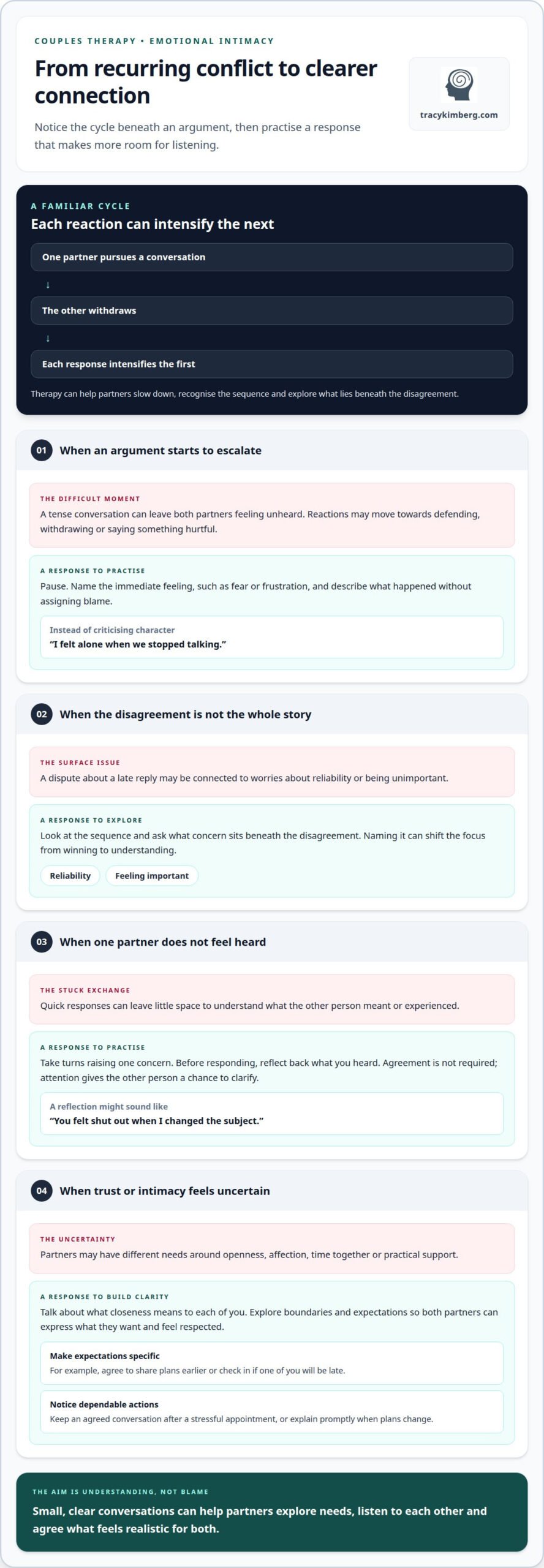
A pause can interrupt escalation before either partner says something hurtful. In therapy, partners practise naming an immediate feeling, such as fear or frustration, and describing what happened without assigning blame. One might say, “I felt alone when we stopped talking,” rather than criticising the other person’s character. This makes room to listen and respond instead of defending or withdrawing.
Recurring conflict often follows a familiar cycle: one partner pursues a conversation, the other withdraws, and each reaction intensifies the first. Identifying the sequence helps couples ask what lies beneath the disagreement. A dispute about a late reply, for example, may reflect worries about reliability or being unimportant. Naming those concerns can shift the focus from winning to understanding.
Strengthening communication and trust
Constructive communication takes curiosity as well as clarity. Partners can take turns raising one concern, then reflect back what they heard before responding. The listener might say, “You felt shut out when I changed the subject.” This doesn’t require agreement; it shows attention to the other person’s experience and gives them a chance to clarify.
Trust also grows when words and actions are consistent. If one partner needs more openness, discuss what that means in practice, such as agreeing to share plans earlier. Couples can explore boundaries and expectations around intimacy so both feel comfortable, respected and able to express what they want.
For support with these conversations, relationship counselling and coaching for couples can offer a structured space to explore the cycle together.
Building connection, trust, stability and intimacy
Couples therapy for emotional intimacy in the UK can help partners explore what closeness means to each of them. One person may feel connected through affectionate words, while the other values shared time or practical support. Naming these differences makes it easier to express preferences without treating them as proof that love is absent. A useful starting point is to describe a moment when you felt close and what made it meaningful.
Trust can also grow through small, dependable actions. If you agree to talk after a stressful appointment, make time for the conversation and give each other your attention. If plans change, explain promptly rather than leaving your partner to guess. These everyday moments build a clearer sense of reliability. In sessions, couples can explore what consistency means to each person and what feels realistic to practise.
Stability doesn’t mean every day needs a fixed routine. It can come from shared expectations about busy evenings, family commitments or time apart. For example, agree on a simple check-in if one of you will be late. Couples therapy for emotional intimacy in the UK can support conversations about these expectations, helping partners decide whether an agreement feels fair and reassuring to both.
Intimacy also means being able to share preferences and boundaries without pressure. Partners might discuss what kind of affection feels welcome after a difficult day, then revisit the conversation as needs change. Asking “Would you like company or quiet time?” can show care without assuming what the other person wants. Over time, thoughtful exchanges can make more room for emotional openness and connection.
Benefits of therapy for emotional intimacy
Therapy can help partners recognise the negative pattern beneath emotional distance, rather than treating each disagreement as isolated. In a session, they might explore what happens when one person seeks reassurance and the other becomes quiet. Mapping that sequence can reduce blame and bring underlying fear, hurt or longing into view. Emotional intimacy can deepen when both partners express those feelings and feel understood.
Understanding the pattern can ease distress by helping each person make sense of their reactions. A partner who withdraws during difficult conversations may be protecting themselves from feeling overwhelmed, rather than signalling indifference. Exploring that response with care can help the couple find a more manageable way to stay present. The focus shifts from judging a reaction to understanding its effect on the relationship.
Emotionally focused therapy also helps partners practise new emotional responses. Instead of repeating a familiar cycle, one partner might share a vulnerable feeling while the other listens with attention rather than criticism. This can create a different experience of closeness: difficult subjects become easier to approach, and each person can ask more directly for comfort. Benefits of emotionally focused therapy for couples have been reported to last at least two years.
Progress may show up in ordinary moments, such as discussing a disappointment without shutting down or reconnecting after tension. Greater emotional safety can help partners talk about needs, repair hurt and feel more secure together. Therapy doesn’t erase painful experiences; it can help couples respond to them with more understanding and care. If you’re ready to explore how therapy could support your relationship, take a step towards emotional intimacy.
Tracy Kimberg: Relationship Counselling and Coaching for Couples
Relationship Counselling and Coaching for Couples with Tracy Kimberg offers a space to explore emotional distance, recurring conflict or weakened trust. It may help when conversations repeatedly stall, affection feels harder to share, or one partner feels alone with relationship concerns. Rather than focusing only on the latest disagreement, counselling can help you explore the interaction patterns and feelings shaping it.
You might bring up a specific moment, such as one partner trying to discuss a difficult issue while the other withdraws. In counselling, both perspectives can be heard, and the couple can begin to understand what happens between them. This can help you identify what each person needs from conversations and what changes could support greater openness. The work is collaborative, with attention to the relationship rather than blame.
For couples seeking a more structured course of support, Tracy Kimberg also offers a 12-Week Relationship Recovery Process. This may be relevant when disconnection or repeated difficulties have become part of daily life and you want a defined process for working on relationship dynamics. The right next step depends on what you’re facing and the kind of support you’re seeking. Therapy for Adults is also available for individual concerns that affect emotional wellbeing or relationships.
You don’t need to have every answer or agree on exactly what needs to change before starting counselling. Begin by describing what feels difficult, what you hope might improve and what each of you wants to understand. That gives the work a clear starting point without asking either partner to promise a particular outcome. To discuss relationship counselling, contact Tracy Kimberg.
Make room for a different conversation
Reaching out doesn’t require a complete plan for your relationship. You can start by noticing what you miss, what feels difficult to say or what you hope your partner will understand. Those reflections give you a starting point and can make your next conversation more intentional.
Couples therapy for emotional intimacy in the UK offers a setting to explore these questions together, at a pace that gives both partners room to speak and listen. You don’t need to agree on every detail before beginning. Approaching the relationship with curiosity can itself create an opening for change. Consider what you each want more of in your relationship and what feels hardest to talk about right now.
If you’re ready to talk about what support could look like for you, contact Tracy Kimberg. A first conversation can help you express what you’re hoping for and consider a meaningful next step. You can begin wherever you are, and move forward one honest conversation at a time.
Frequently Asked Questions
What can a couples therapist help with?
A couples therapist can help partners work through relationship breakdown, infidelity and emotional disconnection. You might bring a specific concern, such as finding it difficult to discuss a partner’s messages or struggling to agree on parenting decisions. The therapist helps both people explore how the issue affects them and what they want to address, keeping the conversation focused on understanding and possible ways forward.
What is couples therapy for emotional intimacy, and how does it work?
Couples therapy is a guided process for understanding what makes emotional closeness difficult and finding new ways to relate. Partners might explore a moment when one wanted comfort but the other didn’t know how to respond. The therapist helps clarify what each person experienced and needed, so the couple can consider how to approach similar moments with greater care.
What approaches do UK couples therapists use to improve emotional intimacy?
Approaches can include cognitive behavioural therapy (CBT), Emotionally Focused Therapy (EFT) and the Gottman method. Each offers a different perspective: CBT examines the links between thoughts and actions, EFT focuses on emotional needs, and the Gottman method addresses relationship skills. Ask how the therapist chooses an approach and how it will address your concern, rather than assuming one method suits every couple.
How can couples find an accredited couples therapist in the UK?
Look for a therapist with counselling or psychotherapy training and relevant couples-therapy education. For Emotionally Focused Therapy, therapists listed in the British Emotionally Focused Therapy Centre directory must belong to the International Centre for Excellence in Emotionally Focused Therapy and complete an EFT Externship, alongside counselling or psychotherapy training. Check that the therapist explains their approach clearly and that both of you feel able to speak openly in sessions.
Can couples therapy help with emotional distance, trust issues, or communication problems?
Yes. Therapy can help partners examine how emotional distance, damaged trust or communication difficulties affect their relationship. After a breach of trust, for example, a couple might discuss what honesty and privacy mean to each person before deciding how to rebuild confidence. Sessions create space to understand each partner’s perspective and identify what they want to change, without treating one person as the sole problem.

Article by
Tracy Kimberg
Tracy Kimberg is a Relationship Expert, Couples Therapist and Coach with a dedicated focus on helping couples and individuals rebuild connection, trust and emotional safety in their relationships. Drawing on the research of John and Julie Gottman, the relational insights of Esther Perel, and years of hands-on therapeutic experience, Tracy offers a warm, non-judgemental and deeply compassionate approach to modern relationships.
Based in Dorset, Tracy works with couples navigating communication breakdowns, betrayal, intimacy challenges, separation, family dynamics and life transitions. Known for creating a safe and grounded therapeutic space, she combines practical tools with emotional depth to help clients move beyond survival patterns and towards meaningful, lasting change.
With a reputation for empathy, professionalism and dedication to her clients’ growth, Tracy is passionate about helping people feel seen, understood and empowered — both within their relationships and within themselves.
Disclaimer
Disclaimer:
The information shared in this article is intended for educational and informational purposes only and should not be considered a substitute for professional therapeutic, psychological, medical or legal advice. Every individual and relationship is unique, and the perspectives offered are based on general therapeutic principles, research and professional experience.
Reading this article does not establish a therapist-client relationship with Tracy Kimberg. If you are experiencing significant emotional distress, relationship crisis, trauma, or mental health concerns, it is important to seek support from a qualified professional appropriate to your individual circumstances.
All content remains the intellectual property of Tracy Kimberg and may not be reproduced or distributed without permission.