
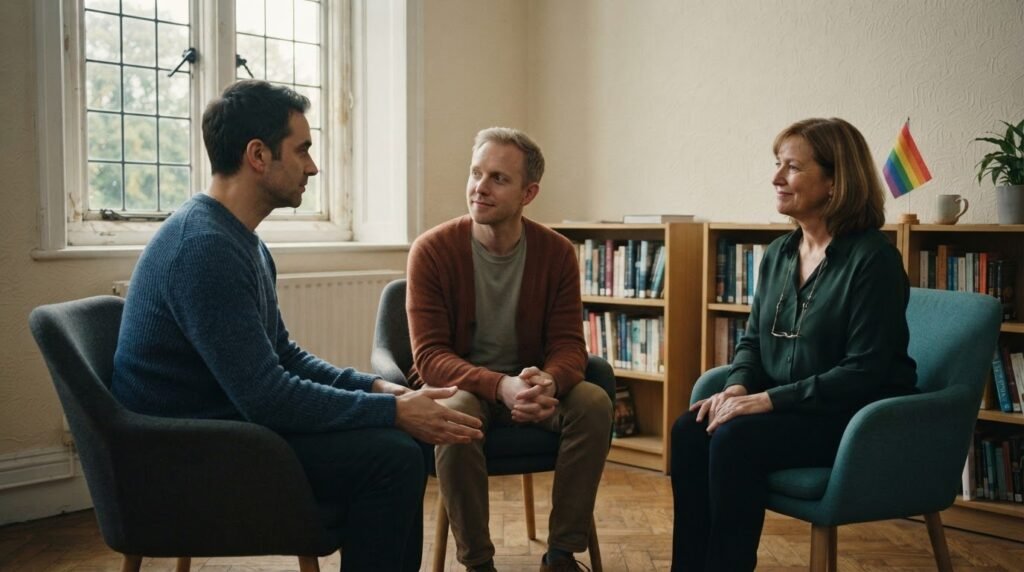
What if repeated arguments aren’t a sign that your relationship is beyond repair, but a pattern you can begin to understand together? For LGBTQ partners in the UK, couples counselling can offer space to explore what’s happening beneath the conflict, whether you’re struggling to communicate, feeling disconnected or unsure how to move forward.
It can be difficult to talk openly when the same disagreements keep returning, especially if you’re also navigating pressures around identity, acceptance or change. You don’t need to have everything worked out before seeking support. A thoughtful conversation can help you notice how each partner responds, what those reactions may be protecting and how a different kind of dialogue might become possible.
This article explains when couples counselling may help and how it can make recurring communication patterns easier to recognise and shift. It also explores what LGBTQ-affirmative support can involve, including when individual counselling may be helpful.
Key Takeaways
- Notice when recurring conflict, disconnection or difficult transitions may be signs that couples counselling could help, and consider whether online or in-person sessions suit you both.
- Look beneath repeated disagreements to understand the pattern between you, then explore ways to slow down conflict and communicate more openly.
- When seeking LGBTQ-affirmative support, consider a therapist’s qualifications, relevant experience, approach and understanding of your identities.
- Individual counselling can sit alongside relationship support, helping each partner explore personal concerns as well as shared challenges.
When might couples counselling help?
Counselling may help when the same disagreement keeps returning, affection feels harder to reach, or a change in identity, commitment or family life creates distance. For example, a lesbian couple may want space to discuss how one partner’s coming out affects closeness. Online video sessions can bring couples together remotely, including partners who live apart or find travel difficult. Some services also work with groups, giving several partners room to explore relationship dynamics together.
Fees vary according to the therapist, location and session format. Some services offer reduced-fee or sliding-scale options, which can make support more accessible; ask what applies before beginning.
NHS provision varies by area and eligibility. Some NHS facilities limit counselling to 6 sessions, though this can vary; couples-specific, LGBTQ-affirmative support isn’t uniformly available through the NHS.
Online counselling can bring couples together without requiring both partners to travel. For privacy, choose a quiet room where others can’t overhear, use headphones and agree how you’ll handle interruptions. Group sessions need particular care: each participant should have a private space to speak freely.
In-person sessions offer a shared room and face-to-face interaction; online sessions offer flexibility and access from different locations. Couples counselling usually involves discussing what brings you in, noticing how each partner responds during conflict, and practising clearer ways to communicate. There’s no fixed number of sessions: the work may be short-term or longer, depending on your aims and the patterns you want to change. Counselling can help you explore those aims together. A useful first step is to agree what you both hope will feel different. Online sessions can also make support practical for partners in different locations.
Communication breakdown and relationship patterns
A repeated argument can point to a pattern, not simply a difference of opinion. Looking at what happens before, during and after conflict can help partners understand how each person responds.
Communication breakdown
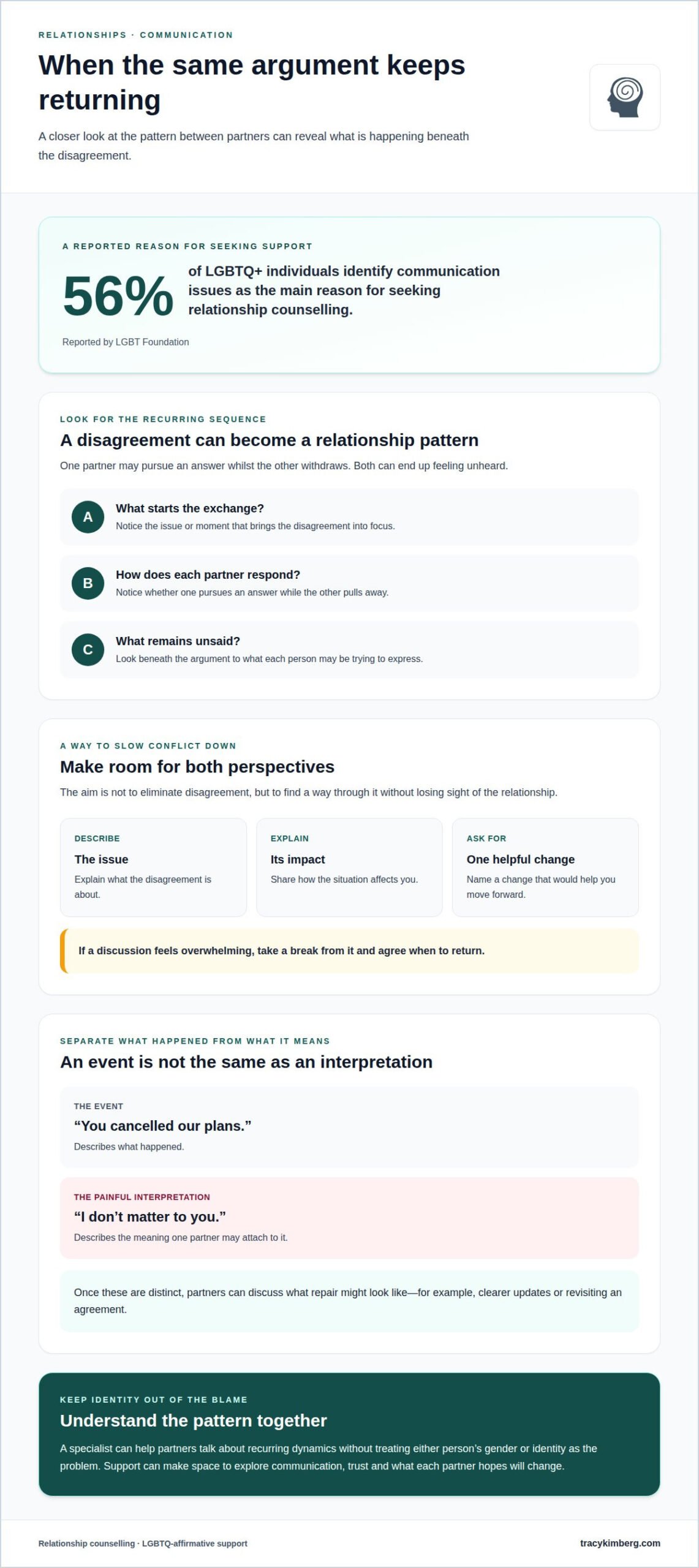
Communication can break down when one partner pursues an answer while the other withdraws, leaving both feeling unheard. For example, a disagreement about household responsibilities may quickly become a dispute about whether either person feels valued. LGBT Foundation reports that 56% of LGBTQ+ individuals identify communication issues as the main reason for seeking relationship counselling. Notice the repeated sequence: what starts the exchange, how each responds, and what remains unsaid. A specialist can help partners discuss the pattern without treating either person’s gender or identity as the problem.
Conflict resolution
Conflict resolution starts by slowing the exchange enough for both partners to explain what matters. If you feel overwhelmed, take a break from an intense relationship discussion and agree when to return to it. Then each partner can describe the issue, its impact and one helpful change they’re seeking. For instance, a couple discussing boundaries in an open relationship might clarify what information they need to feel informed and respected. The aim isn’t to eliminate disagreement, but to find a way through it without losing sight of the relationship.
Trust and relationship conflict
Trust can become strained when conflict repeatedly ends in silence, broken agreements or uncertainty about boundaries. A useful step is to separate the event from its meaning: “You cancelled our plans” describes what happened, whilst “I don’t matter to you” describes a painful interpretation. Partners can then discuss what repair would look like, such as clearer updates or revisiting an agreement. This matters in monogamous and open relationships alike. If you’re ready to explore these patterns together, relationship counselling and coaching can offer a space to work on communication and trust.
Do LGBTQ-affirmative therapists receive special training?
LGBTQ-affirmative couples counselling recognises sexual orientation, gender identity and relationship diversity without treating them as problems to change. A therapist creates space for partners to discuss intimacy, family pressures or expectations around marriage with respect. Training and experience vary, so ask how the therapist’s learning informs their work with LGBTQ+ couples.
Start by considering both practical and personal fit: location or online access, experience with couples, therapeutic approach and understanding of identity-related concerns. A therapist may have experience supporting gay, lesbian, bisexual, trans and queer couples. Consider whether you feel able to speak openly with them and whether their way of working matches what you hope to develop together.
Qualifications matter, but so does how a therapist applies them. Look for relevant professional training and ask about ongoing learning in LGBTQ+ relationships. You might ask for an example of how they support partners with different coming-out experiences or through gender transition. Their response can show whether they listen with curiosity and respect, rather than relying on assumptions.
Systemic therapy looks at relationship patterns and the wider influences around them, such as family, culture and social pressures. Psychodynamic work explores how earlier experiences may shape present emotional responses and intimacy. Integrated systemic and psychodynamic frameworks have more than 50 years of history. Together, these perspectives can help partners work through both their shared dynamic and individual feelings.
Couples sessions focus on the interaction between partners; individual therapy can offer space to explore personal concerns that affect the relationship. One partner might use individual support to understand anxiety while both work on communication together. The formats can complement each other, with attention to each person’s needs and the shared relationship.
LGBTQIA+ couples and individual counselling
Couples counselling for LGBTQ partners in the UK can make room for concerns that affect both the relationship and each person’s wellbeing. Partners may have different levels of openness with family or be deciding how to respond to a relative’s rejection. The aim is to understand how each person experiences the situation and what support feels respectful, rather than assuming they will respond in the same way.
Individual therapy can help when anxiety, depression or emotional strain feels difficult to discuss together. One partner might want space to understand their own reactions before raising a sensitive subject at home. That personal reflection can sit alongside relationship work focused on how partners communicate and make decisions together. Each format has a distinct purpose, and choosing one doesn’t invalidate the other.
Support can also help people consider what they need from a relationship, especially during periods of uncertainty. For instance, partners may have different expectations about privacy, family involvement or how they describe their relationship to others. Exploring those differences with care can clarify what is negotiable and where a boundary matters. The conversation should respect each person’s identity, not frame it as something to explain away.
Before an appointment, each partner could identify one concern they hope to address and one question they’d like to ask. You might want to understand how individual experiences will be held within joint sessions, or how support can adapt if your needs change. These points offer a grounded start without requiring you to arrive with a solution. To explore support for your relationship, find out about relationship counselling for LGBTQIA+ couples.
Tracy Kimberg: Relationship Counselling and Coaching for Couples
Tracy Kimberg offers Relationship Counselling and Coaching for Couples to help partners understand recurring conflict, rebuild trust or address emotional distance. Sessions can provide space to explore how each partner’s needs, history and responses shape the relationship, rather than deciding who is at fault. Support may be relevant whether you’re facing a specific rupture or feeling disconnected over time.
A structured three-month relationship recovery programme offers a defined period for working on relationship dynamics. It may suit partners who want sustained, focused support as they address relational breakdown, infidelity or patterns that keep returning. The work begins with understanding what has happened and what each person hopes can change, then develops towards clearer ways of relating. Progress can be considered against the couple’s own aims and changing needs.
Individual concerns can also affect partnership. Therapy for Adults can provide space to explore anxiety, depression or emotional disconnection, including how these experiences shape communication and closeness. Therapy for Teenagers supports younger people with their own emotional difficulties; it is separate from couples work, with a different focus and needs.
Choosing a next step doesn’t require having a complete plan. Consider whether you want to attend as a couple, focus first on your own experience or explore a structured recovery process. It may help to name one concrete concern, such as recurring arguments or loss of trust, and one hope for the work. These can guide an initial conversation.
If you’d like to discuss a possible next step, contact Tracy Kimberg.
Take a thoughtful next step together
Change doesn’t begin with perfect words or agreement about everything. It can begin by recognising a pattern and becoming curious about what each of you needs. Couples counselling for LGBTQ partners in the UK can offer a place to explore that curiosity with care and respect for each partner’s identity and experience.
You might start by naming one hope for your relationship, such as feeling closer, having difficult conversations with less fear or understanding what keeps pulling you into the same disagreement. That intention can give an initial conversation direction without requiring you to know the outcome. If you’re unsure whether to begin together or individually, that uncertainty can also be part of the discussion.
Taking a first step is not a promise that everything will change at once. It’s an opportunity to speak openly, understand what matters, and consider what support may fit your situation. Contact Tracy Kimberg to start a conversation about the next step. You can move forward at a pace that feels manageable.
Frequently Asked Questions
How can I enquire about a therapist’s experience with LGBTQ issues?
Ask directly about the therapist’s experience supporting LGBTQ+ couples and how they keep their practice informed. You could ask, “How do you make space for different identities and relationship structures?” or “How do you approach conversations about coming out?” Notice whether the answer is open and specific, and whether you feel listened to. You can also ask how they respond if an assumption causes discomfort.
How do I know if relationship counselling can help?
It may be worth exploring counselling if conversations repeatedly stall, a decision feels impossible to make together or one partner feels alone with a shared concern. You don’t need to be on the brink of separation. For example, counselling could help you discuss how to divide caring responsibilities or decide whether to move. A useful starting point is identifying what you’d like to understand or handle differently.
What are the benefits of having therapy for relationship issues?
Therapy can help partners put difficult feelings into words, hear each other’s needs and make clearer agreements. It can also help you recognise what is working, not only what hurts. For example, a couple deciding how to handle contact with a former partner could use sessions to explore boundaries and expectations. The process can support more considered choices, even when partners ultimately want different things.
How can LGBTQ couples find a qualified couples counsellor in the UK?
Begin with your priorities: LGBTQ+ understanding, couples work, preferred approach and online or face-to-face sessions. Then read how a counsellor describes their practice and arrange an initial conversation to discuss your goals. Ask how they would approach a concern specific to your relationship, such as differing views about disclosure to family. Their response can help you assess whether their approach feels respectful and relevant.
Which UK directories list LGBTQ-friendly relationship therapists?
Search UK counselling directories for listings that identify both relationship counselling and LGBTQ+ experience. Try terms such as “LGBTQ+ couples counsellor” alongside your town or “online”. Treat a directory profile as a starting point, then read the therapist’s own description of their approach and relevant experience. A clear listing should help you understand the kinds of relationships and concerns they work with.
What qualifications and accreditation should a UK couples counsellor have?
Ask about the counsellor’s core training, couples-therapy education and experience with LGBTQ+ partners. You can also ask whether they hold accreditation or membership with a professional body and what that involves for their practice. A profile alone may not tell you everything about their qualifications. A helpful response explains their training plainly and connects it to how they would work with your concerns.

Article by
Tracy Kimberg
Tracy Kimberg is a Relationship Expert, Couples Therapist and Coach with a dedicated focus on helping couples and individuals rebuild connection, trust and emotional safety in their relationships. Drawing on the research of John and Julie Gottman, the relational insights of Esther Perel, and years of hands-on therapeutic experience, Tracy offers a warm, non-judgemental and deeply compassionate approach to modern relationships.
Based in Dorset, Tracy works with couples navigating communication breakdowns, betrayal, intimacy challenges, separation, family dynamics and life transitions. Known for creating a safe and grounded therapeutic space, she combines practical tools with emotional depth to help clients move beyond survival patterns and towards meaningful, lasting change.
With a reputation for empathy, professionalism and dedication to her clients’ growth, Tracy is passionate about helping people feel seen, understood and empowered — both within their relationships and within themselves.
Disclaimer
Disclaimer:
The information shared in this article is intended for educational and informational purposes only and should not be considered a substitute for professional therapeutic, psychological, medical or legal advice. Every individual and relationship is unique, and the perspectives offered are based on general therapeutic principles, research and professional experience.
Reading this article does not establish a therapist-client relationship with Tracy Kimberg. If you are experiencing significant emotional distress, relationship crisis, trauma, or mental health concerns, it is important to seek support from a qualified professional appropriate to your individual circumstances.
All content remains the intellectual property of Tracy Kimberg and may not be reproduced or distributed without permission.