

What if the friction you feel when your partner undermines your rules isn’t actually about the children at all, but a mirror reflecting your own unmet needs and childhood blueprints? Dealing with different parenting styles often feels like a battle for the soul of your home, leaving you feeling like the “villain” whilst your partner plays the “favourite”. It’s exhausting to watch resentment build over inconsistent boundaries that your children have already learned to exploit. You aren’t alone in feeling that this constant tug-of-war is slowly eroding the intimacy you once cherished.
I understand the weight of this disconnect, but I also know that these clashes can become a profound opportunity for relational healing. This guide will show you how to bridge the gap between your conflicting approaches, allowing you to move from defensive posturing to a place of deep mutual respect. We’ll explore how to establish a unified front that provides your children with the stability they crave, whilst transforming your partnership into a source of strength rather than a site of constant negotiation. Together, we can discover a way to align your values and restore peace to your household.
Key Takeaways
- Recognise that your parenting style isn’t a fixed trait but a reactive behaviour rooted in your own childhood blueprints and attachment history.
- Discover why the authoritative approach, balancing high warmth with clear boundaries, creates the most stable environment for your children to thrive.
- Learn how dealing with different parenting styles can inadvertently erode the respect and intimacy in your partnership if you don’t address the underlying disconnect.
- Master practical strategies like the “Values Audit” and the “Gottman Rapoport” intervention to transform household tension into a unified front.
- Explore how a structured programme of relationship development can help you break deep-seated patterns and restore the emotional health of your family.
Why We Clash: The Hidden Blueprints Behind Your Parenting Style
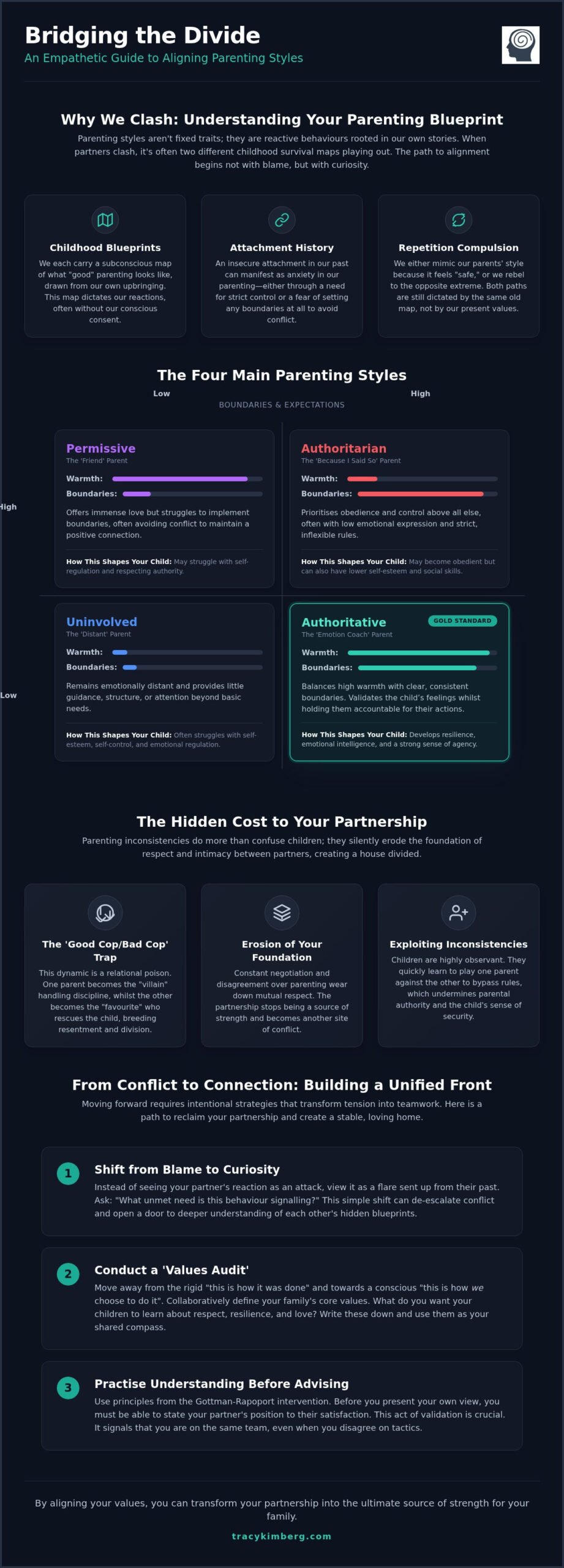
We often speak about parenting styles as if they are fixed personality traits, like being left-handed or having blue eyes. In reality, these approaches are better understood as reactive behaviours. When you find yourself dealing with different parenting styles in your relationship, you’re usually witnessing two different survival strategies playing out in real-time. These reactions aren’t chosen from a menu; they’re deeply rooted in how we were cared for, or perhaps how we weren’t.
A parenting blueprint is the subconscious map we follow from our own childhood. This internal guide dictates what “good” parenting looks like, often without us ever questioning its origin.
This leads to what psychologists call repetition compulsion. You might find yourself mimicking your parents’ strictness because it’s the only way you know how to feel safe and in control. Alternatively, you might rebel against their style entirely; swinging to the opposite extreme of permissiveness to avoid repeating the pain you felt. Both paths are still dictated by the same old map. Recognising that your partner is also following their own blueprint can help shift the conversation from blame to curiosity.
The Influence of Attachment Theory
Secure attachment in a parent often manifests as a calm, flexible approach to discipline. However, if you grew up with insecure attachment, your parenting might be laced with anxiety. This often looks like a desperate need for strict control or, conversely, a fear of setting any boundaries at all to avoid conflict. When your partner reacts strongly to a child’s behaviour, try to see their “trigger” as a flare sent up from their own history. It’s often a sign of an unmet need from their past rather than a deliberate attempt to undermine your authority.
Cultural and Generational Differences
Our backgrounds bring a rich tapestry of cultural expectations, but they can also carry the weight of generational trauma. Honouring your heritage doesn’t mean you have to replicate every tradition, especially those that no longer serve your family’s emotional health. The goal is to move away from the rigid “this is how it was done” and towards a conscious “this is how we choose to do it”. By creating a new, shared family culture, you can break the cycle of past hurts and build a foundation based on your current values as a couple. This intentionality is the first step in dealing with different parenting styles effectively.
The Four Main Parenting Styles and Their Impact on Family Harmony
Understanding the four pillars defined by Diana Baumrind is essential when dealing with different parenting styles. It allows you to focus on the behaviour rather than attacking your partner’s character. Most of us fall into one of these camps: Authoritative, Authoritarian, Permissive, or Uninvolved. Each style carries its own emotional frequency and creates a distinct atmosphere within the home, often clashing with the others in unexpected ways.
Authoritarian parents prioritise obedience and control, often relying on the “because I said so” mantra. There’s low warmth but high discipline. In contrast, Permissive parents offer immense love and warmth but struggle to implement any meaningful boundaries, often acting more like a friend than a parental figure. Uninvolved parents remain emotionally distant and provide little guidance or structure. The friction begins when these worlds collide under one roof and partners find themselves pulling in opposite directions.
Many couples fall into the “Good Cop/Bad Cop” trap, thinking it balances the scales. It doesn’t. This dynamic is a relational poison. One parent becomes the “villain” who handles all the heavy lifting of discipline, whilst the other becomes the “favourite” who rescues the child from consequences. Children are remarkably observant. They quickly learn to exploit these inconsistencies, playing one parent against the other to bypass rules. This doesn’t just disrupt the child’s sense of security; it erodes the foundation of your partnership and creates a house divided.
The Authoritative Gold Standard
Research by John Gottman highlights that authoritative parenting, often referred to as “Emotion Coaching,” is the gold standard for raising resilient, emotionally intelligent children. This style balances high warmth with high boundaries. You validate the child’s internal experience whilst holding them accountable for their external actions. It fosters a sense of agency and self-regulation that lasts well into adulthood. Moving toward this style as a team requires a specialised approach to relationship coaching, helping you align your values so you can present a unified front.
The Friction Points: When Styles Collide
The most explosive conflicts usually occur between a permissive parent and an authoritarian one. The authoritarian parent feels they must become even stricter to compensate for their partner’s perceived “laxness.” This causes the permissive parent to become even softer to “protect” the child from the other’s harshness. It’s a vicious cycle of polarisation. Resentment grows rapidly when one partner feels isolated in the role of the enforcer. If one parent is “Dismissive” of a child’s emotions, the other often feels overwhelmed by the burden of being the sole emotional anchor for the family. This imbalance leads to burnout and a deep sense of being unsupported.
Beyond the Argument: How Parenting Inconsistency Affects Your Relationship
When you are dealing with different parenting styles, the tension rarely stays confined to the nursery or the dinner table. It bleeds into the bedroom and the quiet moments you once shared. Esther Perel often speaks about the fundamental tension between “the domestic” and “the erotic”. The domestic realm thrives on predictability, chores, and the endless logistics of child-rearing. However, the erotic realm requires mystery, play, and a sense of autonomy. When your relationship becomes a battlefield over discipline, the domestic completely swallows the erotic. You stop seeing your partner as the person you fell in love with and start seeing them as an obstacle to your parenting goals.
This is how the “Roommate Phase” begins. You become co-managers of a small, chaotic organisation rather than lovers. Your conversations shift from dreams and desires to a list of grievances about bedtime routines. Children are highly sensitive to this lack of alignment. When they sense a gap between you, they often become “triangulated”. This means they are pulled into adult conflicts, sometimes forced to take sides or act as a buffer. It’s a heavy burden for a child to carry and a sign that the partnership needs urgent recalibration to restore its emotional health.
The Cost of Undermining
Correcting your partner in front of your children is a relational “Four Horsemen” event. It signals a lack of respect and breaks the safety of the family unit. When a child witnesses one parent undermining the other, it creates psychological instability. They lose the sense of a secure, unified base. To fix this, you must adopt a “closed door” policy. Disagreements about rules or consequences happen in private, never in front of the audience of your children. This protects the authority of both parents whilst dealing with different parenting styles in a way that preserves mutual respect.
Reclaiming the Romantic Partnership
It is vital to separate your roles as “Co-parents” and “Lovers”. You are more than just the people who organise the school run. Establishing rituals of connection that have nothing to do with the kids is essential for long-term survival. This might be a ten-minute coffee in the morning before the house wakes up or a strict “no-kid-talk” rule during your weekly date nights. Remember, a healthy, vibrant relationship is the greatest gift you can give your children. It provides them with a blueprint for what a loving, respectful partnership looks like, proving that your bond exists independently of your parental duties.
Navigating the Divide: Practical Strategies for Co-Parenting Alignment
Bridging the gap between conflicting approaches requires more than just good intentions; it demands a structured reconciliation framework. When you are dealing with different parenting styles, the goal isn’t to win an argument but to find a middle ground where both partners feel respected and the children feel secure. This process moves you from reactive clashing to intentional collaboration.
To begin this shift, consider these five foundational steps:
- The Values Audit: Strip away the specific rules and look at the “why” behind your choices.
- The Gottman Rapoport Intervention: A communication tool where one partner speaks whilst the other listens and paraphrases without judgement before switching roles.
- The Family Manifesto: A written rulebook that outlines your shared non-negotiables.
- The Weekly Parenting Meeting: A dedicated 20-minute slot to organise the “business” of the household.
- The Unified Front: Committing to support your partner’s decision in the moment, even if you plan to discuss it later in private.
The Values Audit Exercise
Most parenting wars are fought over “how” things are done, but the resolution lies in the “why”. Sit down together and write a list of the top five values you want your child to embody as an adult. You might choose kindness, discipline, curiosity, or resilience. You’ll likely find that you both want the same outcomes, even if your methods differ. Focusing on this common ground makes the specific disagreements over bedtimes or treats feel much smaller. If you find yourselves stuck in a cycle of polarisation, my 12-Week Relationship Recovery Process provides the safe, non-judgemental space needed to align these core values.
Effective Communication Under Pressure
When tension rises, use a “Gentle Start-up” to voice your concerns. Instead of saying, “You’re always too soft on them,” try an “I” statement like, “I feel overwhelmed when our boundaries around screen time aren’t consistent.” This expresses your internal experience without attacking your partner’s character. If a disagreement happens in real-time, it’s better to stay silent or offer a neutral “Let’s talk about this in a minute” than to correct your partner in front of the child. This preserves the sense of a unified front whilst ensuring the child doesn’t receive conflicting signals that they can later exploit.
Consistency is the greatest gift you can give your family. By treating your parenting disagreements as a collaborative puzzle rather than a personal affront, you model emotional intelligence for your children. This structured approach ensures that the “domestic” logistics don’t overwhelm the “erotic” connection and mutual respect that brought you together in the first place.
Reclaiming Your Partnership: How Professional Coaching Bridges the Gap
Sometimes, despite our best efforts and the most sincere intentions, we find ourselves stuck in a loop. When you are dealing with different parenting styles, simply “trying harder” often leads to more of the same friction because the patterns are so deeply ingrained. These aren’t just disagreements about bedtimes; they are echoes of our own histories. This is where a neutral third party becomes essential. A professional can help de-escalate the “parenting wars” by providing a safe space where neither partner is the villain. We move away from the binary of “right vs wrong” and start asking a more transformative question: “What actually works for our family?”
The 12-Week Relationship Recovery Path
Tracy Kimberg’s 12-Week Relationship Recovery Process is designed specifically to address these relational breakdowns. By using a research-based approach inspired by the Gottman Method and Esther Perel’s systemic insights, this structured path helps you identify the root causes of your disconnect. It isn’t just a clinical necessity; it’s a proactive and positive adventure. You’ll learn to rebuild trust and find alignment, transforming your home from a battlefield into a sanctuary of mutual respect. This process allows you to see your partner as an ally again, rather than a competitor for your children’s affection.
Individual Therapy for the Modern Parent
We must also recognise that our parenting is often coloured by our own internal landscapes. Unresolved anxiety, depression, or past trauma can make us cling to control or retreat into permissiveness. Individual therapy for adults provides a non-judgemental space to explore these triggers. By healing your own blueprints, you become a more present and flexible parent. I also offer specialised support for teenagers, ensuring that every member of the family has the tools to navigate these complex emotional transitions. If you’re ready to stop the cycle of conflict and start building a unified front, book a discovery call with Tracy Kimberg to start your journey to alignment.
Transforming Conflict into Connection
Your parenting journey doesn’t have to be a source of constant friction. By recognising the hidden blueprints that shape your reactions and committing to a values-led approach, you can move from defensive posturing to a place of deep alignment. Dealing with different parenting styles is ultimately an invitation to heal your own history whilst building a more resilient partnership. The goal isn’t to win the argument. It’s to provide your children with a stable, loving environment where both parents feel seen and respected.
If you’re ready to stop the “Good Cop/Bad Cop” cycle and reclaim the intimacy in your relationship, I’m here to guide you. My specialised 12-week structured programme offers a safe, non-judgemental environment for transformation. Using a research-based approach inspired by the work of Gottman and Perel, we’ll work together to turn your challenges into a proactive and positive adventure. Begin your 12-Week Relationship Recovery Process today and start the journey toward a unified family life. You’ve already taken the first step by being here. The path to healing is closer than you think.
Frequently Asked Questions
How do I handle it when my partner undermines my discipline in front of the kids?
You should pause the interaction immediately and address the child with a neutral statement like “We’ll discuss this and get back to you.” Avoid a public confrontation which erodes respect and confuses the child. Later, in private, use an “I” statement to explain how the undermining felt. Establishing a private space for these discussions ensures you remain a unified front. Children need to see that your bond is stronger than their ability to negotiate.
Can a relationship survive totally different parenting styles?
Yes, a relationship can thrive despite different approaches if you view the conflict as a catalyst for growth. Dealing with different parenting styles often forces a couple to examine their own childhood blueprints more deeply. By integrating your strengths, you create a more balanced environment for your family. Success depends on your willingness to move from “Right vs Wrong” to “What works for us,” often with the help of a neutral guide.
Is it ever okay to disagree with my partner’s parenting in front of the children?
It’s only advisable to intervene if there is an immediate safety concern or emotional harm occurring. In all other instances, you should wait until you’re alone to express your disagreement. Children quickly learn to navigate the “gap” between parents who argue publicly. By waiting, you preserve the authority of your partner and the stability of the household. This patience protects your romantic bond from becoming a casualty of parenting wars.
What should I do if my partner refuses to change their “Authoritarian” style?
Start by approaching their rigidity with curiosity rather than criticism. Rigid “Authoritarian” styles are often survival strategies rooted in childhood anxiety or a need for safety. Instead of demanding change, ask what they fear will happen if they are less strict. If the pattern is deeply entrenched, professional coaching can provide a safe, non-judgemental space to explore these triggers without the partner feeling attacked or judged for their methods.
How do we create a “unified front” when we fundamentally disagree on rules?
You must find the common values that sit beneath your conflicting rules. For example, you might disagree on bedtimes but both value the child’s physical health. Use this shared value as a bridge to reach a compromise that you can both support. Even if the rule isn’t your first choice, presenting it as a joint decision prevents the child from triangulating you into further conflict and preserves your mutual respect.
How does our own childhood affect how we parent today?
Your upbringing provides the “parenting blueprint” you follow subconsciously. If you experienced secure attachment, you’ll likely feel more comfortable with flexible boundaries. If your childhood was chaotic or overly rigid, you might parent as a reaction to that experience. Recognising these patterns helps you see your current parenting style as a behaviour to be understood rather than a fixed identity that can’t be changed or improved through conscious effort.
When should we consider professional relationship coaching for parenting issues?
You should seek support when you feel like you’ve drifted into the “Roommate Phase” or when resentment over discipline is killing your intimacy. If you can’t discuss the children without it turning into a battle, a neutral third party is essential. A structured 12-Week Relationship Recovery Process can help you de-escalate these wars and find a way back to each other, ensuring your partnership remains the family’s core strength.
Can different parenting styles actually be a strength for the child?
Differing perspectives can be a strength if they are aligned under a shared set of values. One parent might provide the “challenge” that builds resilience, whilst the other provides the “nurture” that builds emotional safety. When these styles are integrated rather than in conflict, they offer the child a rich, multidimensional emotional education. The key is ensuring that the styles complement each other rather than undermining the other’s authority.

Article by
Tracy Kimberg
Tracy Kimberg is a Relationship Expert, Couples Therapist and Coach with a dedicated focus on helping couples and individuals rebuild connection, trust and emotional safety in their relationships. Drawing on the research of John and Julie Gottman, the relational insights of Esther Perel, and years of hands-on therapeutic experience, Tracy offers a warm, non-judgemental and deeply compassionate approach to modern relationships.
Based in Dorset, Tracy works with couples navigating communication breakdowns, betrayal, intimacy challenges, separation, family dynamics and life transitions. Known for creating a safe and grounded therapeutic space, she combines practical tools with emotional depth to help clients move beyond survival patterns and towards meaningful, lasting change.
With a reputation for empathy, professionalism and dedication to her clients’ growth, Tracy is passionate about helping people feel seen, understood and empowered — both within their relationships and within themselves.
Disclaimer
Disclaimer:
The information shared in this article is intended for educational and informational purposes only and should not be considered a substitute for professional therapeutic, psychological, medical or legal advice. Every individual and relationship is unique, and the perspectives offered are based on general therapeutic principles, research and professional experience.
Reading this article does not establish a therapist-client relationship with Tracy Kimberg. If you are experiencing significant emotional distress, relationship crisis, trauma, or mental health concerns, it is important to seek support from a qualified professional appropriate to your individual circumstances.
All content remains the intellectual property of Tracy Kimberg and may not be reproduced or distributed without permission.