

What if the end of your marriage isn’t just a legal ending, but the beginning of a profound personal reclamation? For many women, the divorce process feels like being erased by a wave of paperwork and solicitors’ letters, leaving you feeling more like a case number than a person with a history. Finding specialised divorce coaching for women UK is often the first step in reclaiming that lost identity. It’s natural to worry about the impact on your children or fear that the coming months will be defined by high-conflict battles. You’ve spent years as part of a partnership, and now the prospect of standing alone feels both daunting and disorienting.
I understand that you want a transition marked by dignity rather than bitterness. You deserve a structured, conscious path through this complex emotional landscape. This article explores how to maintain emotional steadiness during negotiations and gain clarity on effective co-parenting strategies. We’ll look at how to move beyond the trauma of separation to build a vibrant, authentic life that honours your past whilst firmly embracing your new narrative.
Key Takeaways
- Learn why specialised divorce coaching for women UK is essential for navigating the psychological gaps left by the legal process.
- Discover the principles of “Conscious Separation” to help you move from reactive conflict to a state of relational intelligence and dignity.
- Identify the specific roles of your support team; ensure you know when to lean on a coach for the future and a therapist for the past.
- Gain practical tools to manage the cognitive fog of “divorce brain” and establish firm emotional boundaries during difficult negotiations.
- Understand how a structured recovery path can transform your ending into a proactive opportunity for personal growth and a new life narrative.
Understanding Divorce Coaching for Women in the UK
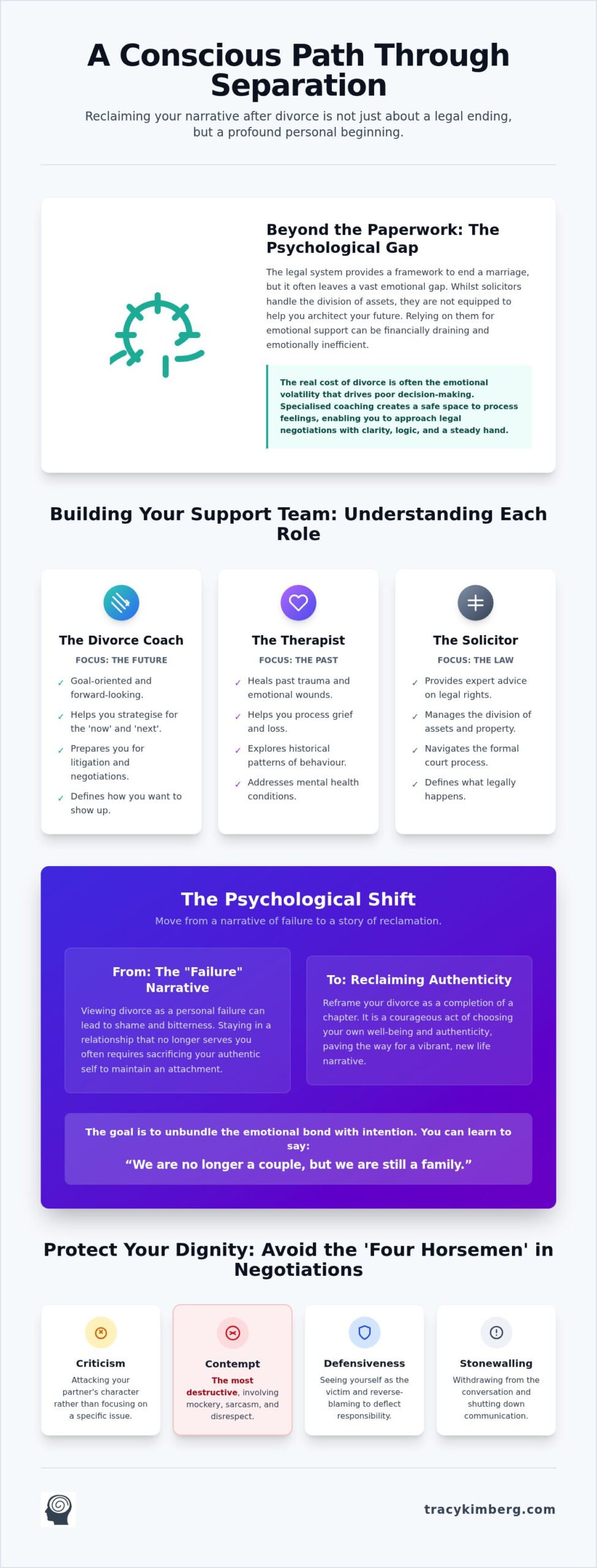
Divorce is often viewed through a narrow lens of legalities and assets, but for most women, it’s a profound identity crisis that requires more than just a decree absolute. While solicitors handle the division of property, divorce coaching for women UK focuses on the architecture of your future. It’s a goal-oriented partnership that anchors you in the “now” and the “next”. Since the introduction of the No-Fault Divorce law in 2022, the legal process has become less adversarial on paper, yet the emotional gap remains vast. The law can end a marriage, but it cannot heal a heart or help you find your voice in the aftermath.
A deeper understanding the divorce process reveals that the most expensive part of separation isn’t usually the court fees. It’s the emotional volatility that drives decision-making. When you’re stuck in a loop of anxiety or resentment, you might find yourself using your solicitor as a sounding board for your grief, which is an incredibly costly way to process pain. Specialist coaching provides a container for those feelings. By addressing the psychological weight of the transition, you can approach legal meetings with a clear head and a steady hand, ensuring your choices are driven by logic rather than fear.
The Role of a Divorce Coach vs a Solicitor
Your solicitor is your expert on the law, but your coach is your expert on your life. A solicitor provides the framework for what happens, whilst a coach helps you decide how you want to show up. By working through your options and emotional triggers beforehand, you become litigation-ready. This synergy ensures you aren’t wasting billable hours on emotional processing. Instead, you’re using that time for strategic, objective legal advice that protects your long-term interests.
Why Specialist Support for Women Matters
Women often carry a unique mental load that doesn’t disappear during a separation. You’re likely managing the children’s schedules, career demands, and social expectations whilst your internal world is shifting. For many “Queenagers” or women in midlife, divorce is tied to a significant identity shift. Specialist support provides a safe, non-judgemental space to untangle who you are outside of the partnership. It’s about finding clarity amongst the noise of family pressure, ensuring your ending is as conscious and dignified as your beginning. Through a Conscious Approached Divorce, you can transform a period of loss into a proactive investment in your future emotional health.
The Psychological Shift: From Conflict to Conscious Separation
Choosing a conscious path through separation doesn’t mean the pain disappears. It means you’re choosing to process that pain with intention. When we apply Esther Perel’s concept of Relational Intelligence to an ending, we see that a marriage can be a success even if it doesn’t last a lifetime. It’s about “unbundling” the emotional bond. You’re untangling the romantic intimacy whilst the legal and parental ties remain, which is exactly where divorce coaching for women UK provides the most value. It’s about learning to say, “We are no longer a couple, but we are still a family.”
A “good divorce” is often better for your long-term health than remaining in a “bad marriage” characterised by chronic stress and emotional distance. Prioritising emotional well-being during separation ensures that the transition doesn’t become a source of long-term trauma for you or your children. By shifting from a mindset of conflict to one of conscious separation, you’re not just ending a contract; you’re redesigning your relational landscape for the future.
Moving Beyond the “Failure” Narrative
Divorce isn’t a failure of character. It’s a completion of a specific chapter. Gabor Maté often speaks about the tension between authenticity and attachment. For many women, staying in a marriage that no longer serves them requires sacrificing their authentic selves to maintain the attachment. Reframing your divorce as an act of reclaiming that authenticity changes the story you tell yourself. If you’re struggling to find this balance, exploring a conscious approached divorce can help you navigate these choppy waters with grace.
Gottman Insights for a Dignified Ending
John Gottman’s research identifies the “Four Horsemen” that predict the end of a relationship: criticism, contempt, defensiveness, and stonewalling. In the heat of a divorce, these behaviours often intensify. Contempt is the most destructive, as it attacks your partner’s sense of self from a place of superiority. To protect your future co-parenting bond, you must learn to de-escalate these patterns. This involves maintaining a “Culture of Appreciation” for the history you shared, even as you move forward into separate lives. By acknowledging what was good, you prevent the past from being entirely eclipsed by the current conflict.
Divorce Coach vs Therapist vs Solicitor: Building Your Team
Assembling your support squad is about professional alignment. To move through this transition with dignity, you need a team that understands the distinct layers of a breakup. A solicitor is your legal advocate; they speak the language of the court and protect your statutory rights. A therapist is your healer; they help you untangle the “why” behind the relationship’s end. A coach is your strategist; they focus on the “how” of your daily survival and future growth. Seeking specialised divorce coaching for women UK ensures you aren’t trying to get legal advice from a therapist or emotional support from a solicitor.
Investing in coaching is often a piece of profound financial wisdom. Solicitors in the UK frequently charge hundreds of pounds per hour. If you use those billable hours to process your grief or vent about an ex-partner’s behaviour, you’re using a very expensive “listening” service. By working with a coach to become litigation-ready, you arrive at legal meetings with clear objectives and regulated emotions. This efficiency reduces the time your solicitor spends on administrative back-and-forth, ultimately preserving your settlement for your future life.
When to Seek Therapy During Divorce
Therapy is essential when the weight of the past feels too heavy to carry into your new chapter. Drawing on Gabor Maté’s insights, separation often triggers deep-seated trauma or attachment wounds that manifest as intense anxiety or depression. If you find yourself stuck in a loop of “why” or struggling with your mental health, Tracy’s Therapy for Adults provides the safe container needed for this deep work. It’s about processing the history so it doesn’t haunt your future narrative.
When Coaching Becomes the Priority
Coaching takes the lead when you need practical strategies for the present moment. This is particularly vital when managing the “Matrimonial Home” phase or negotiating complex co-parenting arrangements like “Birdnesting.” A coach helps you set firm boundaries with an ex-partner and develops the emotional resilience required to face the UK Family Court. It’s about building the “muscles” of your new identity. By focusing on action-oriented goals, divorce coaching for women UK empowers you to lead your family through the storm with a steady hand and a clear vision.
Strategies for Emotional Regulation and Dignity
When you’re in the middle of a separation, your brain often feels like it’s operating through a thick, impenetrable fog. This “Divorce Brain” isn’t a sign of weakness; it’s a physiological response to chronic stress. Your prefrontal cortex, the part of your brain responsible for logical decision-making, is being hijacked by your nervous system’s survival mode. This makes tasks like financial disclosure or reading solicitors’ letters feel like an assault. Regulating your nervous system is vital to ensure you don’t make permanent decisions based on temporary emotional states. Specialist divorce coaching for women UK provides the tools to find the “gap” between a legal trigger and your emotional response, allowing you to maintain your dignity whilst the world feels like it’s shifting beneath your feet.
Establishing clear emotional boundaries is essential to prevent “Relational Drift”. This is the tendency to fall back into old, unproductive communication patterns with your ex-partner. By treating your divorce as a professional transition, you protect your mental energy. You aren’t just ending a marriage; you’re organising a new way of being. This requires a conscious effort to stay grounded during high-stakes negotiations, ensuring your self-respect remains intact throughout the process.
The “Conscious Separation” Framework
Moving through a separation with intention requires a structured approach. Step one is radical honesty. It’s about acknowledging the truth of the situation without the need for blame or a “victim” narrative. Step two involves regulating your emotional response to legal triggers. When a confrontational email arrives, your body enters fight-or-flight. Coaching helps you process these spikes so you can respond with clarity rather than reactivity. Finally, step three is about narrative. You’re defining a new solo or co-parenting identity that isn’t built on the ruins of the past, but on the possibilities of your future.
Protecting the Next Generation
Children are incredibly sensitive to the emotional temperature of their home. Your “Behavioural Modelling” during this time becomes their blueprint for how to handle crisis and conflict in their own future bonds. Using Gottman-based communication strategies-such as avoiding the “Four Horsemen” in front of the children-is vital for their long-term security. It’s about keeping them out of the middle of adult conflicts. If the family transition feels particularly heavy for your children, Therapy for Teenagers can provide them with an independent, safe space to process their own grief. If you’re ready to move from overwhelm to clarity, explore how Conscious Approached Divorce support can help you protect your peace and your family’s future.
Reclaiming Your Narrative with Tracy Kimberg
Reclaiming your narrative is about more than just surviving the legal fallout. It’s an active, evolving experience where you move from being a passenger in your own life to the lead architect of your future. Tracy Kimberg’s signature approach to Conscious Divorce and Separation Support is designed to bridge the gap between clinical expertise and human connection. By utilising research-based methods from experts like Esther Perel and John Gottman, she helps you find the meaning amongst the wreckage. This specialised divorce coaching for women UK provides a structural anchor during a time when everything else feels fluid.
Tracy’s comprehensive approach, whilst beneficial for understanding all relationships, is a powerful tool for individual healing after a breakup. It allows you to process the relational breakdown safely and develop the relational competence needed for your next chapter. You aren’t just moving on; you’re evolving. This structured journey helps you transform what feels like a final ending into a vibrant, intentional beginning. It frames your engagement with the healing process as a proactive and positive adventure rather than a clinical necessity.
A Safe Environment for Transformation
Healing requires a container that is both non-judgemental and profoundly safe. In the UK, the pressure to “keep calm and carry on” often prevents women from truly processing their grief. Whether you prefer Face-to-Face Therapy or the accessibility of Online Therapy, finding a rhythm that suits your new life is essential. This flexibility ensures that your recovery isn’t another item on a stressful to-do list. Instead, it becomes a space for developing the version of yourself you’ve always wanted to be. You’ll learn to navigate adult life transitions with a sense of specialised care that honours your long-term emotional health.
Your Next Steps to Peace
It’s a common misconception that you must have every detail of your future mapped out today. Real progress often begins with a single, manageable step. Moving from a state of overwhelm to actionable clarity is a gradual process of reclaiming your voice. You deserve a space where your anxiety is met with immediate comfort and professional authority. Specialist divorce coaching for women UK is an investment in the woman you are becoming. If you’re ready to start this journey, you can Book a consultation for Conscious Divorce Support and begin the work of building your new, vibrant narrative.
Stepping Into Your New Narrative
The end of a marriage is undoubtedly a profound ending, but it’s also a sacred opportunity to reclaim the parts of yourself that may have been quietened over the years. By choosing a conscious path, you move beyond the “failure” narrative and begin to view your transition as a completion that honours your past whilst protecting your future. We’ve explored how building a specialised support team and regulating your nervous system can save you from both financial and emotional depletion. Finding the right divorce coaching for women UK ensures that you aren’t navigating this complex landscape alone.
Tracy Kimberg brings a research-based approach inspired by the works of Gottman and Perel to every session, providing a safe, non-judgemental space for your transformation. Whether you’re untangling a high-conflict bond or seeking clarity on your next steps, expert guidance helps you move from overwhelm into actionable peace. You don’t have to carry the weight of this change by yourself. Begin your journey to a conscious separation with Tracy Kimberg and discover the strength that lies in a dignified ending. Your future is not a static destination; it’s a proactive adventure that starts with a single, courageous choice.
Frequently Asked Questions
What exactly does a divorce coach for women do?
A divorce coach acts as a goal-oriented partner who helps you navigate the “now” and the “future” of your separation. Unlike a solicitor who handles the law, a coach focuses on your life. They help you manage the cognitive fog of “divorce brain” and build emotional resilience. By providing practical strategies for co-parenting and identity reclamation, they ensure you remain the lead architect of your new narrative whilst keeping your dignity intact.
How is divorce coaching different from relationship counselling?
Relationship counselling typically focuses on processing the past or attempting to repair a bond, whereas divorce coaching for women UK is specifically designed to manage the dissolution of that bond. Coaching is action-oriented and strategic, focusing on how to show up for negotiations and co-parenting. Whilst counselling explores the “why” of the breakdown, coaching provides the “how” for your survival and eventual growth in your post-separation life.
Can I start coaching if I am only contemplating divorce?
Yes, starting coaching during the contemplation phase is often the most impactful time to begin. It provides a safe, non-judgemental space to explore whether your marriage has reached completion or if there is a path toward recovery. By utilising research-based insights from Gottman and Perel, we can untangle the emotional confusion. This helps you move from a state of paralysing overwhelm to one of actionable clarity before any legal steps are taken.
Is divorce coaching recognised or helpful in UK legal proceedings?
Whilst a divorce coach doesn’t have a formal legal standing in court, they are highly valued by UK solicitors for making clients “litigation-ready.” By regulating your nervous system and clarifying your objectives before meetings, you can communicate more effectively with your legal team. This emotional steadiness often leads to more efficient proceedings and can significantly reduce billable hours, as you aren’t using your solicitor for emotional processing or sounding-board support.
How much does divorce coaching typically cost in the UK?
In the UK, divorce coaching for women UK typically costs between £75 and £150 for a one-to-one session. Many professionals also offer structured packages, which can range from a few hundred pounds for short-term support to several thousand for comprehensive, multi-month guidance. It’s best to view this as an investment in your future emotional health, as effective coaching often helps prevent the costly financial mistakes driven by high-conflict emotional reactions during the settlement process.
Will a coach help me with the legal paperwork or mediation?
A coach does not provide legal advice or act as a legal mediator, but they do help you prepare emotionally for these processes. They assist you in organising your thoughts and setting firm boundaries so that you can face mediation or financial disclosure with a steady hand. By focusing on your “Relational Competence,” a coach ensures you are prepared to advocate for your needs without being derailed by the provocations of an ex-partner.
Can coaching help if I am dealing with a high-conflict ex-partner?
Coaching is particularly vital when dealing with high-conflict dynamics. We focus on identifying “Four Horsemen” behaviours, such as contempt or stonewalling, and develop strategies to de-escalate these interactions. By establishing strict communication boundaries and learning to “unbundle” the emotional bond from the legal one, you can protect your peace. This approach is essential for maintaining a functional co-parenting relationship and preventing your ex-partner’s behaviour from defining your new life.
How long does the divorce coaching process usually take?
The duration varies depending on your specific needs, but many women find significant transformation through a structured 12-Week Relationship Recovery Process. Some may require intensive support during the initial “Matrimonial Home” phase, whilst others benefit from ongoing monthly sessions as they navigate the UK Family Court. The goal is to move you from crisis to a state of calm optimism, providing support for as long as it takes to reclaim your narrative.

Article by
Tracy Kimberg
Tracy Kimberg is a Relationship Expert, Couples Therapist and Coach with a dedicated focus on helping couples and individuals rebuild connection, trust and emotional safety in their relationships. Drawing on the research of John and Julie Gottman, the relational insights of Esther Perel, and years of hands-on therapeutic experience, Tracy offers a warm, non-judgemental and deeply compassionate approach to modern relationships.
Based in Dorset, Tracy works with couples navigating communication breakdowns, betrayal, intimacy challenges, separation, family dynamics and life transitions. Known for creating a safe and grounded therapeutic space, she combines practical tools with emotional depth to help clients move beyond survival patterns and towards meaningful, lasting change.
With a reputation for empathy, professionalism and dedication to her clients’ growth, Tracy is passionate about helping people feel seen, understood and empowered — both within their relationships and within themselves.
Disclaimer
Disclaimer:
The information shared in this article is intended for educational and informational purposes only and should not be considered a substitute for professional therapeutic, psychological, medical or legal advice. Every individual and relationship is unique, and the perspectives offered are based on general therapeutic principles, research and professional experience.
Reading this article does not establish a therapist-client relationship with Tracy Kimberg. If you are experiencing significant emotional distress, relationship crisis, trauma, or mental health concerns, it is important to seek support from a qualified professional appropriate to your individual circumstances.
All content remains the intellectual property of Tracy Kimberg and may not be reproduced or distributed without permission.