

Forgiveness is not a gift you give your partner; it is a boundary you set for your own psychological freedom. When a betrayal or deep hurt occurs, the world you built together can suddenly feel like a landscape of landmines. You might struggle with intrusive thoughts that replay the pain or notice a heavy physical tension that settles in your chest every time they walk into the room. It’s a profound loss of safety that leaves you wondering how to forgive your partner and move on without losing yourself in the process. Whilst a multinational study found that 75% of participants report often or always forgiving those who hurt them, the actual path to finding that peace remains one of the most difficult human experiences.
I recognise that you aren’t just looking for an apology; you’re looking for a way to breathe again. You deserve to be free from the exhausting loop of resentment that keeps you anchored to the past. This guide provides a research-backed, compassionate framework to help you navigate these complex emotional waters with clarity. We’ll explore how to release the grip of anxiety, restore your sense of internal peace, and ultimately decide if your relationship can be rebuilt into a space of renewed emotional intimacy. By the end, you’ll have the tools to move forward with a sense of purpose rather than just a heavy heart.
Key Takeaways
- Understand that true forgiveness is a conscious release of the desire for retribution, distinguishing healthy healing from “cheap forgiveness” that prematurely rushes the process.
- Learn how to apply research-based repair attempts and Esther Perel’s concept of the “new marriage” to view your partner through a lens of potential growth and transformation.
- Clarify the vital difference between your internal healing and the joint project of reconciliation, identifying the “green lights” that signal your relationship is safe to rebuild.
- Master a compassionate 5-step framework on how to forgive your partner and move on by honouring your pain whilst seeking the deeper “story of the hurt.”
- Discover practical ways to restore emotional safety using the “Trust Bank Account” metaphor to make consistent, daily deposits into your shared future.
What is Forgiveness in a Relationship? Redefining the Path to Peace
Forgiveness is often misunderstood as a passive surrender or a way of saying that what happened was acceptable. It isn’t. In its truest sense, the psychological definition of forgiveness involves the conscious, intentional release of the desire for retribution or revenge. It’s about deciding that you’ll no longer let the past hurt dictate your future emotional state. This isn’t about the other person’s worthiness; it’s about your own liberation.
We often see two extremes in the aftermath of a relational wound. “Cheap forgiveness” is a premature peace, often driven by a desperate need to keep the relationship intact without actually addressing the root cause. It’s a sticking plaster on a deep fracture. On the other end, a “refusal to forgive” leads to emotional stagnation, where the hurt becomes a permanent part of your identity. Learning how to forgive your partner and move on requires finding the middle ground where accountability meets grace.
Forgiving doesn’t mean you’ve developed amnesia or that you’re excusing the behaviour. You can acknowledge that a boundary was crossed whilst simultaneously choosing to let go of the corrosive anger that eats away at your peace of mind. It’s a way of saying: “What you did was wrong, but I refuse to let that wrongness define the rest of my life.”
The Myths of Moving On
Many couples I recognise in my practice believe forgiveness is a one-time event, a box to be ticked. In reality, it’s a recurring choice you make every morning. You don’t need a grand apology to start this process; forgiveness is an internal act of reclamation that belongs to you alone. It isn’t a sign of weakness or a lack of boundaries. In fact, it takes immense strength to hold a partner accountable whilst refusing to be consumed by the fire of their mistake. When you understand how to forgive your partner and move on, you realise that boundaries and forgiveness actually work together to create safety.
Why Resentment is a Weight on Your Wellbeing
Holding a grudge isn’t just an emotional burden; it’s a physical one. Chronic resentment keeps your body in a state of “high alert,” flooding your system with cortisol. This hormonal imbalance disrupts sleep, strains heart health, and weakens the immune system over time. When hurt remains unresolved, it colours every new interaction, turning a simple question into a perceived attack. This “resentment loop” creates a barrier to the very intimacy you might be trying to save. Ultimately, choosing to forgive is a profound gift of self-compassion that allows your nervous system to return to a state of safety and rest.
The Psychology of Letting Go: Insights from Relationship Experts
Forgiveness isn’t just a moral choice; it’s a biological one. Gabor Maté often reminds us that our brain’s primary job is survival, not happiness. When your partner hurts you, your nervous system registers it as a threat to your safety. This “betrayal trauma” isn’t something you can simply think your way out of. It leaves your body in a state of chronic hyper-vigilance, making the act of letting go feel like a dangerous risk. Understanding how to forgive your partner and move on requires acknowledging that your brain is trying to protect you from being blindsided again. As the American Psychological Association on forgiveness suggests, moving through this process is essential for reducing the long-term psychological distress that betrayal leaves in its wake.
The Gottman Perspective: Repairing the Breach
John Gottman’s decades of research show that the difference between “masters” and “disasters” of relationships isn’t the absence of conflict, but the presence of repair. A repair attempt is any statement or action, silly or serious, that prevents negativity from spiralling out of control. When you’re healing, these repairs are the building blocks of forgiveness. They require “attunement,” where both partners strive to truly understand the other’s inner world without defensiveness. Within the “Sound Relationship House” framework, forgiveness sits atop a foundation of trust and commitment. It’s built through small, daily interactions that prove you’re still on the same team, even when things feel fractured.
Esther Perel and the Complexity of Modern Betrayal
Esther Perel offers a provocative reframe: your first marriage is over. The question is, would you like to start a second one together? This perspective helps couples move away from the rigid “victim and perpetrator” roles that often lead to stagnation. Instead, she encourages you to become “co-authors” of a new narrative. This involves rediscovering the “otherness” of your partner, looking at them with fresh curiosity rather than through the narrow lens of the hurt they caused. Betrayal often triggers a deep identity crisis; you don’t just lose trust in them, you lose trust in your own judgment. Rebuilding requires reclaiming your sense of self whilst acknowledging that your partner is a complex human being, capable of both deep love and significant error.
If you feel stuck in the trauma of the past, my Relationship Counselling and Coaching provides a structured, safe environment to help you de-escalate the panic and begin the work of genuine repair. We don’t just talk about the problem; we work on the underlying attachment patterns that keep you from feeling secure.
- Move from blame to curiosity: Ask what the hurt reveals about the relationship’s unmet needs.
- Prioritise physiological safety: Use breathing techniques to calm your nervous system before difficult conversations.
- Focus on small deposits: Trust isn’t rebuilt in one grand gesture, but in a thousand tiny, consistent actions.
Forgiveness vs Reconciliation: Can You Have One Without the Other?
One of the most common misconceptions I see in my practice is the belief that forgiving someone automatically means staying with them. It doesn’t. Understanding the distinction between these two concepts is a vital part of learning how to forgive your partner and move on with clarity. Forgiveness is a solitary act of emotional hygiene; it’s an internal decision to stop carrying the weight of the injury. Reconciliation, however, is a mutual endeavour. It requires two people, two sets of efforts, and a shared commitment to building something new from the wreckage.
Reconciliation is only possible when certain “Green Lights” are present. This includes radical transparency, consistent behavioural changes, and what I call “True Remorse.” There is a profound difference between being sorry for the pain caused and simply being sorry for being caught. If your partner is defensive, continues to hide the truth, or refuses to acknowledge the impact of their actions, those are significant “Red Flags.” In these cases, forgiveness is still possible, but it must be paired with a healthy distance to protect your own wellbeing.
When Reconciliation is a Healthy Choice
If your partner shows a genuine willingness to do the heavy lifting, reconciliation can lead to a deeper, more resilient bond. This process involves creating a “New Contract” for your partnership. You aren’t trying to return to the way things were, because that version of the relationship allowed for the hurt to happen. Instead, you’re co-creating a new set of rules based on the lessons learned from the crisis. This requires the partner who caused the hurt to be patient with the healing timeline, making consistent “deposits” of reliability and honesty over many months.
Choosing Peace Through Conscious Separation
Sometimes, the most compassionate choice for your long-term mental health is to let the relationship go. Choosing peace through a conscious approach to divorce and separation allows you to forgive for the sake of your own future, and perhaps for the wellbeing of your children. Forgiving your partner in this context means you won’t take the poison of resentment into your next chapter. It allows you to move on with your dignity intact, acknowledging that whilst the partnership has ended, your capacity for peace remains. This path isn’t about failure; it’s about honouring the truth of the situation and choosing a life free from recurring trauma.
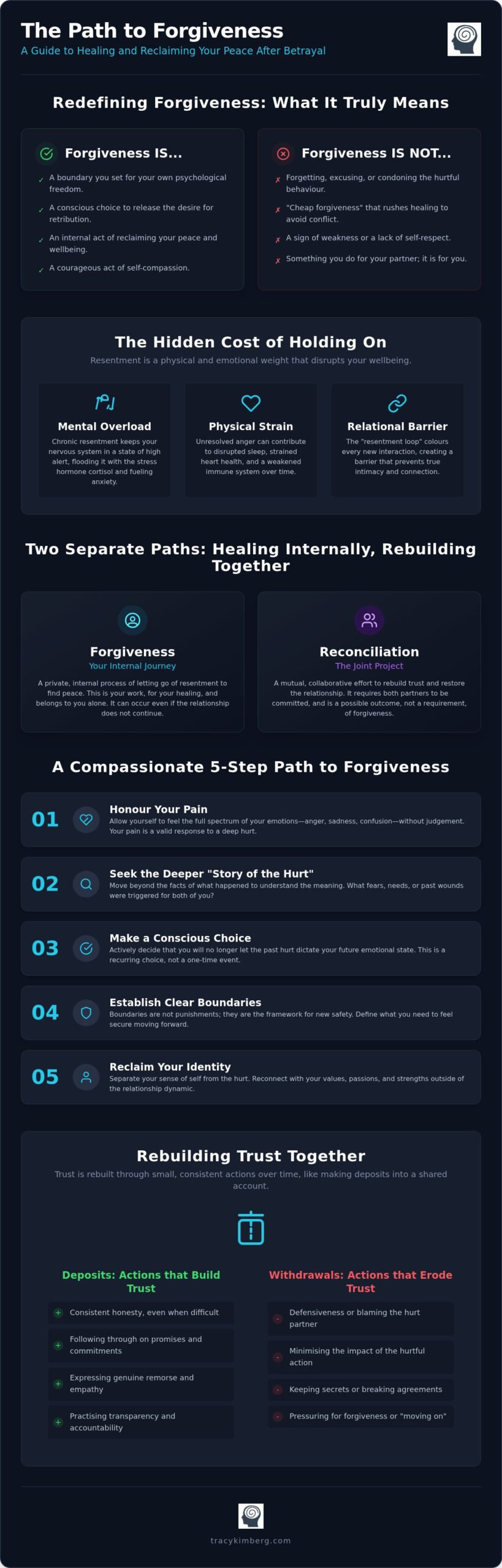
A 5-Step Path to Forgiving Your Partner and Moving On
Forgiveness is not a mystical event that happens to you; it is a series of deliberate, often difficult choices. Moving from the initial shock of betrayal into a space of peace requires a structured approach. If you’re wondering how to forgive your partner and move on, you must first move through the hurt rather than around it. It’s about taking the raw material of your pain and transforming it into a foundation for something new.
Step 1 & 2: Processing the Pain
The first step is to sit with the discomfort. Naming the pain is the first step to taming it. When you avoid acknowledging the depth of your injury, it stays trapped in your body as physical tension or recurring anxiety. Use journaling to identify the specific “unmet need” behind the hurt. Was it a need for emotional safety, a need to be seen, or perhaps a need for basic reliability?
Once you understand your own reaction, you can begin to seek the “Story of the Hurt.” This involves looking for the context of your partner’s actions without offering them an excuse. There is a vital distinction between an explanation and a justification. An explanation helps you understand the “why”, perhaps rooted in their own past trauma or a systemic disconnect in the relationship; whilst a justification would wrongly suggest their behaviour was acceptable. Learning how to forgive your partner and move on requires you to hold both the context and the accountability at the same time.
Step 3, 4 & 5: The Action of Letting Go
The middle of the path involves a conscious decision to release the desire for punishment. This is where you reclaim your psychological power. Holding onto the “debt” your partner owes you only keeps you tethered to the injury. By choosing to let go of the role of the punisher, you create space for your own restoration. It doesn’t mean the hurt didn’t matter; it means you’re choosing not to be defined by it.
Next, you must communicate your boundaries and needs for the future. These “Forgiveness Boundaries” are not about control; they are about protection. They define what you need to feel safe again, such as radical transparency or scheduled check-ins. Finally, practice active forgiveness. This means making the micro-choice every day to stay in the present rather than retreating into the past. For many couples, these steps feel overwhelming to manage without a map.
My Relationship Coaching for Couples provides the expert guidance needed to manage this complex landscape. This work is the core of my 12-Week Relationship Recovery Process, which offers a structured, safe environment for deep, transformational change.
Rebuilding Trust: Moving Forward Together After the Storm
Trust is often described as a fragile glass vase. Once broken, the shards can be glued back together, but the cracks remain. However, I prefer the metaphor of a “Trust Bank Account.” Every time your partner follows through on a promise, listens without judgement, or shows radical transparency, they make a deposit. Over time, these small, daily actions build a balance that provides emotional safety. Learning how to forgive your partner and move on means committing to this slow, deliberate accumulation of reliability. It’s about creating a “new normal” where transparency isn’t a chore, but a shared value that protects the relationship from future fractures.
Managing Triggers and Setbacks
Triggers are an inevitable part of the healing landscape. A certain song, a specific location, or even a subtle tone of voice can suddenly pull you back into the original hurt. When this happens, you need a “Safety Plan” to prevent a spiral. This involves communicating the trigger to your partner without blame, and your partner responding with deep empathy rather than defensiveness. Instead of saying “not this again,” a supportive partner might say, “I can see you’re hurting right now, and I’m here with you.” Regular relationship check-ups allow you to address these moments whilst they are small, ensuring that how to forgive your partner and move on becomes a lived experience rather than just a theoretical goal.
The 12-Week Relationship Recovery Process
Navigating the complex emotions of betrayal and emotional disconnect is exhausting when you try to do it alone. A structured framework removes the guesswork, providing a clear map through the fog of uncertainty. My approach is grounded in the proven, research-based methods of the Gottman Institute and the systemic insights of experts like Esther Perel. This ensures that your recovery isn’t just about “talking it out,” but about building actual, sustainable skills for long-term intimacy and conflict resolution.
By entering a safe, non-judgemental space, you can transform your relationship from a source of anxiety into one of profound growth and renewed connection. I invite you to explore my 12-Week Relationship Recovery Process to begin the work of reclaiming your shared future. This is more than just a clinical necessity; it’s a proactive adventure into the heart of what makes your partnership worth saving.
Choosing a Future Beyond the Hurt
Forgiveness is not about dismissing the past; it is about choosing to no longer be held hostage by it. You have explored the vital difference between your internal healing and the shared work of reconciliation, and why your physical wellbeing depends on releasing the weight of resentment. Understanding how to forgive your partner and move on is a journey that requires both courage and a structured map. Whether you choose to rebuild or consciously separate, you deserve a life defined by peace rather than the shadows of betrayal.
If the path forward feels unclear, you don’t have to navigate it alone. My 12-Week Relationship Recovery Process offers a safe, research-based framework rooted in Gottman and Perel methods to help you transform your relationship dynamic. Whether you prefer face-to-face sessions or online therapy, I am here to act as your wise guide through this transition. Book a discovery call for the 12-Week Relationship Recovery Process today to begin your proactive adventure toward healing. You are capable of moving through this storm and emerging with greater clarity, resilience, and a heart that is finally free to breathe again.
Frequently Asked Questions
How long does it typically take to forgive a partner after infidelity?
Healing is not a linear process and varies for every couple. Research indicates that 60% to 75% of couples who seek professional help after infidelity are able to rebuild their bond. Typically, it takes between one and two years for trust to feel stable again. This timeline depends heavily on the partner’s consistency in repair attempts and their willingness to provide radical transparency during the recovery phase.
Can I forgive my partner if they aren’t actually sorry for what they did?
Yes, because forgiveness is an internal act of emotional liberation. You choose to release the desire for retribution to free yourself from a “resentment loop” that drains your energy. However, whilst you can forgive them unilaterally to find your own peace, reconciliation is a joint project. A relationship cannot truly heal or move forward without the other person’s genuine remorse and a commitment to change.
What is the difference between forgiving and condoning bad behaviour?
Forgiving is the conscious release of the desire for punishment, whilst condoning is the act of justifying or excusing the behaviour. When you forgive, you still acknowledge that the action was wrong and that a boundary was violated. You are simply choosing to stop the fire of anger from consuming your own mental health. You can forgive someone whilst still holding them fully accountable for their actions.
How do I stop bringing up the past during every new argument?
This usually happens because the original wound hasn’t been fully validated or processed. When you feel the urge to “kitchen sink” during a row, it’s often a sign that your nervous system is in a state of hyper-vigilance. Learning how to forgive your partner and move on involves creating a “Safety Plan” where you name the trigger instead of attacking the person. This allows the hurt to be heard without destroying the current moment.
Is it possible to forgive but still choose to end the relationship?
Absolutely. Forgiveness is about your relationship with the past; ending a relationship is about your vision for the future. Choosing a Conscious Approached Divorce and separation allows you to walk away with your dignity intact. You can release the anger to ensure your next chapter is healthy, even if the partnership itself is no longer viable or safe for you to remain in.
What should I do if my partner refuses to acknowledge the hurt they caused?
If a partner refuses to acknowledge the pain, reconciliation becomes nearly impossible because there is no foundation of trust to build upon. In this scenario, your focus should shift to your individual healing. You can still work on forgiving them internally to reclaim your peace, but you must also re-evaluate whether a relationship without accountability or empathy is a healthy place for you to stay.
How do I know if I have truly forgiven my partner or if I am just suppressing it?
Suppression often feels like a “heavy” silence or a physical tension in the chest when your partner is near. True forgiveness feels like a release of that weight. If you find yourself replaying the hurt in intrusive loops or feeling a surge of cortisol during minor disagreements, you are likely suppressing. Genuine healing allows you to remember the event without the visceral, emotional sting that previously accompanied it.
How can relationship coaching help when we are stuck in a cycle of blame?
Professional guidance provides a neutral, safe space to de-escalate the cycle of blame. My 12-Week Relationship Recovery Process uses research-based tools from Gottman and Perel to help you move from “victim/perpetrator” dynamics to a “co-author” narrative. We focus on building emotional attunement and practical skills. This provides you with a structured, expert-led map on how to forgive your partner and move on whilst restoring your long-term emotional health.

Article by
Tracy Kimberg
Tracy Kimberg is a Relationship Expert, Couples Therapist and Coach with a dedicated focus on helping couples and individuals rebuild connection, trust and emotional safety in their relationships. Drawing on the research of John and Julie Gottman, the relational insights of Esther Perel, and years of hands-on therapeutic experience, Tracy offers a warm, non-judgemental and deeply compassionate approach to modern relationships.
Based in Dorset, Tracy works with couples navigating communication breakdowns, betrayal, intimacy challenges, separation, family dynamics and life transitions. Known for creating a safe and grounded therapeutic space, she combines practical tools with emotional depth to help clients move beyond survival patterns and towards meaningful, lasting change.
With a reputation for empathy, professionalism and dedication to her clients’ growth, Tracy is passionate about helping people feel seen, understood and empowered — both within their relationships and within themselves.
Disclaimer
Disclaimer:
The information shared in this article is intended for educational and informational purposes only and should not be considered a substitute for professional therapeutic, psychological, medical or legal advice. Every individual and relationship is unique, and the perspectives offered are based on general therapeutic principles, research and professional experience.
Reading this article does not establish a therapist-client relationship with Tracy Kimberg. If you are experiencing significant emotional distress, relationship crisis, trauma, or mental health concerns, it is important to seek support from a qualified professional appropriate to your individual circumstances.
All content remains the intellectual property of Tracy Kimberg and may not be reproduced or distributed without permission.