

What if the hardest part of your divorce isn’t the legal battle, but the war your nervous system is still fighting long after the papers are signed? Healing from a high-conflict divorce is not merely about the cessation of external conflict; it’s about the internal reclamation of your nervous system and your personal narrative.
You’ve likely spent years in a state of chronic hypervigilance, walking on eggshells whilst trying to maintain your sanity amidst gaslighting and relentless friction. It’s exhausting to feel like a stranger in your own skin, constantly braced for the next emotional blow. I know that the weight of this trauma doesn’t simply vanish because a judge signed a piece of paper. It lingers in the body, affecting how you breathe, think, and relate to the world.
This article provides a trauma-informed, research-based roadmap to help you regulate your nervous system and rediscover your sense of self. We’ll look at how to establish unwavering boundaries, soothe deep-seated anxiety, and rebuild your personal agency. You’ll find the tools to move through the fog of toxic separation and reclaim a life that feels truly yours, grounded in peace rather than survival.
Key Takeaways
- Recognise the physiological signature of hypervigilance and learn how to regulate your nervous system after years of chronic relational stress.
- Understand that healing from a high-conflict divorce is an internal process of uncoupling your emotional state from your ex-partner’s manipulative behaviour.
- Discover how to practice strategic detachment and “conscious separation” to protect your peace, even when the other party remains hostile.
- Reclaim your lost identity by moving through the essential stages of grief and reconnecting with the personal values that were suppressed during the marriage.
- Explore how a structured, research-based approach like the 12-Week Relationship Recovery Process provides the safety needed to move from survival to growth.
Defining the High-Conflict Divorce Experience
A high-conflict divorce is rarely about the logistics of assets or schedules. Instead, it’s defined by a persistent pattern of hostility, manipulation, and a refusal to co-operate. Whilst a standard Divorce eventually reaches a conclusion, high-conflict personalities often use the legal process as a tool for continued control. You might find yourself trapped in a cycle of gaslighting, where your reality is constantly questioned, or facing “paper abuse” through endless, unnecessary legal filings. Traditional closure feels impossible because the other party isn’t interested in resolution; they’re interested in winning. This is why healing from a high-conflict divorce requires a fundamental shift. You must move your focus away from their erratic behaviour and toward your own internal resilience.
The Anatomy of High-Conflict Dynamics
In these dynamics, the partnership doesn’t just end; it transforms into an adversarial arena. Normal communication methods, like those based on logic or mutual respect, simply don’t work. This is because the underlying power imbalance thrives on emotional volatility. When one person is determined to maintain dominance, every interaction becomes a chance to destabilise you. You aren’t dealing with a simple disagreement; you’re navigating a system where “winning” at all costs has replaced the goal of a peaceful separation. Recognising that you cannot reason with an unreasonable person is a painful but necessary step toward your own peace.
Identifying Post-Separation Abuse
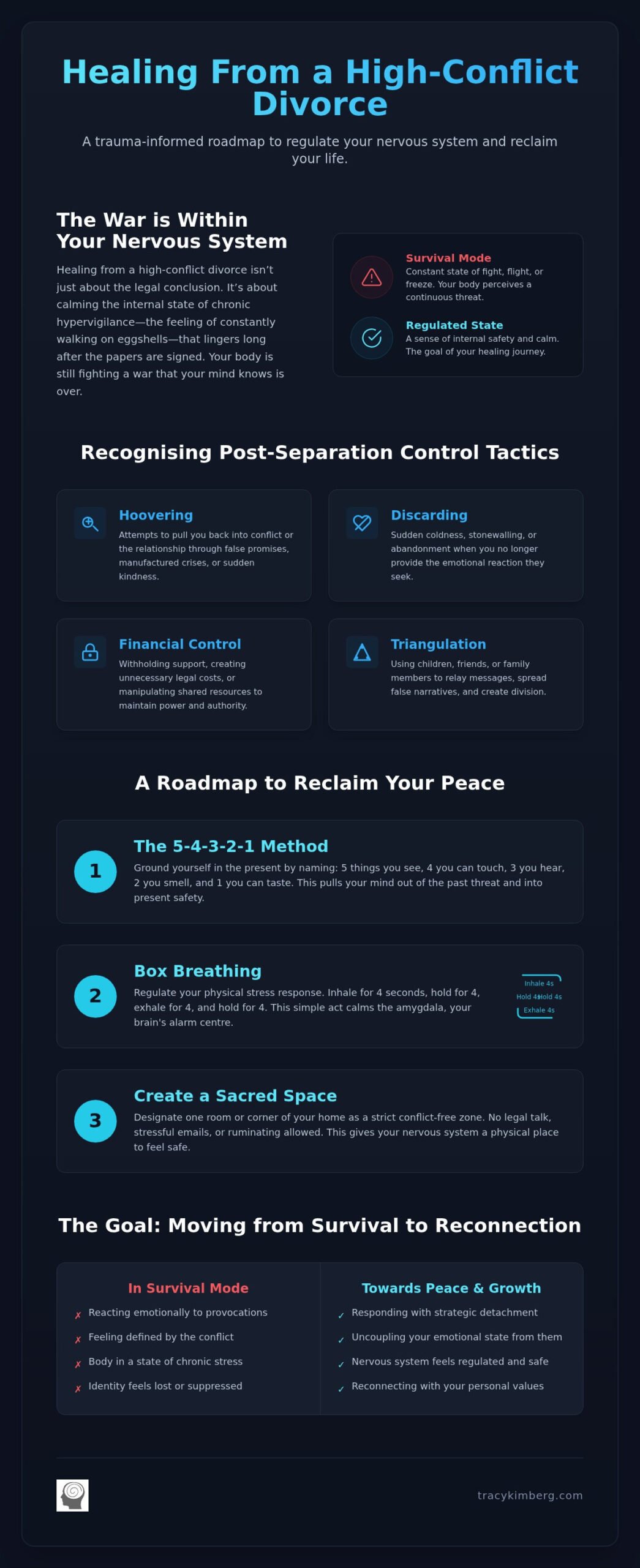
Control doesn’t always stop when you move out. It often morphs into subtle forms of post-separation abuse that are hard for outsiders to see. You might experience:
- Hoovering: Attempts to pull you back into the conflict or the relationship through false promises or sudden crises.
- Discarding: Sudden coldness or abandonment when you no longer provide the emotional reaction they seek.
- Financial Control: Withholding support or manipulating shared resources to maintain a sense of authority.
- Triangulation: Using children, friends, or family members to relay messages or spread false narratives.
It’s vital to realise that your anxiety or hypervigilance isn’t a sign of weakness; it’s a normal response to an abnormal situation. Your body is trying to protect you from a perceived threat that has been constant and unpredictable. Recognising these patterns is the first step in healing from a high-conflict divorce, allowing you to begin the process of building the boundaries necessary for your long-term emotional health.
Understanding Your Nervous System and Post-Divorce Trauma
The end of a relationship is often felt in the mind, but the end of a high-conflict marriage is felt in the marrow. As experts like Gabor Maté and Bessel van der Kolk suggest, the body keeps the score. When you’ve lived through a toxic separation, your nervous system often remains stuck in the past. This state of hypervigilance means you’re constantly waiting for the next “attack,” whether it’s a legal threat or a biting text message. This chronic state of alert is why so many people experience deep anxiety and depression long after the physical separation. Trauma-informed healing is the essential process of restoring internal safety to a body that has forgotten how it feels to be secure.
Moving Out of Survival Mode
Your body doesn’t know the divorce is over. It’s still operating in fight, flight, or freeze mode. When you are triggered, your amygdala takes over, shutting down the logical part of your brain. To begin healing from a high-conflict divorce, you need practical grounding techniques to signal to your brain that the immediate threat has passed. You might try:
- The 5-4-3-2-1 Method: Identify five things you see, four you can touch, three you hear, two you smell, and one you can taste.
- Box Breathing: Inhale for four seconds, hold for four, exhale for four, and hold for four.
- Sacred Space: Designate one room or corner of your home as a conflict-free zone where no legal talk or stressful emails are permitted.
Creating these boundaries for your physical environment is a vital step in calming your physiology. If you find yourself unable to step out of this survival state, specialised therapy for adults can provide the structured support needed to reset your internal alarm system.
The Relational Impact of Trauma
Years of hostility don’t just leave you tired; they alter your attachment style. You might find yourself swinging between a desperate need for connection and a profound inability to trust anyone. This emotional disconnect is a protective layer your psyche built to survive. It’s particularly challenging when navigating co-parenting in high-conflict situations, where the need for functional communication clashes with your instinct to withdraw. Somatic recovery begins with self-compassion. Instead of judging your “overreactions,” recognise them as your body’s attempt to keep you safe. By acknowledging these wounds, you start the real work of healing from a high-conflict divorce and preparing your heart for future, healthier connections.
True liberation begins when you realise that you don’t need your ex-partner’s permission or co-operation to find peace. This is the essence of “Conscious Separation”, a path where you choose to uncouple emotionally even whilst the other person remains trapped in a cycle of unconscious hostility. In the process of healing from a high-conflict divorce, the goal shifts from seeking a mutual understanding to maintaining your own integrity. You stop being a “reactor” to their provocations and start being an “actor” in your own life. This means your choices are driven by your values, not by a reflexive need to defend yourself against their latest accusation.
Parallel Parenting vs. Co-Parenting
Whilst traditional co-parenting is often held up as the ideal, it’s frequently impossible, and even harmful for your mental health, in high-conflict scenarios. Co-parenting relies on a foundation of trust and shared values that simply don’t exist here. Parallel parenting is a healthy, research-based alternative that allows you to parent your children without direct interaction with your ex. By reducing contact to essential, logistics-only communication, you shield your children from the toxic atmosphere of conflict. It allows you to create a calm, separate world for them in your home, free from the tension of the other parent’s influence. This boundary isn’t an act of aggression; it’s an act of protection for everyone involved.
Mastering the Art of the “Grey Rock”
If you’re dealing with a high-conflict individual, you must learn to become as uninteresting as a grey rock. This means providing no emotional “supply”; no anger, no defensiveness, and no personal information. You set rigid boundaries, such as only communicating via a specific co-parenting app at set times of the day. When you first implement these firm boundaries, expect an “extinction burst”. This is a psychological phenomenon where the other person temporarily increases their hostility to try and regain their previous level of control. Staying steady during this burst is critical for your long-term healing from a high-conflict divorce. By remaining boring and predictable, you eventually become a less appealing target for their manipulation, allowing you to focus your energy on your own recovery.
A Roadmap for Reclaiming Your Sense of Self
After the noise of litigation and the constant hum of hypervigilance fades, you might be met with a silence that feels heavy. This is the space where your identity used to live before it was crowded out by conflict. Personal agency is the profound realisation that you are once again the primary author of your own life, possessing the power to act, choose, and create a future independent of your past trauma. Reclaiming this agency is the most significant milestone in healing from a high-conflict divorce. It requires you to move from being a character in someone else’s drama to the lead in your own story.
Grieving and Letting Go
Grief in a high-conflict separation is rarely linear. You aren’t just mourning the loss of a partner; you’re grieving the future you thought you had and the version of yourself that existed before the “war” began. Many of my clients feel a sense of shame when they look at their peers with intact families. They feel as though the volume of the conflict is a reflection of their own failure. It isn’t. The “messy middle” of healing is where you learn to sit with these uncomfortable feelings without letting them define you. It’s about acknowledging that the dream died so that you could finally live in reality. Letting go doesn’t mean forgetting; it means no longer allowing the past to hold a mortgage on your present happiness.
Rediscovering Your Vitality
Esther Perel often speaks of the “erotic” not just as a sexual concept, but as a state of aliveness and curiosity. During a high-conflict marriage, you likely archived your own desires and creative energy just to survive. You became a “part” of a dysfunctional system. Now, we must identify which parts of you were lost. Perhaps it was your love for travel, your professional ambition, or even your sense of humour. To begin healing from a high-conflict divorce, you need small, actionable steps to organise a life that reflects your true values. Start by reclaiming one small preference every day. It could be as simple as choosing a paint colour for a room that you actually like, or picking a hobby that is yours alone.
This process of rediscovery is powerful, but it doesn’t have to be done in isolation. If you feel ready to move through the fog of trauma and build a life of purpose, my 12-Week Relationship Recovery Process offers a structured roadmap to help you reclaim your identity and find lasting peace.
Professional Support: The Path to Conscious Healing
Professional therapy serves as the “safe container” that was absent during your marriage and the subsequent legal battle. Whilst you may feel that the conflict was purely relational, the impact on your psyche is deeply individual. Individual therapy is essential for healing from a high-conflict divorce because it allows you to process the trauma without the distraction of the other person’s erratic behaviour. It’s the space where you finally stop defending your actions and start understanding your needs. By engaging in a structured approach like the 12-Week Relationship Recovery Process, you move beyond chaotic survival and begin a systematic reconstruction of your emotional health.
The Role of Conscious Divorce Support
Navigating the psychological transition of separation requires more than just time; it requires a specialised map. Conscious divorce support focuses on the internal shifts that happen when you finally step out of an adversarial dynamic. By utilising research-based methods inspired by the Gottman Method and Esther Perel’s insights into relational dynamics, you can address the root causes of your anxiety and depression. An expert who understands these frameworks can help you decode the “why” behind the conflict, which is often more healing than simply discussing the “what”. This professional guidance ensures that you don’t just survive the split, but that you use the experience as a catalyst for growth.
Your Invitation to Reconnect with You
I believe that healing should be viewed as a proactive adventure rather than a clinical necessity. It is the most important journey you’ll ever take. Whether you prefer the intimacy of face-to-face therapy or the accessibility of online therapy, the goal remains the same: to return to yourself. Finding a therapist who understands the specific nuances of high-conflict recovery is vital for your success. You deserve a space where you are heard, validated, and challenged to grow beyond the limitations of your past. This is your time to transition from a state of constant alert to one of calm optimism and renewed agency.
If you are ready to stop merely surviving and start truly living again, I invite you to begin your journey with Tracy Kimberg’s 12-Week Recovery Process. Together, we can navigate the complexities of healing from a high-conflict divorce and build a foundation for the peaceful, authentic life you deserve.
Embracing Your New Chapter of Peace
The journey toward healing from a high-conflict divorce isn’t about erasing the past, but about ensuring it no longer dictates your future. You’ve learned that regulating your nervous system is the first step in silencing the echoes of hypervigilance. By shifting from a “reactor” to an intentional “actor,” you reclaim the personal agency that was suppressed during years of hostility. This transition from survival to vitality is a profound act of self-reclamation.
My work is grounded in the research-based methods of experts like Gottman, Perel, and Maté, providing a safe, non-judgemental environment for both teenagers and adults. Whether you’re navigating the fog of a toxic separation or seeking to rebuild your identity, you don’t have to walk this path alone. I invite you to book a consultation to explore the 12-Week Relationship Recovery Process. This structured roadmap is designed to guide you through the complexities of emotional recovery and into a life of lasting peace. You have the strength to redefine your story; let’s begin that adventure together.
Frequently Asked Questions
Is it normal to feel worse after the high-conflict divorce is finalised?
It is incredibly common to experience a dip after the legalities end. During the conflict, your body is flooded with cortisol and adrenaline; you’re in survival mode. Once the external threat lessens, your nervous system finally begins to process the stored trauma. This “crash” often brings exhaustion or delayed grief. Recognising this is a key part of healing from a high-conflict divorce, as it signals that your body finally feels safe enough to process the pain.
How do I know if I experienced emotional abuse or just a “bad” divorce?
Distinguishing between a difficult split and emotional abuse often comes down to the presence of power and control. A “bad” divorce involves mutual anger or sadness. Emotional abuse involves a consistent pattern of gaslighting, isolation, or manipulation designed to destabilise you. If you felt you had to “lose” for your partner to “win,” or if your reality was constantly denied, you likely experienced abuse. Professional support helps you untangle these threads and validate your experience.
Can therapy really help if I still have to co-parent with a high-conflict person?
Therapy is incredibly effective because it focuses on the one thing you can control: your own internal response. Whilst you cannot change a high-conflict co-parent, you can change how much “real estate” they occupy in your mind. We work on strategic detachment and parallel parenting techniques. This allows you to maintain your peace and protect your children’s emotional environment, regardless of the chaos the other parent attempts to create in your life.
What is the Gottman Method and how does it help with divorce recovery?
The Gottman Method is a research-based framework originally designed to help couples build healthy connections, but it’s equally powerful in recovery. By understanding the “Four Horsemen”—criticism, contempt, defensiveness, and stonewalling—you can make sense of why your marriage became so toxic. It provides a clinical lens to view the relationship’s demise, which helps remove personal shame and provides a clear, structured way to rebuild your emotional health and future communication patterns.
How long does it typically take to heal from a high-conflict separation?
Healing doesn’t follow a tidy calendar, but a structured start makes a significant difference. Somatic recovery and nervous system regulation take time, often months or years, to fully integrate. My 12-Week Relationship Recovery Process provides a focused foundation to move you out of the acute “fog” of trauma. The goal isn’t just to “get over it,” but to transform the experience into a source of personal growth and newfound agency.
Can I heal from a high-conflict divorce whilst still in the middle of legal battles?
You can absolutely begin healing from a high-conflict divorce whilst legal proceedings are ongoing. In fact, starting the psychological work early is often a survival necessity. By learning to regulate your nervous system and implement “grey rock” communication now, you’re better equipped to handle the stresses of the courtroom. You don’t have to wait for a judge’s signature to start reclaiming your internal sense of safety and peace.
What is the difference between a divorce coach and a relationship therapist?
A divorce coach often focuses on the tactical aspects of separation, such as organising your life and managing immediate friction. A relationship therapist dives deeper into the psychological and somatic roots of your trauma. My approach blends both; I offer the clinical expertise to heal deep-seated wounds while providing the practical coaching needed for a conscious separation. It’s about healing the past whilst simultaneously building a functional, peaceful future for yourself.
How do I explain the high-conflict dynamic to my children without bad-mouthing my ex?
When talking to children, focus on their feelings of safety rather than the details of the adult conflict. You might explain that “Mummy and Daddy have different ways of solving problems, and it’s better for everyone if we have two separate, peaceful homes.” Avoid using clinical labels like “high-conflict” with them. Instead, model emotional regulation and reassure them that the conflict isn’t their fault. Your role is to be the calm harbour in their storm.

Article by
Tracy Kimberg
Tracy Kimberg is a Relationship Expert, Couples Therapist and Coach with a dedicated focus on helping couples and individuals rebuild connection, trust and emotional safety in their relationships. Drawing on the research of John and Julie Gottman, the relational insights of Esther Perel, and years of hands-on therapeutic experience, Tracy offers a warm, non-judgemental and deeply compassionate approach to modern relationships.
Based in Dorset, Tracy works with couples navigating communication breakdowns, betrayal, intimacy challenges, separation, family dynamics and life transitions. Known for creating a safe and grounded therapeutic space, she combines practical tools with emotional depth to help clients move beyond survival patterns and towards meaningful, lasting change.
With a reputation for empathy, professionalism and dedication to her clients’ growth, Tracy is passionate about helping people feel seen, understood and empowered — both within their relationships and within themselves.
Disclaimer
Disclaimer:
The information shared in this article is intended for educational and informational purposes only and should not be considered a substitute for professional therapeutic, psychological, medical or legal advice. Every individual and relationship is unique, and the perspectives offered are based on general therapeutic principles, research and professional experience.
Reading this article does not establish a therapist-client relationship with Tracy Kimberg. If you are experiencing significant emotional distress, relationship crisis, trauma, or mental health concerns, it is important to seek support from a qualified professional appropriate to your individual circumstances.
All content remains the intellectual property of Tracy Kimberg and may not be reproduced or distributed without permission.