

What if being more vulnerable with your partner isn’t about saying everything, but about letting them see more of what’s true for you? Learning how to be more vulnerable with your partner can feel daunting, especially if you’ve been hurt or dismissed before. That hesitation makes sense: honest sharing means risking a response you may not hope for.
Vulnerability means showing your partner your feelings, fears, hopes or needs without hiding behind blame or pretending you’re unaffected. It doesn’t demand instant trust or require you to disclose every detail. It’s a choice to share at a pace that feels manageable, while making room for your partner to respond.
This guide explores how self-acceptance and a growing sense of security can make openness easier. You’ll also find practical examples of sharing what you feel, asking for support and expressing a concern without turning it into an accusation. Small, honest moments can help you understand one another more deeply and make space for greater closeness.
Key Takeaways
- Vulnerability means sharing what’s real for you, not disclosing everything at once or overwhelming your partner.
- Noticing what makes openness feel risky can help you approach difficult conversations with greater self-understanding.
- Writing down a feeling or need can help you express it clearly and invite support without blame.
- Small acts of honesty, appreciation and direct requests can create more room for trust and intimacy.
Is Vulnerable Communication the Secret to Successful Romantic Relationships?
Vulnerability can strengthen connection, but it doesn’t mean sharing everything at once. It means expressing a real feeling or need, even when you can’t control the response. For example, “I felt left out when plans changed; could we talk about it?” is more open than pretending nothing happened. It gives your partner something specific to understand and respond to.
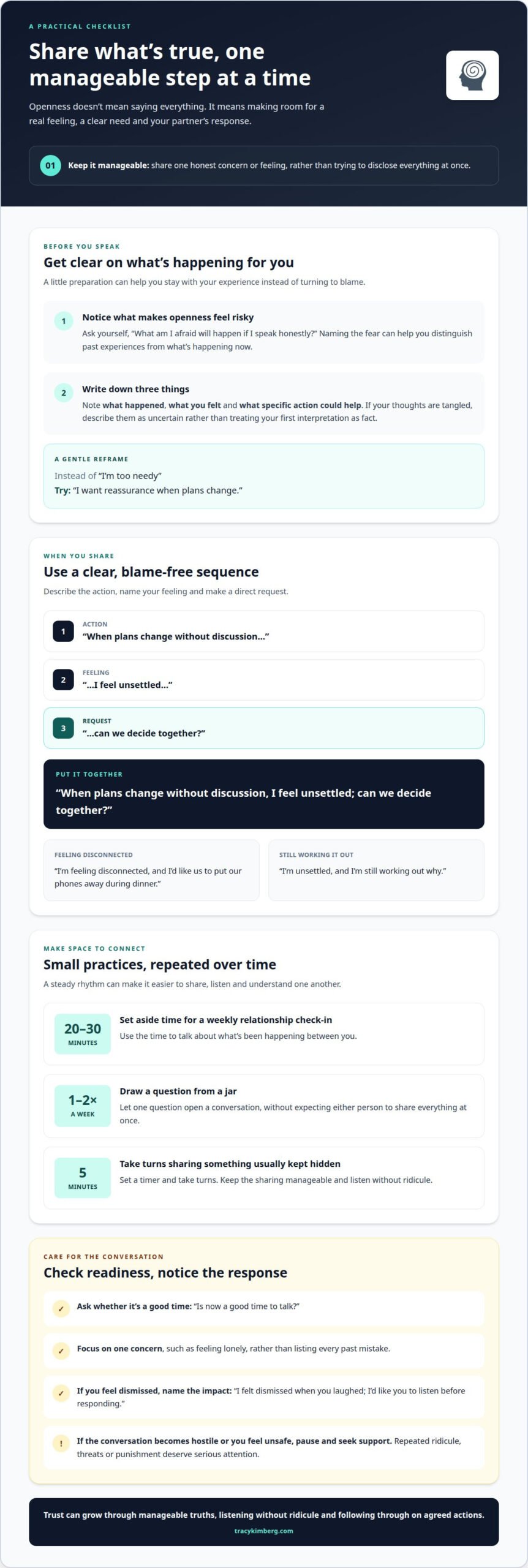
Fear can show up as changing the subject, joking when you feel hurt, or rehearsing a conversation until you say nothing. Pause and ask yourself: “What am I afraid will happen if I speak honestly?” Perhaps you expect criticism, rejection or shame because openness was poorly received before. Naming the fear helps you distinguish past experiences from what’s happening now.
Vulnerability is different from emotional dumping. Sharing a worry and saying what support would help invites your partner into a conversation; unloading every frustration without checking whether they’re ready can leave them overwhelmed. Try asking, “Is now a good time to talk?” Then focus on one concern, such as feeling lonely, rather than listing every past mistake.
For practical exercises, set aside 20-30 minutes once a week for a relationship check-in, or draw a question from a jar once or twice a week. Couples counselling can help partners slow difficult exchanges, hear the feelings beneath conflict and practise responding with care. Emotional walls may prevent immediate discomfort, but they can also leave both people guessing and feeling alone.
If your partner responds poorly, calmly name the impact: “I felt dismissed when you laughed; I’d like you to listen before responding.” If the conversation becomes hostile or you feel unsafe, pause and seek support. One painful response doesn’t define every attempt, but repeated ridicule, threats or punishment deserve serious attention.
Building self-acceptance and relationship security
Vulnerability in a relationship means letting your partner see thoughts and feelings you might usually conceal. Self-acceptance can help you share them without treating every uncertainty as proof that something is wrong with you. Try replacing “I’m too needy” with “I want reassurance when plans change”. That shift acknowledges your feeling while leaving room to discuss what might help.
Writing can help clarify a difficult concern before you raise it. Note what happened, what you felt and what specific action could help you feel more secure. For example: “When our plans changed without warning, I felt unimportant. Could we talk before rearranging them?” Then look for recurring patterns. Do you go quiet after disagreement, or seek reassurance when your partner needs space? Recognising the sequence can help you respond with curiosity rather than blame.
Attachment patterns can shape how opening up feels. Someone who expects rejection may withdraw, while someone who fears distance may seek frequent reassurance. These are responses to explore, not fixed labels or a verdict on either partner. Couples can build trust over time by sharing manageable truths, listening without ridicule and following through on agreed actions. Repeated experiences of being heard can make the next honest conversation feel less difficult.
Self-disclosure means sharing personal feelings and experiences; it is closely tied to relationship satisfaction. Practise by naming one feeling and one need, then invite your partner’s perspective. If old patterns make this exchange hard, Relationship Counselling and Coaching for Couples can provide a supported space to examine them and practise communicating more securely.
Sharing feelings, fears, hopes, and weaknesses
If you’re wondering how to be more vulnerable with your partner, start with one honest sentence about the present moment. If irritation rises when your partner checks a phone, say, “I’m feeling disconnected, and I’d like us to put our phones away during dinner.” This names your feeling and request without assuming you know their intention. You don’t need to understand every emotion before sharing it. “I’m unsettled, and I’m still working out why” is honest too.
Before a difficult conversation, write down what happened, what you felt and what you need. For example: “I felt nervous when we discussed moving, because I’m unsure about leaving my work.” Reading your notes aloud can help you stay with your experience instead of turning to accusation. If your thoughts feel tangled, describe them as uncertain rather than presenting your first interpretation as fact.
Share hopes and vulnerabilities as well as worries. You might say, “I’d love to train as a gardener, but I’m afraid I won’t be good at it,” or, “I’m not confident talking about money.” Saying this can feel like exposing a tender part of yourself, yet it gives your partner a chance to understand what matters to you. In a marriage, sharing an unfinished hope can invite a deeper conversation without requiring an immediate solution.
A practical way to learn how to be more vulnerable with your partner is to choose one manageable feeling and express it in the moment, or write it down first. Try the revealing-yourself exercise: set a timer for 5 minutes and take turns sharing something you usually keep hidden. To raise a concern without blame, describe the action, your feeling, and your request: “When plans change without discussion, I feel unsettled; can we decide together?” This keeps the focus on your experience and what could help.
Examples of vulnerability with a partner
Vulnerability often shows up in ordinary actions, not dramatic revelations. If someone you love has been quiet, try saying, “I miss you, and I’m unsure how to reach you.” This shares your experience without assuming what their silence means. In that moment, intimacy grows through a clear invitation to respond, rather than a test or accusation.
Ask for help directly instead of hoping your partner will read your mind. For example: “Could you take care of dinner tonight? I’m overwhelmed and need a little support.” You might also admit a mistake: “You were right that I interrupted. I’m sorry.” Owning your part can open a more honest conversation, because accountability shows your partner you value repair over winning.
Let your appreciation be seen, too. Tell your partner, “I admire how patiently you listened to your sister,” or share a hope you usually keep private. If Brené Brown’s writing has helped you find language for vulnerability, explain what resonated and why. Sharing this lets your partner know what matters to you, without expecting them to guess or immediately agree.
For a structured practice, try the coming-out-of-hiding exercise: each partner shares for 90 seconds how they avoid being fully seen, then names a part they fear showing. Listen without interrupting, and ask what response would feel supportive. If these moments repeatedly become conflict, explore support for your relationship and practise having vulnerable conversations together.
Tracy Kimberg
If attempts to open up keep turning into conflict or distance, Tracy Kimberg offers Relationship Counselling and Coaching for Couples. Couples can work on recognising recurring patterns, expressing needs more clearly and listening without escalating tension. This support may be useful even when you’re not in crisis but want to understand one another better and make more room for emotional closeness.
When trust has been strained by relational breakdown, infidelity or emotional disconnection, the 12-Week Relationship Recovery Process offers a structured way to work on the relationship. Couples can consider this support when the same painful interactions keep repeating, or when they need help rebuilding connection after a significant rupture. The work can focus on understanding what happens between you, rather than assigning blame to one partner.
Vulnerability can also bring up individual experiences that feel difficult to explore together. Tracy Kimberg offers Therapy for Adults to help people explore personal feelings and patterns affecting closeness, and Therapy for Teenagers for younger people navigating emotional or relationship concerns. Individual therapy isn’t a substitute for both partners working on a shared relationship issue, but it can help someone understand why openness feels risky.
You don’t need to arrive with perfect words or a complete account of what’s wrong. It can be enough to describe one moment when you wanted to share something but found yourself holding back. From there, you can explore what support might help and whether working together feels right. To talk about your relationship or individual support, contact Tracy Kimberg.
Make room for a more honest connection
Let your next step be a choice, not a test of whether you can reveal everything at once. Decide what you want your partner to understand, and notice how you make space for that conversation together. Their response can show what feels possible between you and what may need more care.
Learning how to be more vulnerable with your partner isn’t about performing openness perfectly. It’s about staying connected to yourself as you reach towards someone else, even when the outcome feels uncertain. Take time to reflect, adjust what you share and decide what kind of support would help you move forward.
If you’d like help exploring what gets in the way of closeness, contact Tracy Kimberg to talk. A thoughtful conversation can be a starting point for understanding your next step. You deserve to approach that possibility at a pace that feels right for you.
Frequently Asked Questions
What is Vulnerability?
Vulnerability is the willingness to let another person encounter feelings or truths you might otherwise protect. It can feel different for each person: admitting uncertainty may feel exposing to one partner, while asking for comfort feels more difficult to another. Being vulnerable doesn’t mean abandoning your judgement. You can choose what to share, with whom and when, while paying attention to your own sense of safety.
Want to get even more connected to your partner?
Try learning something about your partner’s inner world that doesn’t usually come up in conversation. Ask, “What’s something you’ve changed your mind about?” Then listen without correcting or rushing to share your own view. You could each choose a song that captures a meaningful time in your life and explain why. Curiosity helps you meet one another as people who continue to grow.
What does emotional vulnerability mean in a romantic relationship?
Emotional vulnerability in a romantic relationship means allowing your partner to know what matters to you, including feelings you may find uncomfortable. It might mean admitting, “I’m embarrassed that I’m jealous,” rather than disguising jealousy as criticism. You’re sharing an experience, not demanding that your partner agree with every interpretation. That distinction can make room for understanding while respecting both people’s perspectives.
How can I tell whether my partner is emotionally safe to be vulnerable with?
Look at patterns over time, especially during disagreements. Does your partner try to understand what you mean, keep private disclosures confidential and respect a request to pause? Notice whether they can acknowledge hurtful behaviour without later turning your feelings into a joke or a weapon. No one responds perfectly every time, but repeated contempt, threats or punishment are serious signs to protect your wellbeing.
How can I be vulnerable while maintaining healthy boundaries?
Share only what you feel ready to share, and be clear about what you need kept private. You might say, “I want to explain why this affects me, but I’m not ready to discuss every detail.” You can also choose a better time or stop the conversation if it becomes overwhelming. Openness is a choice, not an obligation, and a boundary helps define the conditions for sharing.

Article by
Tracy Kimberg
Tracy Kimberg is a Relationship Expert, Couples Therapist and Coach with a dedicated focus on helping couples and individuals rebuild connection, trust and emotional safety in their relationships. Drawing on the research of John and Julie Gottman, the relational insights of Esther Perel, and years of hands-on therapeutic experience, Tracy offers a warm, non-judgemental and deeply compassionate approach to modern relationships.
Based in Dorset, Tracy works with couples navigating communication breakdowns, betrayal, intimacy challenges, separation, family dynamics and life transitions. Known for creating a safe and grounded therapeutic space, she combines practical tools with emotional depth to help clients move beyond survival patterns and towards meaningful, lasting change.
With a reputation for empathy, professionalism and dedication to her clients’ growth, Tracy is passionate about helping people feel seen, understood and empowered — both within their relationships and within themselves.
Disclaimer
Disclaimer:
The information shared in this article is intended for educational and informational purposes only and should not be considered a substitute for professional therapeutic, psychological, medical or legal advice. Every individual and relationship is unique, and the perspectives offered are based on general therapeutic principles, research and professional experience.
Reading this article does not establish a therapist-client relationship with Tracy Kimberg. If you are experiencing significant emotional distress, relationship crisis, trauma, or mental health concerns, it is important to seek support from a qualified professional appropriate to your individual circumstances.
All content remains the intellectual property of Tracy Kimberg and may not be reproduced or distributed without permission.