

What if the recurring friction with your partner’s parents isn’t actually a personality clash, but a vital signal that your relationship is ready for its next stage of growth? It is exhausting to feel like an outsider in your own family or to sense that familiar knot of anxiety tightening as a bank holiday approaches. You are likely tired of the circular arguments and the stinging resentment that builds when it feels like your partner won’t choose you first. Navigating in-law problems UK wide is one of the most common stressors couples face, yet it remains one of the most misunderstood dynamics in modern partnerships.
We understand that these tensions can make your home feel like a battlefield rather than a sanctuary. This article will show you how to transform that friction into relationship strength through expert-led boundary setting and deep psychological insight. You will discover how to build a united front with your partner, move from “child” to “adult” in the family hierarchy, and ensure you are both recognised as the primary priority. By shifting the perspective from blame to boundaries, you can reduce family anxiety and reclaim the intimacy you deserve.
Key Takeaways
- Understand how in-law friction often stems from deep-seated attachment behaviours and the complex psychological shift from being a child to being a primary partner.
- Master the art of navigating in-law problems UK couples face by implementing healthy boundaries and ensuring each partner manages their own family of origin.
- Learn practical tools for family gatherings, such as pre-event briefings and agreed-upon exit signals, to protect your emotional well-being and relationship unity.
- Discover how to transform resentment into resilience by establishing a clear hierarchy where your partnership remains the undisputed primary priority.
- Recognise when professional relationship coaching is necessary to unpick systemic family issues and restore a sense of calm to your shared life.
What is In-Law Conflict and Why Does it Strain UK Marriages?
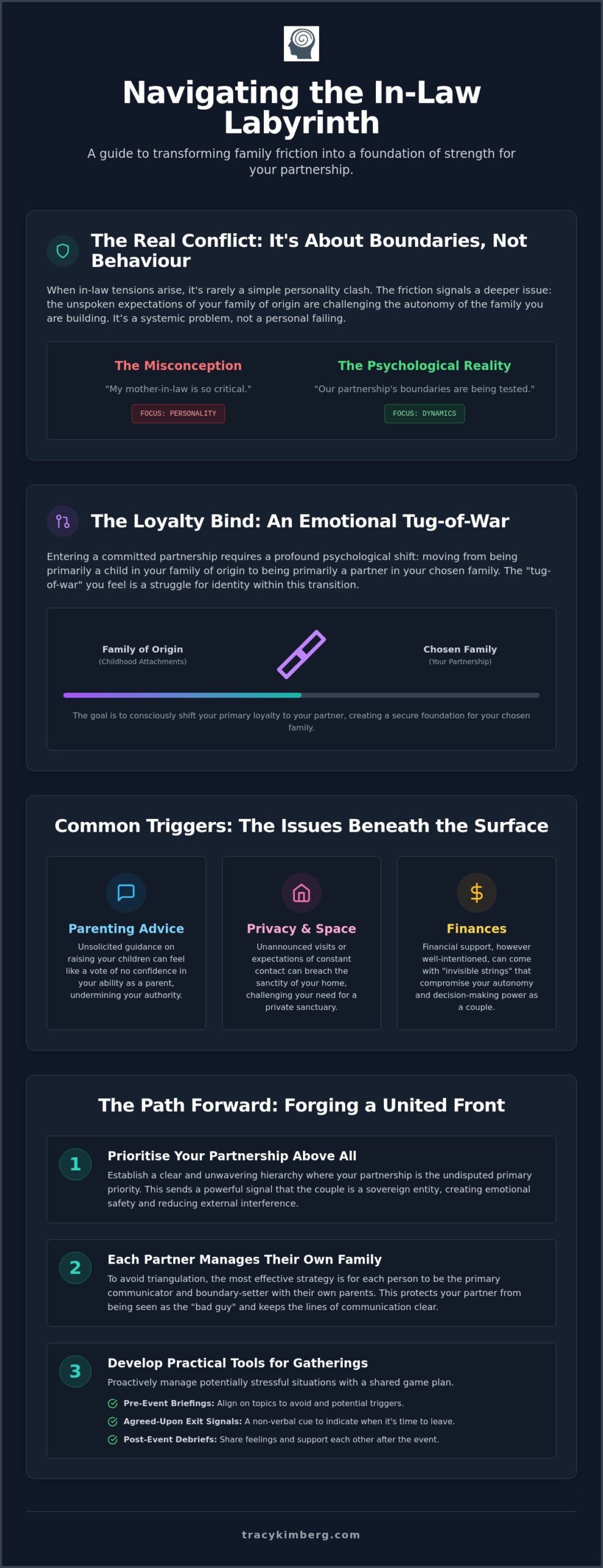
At its core, in-law conflict occurs when the unspoken expectations of your family of origin clash with the burgeoning autonomy of your “chosen” family. It is rarely about a specific disagreement over Sunday roast or holiday plans; instead, it triggers deep-seated attachment behaviours and complex loyalty binds that can make you feel like a child again. In-law conflict is a boundary issue rather than a personality clash. When navigating in-law problems UK couples often find that the cultural emphasis on “politeness” and avoiding a scene actually prevents the honest, vulnerable conversations required for resolution. We sweep the friction under the rug until the rug becomes a mountain we can no longer walk over.
This strain is particularly visceral because it touches our most primal need for belonging. When your partner’s parents criticise your choices, it doesn’t just feel like a difference of opinion. It feels like an attack on the life you are trying to build together. Without a clear understanding of these dynamics, small irritations quickly transform into a pervasive sense of resentment that can erode the foundation of your partnership.
The “Third Person” in Your Relationship
When a parent remains overly involved, they become an invisible participant in your marriage, sitting at the dinner table even when they aren’t physically there. This is often a sign of enmeshment, where the emotional boundaries between a parent and adult child are blurred. In the UK, cultural expectations regarding “looking after your own” can complicate this, making it feel “wrong” to prioritise a partner’s needs over a parent’s demands. Recognising these patterns is the first step toward understanding in-law conflict as a systemic issue rather than a personal failing. It’s about seeing the “tug-of-war” for what it is: a struggle for individual identity within a family system.
Common Triggers: From Parenting to Privacy
Conflict often ignites around the most intimate areas of our lives, where our values and boundaries are most deeply rooted. These triggers are rarely about the event itself, but what the event represents. Common friction points include:
- Parenting: Unsolicited advice on how to raise your children often feels like a vote of no confidence in your competence as a mother or father.
- Privacy: The British value of the private home is frequently challenged by “unannounced visits” that disrupt your sanctuary and sense of control.
- Finances: Whilst helpful, financial support from in-laws can sometimes come with “invisible strings” that pull at your independence and decision-making power.
Navigating in-law problems UK wide requires acknowledging that these triggers are not just “annoyances” but fundamental challenges to your partnership’s sovereignty. When these boundaries are breached, the resulting anxiety can lead to a defensive posture that makes connection with your partner nearly impossible.
The Loyalty Bind: Understanding the Tug-of-War
When you enter a long term partnership, you aren’t just adding a person to your life; you’re renegotiating your entire internal hierarchy. The psychological shift from being someone’s child to being someone’s primary partner is a significant developmental milestone. It requires a conscious move away from the “family of origin” towards the “chosen family.” Navigating in-law problems UK couples face often involves unpicking the “Secret Coalition,” where one partner shares marital frustrations or private secrets with their parents instead of their spouse. This breach of intimacy creates a leak in the relationship’s container, making the partner feel like an outsider in their own home.
You may wonder why your partner becomes prickly or defensive when you mention their parents’ behaviour. Gabor Maté suggests that our earliest attachments are so powerful that, even as adults, we may unconsciously sacrifice our own truth to maintain a sense of safety with our parents. This defensiveness isn’t necessarily a lack of love for you. It’s often a trauma-informed response to a perceived threat to their original survival bond. Establishing a “United Front” is a non-negotiable foundation for marital health. It signals to both sets of parents that the couple is a sovereign entity, capable of making its own decisions without external interference. If you feel caught in this exhausting tug-of-war, exploring these dynamics through Relationship Counselling and Coaching for Couples can provide the clarity needed to move forward together.
Leaving the Family of Origin
John Gottman emphasises that for a marriage to thrive, the couple must create a “new family culture” that is distinct from the past. This isn’t a betrayal of your parents; it’s a requirement for a lasting bond. “Siding with your spouse” means prioritising the needs of the relationship over the approval of the inner child who still seeks parental validation. Whilst most issues are emotional, understanding the broader context of UK family law disputes can highlight how the state views family autonomy and the growing emphasis on mediation to resolve deep-seated domestic friction.
Esther Perel on In-Laws and Intimacy
Esther Perel reminds us that intimacy requires a degree of separateness and mystery. When family interference is constant, it dampens the “erotic space” between a couple, replacing the adventure of the partnership with the suffocating domesticity of the original family home. There is a natural conflict between the safety of the parental nest and the necessary risk of the marital union. Establishing clear, respectful boundaries actually creates a safer space for a warmer, long term relationship with in-laws because it removes the constant threat of intrusion. When the rules of engagement are clear, everyone knows where they stand, allowing for genuine connection rather than forced politeness.
Setting Boundaries Without Creating a Family Feud
Boundaries are not walls. They are the invisible lines that define where you end and another person begins, allowing for a relationship that is both connected and autonomous. When navigating in-law problems UK families often struggle because boundaries are frequently misinterpreted as a lack of love or a rejection of tradition. In reality, a porous boundary leads to enmeshment, where your parents’ moods dictate your marital happiness. Conversely, a rigid boundary can lead to total isolation. The aim is a healthy boundary: a flexible yet firm gate that protects the intimacy of your partnership whilst allowing for a meaningful connection with the wider family.
The Golden Rule for maintaining this balance is that each partner must manage their own family of origin. If your mother is overstepping, it’s your responsibility to address it. This prevents your spouse from being cast as the “villain” who has “stolen” you away. When you take the lead, you reinforce the idea that the boundary is a joint decision made by a united couple. If you find yourself facing the inevitable “guilt-trip,” remember that you can be both empathetic and resolute. You might say, “I can see you’re disappointed that we aren’t coming for Sunday lunch, and I’m sorry you feel that way, but we’ve decided we need a quiet day at home.” You are acknowledging their feelings without allowing those feelings to override your needs.
Healthy vs. Unhealthy Dynamics
Supportive involvement feels like a warm embrace; intrusive meddling feels like a chokehold. A healthy dynamic is one where help is offered but never forced, and where your autonomy is respected. If in-laws have keys to your home and let themselves in unannounced, or if they consistently offer judgemental critiques of your lifestyle, the dynamic has shifted into the unhealthy. Disengaging from a judgemental in-law is a skill. You don’t have to attend every argument you’re invited to. Sometimes, a simple, “I hear your perspective, but we’re comfortable with our choice,” is enough to end a circular debate over parenting or holiday schedules.
The Script: What to Actually Say
Having a pre-prepared script can lower the anxiety of a confrontation. When declining an invitation, keep it brief and kind. “That’s a lovely offer, but it doesn’t work for us this time,” is far more effective than a long list of excuses that can be picked apart. If you need to tell your parents that your partner comes first, focus on the “we.” Use phrases like, “We have decided as a couple,” to signal your united front. If the conflict has escalated to a point where it threatens your legal or domestic security, seeking UK government legal advice regarding mediation can be a necessary step. For most, however, the solution lies in internal dialogue. Learning how to fix communication in a relationship is the most powerful tool you have for ensuring your needs are heard without causing a lasting family rift.
Practical Strategies for UK Couples: From Sunday Lunch to Christmas
Moving from the psychological to the practical requires a tactical shift in how you approach shared time. Navigating in-law problems UK wide often comes to a head during high-pressure events like the traditional Sunday roast or the complex logistics of the holiday season. To protect your partnership, you must treat these gatherings as a team effort. A pre-event briefing is essential. Sit down with your partner and align on your expectations: what topics are off-limits, how long you intend to stay, and what your shared goals for the visit are. When you enter the room with a shared plan, the external noise becomes much easier to manage.
Agreement on an “Exit Strategy” provides an emotional safety valve. This might be a subtle signal or a hard deadline for when you will leave. Having a pre-arranged time to depart prevents the resentment that builds when one partner feels trapped whilst the other is caught in a long goodbye. In our digital age, boundaries must also extend to the family WhatsApp group. Constant notifications and social media “over-sharing” can make it feel like your private life is on display. It’s perfectly healthy to mute groups or set clear rules about what photos of your children or your home can be shared online. These digital fences protect your privacy and reduce the feeling of being constantly “on call” for the extended family.
Navigating the British “Stiff Upper Lip”
In many UK families, the culture of the “stiff upper lip” means that genuine grievances are often masked by passive-aggressive comments or a polite silence that feels anything but peaceful. Breaking this cycle requires moving from “tea and sympathy”, which often just placates the problem, to direct, kind communication. Instead of sweeping friction under the rug, address it in the moment with a soft start-up. You might say, “I felt a bit uncomfortable when the conversation turned to our finances; can we talk about something else?” This shifts the dynamic from avoidance to authentic connection, honouring your truth without starting a war.
Holiday and Tradition Negotiation
The UK holiday season brings unique pressures, often leading to what we call “Boxing Day Burnout.” You don’t have to follow the in-laws’ lead every year. Creating your own traditions as a couple is a vital part of establishing your identity. Whether it’s the “Alternating Year” strategy for Christmas or simply reclaiming your bank holidays, expect some pushback. This resistance is a sign that the family system is adjusting to your new, healthy boundaries. If you find that these strategies are difficult to implement alone, our 12-Week Relationship Recovery Process can help you build the resilience needed to manage extended family noise whilst keeping your partnership at the centre.
Maintaining your couple identity amongst the noise of extended family requires consistent effort. It’s about choosing each other, time and again, in the face of external pressure. By prioritising your shared values and protecting your “we-ness,” you transform these gatherings from endurance tests into opportunities for mutual support and growth.
Moving Forward: How Relationship Coaching Restores Your United Front
Sometimes, the sheer weight of historical family patterns makes “trying harder” feel like running through treacle. You’ve set the boundaries, you’ve had the difficult conversations, yet the same circular arguments keep resurfacing. This is often the point where an objective professional becomes essential. Navigating in-law problems UK couples find most challenging usually involves more than just surface-level friction; it involves unpicking deep-seated attachment issues that have been decades in the making. When you are too close to the fire, it is difficult to see where the smoke is coming from.
Coaching offers a safe, neutral space to explore why certain comments from a mother-in-law or a father’s disapproval carry such a heavy emotional charge. It’s about understanding the “why” behind the defensiveness and the “how” of your shared reaction. Whilst working as a couple is vital, individual relationship counselling can also be a transformative tool. By working on your own internal triggers and self-worth, you strengthen your ability to hold boundaries without the crushing weight of guilt. This personal growth ensures you aren’t just reacting to family drama, but responding from a place of grounded adult strength.
The 12-Week Relationship Recovery Process
If your partnership feels like it’s in a state of constant survival, a structured approach is often the most effective way back to connection. Our 12-Week Relationship Recovery Process is designed to address the root causes of relational breakdown rather than just the symptoms. We move beyond the immediate in-law conflict to look at the systemic health of your bond, identifying where the leaks in your “relationship container” are occurring. By building a toolkit for long term resilience, you and your partner can face external family pressures as a truly united front. For those who want to see the tangible impact of this work, our 12-week relationship recovery case study illustrates how even the most enmeshed dynamics can be successfully untangled through dedicated, expert-led intervention.
Reclaiming Your Narrative
Your marriage is the most important project you will ever work on. It’s the foundation upon which your daily life, your parenting, and your future are built. The ultimate goal of this journey isn’t just to “fix” the in-law problem, but to transition into a state of thriving as a conscious couple. You deserve a relationship where you both feel safe, heard, and prioritised above all else. Navigating in-law problems UK wide doesn’t have to be a lonely endeavour that leads to resentment. Reclaiming your narrative means deciding that your partnership is worth the effort of professional support. It’s time to move away from the noise of extended family and back towards the intimacy you first shared. We invite you to book a session today to begin your proactive adventure back to each other.
Reclaim Your Partnership and Build a Resilient Future
Transforming family friction into a source of relationship strength begins with a simple choice: deciding that your partnership is the primary priority. We’ve explored how shifting from a child-centred loyalty bind to a united adult front creates the necessary space for intimacy to thrive. By establishing healthy, clear boundaries and taking responsibility for managing your own family of origin, you move away from the “villain” trope and towards a sovereign, conscious union. Navigating in-law problems UK wide is a complex journey, but it is one you don’t have to walk alone.
Using a research-based approach informed by the work of Gottman and Perel, Tracy Kimberg provides a safe, non-judgemental environment for transformational change. As a UK-based specialist with global online reach, she helps couples move from survival to thriving. Your marriage is an evolving adventure; healing is always within reach when you have the right tools. Book your 12-Week Relationship Recovery consultation with Tracy Kimberg today to start your proactive journey back to each other. You have the power to protect your connection and build a future defined by mutual respect and deep, lasting closeness.
Frequently Asked Questions
Can in-law problems lead to divorce?
Yes, in-law conflict is a leading contributor to relational breakdown in the UK. Whilst national statistics often group these issues under “unreasonable behaviour,” the underlying stress of constant parental interference can dismantle a couple’s sense of safety. When the “united front” is compromised, the primary bond weakens. This makes the marriage more vulnerable to the irretrievable breakdown that often leads to divorce. Navigating in-law problems UK wide requires addressing these issues before they erode your foundation.
How do I tell my partner their parents are overstepping without an argument?
You can avoid conflict by using “I” statements that focus on your emotional experience rather than your partner’s parents. Instead of critiquing their behaviour, explain how it affects you. For example, say, “I feel anxious when our weekend plans are changed without us talking first.” This approach invites your partner into a collaborative solution rather than forcing them into a defensive position to protect their family of origin.
Is it my partner’s responsibility to deal with their parents?
It is primarily your partner’s responsibility to manage the boundaries with their own family. This “Golden Rule” is essential for navigating in-law problems UK couples face because it preserves your role as a partner rather than an adversary. When your partner takes the lead, it signals that the boundary is a joint decision. This protects you from being scapegoated as the person causing the family rift.
What if my in-laws are genuinely toxic or narcissistic?
If you are dealing with narcissistic or toxic dynamics, you must shift your focus from seeking connection to maintaining protection. This involves setting “rigid” boundaries that limit the amount of personal information you share. You aren’t being “difficult”; you are being wise. Protecting your mental health and the sanctity of your marriage is the highest priority when the family system is fundamentally unsafe or manipulative.
How do we handle in-laws who favour one grandchild over another?
You must address favouritism immediately as a united team to prevent emotional harm to your children. Clearly state that you expect all grandchildren to be treated with equal warmth and attention. If the behaviour persists, you may need to limit supervised visits. Protecting your children’s sense of worth is more important than maintaining a false sense of family harmony with people who cause them pain.
Can relationship coaching help if only one of us attends?
How do we set boundaries with in-laws who live nearby?
Setting boundaries with nearby in-laws requires clear, pre-emptive rules about “dropping in” and unannounced visits. You might agree that all visits must be organised at least a day in advance. Proximity shouldn’t mean a loss of privacy. By being firm about your home being a private sanctuary, you ensure that your time together as a couple remains protected from constant, well-meaning interruptions.
Is it okay to go “low contact” with in-laws for the sake of my marriage?
It is perfectly acceptable to go “low contact” if the relationship with your in-laws is actively damaging your marriage. Your primary loyalty belongs to the person you have chosen to build a life with. If extended family interactions lead to chronic anxiety or resentment, distancing yourself is a healthy act of self-preservation. It allows you to focus your energy on healing and strengthening your own domestic bond.

Article by
Tracy Kimberg
Tracy Kimberg is a Relationship Expert, Couples Therapist and Coach with a dedicated focus on helping couples and individuals rebuild connection, trust and emotional safety in their relationships. Drawing on the research of John and Julie Gottman, the relational insights of Esther Perel, and years of hands-on therapeutic experience, Tracy offers a warm, non-judgemental and deeply compassionate approach to modern relationships.
Based in Dorset, Tracy works with couples navigating communication breakdowns, betrayal, intimacy challenges, separation, family dynamics and life transitions. Known for creating a safe and grounded therapeutic space, she combines practical tools with emotional depth to help clients move beyond survival patterns and towards meaningful, lasting change.
With a reputation for empathy, professionalism and dedication to her clients’ growth, Tracy is passionate about helping people feel seen, understood and empowered — both within their relationships and within themselves.
Disclaimer
Disclaimer:
The information shared in this article is intended for educational and informational purposes only and should not be considered a substitute for professional therapeutic, psychological, medical or legal advice. Every individual and relationship is unique, and the perspectives offered are based on general therapeutic principles, research and professional experience.
Reading this article does not establish a therapist-client relationship with Tracy Kimberg. If you are experiencing significant emotional distress, relationship crisis, trauma, or mental health concerns, it is important to seek support from a qualified professional appropriate to your individual circumstances.
All content remains the intellectual property of Tracy Kimberg and may not be reproduced or distributed without permission.