

Shame can turn reaching out for help into another source of distance. Feeling shame about needing marriage counselling may lead you to hide your worries, become defensive or withdraw, making it harder to talk openly about what hurts. That difficulty doesn’t prove your marriage has failed; it may mean vulnerability feels risky.
It’s understandable to worry that counselling means you should have solved things alone, or that asking for support will invite blame. But counselling can create space to understand the patterns between you, rather than treating either partner as the problem. This article explores how shame affects a marriage, why it can fuel silence and conflict, and how sharing vulnerable feelings may help restore connection. You’ll also learn to recognise shame’s influence during difficult conversations and how a gentler, more curious response can help both partners feel heard.
Key Takeaways
- Notice whether a difficult conversation shifts from discussing a specific action to judging someone’s whole character; that change can signal shame is taking over.
- Separate regret about something you did from the belief that you are fundamentally bad. The distinction can help make repair feel possible.
- Pay attention to your emotional and physical cues, then name what you’re feeling in a way that invites understanding rather than blame.
- When shame repeatedly fuels conflict or silence, couples counselling can help you recognise the pattern and work towards a more connected response.
How Does Shame Affect a Relationship?
Shame can make relationship conflict feel like a threat to belonging, rather than a disagreement to resolve. Defensiveness or withdrawal can follow, leaving both partners feeling further apart.
Shame and fight-or-flight reactions
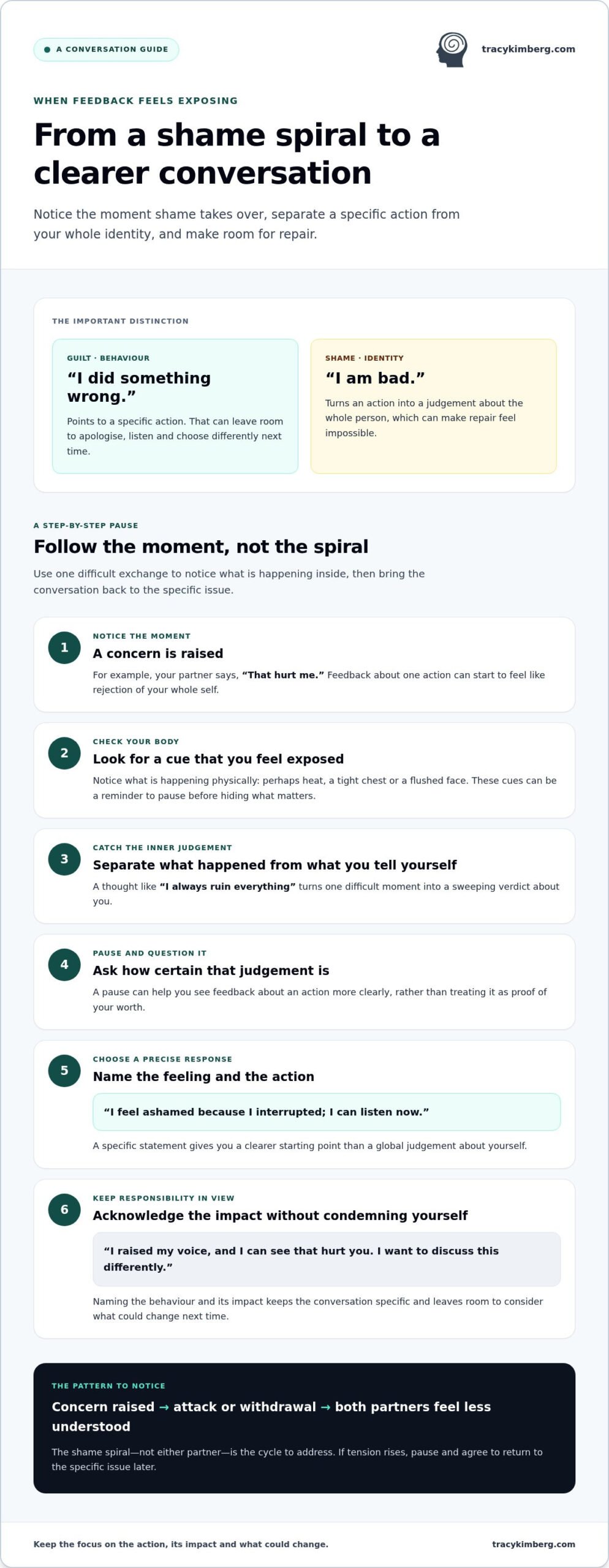
Shame can trigger a fight-or-flight response when love, care, belonging or acceptance feels at risk. A partner may take feedback about one action as rejection of their whole self. For example, a complaint about forgotten plans might prompt yelling, counter-arguments or sudden silence. These reactions may protect against feeling exposed, but they can also make calm conversation harder.
Notice the pattern as it unfolds: one partner raises a concern, the other attacks or withdraws, and both feel less understood. The shame spiral, rather than either partner, is the cycle to address. If tension rises, pause and agree to return to the specific issue later. A little space can help both partners feel safer discussing it.
Guilt focused on an action can support repair because it points to what happened, not who someone is. “I interrupted you” leaves room for an apology and a different choice next time. Shame’s message, “I’m unworthy of love”, can instead turn attention away from the hurt partner and towards self-defence. Compassion helps keep responsibility and self-worth in view together.
Tracing and replacing shame-related thoughts
Tracing shame-related thoughts means noticing the moment, body cue and inner judgement that follow a difficult interaction. After a partner says, “That hurt me”, you might feel heat, then think, “I always ruin everything.” Naming that sequence helps separate feedback about one action from a sweeping verdict about yourself. It also gives you a clearer starting point for responding.
Try pausing at the thought, questioning how certain it is, then replacing it with a precise statement: “I feel ashamed because I interrupted; I can listen now.” Notice repeated patterns, such as arguing, yelling, attacking or going quiet whenever feedback arises. These are clues to explore, not proof that either partner is bad. When couples see the pattern, they can work towards repair instead of repeating the conflict.
What Is Shame, and Why Does It Matter in Marriage?
Shame and guilt can both arise after painful moments, but they point in different directions. Recognising the difference can help partners respond without losing sight of their connection.
Healthy guilt and toxic shame
Healthy guilt focuses on a specific action, while toxic shame turns that action into a judgement about the whole person. If you snapped during an argument, guilt might prompt you to apologise and listen to your partner’s experience. Toxic shame may instead say, “I’m a terrible spouse.” That global conclusion can make repair feel impossible and leave both partners disconnected.
The distinction matters because accountability doesn’t require self-condemnation. A helpful response names the behaviour, acknowledges its impact and considers what could change next time. For example: “I raised my voice, and I can see that hurt you. I want to discuss this differently.” This keeps responsibility in the conversation without treating one painful moment as proof of someone’s worth.
How shame differs from guilt
Shame says, “I am bad”; guilt says, “I did something wrong.” The first targets identity, while the second concerns behaviour. In marriage, a partner who hears feedback as a verdict on their character may defend themselves instead of responding to the hurt. Separating identity from action can make an emotionally charged conversation more specific and easier to continue.
For instance, “You forgot our plans” describes an event; “You never care about me” makes a broader judgement. Partners can slow down and clarify what happened, what each person felt, and what they need now. That shift doesn’t erase the painful impact. It creates space for an honest response and a possible path back to connection.
What are the benefits of marriage counselling for couples? Sessions can give partners a structured space to understand recurring conflict, communicate more clearly and explore ways to repair trust. A balanced conversation can help each person feel heard without making either partner the sole problem.
How do I find a licensed marriage counsellor near me? Look for a qualified professional with specific training in couples work, a research-based relationship approach and the ability to create a safe, balanced space where both partners can be heard.
Does health insurance cover marriage counselling? Coverage depends on the plan’s terms, how the service is classified and provider eligibility. Read the policy wording for those details before relying on cover.
When is marriage counselling not recommended or safe? Joint sessions are not appropriate when one partner cannot speak freely or fears consequences for being honest. A safe, balanced space for both partners is essential; where that isn’t possible, individual safety and support come first.
Sharing vulnerability with a partner
Sharing vulnerable feelings can help partners move from blame towards understanding. Naming one feeling and one need gives the conversation a clearer, gentler starting point.
Recognising shame and vulnerability
Recognising shame means noticing when a painful feeling starts shaping what you believe about yourself. For example, after your partner raises a concern, you might feel exposed and think, “I’m not worth listening to.” That thought can make honest sharing feel risky. Naming the feeling, such as sadness, fear or shame, helps distinguish what’s happening inside from what your partner actually said.
Notice specific cues, too: a tight chest, a flushed face or an urge to change the subject. These signals can remind you to pause before hiding what matters. Saying, “I feel embarrassed, and I’m trying to stay present,” gives your partner a clearer way to understand you.
Vulnerability and defensiveness
Vulnerability means expressing a tender feeling or need without turning it into an accusation. Shame can make feedback feel like proof of personal failure, so a partner may become defensive or counterattack. If your spouse says, “I missed having dinner together,” try asking what they felt rather than listing reasons you were late. Curiosity keeps the focus on their experience.
Sharing doesn’t mean agreeing with every criticism or ignoring your own hurt. You might say, “I hear that you felt alone; I also felt overwhelmed.” This kind of honest exchange helps both partners respond to the moment instead of fighting over whose feelings count. It can create room for care and healing.
Telling a spouse about counselling
How can I tell my spouse I want marriage counselling? Choose a calm moment, then describe your own feelings and hopes rather than presenting counselling as a verdict. For example, say, “I feel stuck in our arguments, and I’d like us to get support so we can understand each other better.”
If your spouse reacts defensively, acknowledge that the suggestion may feel painful. Explain that you want a shared space to talk, not proof that either of you has failed. You could ask, “What worries you about making an appointment?” Listening to their answer can turn the suggestion into a conversation, even if you don’t resolve everything at once.
How toxic shame can create isolation and disconnection
Toxic shame can make a partner hide painful feelings, leaving both people more isolated. Needing marriage counselling doesn’t mean a marriage is failing; couples can seek support before reaching crisis.
The cycle of shame and disconnection
A shame cycle forms when one partner withdraws or attacks, the other feels rejected, and both become less open. Dr Brené Brown’s research identifies secrecy, silence and judgement as conditions that allow shame to grow. For example, if a spouse hides a mistake to avoid criticism, their partner may sense distance and respond with suspicion. That reaction can deepen the secrecy and make genuine connection harder.
Fear and discomfort about marriage therapy
Fear about therapy often grows from what someone believes it says about their relationship. One spouse might worry that a counsellor will take sides, expose private feelings or confirm that the marriage is broken. Naming the concern can make it easier to discuss: “I’m afraid we’ll be blamed, but I want us to understand these patterns.” Couples counselling offers a structured setting for both partners to speak and be heard.
Counselling and fears of marriage failure
Seeking counselling is a choice to examine a relationship, not proof that it has failed. Couples may bring recurring arguments, emotional distance or uncertainty about how to reconnect. For instance, a couple might want help discussing an unresolved disagreement before resentment affects more of their daily interactions. The important question isn’t whether a relationship has problems, but whether both partners can approach them with honesty and care.
If shame or fear makes these conversations difficult, explore relationship counselling as a way to work through the patterns together.
Tracy Kimberg: Relationship Counselling and Coaching for Couples
Tracy Kimberg’s Relationship Counselling and Coaching for Couples offers a space to explore shame, emotional distance and recurring conflict together. It may help when fear of judgement makes honest conversations difficult, or when partners keep falling into patterns they struggle to change alone. The focus is on understanding the relationship dynamic and finding ways to communicate more openly.
For couples seeking a structured programme, Tracy also offers the 12-Week Relationship Recovery Process. Choosing support isn’t an admission of failure; it can be a considered step towards understanding what’s happening between you. You can begin by sharing what feels hard to say, including any shame about asking for help.
If you’d like to explore support, contact Tracy Kimberg.
Let honesty become a starting point
The next step doesn’t need to be a perfect conversation. It can begin with one honest sentence: “I want us to feel closer, and I’m willing to look at my part.” That openness doesn’t erase what’s been painful, but it can change the direction of what happens next.
If shame about needing marriage counselling is making you hesitate, try treating the feeling as something to share rather than a verdict you must carry alone. You might tell your partner what worries you about asking for help, then listen to what the idea brings up for them. You don’t have to settle every concern in one conversation.
When you’re ready to explore support, contact Tracy Kimberg to talk. A first step can simply be saying what you hope could change. You deserve to approach that conversation with kindness towards yourself, and room for a more connected future.
Frequently Asked Questions
What happens in a first marriage counselling session?
A first marriage counselling session gives both partners a chance to explain what brings them in and what they hope will change. You might describe one recent moment, such as an argument about household responsibilities, rather than recounting your whole relationship. The counsellor can ask questions to understand each perspective. You can also mention what feels difficult to say; there’s no need to arrive with a polished account.
What happens in couples when there’s shame?
Shame can shift a couple’s attention from the original hurt to protecting themselves from judgement. One partner may apologise repeatedly or go quiet, while the other presses harder for acknowledgement. After a forgotten commitment, for example, the discussion may turn into whether someone is a “bad spouse” instead of how to rebuild reliability. Noticing that shift can help partners return to the specific issue and its impact.
Is it normal to feel ashamed about needing marriage counselling?
Yes, shame about needing marriage counselling can arise when you believe you should manage relationship difficulties alone. It doesn’t mean you’re weak or that your relationship is beyond repair. You may worry about being judged, admitting things feel hard, or asking your spouse to join. Try naming the concern plainly: “I feel embarrassed bringing this up, but I want us to talk.” That gives the feeling words without letting it decide what support means.
Why do people feel shame or stigma about couples therapy?
People may feel stigma because they see therapy as a last resort or believe private relationship problems should stay hidden. Cultural or family messages can reinforce the idea that seeking help means a couple has failed. If that belief surfaces, ask what you fear others might think, then separate that imagined judgement from what you and your partner actually need. Wanting a more honest conversation is a reason to seek support, not a verdict on your marriage.
What should couples expect during their first marriage counselling session?
Expect that you and your partner may describe the same difficulty differently. One might focus on frequent arguments, while the other feels lonely between them. You don’t need to agree on one account before beginning. Bring an example that shows what you’d like to change, and say what makes the conversation difficult. The counsellor can help both perspectives be heard and clarify what each of you hopes to work towards.

Article by
Tracy Kimberg
Tracy Kimberg is a Relationship Expert, Couples Therapist and Coach with a dedicated focus on helping couples and individuals rebuild connection, trust and emotional safety in their relationships. Drawing on the research of John and Julie Gottman, the relational insights of Esther Perel, and years of hands-on therapeutic experience, Tracy offers a warm, non-judgemental and deeply compassionate approach to modern relationships.
Based in Dorset, Tracy works with couples navigating communication breakdowns, betrayal, intimacy challenges, separation, family dynamics and life transitions. Known for creating a safe and grounded therapeutic space, she combines practical tools with emotional depth to help clients move beyond survival patterns and towards meaningful, lasting change.
With a reputation for empathy, professionalism and dedication to her clients’ growth, Tracy is passionate about helping people feel seen, understood and empowered — both within their relationships and within themselves.
Disclaimer
Disclaimer:
The information shared in this article is intended for educational and informational purposes only and should not be considered a substitute for professional therapeutic, psychological, medical or legal advice. Every individual and relationship is unique, and the perspectives offered are based on general therapeutic principles, research and professional experience.
Reading this article does not establish a therapist-client relationship with Tracy Kimberg. If you are experiencing significant emotional distress, relationship crisis, trauma, or mental health concerns, it is important to seek support from a qualified professional appropriate to your individual circumstances.
All content remains the intellectual property of Tracy Kimberg and may not be reproduced or distributed without permission.