

What if the problem isn’t that you have nothing to say, but that the two of you hear each other through different emotional filters? A couples therapist or relationship counsellor can help partners understand these patterns and practise communicating with greater care. Therapy to improve communication skills can also help you explore what makes it difficult to speak openly, listen without becoming defensive or express what you need.
It’s understandable to hope for a simple phrase that will prevent the next misunderstanding. But clearer conversations often begin with noticing the habits beneath them: whether you hold back, push harder or make space for each other’s perspective. This guide explains which types of therapists can support communication, how passive, aggressive and assertive styles differ, and how reflecting on emotions and key points can help partners feel heard. The aim isn’t to speak perfectly; it’s to create more room for honesty, understanding and connection.
Key Takeaways
- A therapist can help you notice what happens beneath a difficult conversation and practise listening with empathy.
- Recognising passive, aggressive and assertive patterns can help you find a more respectful way to express your needs.
- Holding back may leave important feelings unspoken and contribute to distance between partners.
- Reflecting a partner’s emotions and main points can make it easier to feel understood and continue the conversation.
What type of therapist helps with communication?
Couples therapists help partners understand recurring misunderstandings and practise new ways to talk together. Individual therapists can explore how one person’s experiences shape their communication. Family therapists focus on patterns between relatives, including parents and teenagers. For relationship challenges, couples therapy gives both partners space to speak and listen. Therapy to improve communication skills can be tailored to the relationship or individual concerns involved.
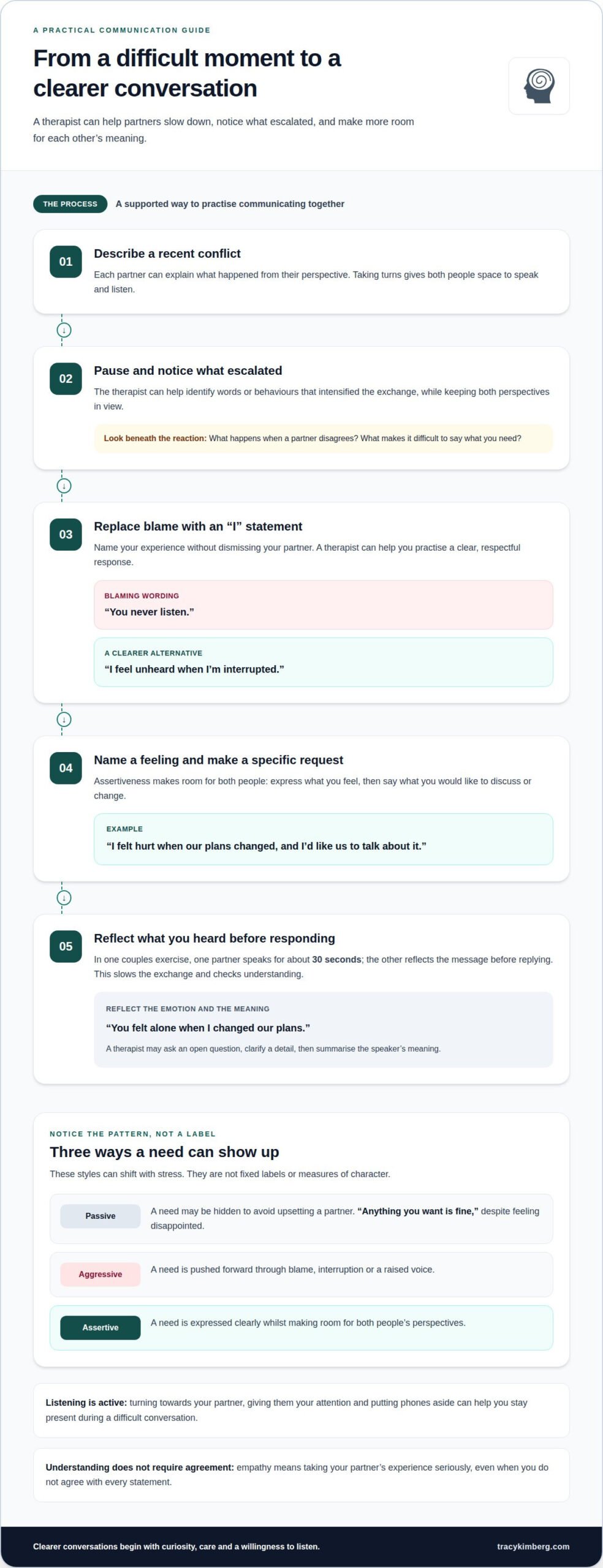
Active listening is more than staying quiet. A therapist may model it by asking an open question, clarifying a detail, then summarising the speaker’s meaning. In a couples exercise, one partner speaks for about 30 seconds; the other reflects the message before responding. This slows the exchange and checks understanding. Empathy means taking the other person’s experience seriously without needing to agree with every statement.
Reflective listening means using your own words to show what you heard: “You felt alone when I changed our plans.” A therapist can explore whether that reflection captures both the emotion and the facts. They may also notice listening behaviours, such as turning towards a partner, giving them your attention and putting phones aside. These techniques can help both people stay present during a difficult conversation.
Couples therapy practises communication together; individual therapy explores one person’s patterns and needs. US insurance coverage depends on plan benefits, provider network status and whether the sessions meet the policy’s terms. Costs vary with the therapist’s fees, location, session format and whether care is individual or joint. Therapy to improve communication skills can focus on the goals that matter most to you. To find a nearby therapist, look for experience with relationship communication and an approach that fits your shared goals.
There’s no fixed timeline for clearer communication; it depends on your goals, patterns and opportunities to practise. Therapy can bring difficult feelings into focus, and communication exercises alone may not address deeper relationship concerns. A therapist can help identify those concerns and adapt the work as conversations change.
Passive, aggressive, and assertive communication styles
A passive communication style can hide a need or the wish to avoid upsetting a partner. For example, someone might agree to plans, then feel overlooked. Aggressive communication pushes a need forward through blame, interruption or a raised voice. Assertive communication makes room for both people: “I felt hurt when our plans changed, and I’d like us to talk about it.” These styles can shift with stress; they aren’t fixed labels or measures of character.
Therapy to improve communication skills helps people notice the responses beneath a disagreement and practise alternatives. A therapist might ask what happens when a partner disagrees, then help shape a clear, respectful response. Assertiveness practice can include rehearsing an “I” statement, naming a feeling and making a specific request. This offers a supported setting to explore a communication style that may feel unfamiliar, without treating either partner as the problem.
In therapy to improve communication skills, a therapist may invite each partner to describe a recent conflict. They can pause the exchange, identify the words or behaviours that escalated it, then support a different response. For instance, “You never listen” might become “I feel unheard when I’m interrupted.” The therapist can help each person consider how that wording affects the conversation while keeping both perspectives in view.
Effective communication doesn’t mean avoiding disagreement; it means expressing differences without dismissing one another. A therapist can help partners distinguish a genuine difference in values from confusion caused by unclear language. They may also adapt the work for an individual, teenager or couple. Practising a difficult conversation in counselling can make feelings and requests easier to express, while allowing the therapist to notice what still feels hard.
Passive communication patterns and their effects
Passive communication often appears in small concessions. A partner says, “Anything you want is fine,” despite feeling disappointed. They may minimise their feelings, apologise for ordinary needs or avoid expressing disagreement. This can keep a conversation calm briefly, but it leaves the other person guessing. A partner might assume there’s agreement, then feel confused when frustration surfaces later.
Some people communicate passively through silence or indirect hints. For example, someone may sigh, withdraw or say, “It doesn’t matter,” rather than explain what upset them. Body language can signal distress, but it doesn’t tell a partner exactly what happened. Without clear words, the other person may misread the cue as irritation, disinterest or a wish to end the conversation.
Over time, unspoken concerns can gather weight. A person who repeatedly accepts plans they dislike may begin to feel unheard or resentful. Their partner may not realise anything is wrong because each individual exchange seemed settled. Later, a disagreement about one plan can carry several older disappointments. Misunderstandings may turn into arguments, grudges or distance as each person avoids another difficult conversation.
Therapy can help partners notice this pattern without treating either person as uncaring. A therapist might explore what makes it difficult to express a preference, such as fear of conflict or rejection. They can also help the listener practise active listening and check what they understood. For example: “You said yes, but you seemed uneasy. Have I understood?” This response creates space for honest clarification. Partners can then consider what each needs to communicate more effectively, rather than asking one person to keep accommodating the other.
Communication problems can grow from tension into distance when misunderstandings lead people to spend less time together.
Reflecting emotions and main points
During a tense interaction, one partner may hear criticism where the other means to express fear or hurt. A therapist can reflect both the feeling and the concern without deciding who is right. For example: “You’re worried that the late reply means you’re not a priority.” Checking understanding this way can encourage the speaker to explain more.
Reflecting the main point means putting the speaker’s message into clear, fresh language. A therapist might summarise: “You want more notice before plans change.” The listener can then ask whether that captures the concern accurately. This technique helps couples separate the central issue from details that might otherwise pull the conversation off course.
Emotions can be harder to name than events. A family therapist may use an emotion wheel to help someone distinguish disappointment from anger, or worry from sadness. During sessions, the therapist can ask what each feeling means in that moment. Naming it precisely gives the other person a clearer response to offer, rather than leaving them to guess.
These techniques work best as an active, respectful exchange, not a test of who remembers every word. A therapist may invite one partner to speak, reflect the key feeling and main point, then ask what they missed. The speaker can correct the reflection before the conversation moves on. That small repair can soften defensiveness and reveal what each person needs. If relationship conflict affects mental health, reflecting feelings can help bring its emotional impact into the discussion. It doesn’t replace exploring the wider patterns behind distress, but it can help partners feel more accurately understood as they do so.
Tracy Kimberg
Tracy Kimberg offers relationship counselling and coaching for couples, as well as therapy for adults and teenagers. These services may be a helpful next step when misunderstandings keep returning, difficult feelings are hard to express, or conversations leave partners feeling further apart. Therapy can make space to explore the patterns beneath those exchanges, not just the words spoken during one disagreement.
For couples, counselling and coaching can help partners consider how each person experiences the relationship and what they want to change. This can be useful when recurring conflict, emotional disconnection or a breach of trust makes clear communication difficult. The work can focus on understanding each other’s perspectives and finding more constructive ways to relate, without assuming one person is solely responsible.
Individual therapy for adults may suit someone who wants to explore their own communication patterns, feelings or relationship concerns. Therapy for teenagers offers support for younger people facing challenges in how they express themselves or connect with others. The right focus depends on who needs support and whether the difficulty is individual or part of a relationship pattern.
When relationship difficulties feel persistent, structured counselling programmes provide another option for couples seeking focused support. These approaches are designed to address deep-seated relationship dynamics, while ongoing counselling and coaching can offer a safe setting to work through communication concerns. The next step is simply to consider what feels hardest to say or hear, and what you hope might change.
If you’d like to explore support for your relationship or communication concerns, contact Tracy Kimberg.
Frequently Asked Questions
Does CBT improve communication skills?
Yes, cognitive behavioural therapy (CBT) can support communication by helping people notice thought patterns that shape their reactions. For example, someone who assumes a delayed reply means rejection might explore that belief before responding. CBT can also build self-awareness and support assertive communication. It may be helpful when anxiety or self-critical thoughts make it harder to express a need clearly in a relationship.
What are the common barriers to effective communication?
Common barriers include fear of conflict, assumptions about a partner’s intentions, emotional overwhelm and distraction. For instance, one person may interpret a quiet response as indifference, while the other is gathering their thoughts. Stress can also make it harder to stay curious or take in what someone means. Naming the barrier helps couples understand the interaction instead of treating a misunderstanding as proof of bad intent.
What types of therapy help improve communication skills?
Couples, family and individual therapy can all address communication, depending on the relationships involved. Couples work focuses on exchanges between partners; family therapy explores patterns affecting relatives, while individual therapy considers one person’s feelings and responses. CBT may also help when unhelpful thoughts affect how someone speaks or interprets others. The focus of the sessions should reflect whether the difficulty is shared or individual.
What techniques might a therapist suggest practising between sessions to communicate better?
A therapist might suggest a short role-play of an upcoming conversation, followed by reflection on what felt difficult. They may encourage partners to practise asking an open question, checking what they understood, or expressing one concern without blame. These exercises should connect to the goals discussed in sessions. A therapist can review what happened afterwards and adjust the practice to suit the couple’s needs.

Article by
Tracy Kimberg
Tracy Kimberg is a Relationship Expert, Couples Therapist and Coach with a dedicated focus on helping couples and individuals rebuild connection, trust and emotional safety in their relationships. Drawing on the research of John and Julie Gottman, the relational insights of Esther Perel, and years of hands-on therapeutic experience, Tracy offers a warm, non-judgemental and deeply compassionate approach to modern relationships.
Based in Dorset, Tracy works with couples navigating communication breakdowns, betrayal, intimacy challenges, separation, family dynamics and life transitions. Known for creating a safe and grounded therapeutic space, she combines practical tools with emotional depth to help clients move beyond survival patterns and towards meaningful, lasting change.
With a reputation for empathy, professionalism and dedication to her clients’ growth, Tracy is passionate about helping people feel seen, understood and empowered — both within their relationships and within themselves.
Disclaimer
Disclaimer:
The information shared in this article is intended for educational and informational purposes only and should not be considered a substitute for professional therapeutic, psychological, medical or legal advice. Every individual and relationship is unique, and the perspectives offered are based on general therapeutic principles, research and professional experience.
Reading this article does not establish a therapist-client relationship with Tracy Kimberg. If you are experiencing significant emotional distress, relationship crisis, trauma, or mental health concerns, it is important to seek support from a qualified professional appropriate to your individual circumstances.
All content remains the intellectual property of Tracy Kimberg and may not be reproduced or distributed without permission.