

What if the most effective way to repair your partnership didn’t involve your partner at all? It’s a heavy burden to feel like you’re the only one carrying the emotional weight of a connection. This is especially true when your partner refuses to step into a therapist’s office. You might feel "too sensitive" during heated arguments or exhausted by the same toxic patterns that 45% of people cite as their primary reason for seeking help. Choosing individual relationship counselling isn’t a sign of failure or a lonely path. It’s a profound act of agency. You are 50% of your relationship’s dynamic. When you shift your internal landscape, you unilaterally change the rules of the interpersonal game.
I understand how daunting it feels to start this journey solo, but it’s often the most direct route to healing. While a 2026 survey found that only 15% of adults have attended couples therapy, individual work is a powerful alternative. I promise to show you how working on your own attachment wounds can break toxic cycles and revitalise your connection. We’ll explore how individual therapy provides the clarity you need to decide whether to stay or go, while giving you the tools to transform your bond from the inside out.
Key Takeaways
- Learn how shifting your own internal reactions can unilaterally transform your partnership dynamic, because when you change, the old system cannot survive.
- Discover why individual relationship counselling offers a unique space to heal attachment wounds and stop the emotional exhaustion of carrying the relationship alone.
- Gain clarity on when to prioritise solo work over couples therapy, particularly in situations involving high conflict, secrecy, or personal burnout.
- Acquire actionable tools for self-regulation and healthy communication, allowing you to speak your truth without inviting defensiveness or blame.
- Explore the structured 12-week Relationship Recovery Process designed to move you from a place of reactive survival toward conscious, intentional connection.
Table of Contents
What is Individual Relationship Counselling?
Hi, I’m Tracy. Most people assume that repairing a bond requires both sets of feet in the therapy room. This isn’t always true. What is Individual Relationship Counselling? It’s a specialized clinical focus on your specific role, history, and reactions within a partnership. Unlike general therapy, which might explore your career or personal anxiety in isolation, every session here is filtered through the lens of your relational health. It’s about understanding how your internal world dictates your external connections.
This approach provides a necessary sanctuary. Sometimes, you need a space to whisper the things you aren’t ready to shout in a joint session. Perhaps you are among the 45% of people struggling with ongoing conflict and feel silenced by your partner’s presence. Or maybe you are single but tired of the same toxic dating patterns that repeat like a script. By focusing on individual relationship counselling, we look at the system through you. If you change your response, the old dynamic simply cannot continue to exist. It’s an act of unilateral transformation.
Counselling vs. Psychotherapy: Which do you need?
Counselling usually acts as a solution-focused bridge. It’s ideal for navigating specific hurdles like a communication breakdown or adopting the "80/80 marriage" model where both partners strive for surplus generosity. Psychotherapy goes deeper. It explores childhood attachment wounds and the "why" behind your current behaviors. I blend these two approaches to create a potent experience. We solve the immediate crisis while healing the roots so the problem doesn’t return. It’s not as daunting as you think; it’s a journey toward clarity. For a truly comprehensive approach, some find it helpful to pair therapy with holistic health support from experts like Dr. Tiffany Yeo-Reddy, ensuring both emotional and physical wellness are addressed.
Common issues addressed in solo sessions
We often tackle the fallout from infidelity. This requires a massive rebuilding of self-worth that’s hard to do while your partner is watching. Many clients also come to me during the "roommate phase." They want to identify their own contribution to the emotional drift before it’s too late. We also work on the pursuer-distancer dynamic. This is where one partner’s anxiety triggers the other’s withdrawal. Since 43% of couples cite communication as their main struggle, learning to regulate your own anxiety can stop this cycle before it starts. Individual relationship counselling gives you the tools to stand firmly in your own truth while remaining connected to another.
The Systemic Shift: How working on yourself changes ‘us’
Think of your relationship as a mobile hanging from the ceiling. If you tug on one string, every other piece moves. This is the essence of Relationship System theory. You don’t need both people to pull the strings to change the shape of the whole structure. When you change your response to a familiar trigger, your partner simply cannot maintain the old dynamic. The "dance" requires two people to follow the steps. If you stop dancing the old way, the music has to change. This is why individual relationship counselling is so effective; it focuses on the only person you can actually control: yourself.
Most of us live in a reactive loop. Your partner says something sharp, your heart rate spikes, and you defend yourself with a barb of your own. Through our work, you move from this impulsive defense to conscious action. Relational agency is the ability to influence a partnership through self-mastery. By developing this agency, you create a ripple effect. Research from 2026 shows that 71% of people who attend therapy see an improvement in their relationship. This shift happens because your increased emotional intelligence naturally invites your partner to step up. When you stop being the "pursuer" or the "attacker," you leave a vacuum that they must eventually fill with a new, hopefully healthier, behavior.
Choosing between Individual vs. Couples Therapy often depends on your readiness to look inward. While joint sessions focus on the "between," solo sessions focus on the "within." If you are ready to explore your own internal landscape, you can start your journey here to see how one person’s growth can save a two-person bond.
Understanding your Attachment Style
Your attachment style is the blueprint for how you handle intimacy and conflict. Whether you lean toward Anxious, Avoidant, or Secure, these patterns dictate your adult arguments. In our sessions, we identify "protest behaviors," those frantic or withdrawing actions that actually push your partner further away. By understanding these blueprints, we work toward an "Earned Secure" attachment through attachment style therapy that rewires the deep-seated patterns keeping you stuck. For women who need extra support, Love Reimagined offers specialized coaching to help overcome anxious attachment and recover from heartbreak. This allows you to stay grounded even when the relationship feels rocky, providing a stabilizing force for the entire partnership.
The Power of Boundaries
Individual sessions are the best place to define your non-negotiables without the pressure of your partner’s immediate reaction. It’s vital to distinguish between a boundary and an ultimatum. A boundary is for you; it’s a line you draw to protect your own peace. An ultimatum is a demand for them to change. Ironically, healthy boundaries create more intimacy, not less. They provide the safety and structure needed for both people to feel respected and seen.
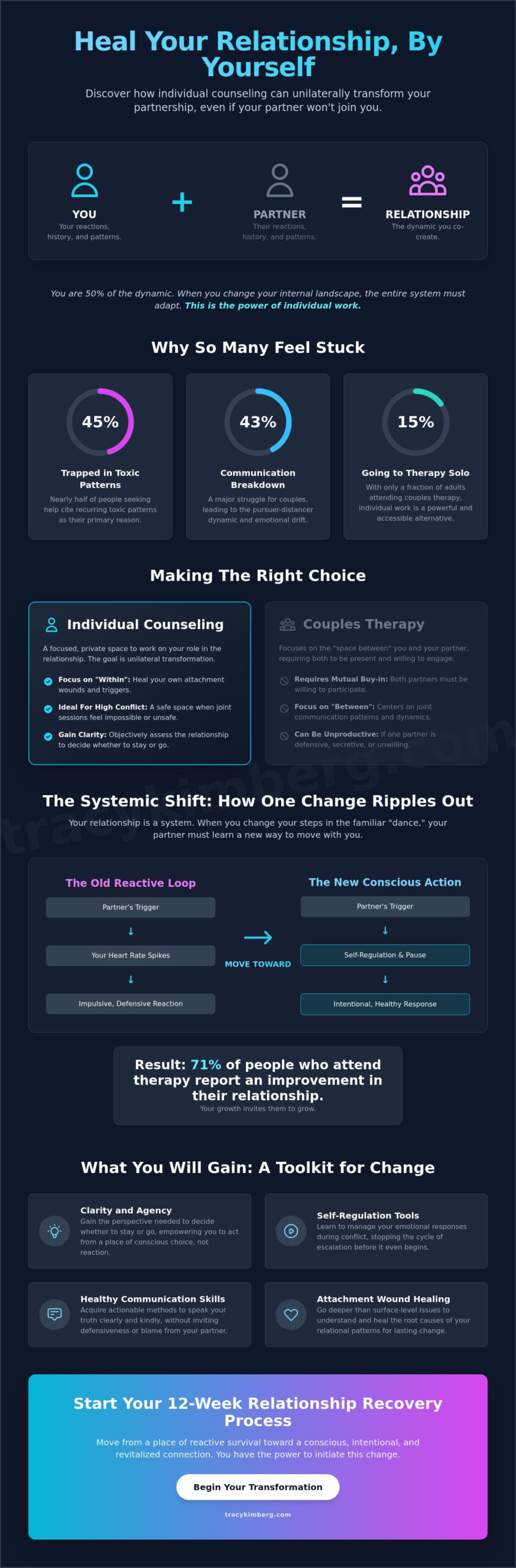
Individual vs. Couples Therapy: Making the right choice
Deciding between solo work and joint sessions isn’t just about who is willing to show up. It’s about what the relationship can actually hold right now. If there is high volatility, active addiction, or secrets like an undisclosed affair, the therapy room can become a battlefield rather than a sanctuary. In these cases, individual relationship counselling is the safer, more productive starting point. It allows you to stabilize your own emotional state before inviting the complexities of the partnership back into the room. Solo sessions act as a necessary warm-up, building the psychological muscle required for successful joint coaching later. When both partners are eventually ready to face the breach of trust together, specialised couples therapy for infidelity can provide the structured roadmap needed to rebuild what was lost.
There are times when couples therapy is essential from the start, particularly during co-parenting crises or when both partners share a mutual, urgent desire for structural repair. However, the "Resistance Factor" often gets in the way. When a partner says, "You’re the problem, you go," it feels like a heavy rejection. I want you to reframe this. This isn’t about you being "broken." It’s about you being the one brave enough to break the cycle. A 2026 survey found that 45% of people seek help for ongoing conflict. If you are the only one willing to address that conflict, your individual growth still forces the relationship to evolve.
Addressing the ‘Partner Refusal’ objection
It’s incredibly frustrating to want to work together but be met with a "no." You might feel like you’re carrying the entire weight of the "us" on your shoulders. Instead of seeing solo therapy as fixing yourself for them, see it as investing in your own future happiness. This clarity is vital. You can explore the question, Can your relationship be saved? in a space where you don’t have to manage your partner’s reactions. This isn’t a consolation prize; it’s a strategic move toward a healthier life, regardless of what they choose to do.
The ‘Safe Haven’ of solo work
One of the greatest benefits of individual relationship counselling is avoiding the "referee" dynamic. In couples sessions, partners often look to the therapist to decide who is right or wrong. In our solo work, you have the freedom to be 100% honest without fear of immediate retaliation or judgment. This honesty is where real change begins. You will build the internal strength needed to eventually engage in my 12-Week Relationship Recovery Process, ensuring that when you do work on the partnership, you do so from a place of grounded self-worth rather than desperation.
Actionable Tools you will gain in individual sessions
Transformation doesn’t happen through insight alone; it requires a new set of muscles. In individual relationship counselling, we move beyond just talking about your problems to practicing the specific skills that change your daily interactions. One of the most vital tools is self-regulation. When your partner "triggers" you, your nervous system often shifts into a fight-or-flight response. I teach you how to stay "cool" in those high-stakes moments. By mastering the pause between a trigger and your reaction, you reclaim your power. You stop being a passenger to your impulses and start becoming the driver of your emotional life.
We also work on the internal narrative you carry about your partner. It’s easy to fall into the trap of thinking "they always do this" or "they never listen." This kind of global labeling creates a prison for both of you. We reframe these thoughts to focus on the dynamic rather than the person. Instead of "he is dismissive," we look at "this is the pursuer-distancer loop we are currently in." Emotional intelligence in relationship maintenance is the capacity to recognize your own emotional triggers and manage them so they don’t dictate the quality of your connection. Once you see the cycle, you can choose to step out of it.
Gottman Method insights for individuals
While often used for couples, the Gottman Method is incredibly effective in solo work. We identify the "Four Horsemen" in your own behavior: Criticism, Contempt, Defensiveness, and Stonewalling. If you realize you’ve been using contempt, for example, we practice the "Antidote," which is building a culture of appreciation. Even if you’re the only one doing this, it shifts the atmosphere of the home. You’ll also build a "Love Map" from your perspective, deeply understanding your partner’s inner world so you can navigate their needs with more precision and less friction.
Emotional Intimacy through Vulnerability
Most arguments are actually about "hard" emotions like anger or frustration. These are defensive. True intimacy comes from sharing the "soft" emotions underneath, such as fear or loneliness. I’ll help you master the "I" statement, which allows you to speak your needs without sounding like an accusation. You’ll learn to ask for what you need directly rather than "testing" your partner and feeling hurt when they fail. If you’re ready to stop the guesswork and start building a real connection, let’s talk about how these tools can work for you.
Starting Your Journey: Individual support with Tracy Kimberg
Hi, I’m Tracy. I believe that therapy should be potent and not as daunting as you think. My approach to individual relationship counselling combines deep clinical expertise with the warmth of a Wise Guide. I’ve spent years helping individuals move from a place of reactive exhaustion to one of grounded clarity. Whether you’re visiting me face-to-face in Dorchester, or we’re connecting through online therapy from anywhere in the world, my goal is to provide a non-judgmental sanctuary. Here, you can safely explore the nuances of anxiety, depression, or the heavy silence of a relational disconnect without fear of being "the problem." If you and your partner are both ready to engage and want to understand what the digital space can offer, exploring the best online couples therapy UK has to offer can be a powerful next step alongside or after your individual work.
For those who feel ready for a significant shift, I offer the 12-Week Relationship Recovery Process. This isn’t just a series of talks; it’s a structured, intentional journey designed to move you through the layers of your relational history. We don’t just look at the symptoms of your arguments. We look at the blueprints of your attachment and the stories you tell yourself about love. This roadmap is essential for anyone who feels they’ve been "carrying" the relationship and needs to find their own feet again. You can start your journey here to begin that transformation.
What to expect in your first session
Our first meeting begins with a simple, low-pressure invitation: Let’s talk. I focus on demystifying the therapeutic process so you feel an immediate sense of connection and accountability. We’ll conduct an initial assessment of your relational history, identifying the specific pain points that brought you here. By the end of this session, we’ll have set clear, potent goals. We aren’t just aiming for a temporary fix; we’re building the foundation for long-term emotional health and self-mastery.
Beyond Repair: Support for Conscious Separation
There are times when individual relationship counselling reveals that the healthiest path forward is an independent one. If our work shows that the partnership has reached its natural conclusion, I provide specialized support for Conscious Separation. This is a nuanced approach to divorce and separation that prioritizes your mental health and emotional integrity. We navigate the transition with sensitivity, ensuring you have the internal strength to move forward without the weight of unresolved resentment. Even when a partnership ends, your personal journey of healing continues.
Reclaim Your Relational Agency
You don’t have to wait for your partner’s permission to begin the healing process. By choosing individual relationship counselling, you’re stepping out of the reactive loop and into a place of self-mastery. We’ve seen how your personal growth acts as a powerful catalyst, forcing the entire relationship system to shift. You now have the understanding that you’re 50% of the dynamic, and that’s the only 50% you truly control. Whether you’re breaking old attachment patterns or setting vital boundaries, you’re no longer just a passenger in your partnership.
My work is grounded in over more than 12 years of transformational results in Dorchester, London, and worldwide, utilising the research-based methods of Gottman and Perel. Whether you’re looking for immediate tools or a deeper dive through my potent 12-Week Relationship Recovery Programme, the path forward is clear. It’s time to stop feeling stuck and start building the intimacy you deserve. Start Your Journey Here: Book a Discovery Call with Tracy Kimberg. Let’s talk about how we can turn this emotional weight into a new beginning. You have the strength to lead the way.
Frequently Asked Questions
Is individual relationship counselling effective if my partner won’t change?
Yes, it’s highly effective because you are 50% of the relationship dynamic. When you change your response to a trigger, your partner cannot maintain the old pattern. The "dance" requires two people to follow the steps; if you stop dancing the old way, the music has to change. Research shows that 71% of therapy attendees see relationship improvement even when working solo.
Can I do individual relationship counselling while also in couples therapy?
You certainly can, and it’s often helpful to have a private space to process your own feelings. However, it’s usually best to see a different therapist for individual work than the one seeing you as a couple. This prevents any perceived bias or "secret-keeping" that could undermine the joint work. It allows you to explore your attachment wounds without any filter.
How many sessions of individual relationship counselling will I need?
The length of your journey depends on your specific goals and history. While some find clarity in 6 sessions, many choose my individualised approach in my 12-week Relationship Recovery Process for a structured transformation. This time frame allows us to move past surface symptoms and address the deep-seated patterns that keep you stuck in reactive loops. We work at a pace that feels safe yet productive.
What is the difference between relationship coaching and relationship counselling?
Counselling typically explores your psychological history and childhood wounds to understand current behaviors. Coaching is more solution-focused and future-oriented. I blend both clinical expertise and coaching strategies to ensure you understand the "why" while also gaining the "how" for immediate change. This creates a more potent therapeutic experience that addresses both your past and your future goals.
Can individual therapy help me decide whether to leave my marriage?
Yes, providing clarity is a core goal of individual relationship counselling. I offer a non-judgmental space where you can weigh your needs against the reality of your partnership. We look at whether the relationship has the capacity for repair or if a conscious separation is the healthiest path for your long-term mental health. The decision always remains yours, but you’ll make it from a grounded place.
Will my therapist take sides if I talk about my partner’s bad behaviour?
A professional therapist never takes sides or acts as a judge. My role is to witness your experience and help you understand the dynamic you’re in. We focus on your reactions and boundaries rather than labeling your partner as a villain. This approach empowers you to manage your own emotional well-being and decide what you will and won’t tolerate in your life.
Is online relationship counselling as effective as face-to-face sessions?
Research consistently shows that online sessions are just as effective as face-to-face therapy. The convenience of individual relationship counselling from your own home often leads to better attendance and consistency. Whether we meet in my Dorchester office or via a secure video link, the depth of connection and the quality of the work remain the same. It’s about the relationship we build together. For couples who are considering taking that step together, finding the best online couples therapy UK can offer is a natural progression once you’ve done the foundational individual work.
Does insurance cover individual relationship counselling in the UK?
Most UK insurance providers don’t cover therapy specifically for relationship issues. However, if your relational distress has led to a diagnosable condition like clinical anxiety or depression, some plans may provide coverage. It’s always best to check your specific policy details. As of 2026, the UK government is still consulting on broader reforms, but currently, relationship work is typically a private investment in your future.

Article by
Tracy Kimberg
Tracy Kimberg is a Relationship Expert, Couples Therapist and Coach with a dedicated focus on helping couples and individuals rebuild connection, trust and emotional safety in their relationships. Drawing on the research of John and Julie Gottman, the relational insights of Esther Perel, and years of hands-on therapeutic experience, Tracy offers a warm, non-judgemental and deeply compassionate approach to modern relationships.
Based in Dorset, Tracy works with couples navigating communication breakdowns, betrayal, intimacy challenges, separation, family dynamics and life transitions. Known for creating a safe and grounded therapeutic space, she combines practical tools with emotional depth to help clients move beyond survival patterns and towards meaningful, lasting change.
With a reputation for empathy, professionalism and dedication to her clients’ growth, Tracy is passionate about helping people feel seen, understood and empowered — both within their relationships and within themselves.
Disclaimer
Disclaimer:
The information shared in this article is intended for educational and informational purposes only and should not be considered a substitute for professional therapeutic, psychological, medical or legal advice. Every individual and relationship is unique, and the perspectives offered are based on general therapeutic principles, research and professional experience.
Reading this article does not establish a therapist-client relationship with Tracy Kimberg. If you are experiencing significant emotional distress, relationship crisis, trauma, or mental health concerns, it is important to seek support from a qualified professional appropriate to your individual circumstances.
All content remains the intellectual property of Tracy Kimberg and may not be reproduced or distributed without permission.