

What if the end of a partnership wasn’t a failure to be fixed, but a transition to be honoured? When you’re standing at the edge of such a profound life change, the fear of the unknown can feel truly overwhelming. You’re likely grappling with a shifting sense of identity and feeling deep anxiety about how these changes might affect your children’s well-being. Navigating a separation doesn’t have to be a descent into toxic conflict; instead, it can be a deliberate, conscious process that preserves your dignity and emotional health.
I recognise that boundaries feel blurred right now and the path forward seems obscured by the weight of your shared history. You deserve a space where your experience is validated and your future is handled with clinical expertise and genuine warmth. This guide provides a compassionate roadmap for moving through this complexity with psychological insight. We’ll explore how to maintain clarity amongst the chaos, establish healthy co-parenting rhythms, and ensure the emotional impact on your family is minimised. Together, we can transform this ending into a foundation for a more intentional and peaceful beginning.
Key Takeaways
- Learn how to reframe your experience from a reactive ending to a deliberate, conscious transition by establishing clear boundaries and agreements.
- Understand the psychological impact of ambiguous loss and discover practical ways to stop the cycle of re-hashing old arguments.
- Prioritise your children’s emotional safety by learning how to deliver a unified, blame-free message that protects their sense of security.
- Discover why professional support is vital when navigating a separation to ensure your decisions are grounded in clarity rather than temporary emotional distress.
- Explore how a structured recovery process can provide a roadmap for healing, whether you are seeking a path back together or a graceful way forward apart.
Shifting the Narrative: Navigating a Separation with Purpose
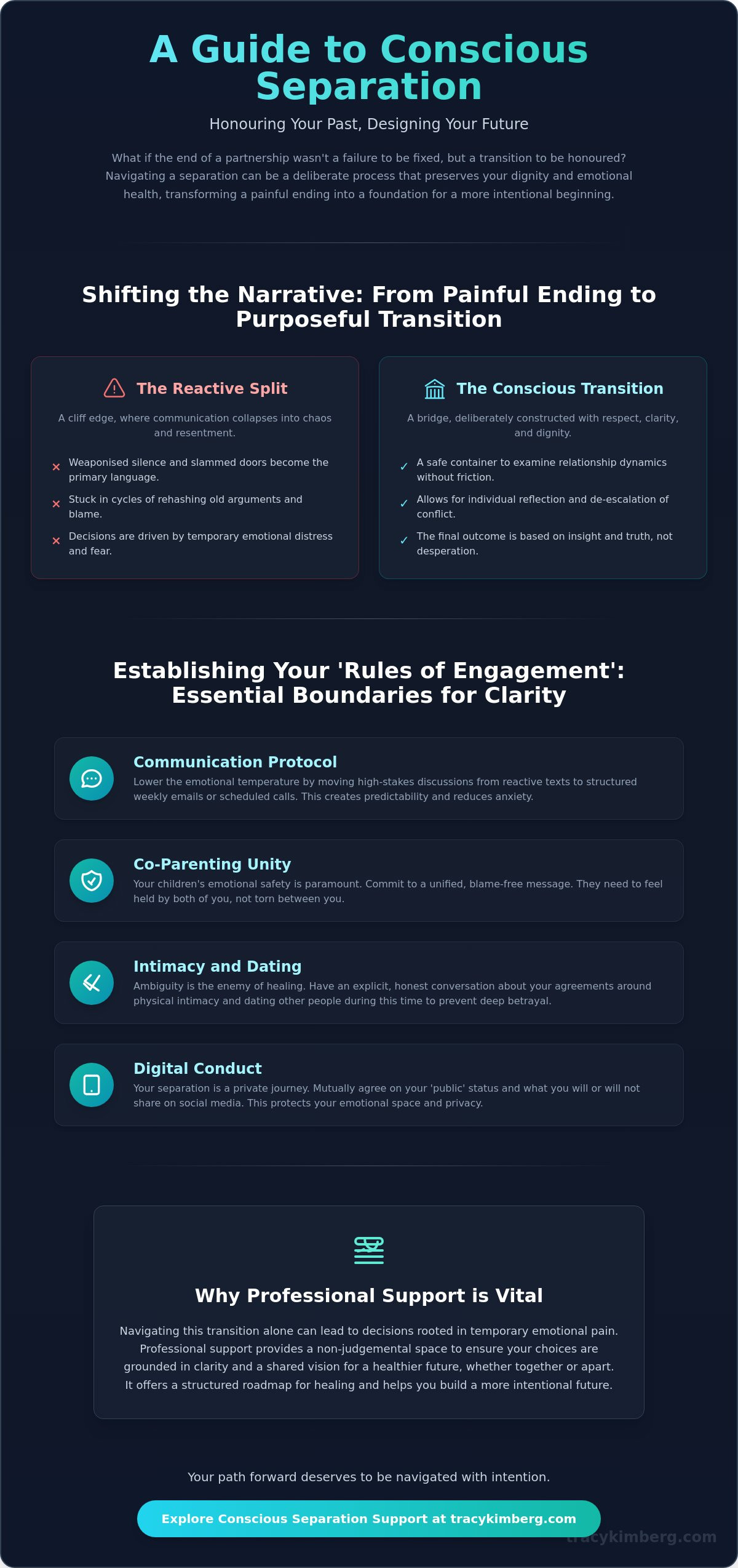
Separation is often viewed as a cliff edge, a final and tragic collapse of a shared life. But what if we reframe this experience as a bridge, a necessary transit between who you were as a couple and who you are becoming as individuals? Navigating a separation requires a fundamental shift from a mindset of ending to one of evolving. It’s about moving away from the reactive split, where doors are slammed and silence is used as a weapon, and toward a deliberate transition grounded in mutual respect and psychological clarity.
A Marital Separation carries significant legal and practical weight, yet its true impact lies in the emotional landscape you choose to cultivate. Validating your grief is essential; you’re mourning the loss of a dream, a routine, and a shared identity. However, we must hold that grief whilst simultaneously focusing on your future well-being. By defining this period as a “Conscious Separation,” we turn a painful hiatus into a powerful tool for emotional awareness. This isn’t just about living in different houses. It’s about creating a safe container to examine the health of your dynamics without the constant friction of shared domestic life.
The Psychological Purpose of Time Apart
High-conflict cycles often trap couples in a state of constant physiological arousal, what psychologists often call “flooding.” When you’re in this state, your ability to communicate rationally vanishes. Creating physical space is a strategic move to de-escalate these cycles and quiet the reactive behaviour that keeps you both stuck. This distance allows for individual reflection on the systemic patterns of the relationship. It’s a chance to evaluate the “unspoken contracts” you’ve both been signing for years, those hidden rules about who holds the power, who carries the emotional labour, and how needs are expressed or ignored. Without the noise of daily conflict, you can finally hear your own voice again.
Reconciliation vs. Conscious Ending
The primary goal of navigating a separation isn’t necessarily to stay together. It’s to find the truth. We use this period to determine if repair is truly possible or if the most compassionate path is a graceful, conscious ending. Many couples find themselves at a crossroads, wondering, Can Your Relationship Be Saved? This question can’t be answered in the heat of an argument. It requires the stillness that only a structured separation can provide. Whether the path eventually leads back to a renewed partnership or toward separate lives, the clarity you gain ensures that the final decision is made with dignity rather than desperation. You’re not just moving apart; you’re moving toward a version of yourself that is more grounded, aware, and prepared for whatever comes next.
Establishing the ‘Rules of Engagement’: Essential Boundaries
When you are navigating a separation, the lack of structure can feel like a psychological freefall. Without clear ‘rules of engagement’, every text message or late-night phone call becomes a potential landmine of misunderstanding. Establishing boundaries isn’t about building walls; it’s about creating a predictable environment where both individuals can breathe and reflect. This process requires moving from unspoken expectations to explicit, written agreements. Whilst resources like California’s legal guide to separation offer a foundation for formal arrangements, the emotional boundaries you set are what will ultimately preserve your peace of mind and prevent the exhausting state of ‘separation limbo’.
Five Steps to Setting Healthy Boundaries
Creating a container for your transition requires specific, actionable commitments. I often suggest couples formalise these five areas to reduce daily friction:
- Communication Protocol: Determine the frequency and method of contact. Moving high-stakes emotional discussions from reactive texts to structured weekly emails can significantly lower anxiety.
- Digital Conduct: Agree on social media behaviour and the ‘public’ status of your relationship. Deciding what to share and when protects your privacy whilst you process the change.
- Intimacy and Dating: Be explicit about expectations regarding ‘monogamy’ versus ‘dating’ during this period. Ambiguity here is a primary source of deep betrayal and trauma.
- Financial Transparency: Agree on how joint expenses and living costs will be managed with dignity. Accessing independent advice from Lee Tonks: Mortgage Guru regarding mortgage arrangements can provide the financial clarity needed to prevent resentment from poisoning the emotional work you are doing.
- The Shared Intent: Write a single sentence defining your purpose. For example: “We are separating to gain the clarity needed to decide our future with kindness.”
The ‘In-Home’ Separation Challenge
Sometimes, practicalities mean you must share a roof whilst emotionally uncoupling. This is a significant psychological challenge. Physical distance is always preferred for a true ‘cooling off’ period, but if you must stay in the same house, you must treat your living space with the same intentionality as a legal contract. It’s essential to protect the ‘sacred space’ of individual bedrooms and maintain separate schedules to avoid the ‘tumbleweed’ effect of re-hashing old arguments over the dinner table. If the weight of these logistical decisions feels too heavy to carry alone, professional relationship counselling can provide the neutral ground needed to navigate these conversations with clarity and professional insight.
The Emotional Landscape: Dealing with Grief and Uncertainty
Navigating a separation often feels like living in a house where the lights have suddenly been cut. You know the layout by heart, but the familiar landmarks of your life have become obstacles you trip over in the dark. This period is defined by what clinicians call ‘ambiguous loss’. It is a unique, suspended form of grief where the relationship has changed form, yet it hasn’t fully ended. Unlike the finality of a death, there is no ritual or funeral to mark the transition. This lack of closure can keep you trapped in the ‘Tumbleweed’ effect, a cycle where you re-hash old arguments as a subconscious way of staying connected. Even a painful connection can feel safer than the void of uncertainty, but it ultimately prevents the healing you deserve.
To move through this, you must begin to reclaim the ‘I’ that existed before the ‘we’. This isn’t about selfishness; it’s about survival. Reclaiming your favourite hobbies, interests, and individual friendships provides the psychological scaffolding needed to stand on your own. Whether it’s returning to a sport you abandoned or simply sitting in a cafe alone without checking your phone, these small acts of autonomy signal to your brain that you are still a whole person, even whilst your partnership is in flux.
Understanding the Trauma-Informed Perspective
Our behaviour during a relational breakdown is rarely just about the present moment. Deep-seated attachment styles and past wounds often drive our reactions. When our sense of security is threatened, we might resort to ‘protest behaviours’, such as frantic texting, emotional withdrawal, or outbursts of anger. These are actually cries from a nervous system that feels profoundly unsafe. Recognising these patterns is the first step toward emotional regulation. Engaging in Individual Relationship Counselling allows you to unpack these systemic patterns in a safe, non-judgemental space, ensuring that your past doesn’t dictate your future choices.
Self-Care as a Radical Act of Healing
When you are navigating a separation, your body is often flooded with cortisol, the stress hormone. This makes clear thinking nearly impossible. Prioritising sleep, nutrition, and movement isn’t just lifestyle advice; it’s a clinical necessity for managing those physiological spikes. To help rebuild your physical resilience, you can visit Pipman team (פיפמן) for professional coaching in triathlon and swimming. Surround yourself with a support network that offers empathy rather than just taking sides. Journaling can also be a powerful tool for tracking your emotional progress. By writing down your thoughts, you move the chaos from your internal world onto the page, creating the distance needed to gain clarity and perspective on your journey toward a new beginning.
Protecting the Family Unit: Children and Co-parenting
When you are navigating a separation, your identity as a romantic partner undergoes a painful deconstruction, but your identity as a parent remains a permanent, sacred architecture. Children experience the breakdown of a parental union as a fundamental threat to their attachment security. To protect them, you must place their emotional safety at the absolute centre of every decision you make. This means moving beyond your individual hurt to present a unified front. By delivering a consistent message that minimises blame and confusion, you provide the psychological containment they need to process this transition without feeling forced to choose sides.
Maintaining consistent routines across two households is one of the most powerful ways to offer stability. Children thrive on predictability; knowing that their Tuesday night football or Sunday morning pancakes will happen regardless of where they sleep provides a sense of continuity amongst the chaos. You are teaching them that whilst the structure of the family is changing, the love and commitment of their parents are unshakeable. If your children are struggling to articulate their feelings during this time, specialized therapy for teenagers and younger children can provide a vital outlet for their unique grief.
A Gentle Guide to Telling the Kids
The conversation where you disclose the separation is a “flashbulb memory” your children will likely carry for years. Choose a neutral, calm time when no one is rushed. It is essential to use age-appropriate language that avoids adult details, legal grievances, or mentions of infidelity. Focus on the “we” rather than the “I”. Above all, children must hear clearly and repeatedly that the changes in the family are a result of adult decisions and have absolutely nothing to do with anything they have done or said. This direct reassurance is the only way to prevent them from internalising the split as a personal failure.
Healthy Co-parenting Dynamics
Transitioning into a healthy co-parenting rhythm often requires adopting the ‘Business Partner’ model. You wouldn’t vent your personal frustrations to a colleague during a project meeting; similarly, your communication regarding the children should be professional, brief, and informative. Avoid the common trap of using children as messengers or emotional confidants, a practice that leads to “parentification” and deep psychological distress. Create a flexible but reliable parenting schedule that prioritises the children’s needs over adult convenience. By treating your co-parenting relationship as a professional commitment to your children’s future, you minimise the long-term psychological damage and foster a resilient family unit that can still flourish in its new form.
Beyond the Split: Conscious Separation and Professional Support
Standing at the threshold of a new chapter requires more than just a map; it requires a guide who understands the emotional terrain. Navigating a separation is often a lonely journey, yet professional intervention is vital during this ‘brink’ phase to prevent the descent into a purely adversarial process. Choosing a conscious approach to divorce and separation is a proactive, positive choice. It allows you to transform a period of crisis into a season of profound clarity. Even if reconciliation is not the ultimate destination, expert coaching facilitates a ‘good divorce’ by ensuring that the end of the marriage does not mean the end of mutual respect or family stability.
The 12-Week Relationship Recovery Process offers a structured path for those who feel stuck in the cycle of indecision. This programme isn’t just about ‘saving’ a marriage in the traditional sense; it’s about recovering the health of the individuals within the dynamic. By engaging with a specialised centre for your relational needs, you ensure that the complex interplay of intimacy, trauma, and communication is handled with the clinical precision it deserves. This structured support provides the safety net needed to explore difficult truths without the fear of total relational collapse.
The Role of the Wise Guide
I utilise research-based methods, drawing on the profound insights of experts like John Gottman and Esther Perel, to help you navigate the crisis of uncoupling. In a safe, non-judgemental environment, we work to move the narrative from ‘Blame’ to ‘Responsibility’. This shift is transformative. It allows you to see the systemic patterns at play rather than just the faults of your partner. You can explore these dynamics further through our 12-Week Relationship Recovery case study, which illustrates how intentional self-work can stabilise even the most fractured connections.
Your Next Steps Toward Clarity
Clarity rarely arrives in a single ‘aha’ moment. It’s built through small, intentional actions. Assessing whether you are ready for a structured programme or individual support is a vital first step. You might find value in our masterclasses, which demystify human behaviour and the intricacies of adult intimacy. These resources are designed to give you the language you need to describe your internal world. If you feel ready to move beyond the uncertainty and begin navigating a separation with dignity and purpose, I invite you to book a consultation. Together, we can find the personalised guidance you need to honour your past whilst building a healthy, intentional future.
Honouring Your Journey Forward
Choosing to approach this transition with intention is a profound act of courage. By reframing your experience as a conscious pause and establishing clear ‘rules of engagement’, you protect your emotional well-being and the stability of your family unit. Remember that the end of a romantic partnership does not necessitate the end of mutual respect or personal collapse. Navigating a separation is a complex psychological process, but it’s also an opportunity to uncover deeper clarity about your needs and your future identity.
I am here to act as your wise guide through this landscape. My specialised 12-Week Relationship Recovery Process offers a research-based approach, inspired by the work of Gottman and Perel, within a safe and non-judgemental environment. Whether you are seeking a path to reconciliation or a dignified way to part, you don’t have to carry the weight of these life-altering decisions alone. I invite you to book a consultation with Tracy Kimberg to navigate your separation with conscious support. You deserve a future built on clarity, healing, and peace.
Frequently Asked Questions
Is taking a break in a relationship a bad idea?
Taking a break is not inherently a bad idea; it’s often a necessary psychological pause to de-escalate high-conflict cycles. When you’re constantly in a state of “flooding,” your ability to solve problems vanishes. A structured break provides the space needed to move from a reactive state to one of reflection. This allows both partners to assess their needs without the daily friction of domestic life.
How long should a trial separation last for it to be effective?
A trial separation typically lasts between three to six months to be truly effective. This timeframe is long enough to break old habits and establish individual routines, but short enough to maintain a sense of urgency for the work ahead. It’s essential to set a specific review date at the start to prevent falling into “separation limbo,” where growth stagnates because the future remains undefined.
Can you do a separation whilst living in the same house?
Yes, you can separate whilst living in the same house, though it requires rigorous boundaries to be psychologically effective. Navigating a separation under one roof involves creating separate sleeping arrangements and independent schedules. You must treat the home as a shared professional space, protecting individual “sacred areas” and avoiding the temptation to re-hash old arguments over dinner, which only keeps you stuck in reactive patterns.
What are the rules for dating other people during a separation?
There are no universal rules, but clarity between partners is vital for emotional safety. Ambiguity in this area is a primary source of betrayal trauma. You must explicitly agree on expectations regarding monogamy or dating before the separation begins. If your goal is reconciliation, introducing a third party often complicates the healing process and obscures the underlying systemic issues you’re trying to resolve.
How do I tell my partner I want a separation without starting a fight?
The best way to initiate this conversation is to use “I” statements that focus on your internal experience rather than your partner’s failings. Choose a calm, neutral time and explain that you need space to gain clarity and regulate your emotions. Frame the request as a proactive step toward a healthier dynamic rather than a punishment. This approach reduces defensiveness and keeps the focus on the psychological purpose of the transition.
Will a separation automatically lead to a divorce?
A separation doesn’t automatically lead to divorce; it’s a tool for discernment that can lead to either a renewed partnership or a conscious ending. Roughly 10% of separated couples eventually reconcile, according to various relationship studies. The outcome depends on how you use the time apart. If you engage in individual therapy and structured recovery, you gain the clarity needed to make a choice grounded in awareness.
How do I manage my anxiety whilst navigating a separation?
Managing anxiety whilst navigating a separation requires prioritising your physiological health to manage cortisol spikes. Focus on the “radical acts” of self-care: consistent sleep, nutrition, and movement. Journaling also serves as a clinical tool to move the internal chaos onto the page. By tracking your emotional progress, you regain a sense of agency and move from a state of fear to one of calm observation.
What is the best way to tell children about our separation?
Tell your children together using a unified, blame-free message that emphasises the stability of your parental love. Use age-appropriate language and avoid adult details like infidelity or financial stress. It’s critical to reassure them that this is an adult decision and is not their fault. By presenting a calm, consistent front, you provide the psychological containment they need to feel safe despite the changes in their family structure.

Article by
Tracy Kimberg
Tracy Kimberg is a Relationship Expert, Couples Therapist and Coach with a dedicated focus on helping couples and individuals rebuild connection, trust and emotional safety in their relationships. Drawing on the research of John and Julie Gottman, the relational insights of Esther Perel, and years of hands-on therapeutic experience, Tracy offers a warm, non-judgemental and deeply compassionate approach to modern relationships.
Based in Dorset, Tracy works with couples navigating communication breakdowns, betrayal, intimacy challenges, separation, family dynamics and life transitions. Known for creating a safe and grounded therapeutic space, she combines practical tools with emotional depth to help clients move beyond survival patterns and towards meaningful, lasting change.
With a reputation for empathy, professionalism and dedication to her clients’ growth, Tracy is passionate about helping people feel seen, understood and empowered — both within their relationships and within themselves.
Disclaimer
Disclaimer:
The information shared in this article is intended for educational and informational purposes only and should not be considered a substitute for professional therapeutic, psychological, medical or legal advice. Every individual and relationship is unique, and the perspectives offered are based on general therapeutic principles, research and professional experience.
Reading this article does not establish a therapist-client relationship with Tracy Kimberg. If you are experiencing significant emotional distress, relationship crisis, trauma, or mental health concerns, it is important to seek support from a qualified professional appropriate to your individual circumstances.
All content remains the intellectual property of Tracy Kimberg and may not be reproduced or distributed without permission.