

Investing in your relationship often feels like a luxury until you consider the alternative; the staggering emotional and financial price of a permanent breakdown. I understand that when you’re already feeling the strain of miscommunication or distance, the cost of relationship counselling UK can feel like just another weight on your shoulders. You might worry about paying for sessions that turn into aimless venting, or feel confused by why prices vary so wildly between local charities and private specialists. It’s natural to feel anxious about whether your investment will lead to the healing you both deserve.
I agree that your time and resources are precious, and you need to know that the path you choose is both powerful and manageable. This guide will help you understand the financial and emotional landscape of UK relationship support, helping you choose the right path for your partnership’s future. We will explore current price points, provide a framework to judge a therapist’s value, and explain why a structured programme often offers more confidence than open-ended sessions. My goal is to help you move from a place of uncertainty to one of calm optimism, seeing this process as a proactive adventure in connection.
Key Takeaways
- Understand the current financial landscape and what to realistically expect regarding the cost of relationship counselling UK across various sectors.
- Learn why specialist certifications and systemic expertise often translate to more effective, long-term healing than generalist sessions.
- Discover a framework for weighing up charities, private practitioners, and digital platforms based on wait times and depth of care.
- Reframe therapy as a strategic investment by comparing the price of professional support to the staggering financial and emotional toll of a relationship breakdown.
- Explore why a structured, goal-oriented 12-Week Relationship Recovery Process can be more efficient and impactful than years of open-ended therapy.
Navigating the Financial Landscape: What is the Average Cost of Relationship Counselling in the UK?
Money is the silent witness to our relational struggles. It’s the lens through which we often view our problems, yet it can also be the tool for our restoration. When researching the cost of relationship counselling UK, you’ll find a landscape that is both varied and complex. I believe that understanding these figures is the first step in moving from a place of anxiety to one of calm optimism. Couples therapy is a commitment to the long-term health of your partnership; like any significant investment, it requires a clear understanding of the value being delivered.
There is a profound distinction between general support and specialist intervention. General counselling often provides a space to vent, but without a systemic focus, it can lead to “circular” therapy that lasts for years without resolution. This makes “cheap” sessions ultimately more expensive in the long run. I frame the work as a “therapeutic ROI.” By investing in a specialist who understands the intricate dance of attachment and trauma, you’re protecting your family’s emotional and financial stability. It’s about moving from a reactive state to a proactive adventure in connection.
Private Practice Rates vs. Charity Sliding Scales
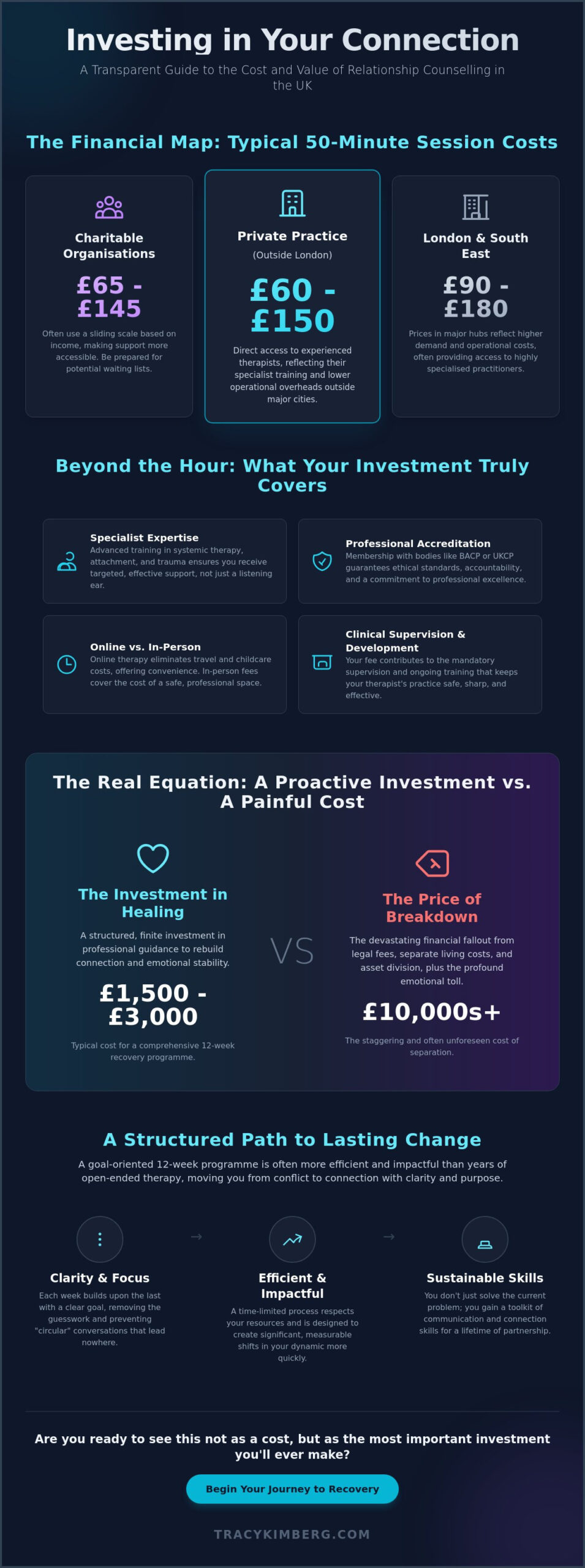
The UK’s therapeutic landscape offers several entry points. Large charitable organisations typically operate on a sliding scale based on household income, with fees for ongoing sessions often ranging from £65 to £145 as of June 2026. These models are designed for accessibility, though they often come with longer waitlists that can be difficult for couples in active crisis. In contrast, private practice rates reflect the therapist’s level of specialist training and clinical experience. Outside of major hubs, standard rates for a 50-minute session fall between £60 and £150. In London and the South East, where demand is higher, you can expect to pay between £90 and £180. These fees ensure you have direct access to a Wise Guide who is deeply invested in your specific journey.
Online vs. Face-to-Face Fee Structures
Your choice between online and face-to-face support often comes down to a balance of convenience and connection. Online therapy has removed many of the hidden costs associated with seeking help, such as travel time, petrol, and childcare. It allows you to engage in powerful work from the sanctuary of your own home, fitting into the rhythm of your life whilst maintaining clinical efficacy. Premium face-to-face sessions in city centres command a higher price due to the cost of maintaining a professional, neutral space. I offer both Relationship Counselling and Coaching for Couples and Online Therapy to accommodate different budget and lifestyle needs, ensuring that the cost of relationship counselling UK remains a manageable part of your path to healing.
Beyond the Hourly Rate: Factors That Influence the Price of Professional Support
When couples ask about the cost of relationship counselling UK, they’re often looking for a simple number. But the fee you pay is rarely just about the 50 minutes you spend in the room. It’s a reflection of the clinical infrastructure supporting your healing. This includes the therapist’s mandatory clinical supervision, which ensures your sessions remain safe and effective, and their commitment to rigorous professional development. To ensure you’re receiving ethical care, it’s vital to find a qualified relationship counsellor who is accredited by a body like the BACP or UKCP. These benchmarks guarantee a level of training and accountability that generalist coaches might not possess.
The complexity of your situation also dictates the intensity of the support required. High-conflict dynamics, deep-seated trauma, or the delicate aftermath of a betrayal require a therapist with a steady hand and specialized expertise. These issues aren’t resolved through simple venting; they require a Wise Guide who can hold the space for both of you whilst navigating a path toward restoration. This level of specialized care involves significant psychological labour and administrative overheads, which are reflected in the professional investment you make in your future.
The Value of Research-Based Modalities
Some therapeutic approaches offer a more structured, evidence-based roadmap than others. John Gottman’s research-based method provides couples with more predictable outcomes because it’s built on decades of longitudinal data. For those on the brink of divorce, discernment counselling offers an intensive, short-term framework designed to help you choose a direction with clarity and confidence. Esther Perel’s systemic approach informs modern pricing for intimacy coaching by integrating the complex layers of desire, identity, and personal history into the therapeutic work. These modalities require years of additional study for the practitioner, which ensures the work you do is both profound and efficient.
Experience and Specialisation
A generalist counsellor may help with individual stress, but a specialist relationship expert understands the intricate dance of two people’s histories and hurts. This is why couples therapy for infidelity often commands a premium; the therapist must manage high emotional volatility whilst guiding you through a meticulous rebuilding process. If you’re ready to move beyond “chatting” and start a focused transformation, exploring a Relationship Recovery Process can provide the specialised focus your partnership needs. Ultimately, the price reflects the depth of the transformation you’re seeking to achieve together.
Comparing Your Options: Private Therapists, Charities, and Digital Platforms
When you’re standing at the crossroads of a relationship crisis, the variety of help available can feel overwhelming. You’re balancing the immediate need for relief against the long-term cost of relationship counselling UK. To choose wisely, you need a framework that looks beyond the price tag to consider wait times, session consistency, and the quality of the therapeutic bond. After all, the true cost of relationship counselling UK isn’t just the fee; it’s the time spent in a process that may or may not lead to restoration. Choosing the wrong path can lead to “therapy fatigue,” where you both give up on the possibility of change before you’ve even found the right support.
I believe that the relationship you have with your therapist is the most significant predictor of success. This bond is hard to cultivate when you’re navigating systems designed for high-volume throughput rather than deep, individualised care. Whether you choose a local charity, a global digital platform, or a private specialist, you must ask yourself if the structure of the service supports the profound transformation you’re looking for. Consistency is the heartbeat of therapy; it’s what allows you to feel safe enough to explore the more painful parts of your shared history.
Charity Models: Pros, Cons, and Waitlists
Charity organisations provide a vital service for those on restricted budgets, but they often come with hidden emotional costs that aren’t immediately apparent. Whilst the sliding scale fees are accessible, waitlists can stretch for months. In a relationship where trust is fraying, waiting that long can be catastrophic. Often, learning how to fix communication in a relationship requires immediate, focused intervention before patterns of resentment become too deeply ingrained. Additionally, charity models may limit the number of sessions you can have, which can feel like being cut off just as you’re starting to reach the core of the issue. This lack of continuity can sometimes leave couples feeling more lost than when they started.
Digital Subscription Platforms
Large digital aggregators have popularised weekly subscription models, often positioning themselves as the most affordable way to access support. Whilst they offer convenience, there is a risk of high therapist turnover. Relational breakdown is rarely a high-volume problem; it’s a deeply personal, systemic knot that requires a consistent, dedicated expert who knows your story by heart. Relying on an algorithm to assign you a therapist can feel cold when what you truly need is human resonance. On these platforms, therapists are often stretched thin, which can impact the depth and focus of the work they can offer you. Direct access to a dedicated expert like Tracy Kimberg removes these barriers, ensuring you aren’t just another case number in a queue, but a couple receiving specialised, uninterrupted care.
The Real Cost of Staying Stuck: Evaluating Value Over Price
I often hear couples say, “We simply can’t afford this right now.” It’s a valid concern, especially when life feels heavy and finances are tight. However, I invite you to consider the “emotional tax” you’re already paying. Living in a state of constant conflict, or perhaps worse, a hollow silence, drains your energy, impacts your career stability, and erodes your physical health. When we look at the cost of relationship counselling UK, we must weigh it against the staggering price of remaining exactly where you are. Staying stuck is not a neutral choice; it’s a decision that carries a compounding interest of resentment and exhaustion.
Framing therapy as a preventative measure is essential for your long-term well-being. Proactive support allows you to address the cracks in your foundation before the entire structure is at risk. It’s about moving from a reactive “crisis mode” to a place of conscious growth. This shift in perspective transforms the fee from an unwanted bill into a strategic investment in your family’s emotional and financial stability.
Therapy as Divorce Prevention
The financial reality of a relationship breakdown in the UK is sobering. Beyond the emotional devastation, a contested divorce often costs upwards of £14,500 per person in legal fees and court costs alone. When you factor in the division of assets, the sale of a family home, and the requirement to maintain two separate households, the figures become life-altering. By comparison, a structured recovery programme is a fraction of that cost. Even individual relationship counselling can act as a powerful preventative measure, allowing you to transform your own patterns and save a partnership before it reaches a point of no return. Investing in professional support is a way of protecting your financial future as much as your heart.
The Impact on Children and Future Generations
We often think we’re hiding our struggles from our children, but as Gabor Maté frequently highlights, children are incredibly sensitive to the “emotional weather” of their home. They don’t just hear our arguments; they absorb the stress in our nervous systems. Raising children in an environment of emotional disconnect or chronic tension carries a heavy “cost” for their future development and their own ability to form healthy attachments. By choosing to address your relational dynamics now, you aren’t just improving your own life. You’re providing your children with a blueprint for intimacy and resilience. Investing in your relationship is, quite literally, an investment in your children’s long-term emotional health. If you’re ready to stop the cycle of disconnect, I invite you to explore how a 12-Week Relationship Recovery Process can provide the structured path your family deserves.
A Structured Path to Healing: The 12-Week Relationship Recovery Process
Many couples I work with share a common fear: that therapy will become a permanent, open-ended fixture in their lives with no clear end in sight. They worry that the cost of relationship counselling UK will continue to mount whilst they simply “chat” about their week without making real progress. I believe that your relationship deserves more than just a weekly venting session. It deserves a roadmap. The 12-Week Relationship Recovery Process is designed as a high-value, goal-oriented alternative to traditional pay-as-you-go models. It provides a container for your healing that is both powerful and manageable, focusing on intensive transformation rather than indefinite maintenance.
This isn’t just about the time spent in the room. This process integrates expert guidance with structured exercises and masterclasses that help you rebuild your partnership from the ground up. By combining clinical expertise with actionable tools, we move beyond the surface-level arguments to address the systemic patterns that keep you stuck. It’s a proactive adventure that respects your time and your emotional energy, ensuring that every pound and every hour you invest is working toward a tangible outcome.
Why Structure Beats Open-Ended Counselling
An open-ended approach can sometimes inadvertently foster a sense of dependency, where the therapist becomes a crutch rather than a guide. In contrast, a fixed-term programme provides a clear “light at the end of the tunnel.” This roadmap reduces the anxiety of the unknown, allowing you both to commit fully to the work. You can see the efficacy of this approach in this 12-week relationship recovery case study, which demonstrates how focused intervention can move a couple from crisis to connection in a matter of months. Efficiency in therapy isn’t about rushing; it’s about being purposeful with the psychological space we create together.
Taking the First Step: Consultation and Fit
The most important investment you’ll make isn’t the first session, but the initial consultation. This is where you determine if the resonance between you and your therapist is right. You’re looking for a Wise Guide who understands your specific dynamics and can hold the space for your complexities. To ensure you find the right fit for your budget and goals, consider asking:
- What specific modality do you use for high-conflict or stagnant relationships?
- How do you measure progress throughout our work together?
- Is there a structured roadmap, or is each session led by our current mood?
- What is the total expected cost of relationship counselling UK for a full recovery programme?
I invite you to book a discovery call with Tracy Kimberg to discuss your bespoke needs and find the right programme for your relationship. Every partnership is unique, and your path to healing should be too. Let’s work together toward a collaborative solution that honours your shared future.
Choosing Your Path to Relational Health
Choosing to seek support is a profound act of courage. It’s an acknowledgement that your partnership is worth the effort, the time, and the financial investment. We’ve explored how the cost of relationship counselling UK is often a fraction of the price of a permanent breakdown, and why specialist expertise offers a more direct route to healing than generalist sessions. By focusing on research-based methods and a transformational 12-week structured roadmap, you move away from the uncertainty of open-ended venting and toward a clear, manageable outcome.
I am a BACP Accredited Specialist committed to using the research-based Gottman and Perel methods to help you navigate your unique emotional landscape. Whether you choose online or face-to-face sessions, my goal is to provide you with the tools to transform your connection from the inside out. I invite you to view my 12-Week Relationship Recovery Programme and investment options to see how we can begin this proactive adventure together. Your relationship is a living, breathing entity; with the right guidance, it’s entirely possible to move from a place of weight to one of calm optimism and lasting closeness.
Frequently Asked Questions
How much does couples therapy cost per hour in the UK on average?
Average private rates for relationship support typically range from £60 to £150 per session across the UK. In London and the South East, you should expect to pay between £90 and £180 for a specialist practitioner. These fees reflect the therapist’s years of training, clinical supervision overheads, and the deep complexity of systemic work required to heal a partnership.
Does the NHS provide free relationship counselling for couples?
Free couples counselling is extremely limited on the NHS and is usually only available if relationship distress is directly impacting a diagnosed mental health condition. Most couples find that waitlists are prohibitively long, often stretching for many months. For those in active crisis, the immediate access provided by private specialists is often a more viable path to restoration.
Is relationship counselling covered by private health insurance in the UK?
Most private health insurance providers don’t cover relationship counselling as a standard benefit. Coverage is typically reserved for individual treatments for clinical diagnoses like depression or anxiety. It’s always best to check your specific policy, but most couples find they need to fund their cost of relationship counselling UK as a personal investment in their future.
Why is couples therapy more expensive than individual therapy?
Working with a couple involves managing three distinct entities: each partner and the relationship itself. This systemic complexity requires a higher level of clinical expertise and more intensive professional supervision than individual work. The therapist must navigate high emotional volatility whilst remaining a neutral, Wise Guide for both people, which demands significant psychological energy and specialised training.
How many sessions of relationship counselling will we realistically need?
Relational healing is an evolving journey, but most couples find that a structured 12-week programme provides a clear, efficient roadmap for change. Whilst open-ended therapy can continue for years, a goal-oriented process ensures you aren’t just “venting” but are actively building new communication skills. This structure helps you manage the cost of relationship counselling UK by providing a defined light at the end of the tunnel.
What is the difference between a relationship counsellor and a relationship coach in terms of price?
Can I get a discount if I book a block of sessions or a programme?
Many private practitioners offer better value when you invest in a structured recovery programme rather than paying for individual sessions. Choosing a block booking or a fixed-term process often provides a more predictable financial path whilst ensuring the commitment needed for real transformation. It’s a way to ensure your investment is focused on a collaborative, long-term solution.
What happens if my partner refuses to go; is individual work a waste of money?

Article by
Tracy Kimberg
Tracy Kimberg is a Relationship Expert, Couples Therapist and Coach with a dedicated focus on helping couples and individuals rebuild connection, trust and emotional safety in their relationships. Drawing on the research of John and Julie Gottman, the relational insights of Esther Perel, and years of hands-on therapeutic experience, Tracy offers a warm, non-judgemental and deeply compassionate approach to modern relationships.
Based in Dorset, Tracy works with couples navigating communication breakdowns, betrayal, intimacy challenges, separation, family dynamics and life transitions. Known for creating a safe and grounded therapeutic space, she combines practical tools with emotional depth to help clients move beyond survival patterns and towards meaningful, lasting change.
With a reputation for empathy, professionalism and dedication to her clients’ growth, Tracy is passionate about helping people feel seen, understood and empowered — both within their relationships and within themselves.
Disclaimer
Disclaimer:
The information shared in this article is intended for educational and informational purposes only and should not be considered a substitute for professional therapeutic, psychological, medical or legal advice. Every individual and relationship is unique, and the perspectives offered are based on general therapeutic principles, research and professional experience.
Reading this article does not establish a therapist-client relationship with Tracy Kimberg. If you are experiencing significant emotional distress, relationship crisis, trauma, or mental health concerns, it is important to seek support from a qualified professional appropriate to your individual circumstances.
All content remains the intellectual property of Tracy Kimberg and may not be reproduced or distributed without permission.