

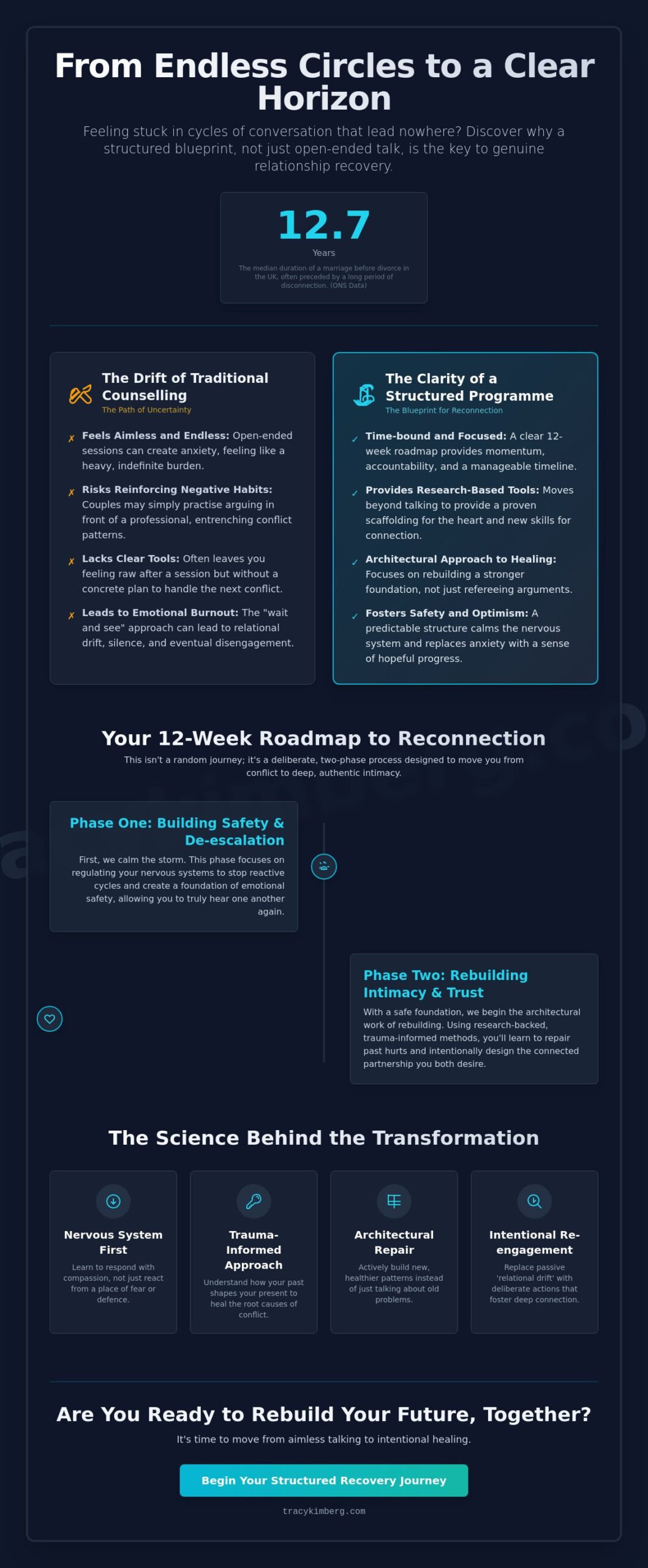
What if the reason your relationship feels stuck isn’t a lack of love, but the absence of a blueprint? Many couples find themselves trapped in a cycle of “talking it out” without ever reaching a resolution, leaving them emotionally exhausted and anxious about the seemingly endless nature of traditional counselling. If you feel like you’re going in circles, you aren’t alone; the latest ONS data shows that the median duration of a marriage before divorce is 12.7 years, often marked by a slow drift into silence or conflict. This is why many are now seeking a structured relationship recovery program UK to provide the clarity and direction that general therapy sometimes lacks.
I understand how heavy that silence feels, but there’s a path back to each other that doesn’t involve years of aimless searching. In this guide, I’ll show you how a structured, research-based programme can transform your partnership from emotional disconnect to profound intimacy in just 12 weeks. We’ll explore how a clear roadmap to healing and specific tools to manage conflict can replace the weight of the past with a sense of calm optimism. You’ll learn exactly how this architectural approach to repair can help you rebuild a foundation that’s stronger than the one you started with.
Key Takeaways
- Understand why open-ended “talk therapy” can often feel like going in circles and how a time-bound framework provides the necessary momentum for genuine recovery.
- Learn how a structured relationship recovery program UK utilises research-based tools to move your partnership from a state of constant conflict to one of emotional safety.
- Discover the two-phase roadmap designed to first de-escalate tension and then rebuild deep, authentic intimacy through a trauma-informed lens.
- Explore how integrating insights from world-renowned experts helps you manage your nervous system and respond to your partner with compassion rather than reactivity.
- Identify the specific benefits of a 12-week commitment, including increased accountability and a clear, manageable timeline for couples facing a critical turning point.
Beyond Just Talking: Why UK Couples Seek a Structured Relationship Recovery Program
Many couples come to me after months of traditional sessions, feeling like they’ve just been paying someone to watch them argue. It’s a common frustration. Whilst Couples therapy has historically been open-ended, modern partnerships often require more than just a space to vent. They need a map. In the UK, where we often value our privacy and dignity, the idea of “airing dirty laundry” for years without a clear exit strategy can feel daunting. This is where a structured relationship recovery program UK changes the narrative. It moves the focus from the problem to the architecture of the solution, providing a sense of professional efficiency that respects your time and emotional energy.
It’s not always the explosive rows that lead couples to seek help. Often, it’s the “silent breakdown.” This is a profound loss of behaviour-sync where you become roommates rather than lovers. You’re efficient at co-parenting or managing the household, but the emotional intimacy has evaporated. You aren’t fighting, but you aren’t connecting either. A structured approach provides the safety net needed to address this drift. It acknowledges that when the nervous system feels a lack of safety, we either fight or, more commonly in long-term UK partnerships, we simply shut down. This silence isn’t peace; it’s a symptom of a connection that has lost its rhythm.
The Problem with “Wait and See” Therapy
General counselling can sometimes feel like refereeing. The therapist makes sure the fight is “fair,” but the underlying wound remains unaddressed. Entering a session without a clear objective creates a heavy psychological toll. You leave feeling raw but without any new tools to handle the next conflict. Over time, these open-ended sessions can actually entrench negative communication patterns because you’re simply practising how to argue in front of a professional. Without milestones, the process feels endless, which often leads one partner to disengage or give up entirely.
The Antidote to Relational Drift
Relational drift is a systemic loss of connection that happens when we stop being intentional. A programme-based approach reframes the work entirely. It’s no longer a clinical necessity to “fix” something broken. Instead, it becomes an active adventure in rediscovery. A structured relationship recovery program UK offers this predictability, ensuring that every session serves a specific purpose in your healing. By having a clear beginning, middle, and end, both partners feel a sense of momentum. When you know there’s a 12-week roadmap, the anxiety about “endless counselling” disappears. It transforms the experience from a heavy, indefinite burden into a manageable journey with tangible milestones.
The Science of Connection: The Framework Behind Effective Relationship Rescue
Relationship recovery isn’t a lucky accident or a matter of “trying harder.” It is a deliberate, research-based process of identifying ruptures, de-escalating conflict, and rebuilding trust. Whilst many couples rely on intuition to fix their problems, intuition often fails us when we are emotionally flooded. In high-conflict scenarios, your brain’s survival mechanism takes over, making it nearly impossible to listen with empathy. This is why a structured relationship recovery program UK is so effective. It provides a scaffolding for the heart, using proven methodologies to replace reactive behaviours with intentional connection.
The foundation of this work lies in moving away from the “wait and see” approach. According to NHS guidance on counselling, talking therapies provide a vital space for exploration, but for deep relational repair, we must integrate specific psychological frameworks. We don’t just talk about the problem; we look at the system that sustains it. This involves a blend of clinical precision and human warmth, ensuring that the recovery process feels both safe and transformative.
Gottman Method vs. Systemic Insights
In our work, we utilise John Gottman’s “Sound Relationship House” to identify the “Four Horsemen” of the apocalypse: criticism, contempt, defensiveness, and stonewalling. These are the specific behaviours that research shows can predict the end of a relationship. However, safety alone isn’t enough to sustain a partnership. We also draw on Esther Perel’s insights into the paradox of intimacy. Whilst we need security to feel safe, we also need a sense of “otherness” to sustain desire. A structured relationship recovery program UK helps you navigate this delicate balance, creating a “safe harbour” where you can be vulnerable whilst maintaining your individual autonomy.
The Trauma-Informed Lens
Gabor Maté’s work reminds us that our adult relationship triggers are often echoes of childhood wounds. When you react with disproportionate anger or total withdrawal, it’s rarely just about the dishes or the schedule. It’s about a nervous system that feels threatened. We move from asking “What is wrong with you?” to “What happened to you?” This shift is vital for co-regulation. If you’re ready to move beyond the surface of your arguments, exploring a 12-week relationship recovery process can help you turn these insights into lasting change. Understanding your partner’s history allows you to become an ally in their healing rather than an adversary in their pain.
Structured Program vs. General Counselling: Which Path Fits Your Partnership?
Choosing between a standard weekly session and a more intensive roadmap often comes down to the level of urgency you feel. If your relationship is in a state of “slow fade” or acute crisis, a casual weekly chat might feel like trying to empty the ocean with a teaspoon. General counselling frequently follows the “crisis of the week,” where you spend fifty minutes deconstructing a Tuesday argument without ever touching the underlying patterns. In contrast, a structured relationship recovery program UK offers a curriculum designed to stop the bleeding and rebuild the foundation simultaneously.
Comparing the Methodologies
The primary difference lies in the proactive nature of the work. Structured programmes focus heavily on skill-building and “homework” between sessions. You aren’t just talking; you’re practising new ways of being. Research supports this intensive approach. The UK government evaluation of relationship support highlights how evidence-based interventions can significantly improve relational stability. For many, the “12-week” timeframe acts as a vital psychological motivator. It creates a container for the work, making the process feel manageable for partners who might otherwise be reluctant to commit to the “endless” nature of traditional therapy.
Viewing a structured relationship recovery program UK as an investment is a vital shift in perspective. Whilst the upfront commitment of time and energy is higher, the cost of a failed partnership, both emotionally and financially, is far greater. It’s an investment in your family’s future and your own long-term health; for many, this includes addressing personal barriers to connection through 1:1 Sobriety Coaching and Membership Programs. I often hear couples ask if they’re “too far gone.” If there is still a flicker of desire to understand each other, the answer is no. A set programme provides the external structure needed when your internal resources are depleted.
Who is a Structured Program For?
This path is particularly effective for couples recovering from infidelity or a significant breach of trust where the old “normal” is no longer an option. It’s also for those who have drifted into becoming “roommates” or “co-parents,” losing the romantic spark that once defined them. Sometimes, the journey starts with one person. Seeking individual relationship counselling can be a powerful way to change your own relational patterns, which often acts as a catalyst for the entire system to shift. Whether you come as a pair or start alone, the goal is to replace reactive habits with conscious connection.
The 12-Week Roadmap: What to Expect from a Transformational Recovery Process
Embarking on a 12-week journey is about more than just marking days off a calendar. It is a deliberate architecture of change. When couples enter a structured relationship recovery program UK, they move away from the chaos of reactive fighting and toward a logically sequenced path of repair. This timeline provides a container for the work, ensuring that we don’t just dig up old wounds without the tools to heal them. It’s a proactive and positive adventure that treats your partnership as a living, evolving system rather than a static problem to be solved.
The First 4 Weeks: Stabilisation
The initial phase is all about stopping the “bleed” of constant conflict. We focus on stabilisation by learning the art of the “Softened Start-up.” This involves changing how you approach your partner, replacing criticism with a gentle expression of your own needs. It’s about safety. When we establish a “no-exit” zone, we tell our partner that the relationship is bigger than the current argument, creating a container where vulnerability can finally breathe. During these first few weeks, we identify the specific “dances” or patterns that keep you stuck, allowing you to see the cycle as the enemy rather than each other.
The Middle Phase: Navigating the Rupture
Once the immediate fires are under control, we move into the middle phase: processing past hurts. This is where the deep work happens. We look at the ruptures that have defined your history, but we do so without getting lost in the blame game. Instead of litigating the past, we seek to understand the underlying needs that were missed. To bridge the emotional gap, we utilise specific exercises for couples to reconnect. These tools help you develop empathy for your partner’s internal world, turning old triggers into opportunities for co-regulation and intimacy.
The Final Phase: Sustaining the Spark
The final four weeks focus on future-building and ensuring that the progress you’ve made becomes permanent. We create a “Relational Life Plan” to prevent future drift, identifying your favourite shared activities and creating new rituals of connection. This isn’t just about avoiding divorce; it’s about reigniting the spark and building a life you both want to be part of. The transition from therapy to daily life is supported through structured follow-up, ensuring that the new behaviours you’ve practised are fully integrated into your home life.
The success of this roadmap depends on integration. The “homework” and exercises we do between sessions are the vital threads that weave these new patterns into your daily existence. If you are ready to stop the cycle of silence and conflict, you can begin your journey with a 12-Week Relationship Recovery Process today. It’s time to build a foundation that supports the love you both deserve.
Reclaiming Your Future with the Tracy Kimberg Relationship Recovery Process
Deciding to seek help isn’t an admission of defeat; it’s a profound act of courage. It’s the moment you decide that the silence or the conflict in your home no longer defines your future. My signature 12-week relationship recovery programme is designed for couples who are ready to move beyond the surface of their arguments and build something more resilient. This structured relationship recovery program UK provides a delicate balance between high-level clinical expertise and a warm, accessible approach that respects the unique nuances of British life. Whether you prefer the intimacy of face-to-face therapy or the convenience of online therapy, the process remains focused on your specific needs and pace.
I believe that every couple deserves a space where they feel seen, heard, and understood without the fear of judgement. My work is grounded in the understanding that our relationships are our greatest teachers, even when they’re at their most challenging. By framing this recovery as a manageable, 12-week journey, I help you demystify the therapeutic process. You aren’t just entering another round of counselling; you’re embarking on a proactive and positive adventure that seeks to restore your emotional and physical closeness.
Why Tracy Kimberg’s Approach is Different
What sets this process apart is the integration of diverse psychological perspectives. I draw on systemic therapy to understand your family dynamics and trauma-informed insights to help you navigate individual triggers. My goal is to create a safe harbour where both partners can express their vulnerability. I also focus on “conscious” outcomes. Whilst the primary aim is often repair, I also support couples through a conscious approach to divorce and separation. Whether you’re rebuilding your union or transition into a new chapter, the focus remains on long-term emotional health and mutual respect.
Ready to Transform Your Partnership?
If you’re feeling hesitant, remember that your partner likely feels the same anxiety. When discussing this programme with them, focus on the possibility of a “proactive adventure” rather than a clinical necessity. Talk about the desire for a roadmap and the relief of having a clear beginning and end to the process. You’ve already survived the hardest part: the disconnect. Now, it’s time to choose a path that leads toward clarity. Book your initial discovery call today and let’s explore how we can reconstruct your foundation, one week at a time.
Building Your New Foundation Together
The journey from emotional disconnect to profound intimacy doesn’t have to be a mystery. We’ve seen how moving beyond the exhaustion of “wait and see” therapy allows you to address the slow fade of your partnership with clinical precision and human warmth. By choosing a structured relationship recovery program UK, you’re opting for a 12-week transformational framework that replaces reactivity with intentional connection. This architectural approach ensures you aren’t just talking about your problems but actively building the tools to solve them together.
As an Accredited Specialist in the Gottman Method and Systemic Therapy, I provide a blend of research-based tools and trauma-informed insights to help you understand your unique relational landscape. Whether you join me for face-to-face sessions or utilise my global online availability, the focus remains on creating a safe harbour for your partnership. You don’t have to walk this complex emotional terrain alone; healing is entirely possible when you have a clear map to follow.
If you’re ready to reclaim your future and restore the intimacy you’ve lost, I invite you to take that first courageous step. Book Your 12-Week Relationship Recovery Consultation today. There is a path back to each other, and it begins with the decision to start this proactive adventure today.
Frequently Asked Questions
What is a structured relationship recovery program exactly?
A structured relationship recovery program UK is a deliberate, curriculum-led framework designed to move couples from emotional disconnect to safety. Unlike traditional sessions that might lack a clear path, this approach uses research-backed methodologies like the Gottman Method. It focuses on specific milestones, including de-escalation and rebuilding trust, ensuring that every session serves a clear purpose in your healing journey. It’s a proactive adventure rather than a clinical necessity.
How does a 12-week programme differ from standard couples therapy?
Standard counselling often follows the “crisis of the week,” which can feel like you’re going in circles. A 12-week programme differs by providing a clear beginning, middle, and end. It’s an intensive roadmap that focuses on skill-building and systemic repair. This time-bound structure acts as a vital psychological motivator, helping couples stay engaged whilst working through the three phases of stabilisation, deep understanding, and future-building.
Can a structured program help if my partner is reluctant to attend?
Reluctance often stems from a fear of “endless” therapy or being judged. The 12-week agreement provides a manageable container that many reluctant partners find more acceptable. Because the focus is on practical tools and de-escalation rather than just litigating the past, it feels more like a collaborative project. It’s about changing the “dance” between you, which often appeals to those who want tangible solutions rather than just talking.
Is the 12-week process effective for recovering from infidelity?
Rebuilding after a breach of trust requires more than just time; it requires a specific architecture of repair. The 12-week process is highly effective for infidelity because it establishes immediate emotional safety and a “no-exit” zone. We move beyond the blame game to process the rupture through a trauma-informed lens. This allows you to understand the underlying needs that were missed and systematically rebuild a new, more resilient foundation.
Do we have to be in London for face-to-face sessions, or is online an option?
You don’t need to be in a specific city to access high-quality care. Whilst I offer face-to-face therapy, online therapy is an equally powerful and popular option for any structured relationship recovery program UK. This flexibility allows you to engage in the work from a space where you already feel safe. It removes the stress of travel, making it easier for busy couples to maintain their 12-week commitment consistently.
What happens if we realize we want to separate during the 12 weeks?
Not every journey ends in reconciliation, and that’s okay. If you realise that separation is the healthiest path, the programme pivots to support a “Conscious Approached Divorce and separation.” We use the remaining time to ensure the transition is handled with dignity and emotional intelligence. This is especially vital for co-parents who need to maintain a functional, respectful relationship for the sake of their children’s long-term well-being.
How much time commitment is required outside of the sessions?
The work you do between our meetings is just as important as the sessions themselves. You should typically set aside about 45 to 60 minutes each week for specific exercises or “homework.” These tasks are designed to integrate your new communication skills into your daily life. By practising these tools in your own environment, you ensure that the changes you’re making become permanent habits rather than just temporary shifts.

Article by
Tracy Kimberg
Tracy Kimberg is a Relationship Expert, Couples Therapist and Coach with a dedicated focus on helping couples and individuals rebuild connection, trust and emotional safety in their relationships. Drawing on the research of John and Julie Gottman, the relational insights of Esther Perel, and years of hands-on therapeutic experience, Tracy offers a warm, non-judgemental and deeply compassionate approach to modern relationships. Based in Dorset, Tracy works with couples navigating communication breakdowns, betrayal, intimacy challenges, separation, family dynamics and life transitions. Known for creating a safe and grounded therapeutic space, she combines practical tools with emotional depth to help clients move beyond survival patterns and towards meaningful, lasting change. With a reputation for empathy, professionalism and dedication to her clients’ growth, Tracy is passionate about helping people feel seen, understood and empowered — both within their relationships and within themselves.
Disclaimer
Disclaimer: The information shared in this article is intended for educational and informational purposes only and should not be considered a substitute for professional therapeutic, psychological, medical or legal advice. Every individual and relationship is unique, and the perspectives offered are based on general therapeutic principles, research and professional experience. Reading this article does not establish a therapist-client relationship with Tracy Kimberg. If you are experiencing significant emotional distress, relationship crisis, trauma, or mental health concerns, it is important to seek support from a qualified professional appropriate to your individual circumstances. All content remains the intellectual property of Tracy Kimberg and may not be reproduced or distributed without permission.