

What if the friction you feel today is not a sign of failure, but the necessary heat required to forge a more resilient family bond? When you stepped into this new chapter, you likely envisioned a seamless union, yet the reality often involves managing complex loyalty binds, clashing parenting styles, and the lingering “ghosts” of previous relationships. It is exhausting to feel like an outsider in your own home, caught between the love for your partner and the protective instincts for your children. If you are searching for blended family counselling UK, you already recognise that love alone is not always enough to bridge these deep historical divides.
We understand that blending a family is an act of brave integration, not an erasure of the past. You deserve a home where boundaries are respected and the sense of “teamwork” between you and your partner feels effortless rather than a constant negotiation. This article will show you how to transform daily friction into a harmonious connection using research-based psychological insights. We will explore practical ways to reduce conflict amongst step-siblings and reclaim your romantic intimacy, proving that your family’s unique narrative can become its greatest source of strength.
Key Takeaways
- Understand why the “blended” label often masks the initial friction of merging two distinct family histories and cultures.
- Learn to navigate “loyalty binds” and the “outsider” dynamic to ensure everyone feels they belong without betraying their past.
- Discover why professional blended family counselling UK emphasises the “couple bubble” as the essential foundation for a stable, secure home.
- Explore practical tools like the “Family Constitution” and parallel parenting to create clear boundaries and reduce daily household conflict.
- Shift from reactive survival to proactive teamwork by integrating research-based psychological insights into your family’s daily rhythm.
Understanding the Blended Family Dynamic in the UK
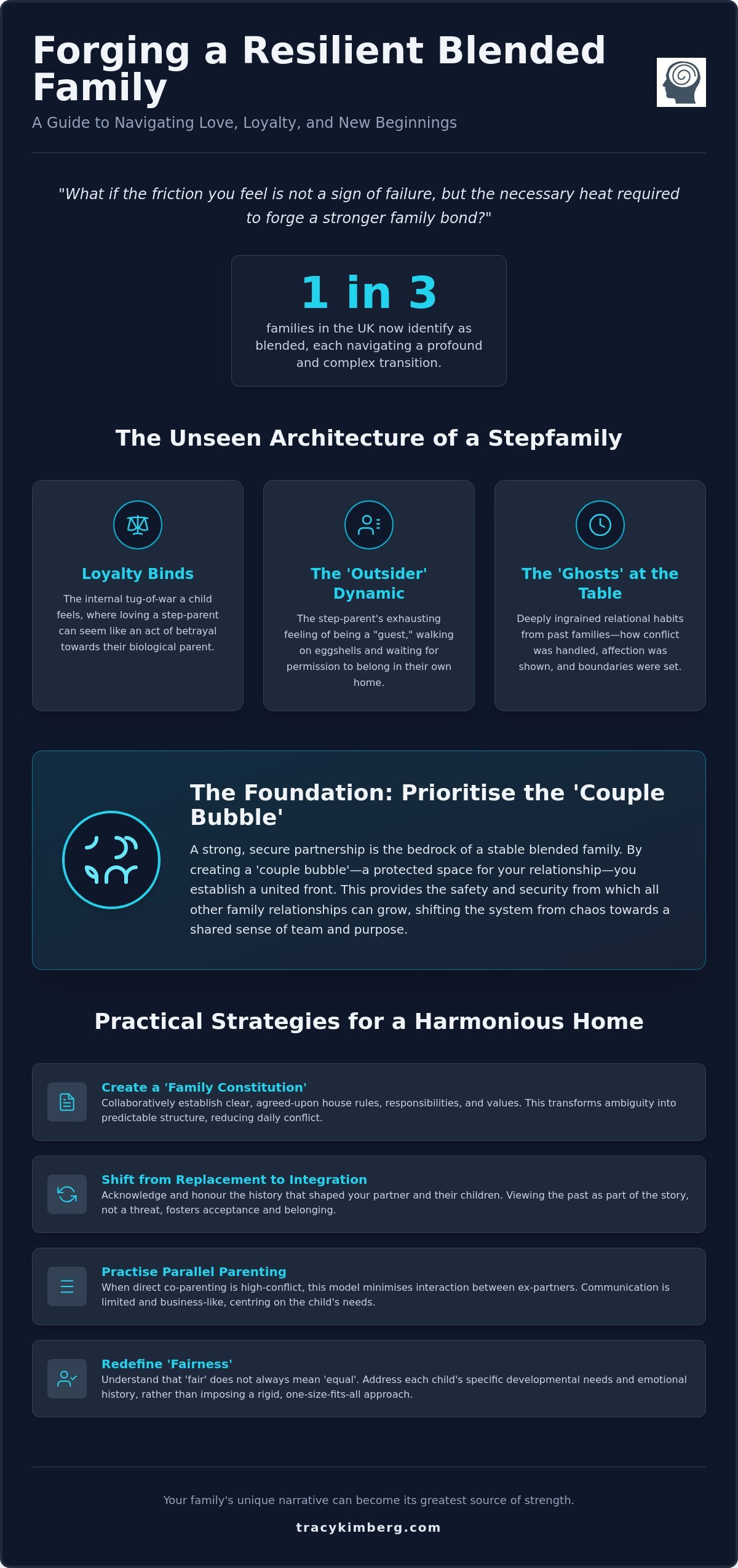
The modern British family is no longer a static, predictable unit. With approximately one in three families in the UK now identifying as blended, we are witnessing a profound shift in how we organise our domestic lives. Yet, the term “blended” itself can feel like a gentle misnomer. It suggests a smooth, effortless mixing, whilst the reality for many is more akin to a collision of two distinct cultures, histories, and sets of unwritten rules. If you feel overwhelmed, please know that this is the natural response to a highly complex systemic transition. You aren’t just marrying a partner; you are integrating into a living tapestry of previous attachments and established loyalties.
This systemic reality means that every member of the household is navigating a loss whilst trying to build something new. Children may be grieving the dream of their biological parents reconciling, whilst adults are trying to balance the fire of a new romance with the heavy responsibilities of existing parenthood. Acknowledging this complexity is the first step toward healing. It moves the conversation away from “What is wrong with us?” toward “How do we navigate this together?”
The “Ghost” at the Table: Recognising Past Influences
Every new relationship carries the “ghosts” of what came before. These aren’t just memories of ex-partners, but the deeply ingrained relational leftovers of how conflict was handled, how affection was shown, and how boundaries were set in a previous life. When these “ghosts” show up at your dinner table, they often manifest as irrational fears or rigid expectations. Understanding the stepfamily dynamic requires us to move away from a “replacement” mindset. You aren’t trying to delete the past to make room for the present. Instead, successful blended family counselling UK focuses on integration. It’s about acknowledging the history that shaped your partner and their children, rather than viewing that history as a threat to your current intimacy.
Why Traditional Parenting Advice Often Fails Blended Families
Most parenting manuals are written for the nuclear unit, where biological bonds and shared history are assumed. In a reconstituted family, the myth of “instant love” can be incredibly damaging. It creates a heavy burden of guilt for step-parents who don’t feel an immediate bond, and for children who feel they are betraying a biological parent by liking a newcomer. In this context, “fairness” rarely looks like “equality.” Treating every child exactly the same might actually ignore the specific developmental needs and historical traumas they carry. Practical logistics also add a layer of strain that traditional advice ignores. Navigating the UK school run, coordinating with ex-partners over half-term holidays, and managing the “handover” blues requires a level of diplomatic precision. This is why a specialised approach to blended family counselling UK is so vital. It provides the psychological architecture needed to build a home that feels safe for everyone involved.
The Psychological Architecture of Step-parenting and Loyalty
Loyalty binds are the internal tug-of-war children experience when they feel that loving a step-parent is an act of betrayal toward their biological parent. This emotional friction is a hallmark of the modern household. According to recent UK blended family statistics, hundreds of thousands of children are navigating these complex structures, each carrying their own unique history of attachment and loss. For the child, the arrival of a new partner isn’t just an addition; it’s a reminder of what was lost. Their resistance isn’t usually a rejection of you, but a protective mechanism to honour the parent who isn’t there.
For the step-parent, the home often feels like a stage where they are a guest performer rather than a lead. This “outsider” dynamic is exhausting. You may feel you are walking on eggshells, waiting for permission to belong in a space you pay for and maintain. Our individual attachment styles, forged in our own childhoods, dictate how we respond to these shifts. An anxious step-parent might push for too much closeness too soon, whilst an avoidant child might pull away when things feel too intimate. Recognising these patterns is a core part of blended family counselling UK, helping you move from reactive frustration to a place of curious empathy.
Navigating Loyalty Conflicts and “Binds”
When a child shouts, “You’re not my real mum,” they aren’t debating genealogy. They are expressing a loyalty bind. As a biological parent, your role is to give them “permission to love” the newcomer. This means speaking respectfully of your ex-partner and validating the child’s grief without trying to “fix” it. By lowering the competitive stakes, you allow the child’s nervous system to settle. Conscious presence, where you show up with consistency rather than forced authority, creates the safety children need to eventually lower their guard.
The Step-parent’s Dilemma: Discipline vs. Connection
In the early years of blending, connection must always precede correction. If a step-parent attempts to enforce rules before they have established a relational bank account, they risk total withdrawal from the child. The biological parent should remain the primary “enforcer” initially, allowing the step-parent to focus on building a unique bond. Whether it’s a shared interest in football or a quiet Sunday morning ritual, these “exclusive” activities create a safe harbour for the relationship to grow. If you find yourselves stuck in a cycle of resentment over house rules, exploring online therapy can help you realign your parenting strategies before the friction becomes a fracture.
Prioritising the Couple: Why Your Relationship is the Foundation
In the whirlwind of school runs and managing complex schedules with ex-partners, the relationship that started this new chapter often gets pushed to the bottom of the priority list. We tend to focus on the children’s immediate needs first, fearing that any focus on our own partnership is a betrayal of our parental duties. However, in the context of blended family counselling UK, we view the couple as the primary architects of the family structure. If the foundation is cracked, the entire house feels unstable. John Gottman’s research into the “couple bubble” suggests that a secure, prioritised partnership actually creates a sense of safety for the children. They need to see that you are a resilient team to feel secure in their own evolving lives.
Maintaining this bubble requires us to confront the “Four Horsemen”: criticism, contempt, defensiveness, and stonewalling. These patterns often gallop into the home when stress levels are high and loyalty binds are tested. When you feel defensive about your partner’s parenting or contemptuous of their ex-spouse, you are leaking vital energy from your relationship. Esther Perel reminds us that erotic intelligence and emotional intimacy require a degree of separateness and mystery, which is hard to find amongst the domestic chaos of a reconstituted household. Reclaiming your romance isn’t a luxury; it’s a vital survival strategy for the entire family unit.
Protecting the “Couple Bubble”
Scheduling “us time” isn’t about being selfish. It’s about demonstrating to the children that your partnership is a permanent, respected boundary. Savvy teenagers often attempt to “split” parents, playing one against the other to test the strength of the new union. By communicating as a united front, you prevent these fractures before they start. If you find yourself wondering, Can Your Relationship Be Saved?, it is often because the couple bubble has been allowed to deflate under the weight of external pressures and neglected intimacy.
Managing Communication Breakdowns
Arguments about the ex-partner are one of the most common triggers in blended homes. To manage this, we encourage the “Stress-Reducing Conversation.” This isn’t the time to fix the problem, but to listen and validate your partner’s frustration without becoming defensive or taking it personally. Recognising When Communication Breaks Down is the first step toward repair. Through specialised blended family counselling UK, you can learn to navigate these emotional minefields without blowing up the progress you’ve made together.
Practical Strategies for Harmonious Co-parenting and Boundaries
Moving from psychological awareness to daily practice requires a tangible framework. One of the most effective tools we use in blended family counselling UK is the “Family Constitution.” This isn’t a rigid list of chores or a set of punishments. Instead, it’s a living document that outlines your new unit’s core values and house rules. It provides a sense of predictability for children who may feel their world has been in constant flux. When children know what to expect in your home, their nervous systems can finally begin to settle, moving out of “survival mode” and into a space where connection becomes possible. For families where neurodiversity is present, integrating holistic support like Colours of Sound can provide valuable sensory regulation for both mothers and children during these transitions.
We must also acknowledge that “co-parenting” isn’t always a realistic goal, especially when dealing with a high-conflict ex-partner. In these cases, we pivot toward “parallel parenting.” This approach allows you to remain a dedicated parent whilst minimising direct contact with the other household. You don’t need to agree on every parenting philosophy to provide a stable environment. By focusing entirely on what happens under your roof and letting go of the need to control the other parent’s behaviour, you reduce the atmospheric tension that children absorb so easily.
The “switchover” period is often the most volatile time for a blended family. These transitions are liminal spaces where loyalty binds are most acutely felt. To minimise anxiety, create a “landing ritual” that allows the children to decompress without being immediately interrogated about their time away. Whether it’s a favourite meal or thirty minutes of quiet time, these routines act as an emotional bridge between two different worlds. If you are struggling to set these boundaries effectively, our Relationship Counselling and Coaching for Couples offers a structured path to domestic peace.
Creating a Shared Family Vision
Regular family meetings are essential for ensuring every voice is heard, from the youngest child to the step-parent. These aren’t meant to be disciplinary hearings; they are opportunities to celebrate wins and organise upcoming events like birthdays or school holidays. Blending traditions requires creativity. You don’t have to choose between your old Christmas rituals and your partner’s; you can weave them together to create something entirely new and unique to your unit. Flexible boundaries are the key to blended resilience, allowing for individual histories whilst building a shared future.
Co-parenting with the “Outside” Parent
Digital boundaries are your best friend in a reconstituted family. Use shared calendars and parenting apps to keep logistics transparent and keep the children out of adult “business.” It’s vital that legal disputes or financial disagreements remain strictly between the adults. Taking a conscious approach means acknowledging the other parent’s role without feeling threatened by it. When you speak neutrally or kindly about the “outside” parent, you aren’t just being polite; you are giving your children permission to be whole people who don’t have to hide parts of their lives from you.
Transformational Support: Professional Counselling for Your Blended Family
Blending two lives is rarely the smooth transition we hope for. It is more often a messy, non-linear process of trial and error. Whilst the strategies we’ve discussed offer a roadmap, the emotional weight of historical trauma and complex attachments can make implementation feel impossible on your own. Seeking specialised blended family counselling UK provides the psychological architecture you need to move beyond mere survival. It demystifies the friction, showing you that your struggles aren’t a sign of a “broken” family, but a natural part of a complex integration process.
Our approach is grounded in the research of experts like John Gottman, Esther Perel, and Gabor Maté. We don’t just offer generic talk therapy; we provide a trauma-informed lens that respects the history each person brings to the table. By understanding the nervous system’s response to change, we help you transition from a culture of reactivity to one of proactive connection. This shift is powerful. It allows you to build a family culture where every member feels seen, safe, and valued. Choosing to work with a professional isn’t an admission of defeat. It’s a courageous commitment to the long-term emotional health of your new life together.
The 12-Week Relationship Recovery Process
When the pressure of blending families threatens the couple’s bond, a structured intervention is often the most effective path forward. Our 12-Week Relationship Recovery process is designed to rebuild trust and intimacy whilst specifically addressing the unique demands of a reconstituted home. By focusing on the “we,” you become better equipped to serve the “they.” This programme provides a clear timeline for transformation, helping you realign your goals and rediscover the romance that brought you together amongst the domestic chaos.
Individual and Teenager Support
Sometimes, the best way to help the family is to support the individuals within it. For a step-parent, Individual Relationship Counselling can be a vital first step in processing the “outsider” dynamic and developing resilient coping strategies. Similarly, teenagers often need a neutral, safe space to process their grief and the rapid transitions in their lives. We offer specialised therapy for teenagers to help them navigate their own loyalty binds and identity shifts. Whether through online therapy or face-to-face sessions, we ensure that every member of your blended unit has the support they need to thrive in this new chapter.
Building a Resilient Family Legacy
Forging a harmonious life from two separate histories is a profound undertaking. It requires more than just patience; it demands a conscious integration of past influences and a steadfast commitment to your partnership as the family’s foundation. By establishing clear boundaries and navigating loyalty binds with empathy, you transform a house of friction into a home of resilience. If the weight of these transitions feels heavy, seeking professional blended family counselling UK can provide the clarity and tools needed to move from survival to a state of thriving connection.
As a specialist in Gottman and Perel research-based methods, I am dedicated to helping you navigate these complex emotional landscapes. Whether through my signature 12-Week Relationship Recovery Process or safe, non-judgemental sessions available online and face-to-face across the UK, we can work together to reclaim your intimacy and build a lasting family legacy. You don’t have to navigate this new chapter alone. Begin your family’s transformational journey with Tracy Kimberg today and discover the power of a truly united front. Your new chapter is just beginning, and it can be more beautiful than you ever imagined.
Frequently Asked Questions
How long does it typically take for a blended family to “settle”?
Research suggests it typically takes between two and five years for a blended family to find its rhythm and “settle.” This timeline varies depending on the children’s ages and the intensity of previous relationship dynamics. It’s helpful to view this as a long-term integration rather than a sprint toward domestic bliss. Giving everyone permission to move at their own pace reduces the pressure to perform “instant family” and allows genuine bonds to form.
Can blended family counselling help if my ex-partner refuses to participate?
Yes, blended family counselling UK can be profoundly effective even if an ex-partner chooses not to participate. You cannot control the environment in another person’s home, but you can certainly transform the atmosphere in your own. Therapy focuses on strengthening your partnership and establishing healthy boundaries within your household. This internal alignment creates a stable sanctuary for the children, providing them with a consistent sense of safety regardless of external conflict.
What is the most common mistake new step-parents make?
The most frequent mistake is attempting to enforce discipline before a solid emotional connection has been established with the child. If a step-parent rushes into the role of “enforcer,” they often trigger deep resentment and resistance. Focus on being a “supportive adult” first. Building a relational bank account through shared interests and low-pressure time together makes future boundaries much easier for children to accept. Connection must always precede correction in a healthy home.
Is it normal for my biological children to resent my new partner?
Resentment from biological children is a normal response to the grief of losing their original family structure. Children often experience a loyalty bind, feeling that accepting a new partner is a betrayal of their other biological parent. It isn’t a personal rejection of you, but an expression of their internal conflict. Validating their feelings whilst maintaining a consistent, gentle presence is the most effective way to help them navigate this difficult emotional phase.
How do we handle different parenting styles without arguing in front of the kids?
You must present a unified front in front of the children and save any disagreements about parenting for private discussion. If children sense a divide between you, they may subconsciously exploit it to regain a sense of control. Use your “Family Constitution” to align on core values and house rules during peaceful times. This ensures that when friction arises, you both know the agreed protocol without needing to argue in the heat of the moment.
Can online counselling be as effective as face-to-face for family sessions?
Online counselling is often as effective as face-to-face sessions, particularly for families with complex schedules. Many clients find that being in their own comfortable environment allows them to open up more freely. It also removes the logistical stress of coordinating multiple people to a physical location, making it easier to maintain the consistency required for long-term psychological growth. This flexibility is often the key to making therapy a sustainable and positive family practice.
What should we do if one child is “acting out” more than the others?
When one child acts out more than the others, it is usually a “cry for help” regarding an unmet emotional need. They may be carrying a heavier burden of grief or feeling particularly lost in the new family hierarchy. It’s important to look beneath the behaviour to the underlying emotion. In these cases, providing individual support for the child alongside family sessions can offer the targeted care they need to feel safe once more.
How much does blended family counselling in the UK typically cost?
The investment for blended family counselling UK varies depending on the therapist’s specialisation and the complexity of your family’s specific needs. Whilst private sessions represent a financial commitment, they are also an essential investment in your family’s long-term emotional stability and peace. Many practitioners offer different pathways, such as structured recovery programmes or individual sessions, to ensure that the support is both manageable and effective for your unique domestic circumstances.

Article by
Tracy Kimberg
Tracy Kimberg is a Relationship Expert, Couples Therapist and Coach with a dedicated focus on helping couples and individuals rebuild connection, trust and emotional safety in their relationships. Drawing on the research of John and Julie Gottman, the relational insights of Esther Perel, and years of hands-on therapeutic experience, Tracy offers a warm, non-judgemental and deeply compassionate approach to modern relationships.
Based in Dorset, Tracy works with couples navigating communication breakdowns, betrayal, intimacy challenges, separation, family dynamics and life transitions. Known for creating a safe and grounded therapeutic space, she combines practical tools with emotional depth to help clients move beyond survival patterns and towards meaningful, lasting change.
With a reputation for empathy, professionalism and dedication to her clients’ growth, Tracy is passionate about helping people feel seen, understood and empowered — both within their relationships and within themselves.
Disclaimer
Disclaimer:
The information shared in this article is intended for educational and informational purposes only and should not be considered a substitute for professional therapeutic, psychological, medical or legal advice. Every individual and relationship is unique, and the perspectives offered are based on general therapeutic principles, research and professional experience.
Reading this article does not establish a therapist-client relationship with Tracy Kimberg. If you are experiencing significant emotional distress, relationship crisis, trauma, or mental health concerns, it is important to seek support from a qualified professional appropriate to your individual circumstances.
All content remains the intellectual property of Tracy Kimberg and may not be reproduced or distributed without permission.